

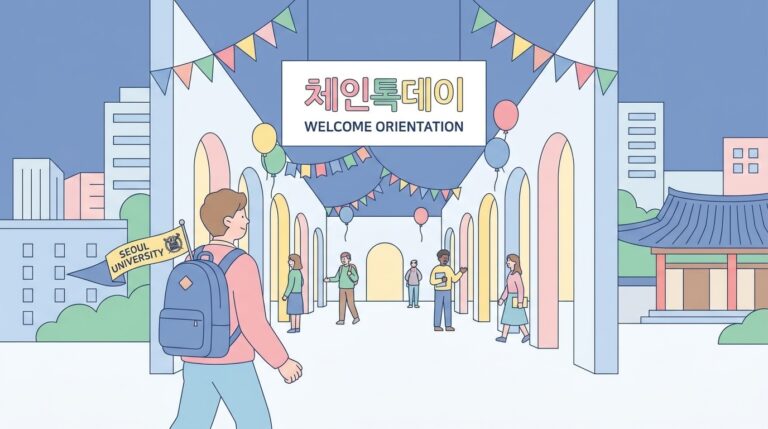
안녕하세요! 매일한글 에디터입니다. Welcome back to Daily Hangul! Imagine this: You’ve finally arrived in Korea for your study abroad semester. You walk into a brightly lit auditorium packed with excited university freshmen and exchange students. The OT (Orientation) banner hangs high at the front. Speakers are playing top K-Pop tracks, and vibrant energy fills the room. Suddenly, the student council representative steps up to the mic to explain the infamous 수강 신청 (sugang sincheong – course registration) process. Everyone around you starts taking notes furiously and whispering to their group mates. You catch terms like OT, OT 쪼개기, and 선배, but feel a bit lost on how to naturally join the conversation and ask questions. Don’t worry! This guide is crafted directly from real international student experiences to help you navigate campus orientation confidently like a pro.
1. OT 꼭 참석해야 돼요? (OT kkok chamseokhaeya dwaeyo?)
- Pronunciation: [OT kkok cham-seok-hae-ya dwae-yo?] (Sounds like “OT cook cham-seok-hae-ya dwae-yo”)
- Meaning: “Do I really have to attend the orientation?” (Literal: Must I attend OT?)
- K-Culture Moment: Seen in campus web dramas like Love Playlist where freshmen anxiously message their group chats about whether missing orientation affects their student life.
- Editor’s Insight: While attendance isn’t always strictly tied to grades, attending OT is crucial for forming student networks, getting insider tips on easy courses (꿀강), and securing reliable project teammates.
- Situation Spectrum:
- Casual: OT 꼭 가야 돼? (⚠️ Friends only)
- Semi-formal: OT 꼭 참석해야 돼요? (✅ Upperclassmen / Student Council)
- Formal: 오리엔테이션에 반드시 참석해야 합니까? (🚫 Too rigid for casual interaction)
- 🤔 Think About It: In Korean universities, informal peer networks (동기/선배) play a huge role in academic success. How does networking during orientation differ in your home country?
2. 수강 신청 팁 좀 알려주세요! (Sugang sincheong tip jom allyeojuseyo!)
- Pronunciation: [Su-gang sin-cheong tip jom al-lyeo-ju-se-yo!]
- Meaning: “Could you give me some tips for course registration?”
- K-Culture Moment: Scenes where students gather in PC bangs (gaming centers) with atomic clocks on their screens, frantically clicking to register before slots fill in seconds.
- Editor’s Insight: Adding ‘좀’ (jom) softens your request from a demand to a polite, humble favor. It works like magic when asking seniors for help.
- Situation Spectrum:
- Casual: 수강 신청 팁 좀 줘! (⚠️ Close peers)
- Semi-formal: 수강 신청 팁 좀 알려주세요! (✅ Perfect for OT)
- Formal: 수강 신청 관련 조언을 부탁드립니다. (🚫 Formal email only)
- 🤔 Think About It: Why do you think Korean students place so much emphasis on softening polite requests with words like ‘좀’?
3. 뒤풀이 가실 거예요? (Dwipuri gasil geoyeyo?)
- Pronunciation: [Dwi-pu-ri ga-sil geo-ye-yo?]
- Meaning: “Are you going to the after-party?”
- K-Culture Moment: Freshmen heading out to pub districts near campus (like Hongdae or Sinchon) right after orientation ends.
- Editor’s Insight: ‘뒤풀이’ (dwipuri) literally means ‘unraveling what comes after’. It’s where the real bonds are formed over Korean fried chicken or snacks.
- Situation Spectrum:
- Casual: 뒤풀이 갈 거야? (⚠️ Same-year friends)
- Semi-formal: 뒤풀이 가실 거예요? (✅ Safe for everyone at OT)
- Formal: 뒤풀이에 참석하시겠습니까? (🚫 Sounds like an official invitation letter)
- 🤔 Think About It: After-parties are key social events in Korea. Is social bonding outside formal settings equally important in your academic culture?
📖 Textbook Korean: 오리엔테이션 일정표를 확인하십시오. (Please check the orientation schedule.)
🗣️ Real Korean: OT 시간표 어디서 봐요? (Where can I see the OT schedule?)
💡 Why the difference? Textbook phrasing uses heavy formal commands (-하십시오), whereas real students rely on natural, casual-polite active questions (-어디서 봐요?).
📖 Textbook Korean: 저는 교양 과목을 수강하고 싶습니다. (I wish to take general education courses.)
🗣️ Real Korean: 꿀교양추천 좀 해주세요! (Could you recommend some easy general education courses?)
💡 Why the difference? Students use the term ‘꿀교양’ (‘honey general education’ = easy/fun elective) instead of just ‘교양 과목’.
4-1. Nunchi & Campus Gestures
When listening to upperclassmen explain course registration during OT, subtle head nods (끄덕끄덕) and maintaining light eye contact show respect. If you need to enter the lecture hall late, lower your shoulders slightly and give a quick 15-degree bow toward the presenter.
4-2. Culture Code: PC Bang & Navyism Clock
Course registration in Korean universities is a high-stakes, timed event. Students use sites like Navyism (네이비즘) to check the server time down to the millisecond, often booking seats at high-speed internet PC bangs to register within 0.1 seconds!
- Setting: University lecture hall during freshman orientation break.
- Characters: You (International Student) & Ji-hun (Senior / Student Council Leader)
- Ji-hun: 안녕하세요! 혹시 경영학과 신입생이세요? (Hello! By any chance, are you a Business Administration freshman?)
- You: 네, 맞아요! / 안녕하세요, 선배님! (Yes, that’s right! / Hello, Sunbae-nim!)
🎭 [Nods politely with a bright smile] - Ji-hun: 수강 신청 때문에 많이 긴장되죠? 시스템이 좀 복잡해요. (You must be nervous about course registration, right? The system is a bit complex.)
- You: 네, 조금요. 수강 신청 팁 좀 알려주세요! (Yes, a little. Could you give me some course registration tips?)
🎭 [Leans forward with focused eyes] - Ji-hun: 서버 시계 꼭 확인하고, 꿀교양부터 잡으세요! (Make sure to check the server clock, and grab easy general electives first!)
- You: 아, 서버 시계요? 뒤풀이에서도 더 물어봐도 돼요? (Ah, server clock? Can I ask you more at the after-party?)
🎭 [Laughs lightly] - Ji-hun: 당연하죠! 오늘 뒤풀이 가실 거예요? (Of course! Are you going to the after-party today?)
- You: 네, 꼭 갈게요! 잘 부탁드립니다. (Yes, I’ll definitely go! I look forward to your guidance.)
🎭 [Slight polite bow]
🔀 Interactive Choice Point
After OT ends, Ji-hun asks if you’re coming to the pub for the after-party (뒤풀이).
* Option A: “죄송하지만 바빠서 집에 갑니다.” (Sorry, but I’m busy so I’m going home.)
* Option B: “네, 가고 싶어요! 몇 시에 시작해요?” (Yes, I’d love to! What time does it start?)
* Option C: “술 꼭 마셔야 돼요?” (Do I really have to drink alcohol?)
Feedback:
* Option A (Risk): Honest, but missing the main bonding opportunity. Might make you seem distant on day one.
* Option B (BEST!): Enthusiastic and polite! Shows great social interest while naturally continuing the conversation.
* Option C (Bad): Sounds defensive. Non-alcoholic drinks are widely accepted now, so asking directly about drinking isn’t necessary.
Practice reading these out loud with rhythm and emotion! (/ indicates a natural breathing pause)
[😊 Excously Curious]수강 신청 / 팁 좀 / 알려주세요! (Su-gang sin-cheong / tip jom / al-lyeo-ju-se-yo!)[🤝 Polite & Enthusiastic]오늘 뒤풀이 / 가실 거예요? (O-neul dwi-pu-ri / ga-sil geo-ye-yo?)[😮 Realization]아, 서버 시계 / 확인해야 하는군요! (A, seo-beo si-gye / hwa-gin-hae-ya ha-neun-gun-yo!)
- OT (오티) | Short for Orientation. The essential welcoming event for department newcomers.
- 선배 (Sunbae) | Upperclassman/Senior student at school or work who offers guidance.
- 꿀강 (Kkul-gang) | Lit. “Honey Class”. A high-scoring, enjoyable, or easy university course.
- 뒤풀이 (Dwipuri) | Post-event gathering or after-party to socialise and celebrate.
- Top 1: “새내기 모임 어디서 해요?” (Senaegi moim eodiseo haeyo? – Where is the freshman gathering happening?)
- Top 2: “강의계획서 어디서 봐요?” (Gang-ui gyehoekseo eodiseo bwayo? – Where can I check the syllabus?)
- Top 3: “출석 체크 하셨어요?” (Chulseok chekeu hasyeosseoyo? – Did you do the attendance check?)
Editor’s Campus Survival Note
Make sure to install essential apps before orientation! Download the official Everytime Campus Portal App to check anonymous course reviews, time tables, and departmental announcements. Also, bookmark Navyism Server Clock Site to prepare for second-accurate course registration.
In Korean university culture, orientation is more than administrative instructions—it is the official doorway into a shared community. Respect for hierarchy exists through terms like ‘선배’, yet the warmth of peer support (‘동기’) creates an encouraging environment. Embracing these early social gatherings helps build your personal ‘safety net’ throughout campus life.
💬 Your Turn: What is the most unique freshman orientation tradition in your university or country? Share your stories in the comments below!
Q: Is attendance at OT mandatory for foreign exchange students?
A: While policies vary by university, attending OT is highly recommended. It covers visa compliance, course registration rules, and local emergency support that you cannot afford to miss.
Q: What if I don’t drink alcohol during the 뒤풀이 (after-party)?
A: Don’t worry! Korean campus drinking culture has modernized significantly. You can freely drink soft drinks or zero-sugar beverages without any peer pressure.
Q: What should I bring to campus orientation?
A: Just bring your smartphone, a notebook or tablet, and a friendly, open attitude!
🚨 Common Mistakes TOP 3
- Mistake: Calling upperclassmen “언니/오빠” right away on day one.
- Correct Action: Address them as ‘선배님’ (Sunbae-nim) until you become close friends.
- Mistake: Assuming course registration starts on the hour based on smartphone time.
- Correct Action: Always check the exact university server clock via Navyism.
- Mistake: Using formal
-하십시오speech with peers.- Correct Action: Stick to friendly semi-formal
-요ending (e.g., “반가워요!”).
- Correct Action: Stick to friendly semi-formal
- Bronze Mission: Practice saying “수강 신청 팁 좀 알려주세요!” 3 times aloud in front of a mirror.
- Silver Mission: Post your student timetable or OT prep picture on Instagram story and tag
@DailyHangul! - Gold Mission: Ask a Korean student or language exchange partner for course recommendations using “꿀강 추천해 주세요!”.
🎮 K-Culture Mission: Watch a campus K-Drama episode (e.g., Cheese in the Trap or My ID is Gangnam Beauty) and spot 2 scenes featuring university orientation or course registration!
Q1. Situation Judgment
You want to ask an upperclassman for tips on course registration polite and naturally during OT. Which sentence should you use?
A) 수강 신청 팁을 당장 밝히십시오.
B) 수강 신청 팁 좀 알려주세요!
C) 수강 신청 팁 줘봐.
Click to view Answer & Explanation
Answer: B
Explanation: “수강 신청 팁 좀 알려주세요!” uses the softening word ‘좀’ and polite ending ‘-요’, making it the ideal choice for asking seniors.
Q2. Fill-in-the-Blank
Fill in the blank: University students call fun, high-scoring courses “____”.
(Hint: 꿀 + 강)
Click to view Answer & Explanation
Answer: 꿀강 (Kkul-gang)
Explanation: ‘꿀’ (Honey) + ‘강의’ (Lecture) creates the slang term for easy, sweet courses.
Q3. True / False
In modern Korean university after-parties (뒤풀이), everyone is forced to drink alcohol.
(True / False)
Click to view Answer & Explanation
Answer: False
Explanation: Modern campus culture respects personal drinking preferences, and soft drinks are widely accepted!







