

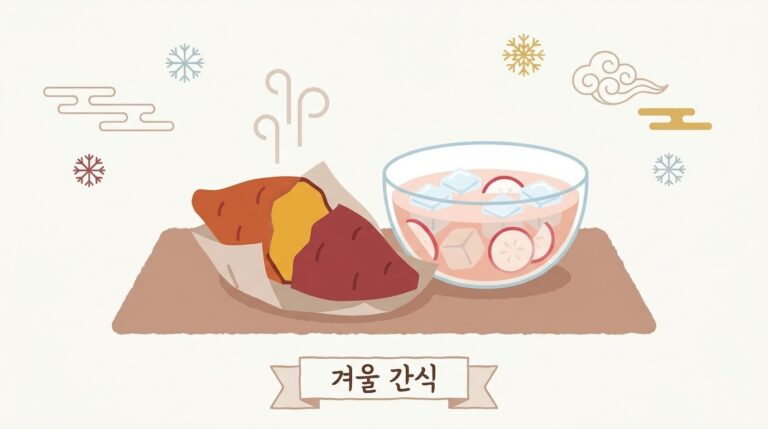
Why Roasted Sweet Potatoes and Cold Kimchi Are Korea’s Ultimate Winter Duo
Phase 1: Empathy (Storytelling Opening)
안녕하세요! 매일한글 에디터입니다. (Hello! I’m the chief editor at Daily Hangul.)
Picture this: It is late December in Seoul. The freezing icy winter wind blows through the alleys of Hongdae or Bukchon, freezing your fingers instantly. You spot a street stall or a cozy convenience store emitting thick white steam, accompanied by the sweet aroma of caramelized sugar and roasted starch. You buy a steaming, piping-hot roast sweet potato (gungoguma). It’s warm, soft, and sweet, but after three big bites, your throat feels thick and dry—what Koreans call mokhada (목막히다).
Suddenly, an elder or local friend hands you a clear plastic bowl filled with ice-cold, tart radish water kimchi called dongchimi (동치미). You take a sip of the translucent broth and a crisp bite of pickled radish. Instantly, the sweet heaviness disappears, refreshed by the sparkling acidity! This combination, gungoguma and dongchimi, is Korea’s ultimate classic winter pairing. Many foreign learners find it bizarre at first: “Sweet potatoes with spicy-sour cold soup?” But once you experience this harmonious culinary synergy, you’ll never eat sweet potatoes alone again. Today, let’s dive deep into intermediate (B2) expressions, social nuances, and cultural codes that will help you order, discuss, and enjoy Korean winter snacks like a true Seoulite!
Phase 2: Core Expressions Deep Dive
1. 목이 막혀서 동치미 좀 마셔야겠어요 (Mogi makyeoseo dongchimi jom masyeoyageosseoyo)
- Pronunciation: [Mog-i mak-hyeo-seo dong-chi-mi jom ma-shyeo-ya-get-seo-yo] (Pronounce ‘makyeoseo’ smoothly like ‘ma-kyeo-seo’, similar to ‘mark’ without the ‘r’)
- Meaning: “My throat feels stuffed/dry from the food, so I need to sip some radish water kimchi.”
- Literal: Because throat is blocked, radish kimchi a bit must drink.
- Nuance: Expressing a mild physical discomfort from dry, dense foods and seeking the iconic Korean digestive remedy.
- K-Culture Moment: In historical or modern winter dramas (like Reply 1988), family members sitting on a warm ondol floor always shout this line while eating sweet potatoes or rice cakes.
- Editor’s Insight: In Korean, mok-i mak-hida isn’t just medical choking; it describes the heavy sensation of eating dense carbohydrate foods like chestnut, boiled egg, or sweet potato without a drink.
- Situation Spectrum:
- Casual: 목 막혀, 동치미 마셔야겠다! ✅
- Semi-formal: 목이 막혀서 동치미 좀 마셔야겠어요. ✅
- Formal: 목이 막혀 동치미를 마셔야 할 것 같습니다. ⚠️
- 🤔 Think About It: Does your native culture have a specific food consumed purely to balance out the texture or dryness of another food?
2. 단짠단짠의 정석이에요 (Danjjandanjjaneui jeongseogieyo)
- Pronunciation: [Dan-jjan-dan-jjan-ui jeong-seok-i-e-yo] (Danjjan sounds rhythmically like ‘dahn-jahn-dahn-jahn’)
- Meaning: “This is the textbook definition of sweet-and-salty harmony.”
- Literal: Sweet-salty-sweet-salty’s classic example it is.
- Nuance: Used enthusiastically when praising a flavor profile that perfectly balances sweetness with savory or salty notes.
- K-Culture Moment: Commonly seen on Korean mukbang YouTube titles or gourmet TV shows when hosts evaluate traditional snack combos.
- Editor’s Insight: While danjjan originally meant sweet (dalda) and salty (jada), for gungoguma + dongchimi, it expands to mean dandan-samsam or danshin (sweet + refreshing/tart). It signifies food rhythm!
- Situation Spectrum:
- Casual: 완전 단짠단짠의 정석이야! ✅
- Semi-formal: 단짠단짠의 정석이에요. ✅
- Formal: 달고 짜는 맛의 정석입니다. 🚫 (Too dry/robotic)
- 🤔 Think About It: Why do modern food trends emphasize sensory contrast over single-flavor profiles?
3. 별미니까 꼭 한번 드셔보세요 (Byeolminikka kkok hanbeon deosyeoboseyo)
- Pronunciation: [Byeol-mi-ni-kka kkok han-beon deu-syeo-bo-seyo] (Byeol-mi rhymes with ‘pure-me’)
- Meaning: “It’s a special seasonal delicacy, so you should definitely try it.”
- Literal: Because it is a special taste, certainly once please try eating.
- Nuance: Politely and enthusiastically recommending an authentic or unique regional/seasonal dish to a guest.
- K-Culture Moment: Host families or Korean colleagues introducing seasonal street snacks during winter trips.
- Editor’s Insight: Byeolmi (별미) combines “Special” (별) and “Taste” (미). It refers to food that isn’t part of everyday meals, but enjoyed seasonally for unique enjoyment.
- Situation Spectrum:
- Casual: 별미니까 꼭 먹어봐! ✅
- Semi-formal: 별미니까 꼭 한번 드셔보세요. ✅
- Formal: 계절 별미이오니 꼭 시식해 보시길 권합니다. ⚠️ (Too formal for casual dining)
- 🤔 Think About It: How does sharing seasonal delicacies foster a sense of belonging in a community?
Phase 3: Textbook Korean vs. Real Korean
Situation 1: Expressing that food feels heavy/dry in your throat
* 📖 Textbook Korean: 음식이 뻑뻑해서 목으로 넘기기 어렵습니다. (This food is dry so it is difficult to swallow.)
* 🗣️ Real Korean: 아, 목 막혀! 동치미 국물 좀 당기는데? (Ah, my throat feels stuffed! I really crave some cold kimchi broth right now!)
* 💡 Why the difference?: Native speakers rarely use formal descriptions like “뻑뻑하다” in casual dining. They use active verbs like “목 막히다” and expressive verbs like “~가 당기다” (to crave/pull towards).
Situation 2: Asking if a food combination tastes good
* 📖 Textbook Korean: 고구마와 동치미를 함께 먹으면 맛이 있습니까? (Is it delicious if you eat sweet potato and radish kimchi together?)
* 🗣️ Real Korean: 고구마에 동치미 조합, 은근히 꿀조합 아니에요? (Isn’t the sweet potato and dongchimi combo secretly a total honey-match?)
* 💡 Why the difference?: Intermediate speakers use terms like “꿀조합” (honey combo/perfect pairing) and the subtle nuance adverb “은근히” (surprisingly / quietly) to convey culinary enthusiasm.
Phase 4: K-Culture Deep Dive & Non-verbal Manners
4-1. Nunchi & Gestures
When eating gungoguma and dongchimi with Koreans in an informal setting (like an Airbnb, a local host’s home, or a traditional market):
* The Two-Hand Bowl Hold: When sipping dongchimi broth directly from a small ceramic bowl, use both hands to hold the edge lightly. Sipping directly is socially acceptable for cold water kimchi soups at casual tables!
* Blowing Warm Air: Steam from freshly roasted sweet potatoes is hot. Instead of blowing directly onto someone else’s food, gently peel the skin away from yourself while making a soft sound (hu-hu).
4-2. Culture Code Analysis: Yin-Yang Balance in K-Food
In Korean culinary philosophy, food harmony relies on balancing temperature, texture, and digestion. Sweet potatoes are warm in nature, heavy in fiber, and dense. Dongchimi, fermented naturally over weeks in ice-cold pots (onggi), contains lactic acid bacteria and natural digestive enzymes (like amylase from radish). The cold, sparkling tartness cuts through the hot, dense sweetness. In K-Dramaland, scenes featuring roasted sweet potatoes in winter often symbolize warmth, nostalgic poverty transformed into comfort, and family togetherness.
Phase 5: Real-world Roleplay Scenario
Setting: A traditional night market stall in Gangneung on a chilly January evening.
Characters: You (B2 Intermediate Korean Learner) & Auntie Owner (Imo-nim, age 55).
- Turn 1 (Imo-nim): 어서 오세요! 갓 구운 따끈따끈한 군고구마 있어요! (Welcome! We have hot roasted sweet potatoes fresh out of the oven!)
- 🎭 Smiling warmly while fanning the iron drum heater.
- Turn 2 (You): 이모님, 군고구마 2개만 주세요. 혹시 동치미도 같이 파시나요? (Auntie, two roasted sweet potatoes please. By any chance, do you also sell dongchimi?)
- 🎭 Politely rubbing hands together to stay warm.
- Turn 3 (Imo-nim): 아이구, 먹을 줄 아네! 동치미는 서비스로 한 대접 챙겨줄게. (Oh my, you really know how to eat! I’ll give you a big bowl of dongchimi on the house.)
- 🎭 Scooping icy kimchi broth with a big ladle.
- Turn 4 (You): 와, 감사해요! 고구마만 먹으면 목이 막히는데, 동치미가 완벽한 꿀조합이잖아요. (Wow, thank you! Eating just sweet potatoes makes my throat stuffy, and dongchimi is the perfect honey-combo, right?)
- 🎭 Accepting the bowl with both hands enthusiastically.
- Turn 5 (Imo-nim): 맞아요. 우리 집 동치미가 사이다처럼 시원해서 달달한 고구마랑 찰떡궁합이지! (That’s right. My home’s dongchimi is sparkling like cider, so it’s a perfect match with sweet potatoes!)
- 🎭 Handing over wrapped yellow sweet potatoes.
- Turn 6 (You): 진짜요! 국물 한 입 마시니까 싹 내려가는 기분이에요. (Really! Taking one sip of the soup feels like everything washes right down.)
- 🎭 Taking a small sip of cold broth and nodding rapidly.
- Turn 7 (Imo-nim): 외국인이 어쩜 이렇게 한국 입맛이야? 추운데 안쪽 테이블에 앉아서 천천히 먹고 가요. (How does a foreigner have such an authentic Korean palate? It’s cold, go sit at the inner table and eat slowly.)
- 🎭 Patting your shoulder gently with a proud motherly smile.
- Turn 8 (You): 네, 따뜻하게 잘 먹겠습니다! 별미를 맛보게 해 주셔서 감사해요. (Yes, I will enjoy this warm meal! Thank you for letting me taste this seasonal delicacy.)
- 🎭 Bowing head slightly before sitting down.
🔀 Interactive Branch
Situation: Imo-nim asks if you want your sweet potato peeled or served hot with skin on. How do you respond?
* Option A: 그냥 껍질째 주셔도 돼요! 까먹는 재미가 있으니까요. (It’s fine to give it with skin! It’s fun to peel.)
* Option B: 뜨거우니까 이모님이 다 까주시면 안 돼요? (Since it’s hot, can’t you peel it all for me, Auntie?)
* Option C: 껍질은 안 먹는데 그냥 버려주세요. (I don’t eat skin, so just throw it away.)
Feedback & Analysis:
* Best Choice (Option A): Excellent! Shows cultural understanding of interactive street food dining and polite independence. Imo-nim will love your enthusiasm!
* Bad Choice (Option C): Unfriendly and wasteful tone. Reduces rapport with street food vendors.
* Risk Choice (Option B): Asking busy market vendors to peel hot potatoes for you can come across as overly demanding or childlike unless offered first.
Phase 6: 10-Second Emotion Shadowing Drill
Practice reading these rhythmically marked lines aloud with emotional inflection!
[😊 기쁘고 감탄스럽게 - Delight & Admiration]- 고구마의 달달함이랑 / 동치미의 시원함이 / 은근히 잘 어울려요!
- (Go-gu-ma-ui dal-dal-ham-i-rang / dong-chi-mi-ui si-won-ham-i / eun-geun-hi jal eo-ul-ryeoy-o!)
[🥺 목이 막혀서 살짝 아쉽게 - Mildly Stuffed/Thirsty]- 아, / 목이 약간 막히는데… / 시원한 동치미 국물 / 한 입만 마실게요!
- (A, / mog-i yak-gan mak-hi-neun-de… / si-won-han dong-chi-mi guk-mul / han ip-man ma-shil-ge-yo!)
[🔥 정감 있고 자신감 넘치게 - Warm & Confident]- 이 조합은 / 한국 겨울 간식의 / 완전 꿀조합이에요!
- (I jo-hap-eun / han-guk gyeo-ul gan-sig-ui / wan-jeon kkul-jo-hap-i-e-yo!)
Phase 7: K-Culture Mini Dictionary
- 군고구마 (Gungoguma) | Roasted Sweet Potato | High-sugar roasted yellow or purple sweet potatoes cooked over hot charcoal or drums during late autumn and winter.
- 동치미 (Dongchimi) | Radish Water Kimchi | Non-spicy kimchi made with radish, water, green onions, and ginger, fermented to create natural sparkling acidic broth.
- 목막힘 (Mok-mak-him) | Throat Stuffed Sensation | The heavy feeling in your throat when eating thick, dry starch without beverages.
- 찰떡궁합 (Chaltteok-gunghap) | Perfect Match | Originally referring to astrological marriage compatibility, now widely used for food pairings that complement each other flawlessly.
Phase 8: Survival Kit for Travelers
Top 3 Survival Expressions
- 동치미 국물좀 더 주실 수 있나요? (Dongchimi gukmul jom deo jusil su innayo?) — Could I please get a little more radish kimchi broth?
- 따끈따끈할 때 드세요. (Ttagkeuntteageunhal ttae deuseyo.) — Please eat it while it’s piping hot.
- 포장해 주실 수 있나요? (Pojanghae jusil su innayo?) — Can you pack/wrap this for takeaway?
Editor’s Travel Note
When looking for traditional winter snacks in Seoul, don’t rely only on global maps. Use the Naver Map App Download Page to search for local terms like “군고구마” or traditional tea houses in Insadong that serve seasonal dongchimi sets. Also, carry small cash (1,000 to 5,000 KRW bills) or prepare Korean mobile transfer apps, as traditional street pop-up stalls (pochangmacha) often prefer cash or direct bank transfers over international credit cards.
Phase 9: One Step Deeper (Reflective Essay)
In Korean food culture, flavor is rarely viewed in isolation. Food is seen as a conversation between contrasting elements—hot and cold, sweet and sour, dense and refreshing. The gungoguma and dongchimi dynamic reflects the Korean concept of Jeong (정) and mutual balance. Just as winter brings isolation, gathering around warm potatoes and cold kimchi broth creates communal comfort. By understanding food pairings beyond mere calories, you glimpse how Koreans cultivate warmth in the depths of winter.
💬 Your Turn: What unusual food combination from your home culture surprises foreigners at first? Tell us in the comments below in Korean!
Phase 10: FAQ & Common Mistakes
Q: Can I buy dongchimi at convenience stores in Korea?
A: Yes! Major convenience stores like GS25 and CU sell small packaged portion cups of dongchimi near the kimchi and refrigerated meal section during winter months.
Q: Is dongchimi supposed to be served freezing cold with ice?
A: Absolutely. Traditional dongchimi broth often has thin sheets of floating ice (eoreum-dong-dong). The contrast between hot potato and icy soup is the highlight!
Q: Is sweet potato skin edible in Korea?
A: Roasted sweet potato skin (gungoguma kkeup-jil) is edible if thoroughly washed, but most people peel off the blackened outer skin and eat the soft interior.
🚨 Common Mistakes TOP 3
- Calling all cold kimchi ‘Mul-Kimchi’: While dongchimi is a type of water kimchi (mul-kimchi), water kimchi made with cabbage or summer radishes tastes different. Always ask specifically for dongchimi (동치미) for sweet potato pairing!
- Confusing ‘목이다’ with ‘목막히다’: Saying “목이 아파요” means your throat hurts (sore throat). Say “목이 막혀요” when food feels dry or stuck.
- Expecting sweet potatoes to taste like Western yams: Korean sweet potatoes (soobak/bam-goguma) are much sweeter, denser, and dessert-like compared to savory Western orange yams.
Phase 11: Action Mission & Engagement
Action Mission 3-Steps
- 🥉 Bronze: Practice saying “군고구마와 동치미는 찰떡궁합이에요” out loud 3 times with natural pauses.
- 🥈 Silver: Next time you eat a dry snack (bread, sweet potato, muffin), try eating it with a tart cold beverage/pickfully fermented drink and describe the feeling on Instagram in Korean!
- 🥇 Gold: Visit a Korean market or restaurant, order a winter snack set, and compliment the owner using the phrase “단짠단짠의 정석이에요!”.
🎮 K-Culture Mission
Watch a winter scene from Korean dramas like Reply 1988 or Goblin. Spot any scene where characters sit under blankets (kotatsu style or on ondol) eating sweet potatoes, and spot whether a jar of dongchimi is nearby!
Phase 12: Interactive Quiz Challenge
Test your knowledge from today’s guide!
Q1. What is the main reason Koreans pair cold dongchimi with hot gungoguma?
A) Because sweet potatoes are too cold.
B) To relieve the dense, throat-stuffing texture (mok-mak-him) with refreshing acid/broth.
C) Because dongchimi makes sweet potatoes taste spicy.
Q2. Fill in the blank: “이 고구마랑 동치미 조합은 진짜 완전 _____이에요!” (This combination is a complete perfect match!)
A) 찰떡궁합
B) 목막힘
C) 별미없음
Q3. True or False: You should never drink dongchimi broth directly from the bowl.
(True / False)
🔍 Click here to reveal Answers & Explanations!
- Q1 Answer: B — Dongchimi provides hydration, acidity, and digestive balance to dense, sweet potatoes.
- Q2 Answer: A — Chaltteok-gunghap (찰떡궁합) means perfect harmony/match!
- Q3 Answer: False — In casual winter settings, holding the small bowl with both hands and sipping the sparkling broth directly is completely accepted and enjoyed!







