

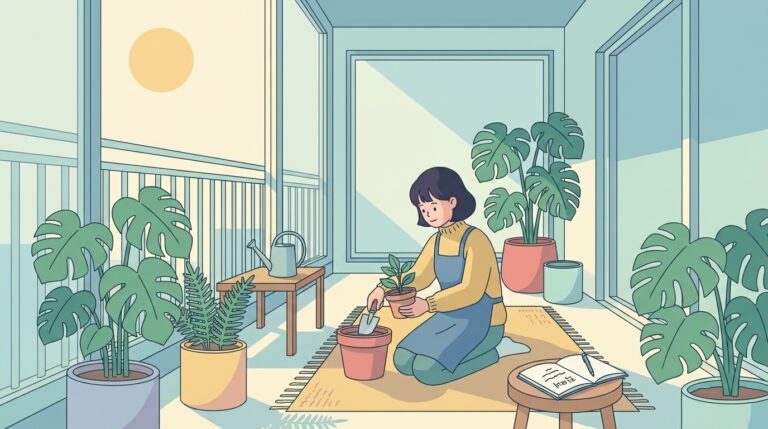
Talk to Your Companion Plants in Korean! Intermediate Guide to Home Gardening Terms
Phase 1: Empathy & Connection
안녕하세요! I’m your Daily Hangul editor! Have you ever walked into a cozy Korean cafe or a friend’s studio apartment in Seoul and noticed lush green plants occupying prime real estate by the window? In Korea, indoor gardening has evolved into a full-fledged cultural movement known as ‘반려식물’ (Companion Plants). Just like pets (‘반려동물’), Koreans treat their indoor plants as living emotional companions that offer solace in busy urban life.
However, if you’ve ever tried discussing your plant care routine with Korean friends or shopping at a local flower market like Yangjae Flower Market, you might have felt a bit lost. Beyond basic vocabulary like ‘꽃’ (flower) or ‘나무’ (tree), intermediate learners (B2) often struggle to express nuanced gardening concepts like repotting, balancing sunlight, or diagnosing overwatered leaves in authentic, natural Korean. This guide was crafted based on real feedback from intermediate learners who wanted to bridge the gap between textbook plant vocabulary and real-life plant parent conversations in Korea!
Phase 2: Deep Dive into 3 Core Expressions
1. 분갈이하다 (bun-ga-ri-ha-da)
- Pronunciation: [boon-gah-ree-hah-dah] (Sounds like boon as in ‘boondocks’ + gah + ree)
- Meaning: Literally ‘to change pots’; contextually means repotting a plant into a larger container with fresh soil.
- K-Culture Moment: Seen in cozy K-dramas where characters bond on a balcony while changing plant pots on a weekend afternoon.
- Editor’s Insight: ‘분’ comes from ‘화분’ (flowerpot) and ‘갈이’ comes from ‘갈다’ (to replace/change). Using this term instantly elevates your Korean from beginner to authentic intermediate!
- Situation Spectrum: Casual ✅ | Semi-formal ✅ | Formal ✅
- 🤔 Think About It: Why do you think Korean society embraces the word ‘갈이’ (replacement/care) for plants in the same way they talk about seasonal wardrobe switches?
2. 물주기 (mul-ju-gi)
- Pronunciation: [mool-joo-gee] (Sounds like mool as in ‘mule’ without the y + joo + gee)
- Meaning: Watering plants (literally ‘water-giving’).
- K-Culture Moment: K-pop idols showing off their living spaces on reality shows and sharing their strict morning ‘물주기’ routines.
- Editor’s Insight: Instead of saying ‘물 줘요’ (I give water), intermediate speakers use ‘물주기 루틴’ (watering routine) or ‘물주기를 놓쳤어요’ (I missed watering).
- Situation Spectrum: Casual ✅ | Semi-formal ✅ | Formal ✅
- 🤔 Think About It: Giving water is phrased as ‘giving’ (주기) rather than ‘pouring’ or ‘sprinkling’. What does this tell us about treating plants as living entities?
3. 햇빛을 쬐다 (haet-bit-eul jjoe-da)
- Pronunciation: [haet-bee-teul jjoe-dah] (Sounds like haet + beet + jjoe like ‘choy’ with a tense jj)
- Meaning: To bask in the sunlight / get sun exposure.
- K-Culture Moment: Lifestyle vloggers carefully moving their Monsteras to the balcony so they can get good afternoon light.
- Editor’s Insight: While ‘햇빛을 받다’ (to receive sunlight) is fine, ‘쬐다’ conveys the warm, intentional act of soaking up rays—often used for both plants and humans!
- Situation Spectrum: Casual ✅ | Semi-formal ✅ | Formal ⚠️
- 🤔 Think About It: In Korean culture, sunbathing plants on apartment balconies is a communal sight. How does balcony culture reflect urban living in Korea?
Phase 3: Textbook Korean vs. Real Native Korean
Situation 1: Diagnosing yellow leaves
- 📖 Textbook Korean: “식물의 잎이 노란색으로 변했습니다. 물을 너무 많이 주었습니다.”
(The plant’s leaf turned yellow. I gave too much water.) - 🗣️ Real Native Korean: “식물 잎이 노랗게 뜬 걸 보니 과습인 것 같아요.”
(Looking at how the leaf turned pale yellow, I think it’s overwatered.) - 💡 Why the difference? Natives rarely say ‘물 많이 줬다’ in plant circles; they use the precise gardening term 과습 (gwa-seup – overwatering/excess moisture) and the natural descriptor ‘노랗게 뜨다’.
Situation 2: Asking for repotting advice
- 📖 Textbook Korean: “이 화분은 작습니다. 더 큰 화분이 필요합니다.”
(This pot is small. A bigger pot is needed.) - 🗣️ Real Native Korean: “뿌리가 꽉 차서 분갈이해 줄 때가 된 것 같아요.”
(The roots are root-bound, so I think it’s time to repot it.) - 💡 Why the difference? B2 speakers sound natural when connecting the plant’s condition (‘뿌리가 꽉 차다’) directly to the action needed (‘분갈이해 주다’).
Phase 4: K-Culture Deep Dive & Non-Verbal Etiquette
4-1. Nunchi & Plant Etiquette
When visiting a Korean house or local flower shop (화원), admiring someone’s companion plant requires a touch of 눈치 (Nunchi). Do not touch new soft shoots or flowers without asking first. When complimenting someone’s plant, use gentle head nods and open palms directed toward the plant, saying “어머, 진짜 잘 키우셨네요!” (Wow, you raised it so well!).
4-2. Culture Code: The ‘반려식물’ (Companion Plant) Phenomenon
With the rise of single-person households (1인 가구) in Seoul, ‘반려식물’ culture has surged. Korean urbanites view plants as mental wellness partners. You’ll often hear plant lovers refer to themselves as ‘식집사’ (sik-jip-sa)—a blend of ‘식물’ (plant) and ‘집사’ (butler). Being a plant butler means serving your leafy friends with utmost care!
Phase 5: Real-Life Roleplay Scenario
Setting: You are visiting your friend Sujin’s cozy apartment in Mapo-gu. She has a gorgeous plant corner on her sunny balcony.
NPC: Sujin (Plant Enthusiast Friend)
- Turn 1 (Sujin): “어서 와! 우리 집 베란다 정원 어때? 요즘 내 최애 공간이야.”
(Welcome! How do you like my balcony garden? It’s my favorite spot these days.) - Turn 2 (You): “와, 진짜 예쁘다! 식물들이 다 건강해 보여. 이 몬스테라는 잎이 엄청 크네!”
(Wa, jin-jja ye-ppeu-da! Sik-mul-deul-i da geon-gang-hae beo-yeo. I mon-seu-te-ra-neun ip-i eom-cheong keu-ne!)
🎭 [Eyes wide, clapping hands lightly with admiration]
(Wow, it’s so pretty! All plants look healthy. This Monstera has huge leaves!) - Turn 3 (Sujin): “고마워! 얼마 전에 분갈이를 해줬더니 신엽이 계속 나오더라고.”
(Thanks! I repotted it a while ago, and new leaves keep popping out.) - Turn 4 (You): “아, 정말? 나도 집에서 키우는 식물이 있는데 물주기 조절이 너무 어렵더라.”
(A, jeong-mal? Na-do jip-e-seo ki-u-neun sik-mul-i in-neun-de mul-ju-gi jo-jeol-i neo-mu eo-ryeop-deo-ra.)
🎭 [Sighs slightly, shaking head in relatable struggle]
(Ah, really? I also have plants at home, but adjusting the watering schedule is so hard.) - Turn 5 (Sujin): “맞아, 과습이 제일 무서워. 겉흙이 바짝 말랐을 때 주는 게 팁이야.”
(Right, overwatering is the scariest. The tip is to water when the topsoil is bone dry.) - Turn 6 (You): “좋은 팁 고마워! 나도 이번 주말에 화원 가서 분갈이 흙 좀 사야겠어.”
(Jot-eun tip go-ma-wo! Na-do i-beon ju-mal-e hwa-won ga-seo bun-ga-ri heuk jom sa-ya-get-seo.)
🎭 [Nodding enthusiastically while making a mental note]
(Thanks for the good tip! I should go to a plant nursery this weekend and buy repotting soil.) - Turn 7 (Sujin): “같이 갈까? 양재 꽃시장에 가면 좋은 흙이랑 화분 진짜 많아!”
(Shall we go together? If we go to Yangjae Flower Market, there’s tons of good soil and pots!) - Turn 8 (You): “좋아! 주말에 같이 가자!”
(Jo-ha! Ju-mal-e gat-i ga-ja!)
🎭 [Smiling bright and giving a high-five]
(Sounds great! Let me know what time works for you!)
🔀 Interactive Branching Choice
When Sujin offers to visit Yangjae Flower Market together, how do you respond?
* Option A: “좋아! 주말에 같이 가자!” (Let’s go together this weekend!)
* Option B: “아니, 혼자 갈게.” (No, I’ll go alone.)
* Option C: “화분은 다이소에서 사면 돼요.” (I can just buy flowerpots at Daiso.)
Feedback:
* Option A (Best): Super natural! Expressing enthusiasm strengthens your bond over a shared hobby.
* Option B (Risk): Too blunt for close friendship tone; might sound dismissive.
* Option C (Bad): While practical, it misses the warm social invite to explore a classic Korean plant destination together.
Phase 6: 10-Second Emotion Shadowing Drill
- [😊 Expressing admiration]
“와, / 식물들이 / 진짜 / 건강해 보여요!”
(Wa, / sik-mul-deul-i / jin-jja / geon-gang-hae beo-yeo-yo!) - [🥺 Seeking advice with mild frustration]
“잎끝이 / 노랗게 / 타들어 가는데 / 이유가 뭘까요?”
(Ip-kkeut-i / no-rah-ke / ta-deu-leo gah-neun-de / i-yu-ga mweol-kka-yo?) - [🥳 Enthusiastic agreement]
“이번 주말에 / 같이 / 꽃시장 / 놀러 가요!”
(I-beon ju-mal-e / gat-i / kkot-si-jang / nol-leo gah-yo!)
Phase 7: K-Culture Mini Dictionary
- 식집사 (Sik-jip-sa) | Plant Butler | A blend of 식물 (plant) + 집사 (butler). Used on social media to describe passionate plant owners who cater to their plants’ every need.
- 과습 (Gwa-seup) | Overwatering / Excess Moisture | The #1 cause of plant failure among beginners; a key term used in gardening forums.
- 신엽 (Sin-yeop) | New Leaf / Shoot | Sino-Korean term (新葉) used by intermediate plant lovers to celebrate fresh growth.
- 반려식물 (Ban-ryeo-sik-mul) | Companion Plant | Elevates plants from mere room decorations to emotional companion entities in modern Korean urban life.
Phase 8: Survival Kit for Travelers & Plant Enthusiasts
TOP 3 Survival Phrases
- “분갈이용 흙 어디에 있나요?” (boon-ga-ri-yong heuk eoh-di-e in-na-yo?) – Where is the soil for repotting?
- “이 식물은 햇빛을 많이 봐야 하나요?” (i sik-mul-eun haet-bit-eul mah-ni bwa-ya ha-na-yo?) – Does this plant need a lot of sunlight?
- “초보자가 키우기 쉬운 식물 추천해 주세요.” (cho-bo-ja-ga ki-u-gi swi-un sik-mul chu-cheon-hae ju-se-yo.) – Please recommend an easy plant for beginners.
Editor’s Travel Note
Planning to visit Korea’s largest flower market? Use the Naver Map App Download guide to navigate your way to Yangjae Flower Outlet Market (양재화훼공판장) near Yangjae Citizen’s Forest Station. Cash or local cards are preferred at small vendor stalls!
Phase 9: One Step Deeper (Culture & Mindset)
In Korea, treating living things with care and respect is deeply rooted in communal warmth (Jeong, 정). Applying the prefix ‘반려’ (companion)—once reserved exclusively for humans and pets—to plants shows how modern Koreans seek grounding and peace amidst fast-paced city life. Cultivating a companion plant is not just a chore; it’s an exercise in mindfulness.
💬 Your Turn: Do you have a favorite plant at home? What do you call it in your language, and would you introduce yourself as a ‘식집사’ (Plant Butler)? Tell us in the comments below!
Phase 10: FAQ & Common Mistakes
Q: What is the difference between 화분 (Hwa-bun) and 식물 (Sik-mul)?
A: ‘화분’ refers specifically to the flowerpot or pot container (and sometimes the potted plant ensemble), whereas ‘식물’ refers to the plant itself as a living organism.
Q: Is ‘반려식물’ a formal scientific term?
A: No, it is a modern lifestyle term that has been officially adopted in popular culture and city green-initiatives to encourage mental health through plant parenting.
Q: How do I say ‘my plant died’ naturally without sounding too harsh?
A: Instead of saying ‘식물이 죽었어요’, plant lovers often softly say “식물이 초록별로 갔어요” (My plant went to the green star) or “초록별로 보냈어요”.
🚨 Common Mistakes Warning
- ❌ Mistake: “식물에게 물을 주었습니다” in casual friend chats.
- 👉 Correct Action: Say “식물 물줬어” or “물주기 했어” in casual conversations.
- ❌ Mistake: Using ‘가우다’ instead of ‘키우다’.
- 👉 Correct Action: The correct verb for growing/raising plants (and pets) is 키우다.
- ❌ Mistake: Saying ‘작은 나무’ for indoor foliage.
- 👉 Correct Action: Use 관엽식물 (foliage plant) or specific plant names like ‘몬스테라’ or ‘스킨답서스’.
Phase 11: Action Mission & K-Culture Challenge
- 🥉 Bronze Mission: Practice saying “분갈이하다” and “햇빛을 쬐다” out loud 3 times.
- 🥈 Silver Mission: Post a photo of your indoor plant on Instagram/X with the hashtag
#매일한글 #식집사 #반려식물. - 🥇 Gold Mission: Write a 2-sentence update in Korean describing your plant’s condition using terms like 과습, 신엽, or 물주기!
🎮 K-Culture Mission: Watch a Korean house tour vlog on YouTube and comment whenever you spot a companion plant using the term “반려식물”!
Phase 12: Interactive Quiz Challenge
Quiz 1. Situation Judgment
Your friend shows you a brown, overwatered leaf on their favorite indoor plant. What is the most appropriate B2-level response?
– A) “불쌍해요. 물을 더 주세요.”
– B) “과습인 것 같은데, 흙 상태를 한번 확인해 봐.”
– C) “화분을 버리세요.”
🔍 Click to view Answer & Explanation
Answer: B
Explanation: B uses the authentic term ‘과습’ (overwatering) and suggests checking soil conditions, perfectly fitting an intermediate conversation tone!
Quiz 2. Fill in the Blank
“뿌리가 너무 많이 자라서 큰 화분으로 ( ______ )을/를 해야겠어요.”
– A) 물주기
– B) 분갈이
– C) 청소
🔍 Click to view Answer & Explanation
Answer: B) 분갈이
Explanation: Replacing a pot because roots have grown out requires ‘분갈이’ (repotting).
Quiz 3. True / False Cultural Quiz
In Korea, calling yourself a ‘식집사’ means you work professionally as a gardener in a public park. (True / False)
🔍 Click to view Answer & Explanation
Answer: False
Explanation: ‘식집사’ (Plant Butler) is a playful nickname used by everyday indoor plant enthusiasts who lovingly care for their home plants!







