

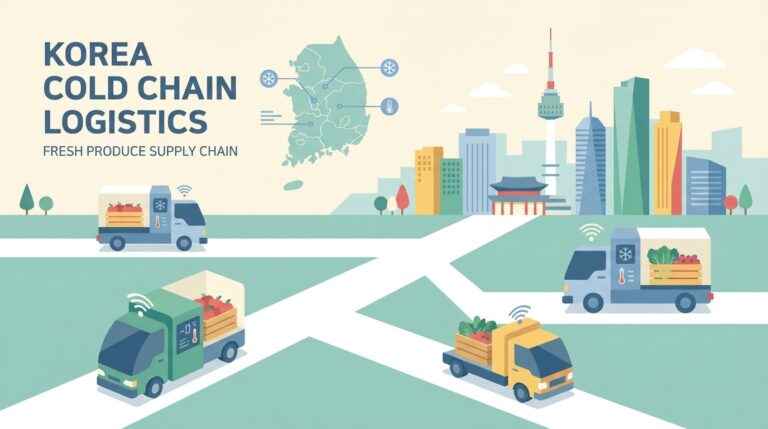
안녕하세요! 매일한글 에디터입니다. Welcome back to another high-level Korean language deep dive with Daily Hangul!
Have you ever wondered how fresh Korean strawberries arrive at your doorstep in Seoul at 6:00 AM, looking as crisp as if they were just plucked from a greenhouse in Nonsan? Or how high-tech pharmaceuticals are transported across the Korean peninsula without a single degree of temperature fluctuation? Korea’s logistics and retail ecosystem is world-renowned for its hyper-fast ‘Dawn Delivery’ (새벽배송) and cutting-edge cold chain infrastructure. However, for C2-level professional Korean learners, moving beyond basic retail vocabulary into advanced supply chain mechanics—such as temperature compliance, sensor monitoring, and distribution bottlenecks—presents a unique hurdle. You might know words like ‘냉장’ (refrigerated) or ‘배송’ (delivery), but expressing nuanced corporate risks like cold chain disruptions or automated temperature monitoring requires sophisticated professional phrasing. This lesson is meticulously built on real feedback from international logistics managers working in Korea to give you total fluency in high-stakes logistics discussions.
1. 적정 온도를 엄격히 준수하다 (Jeokjeong ondeoreul eomgyeokhi junsuhada)
- Pronunciation: [Jeok-jeong on-deo-reul eom-gyeok-hee jun-soo-hah-dah] (Sounds like: “Jock-jeong on-door-rule umm-gyeok-hee june-soo-hah-dah”)
- Meaning: Direct Translation: “To strictly observe the appropriate temperature.” | Nuance: Used in formal business contexts to emphasize zero-tolerance compliance with designated thermal limits during transport and storage.
- K-Culture Moment: In modern Korean corporate dramas like Agency or workplace documentaries, quality control directors sternly remind logistics teams about safety standards for perishable goods.
- Editor’s Insight: While ‘온도를 맞추다’ (to set/match the temperature) works in casual contexts, ‘엄격히 준수하다’ elevates your speech to executive-level precision during compliance audits.
- Situation Spectrum: Casual: 🚫 | Semi-formal: ⚠️ | Formal: ✅
- 🤔 Think About It: How does your home culture handle accountability when cold chain standards fail? How does the emphasis on ‘zero-error compliance’ reflect Korean business speed and precision?
2. 콜드체인 유통망에 차질이 생기다 (Koldeuchein yutongmange chajiri saenggida)
- Pronunciation: [Kol-deu-chein yoo-tong-mang-e cha-jir-i saeng-gee-dah] (Sounds like: “Cold-chain you-tong-mahng-eh chah-jeer-ee saeng-gee-dah”)
- Meaning: Direct Translation: “A disruption/hitch occurs in the cold chain distribution network.” | Nuance: A sophisticated phrase used to report unexpected supply chain operational delays or thermal failures.
- K-Culture Moment: Featured heavily in Korean news broadcasts covering seasonal food supply surges or vaccine supply logistics.
- Editor’s Insight: ‘차질’ (a hitch/disruption) is a quintessential business noun paired with ‘생기다’ (to occur) or ‘빛어지다’ (to be caused). It avoids emotional blame while accurately describing operational issues.
- Situation Spectrum: Casual: 🚫 | Semi-formal: ⚠️ | Formal: ✅
- 🤔 Think About It: Why do Korean corporations prefer indirect terms like ‘차질이 생기다’ over direct expressions like ‘우리가 실수했다’ (we made a mistake)?
3. 실시간 온도 관제 시스템을 가동하다 (Silsigan ondo gwanje sisitemeul gadonghada)
- Pronunciation: [Sil-si-gan on-do gwan-je see-steu-meul gah-dong-hah-dah] (Sounds like: “Seel-see-gahn on-dough gwhan-jeh system-ul gah-dong-hah-dah”)
- Meaning: Direct Translation: “To operate a real-time temperature monitoring and control system.” | Nuance: Refers to utilizing automated IoT sensor networks to track thermal data throughout the supply chain route.
- K-Culture Moment: Seen on tech-focused documentaries showcasing Korea’s smart logistics centers in Incheon and Gimpo.
- Editor’s Insight: ‘관제’ (control/monitoring) implies central command oversight, superior to simple ‘확인’ (checking).
- Situation Spectrum: Casual: 🚫 | Semi-formal: ⚠️ | Formal: ✅
- 🤔 Think About It: How has real-time tracking technology changed consumer expectations for fresh delivery in your country?
📖 교과서 한국어: “냉동 차량의 온도가 올라가면 경보가 울립니다.”
(If the refrigerated vehicle’s temperature rises, an alarm rings.)
🗣️ 진짜 한국어: “온도 이탈 즉시 관제실로 실시간 알림이 팝업됩니다.”
(The moment a temperature breach occurs, a real-time pop-up notification hits the control center.)
💡 왜 다를까?: Korean industry insiders use precise industry jargon like ‘온도 이탈’ (temperature breach/deviation) and ‘관제실’ (control room) instead of simple grade-school explanations.
📖 교과서 한국어: “신선 식품 배송이 늦어지면 안 됩니다.”
(Fresh food delivery must not be delayed.)
🗣️ 진짜 한국어: “신선도 하차 임계점을 넘기면 전량 폐기 수순입니다.”
(If we cross the freshness decay threshold, it goes straight to total disposal.)
💡 왜 다를까?: Senior professionals focus on critical risk limits (‘임계점’) and standardized legal procedures (‘수순’).
4-1. 눈치 (Nunchi) & Professional Gestures
When discussing cold chain parameters with Korean logistics supervisors, maintain structured eye contact while holding operational tablet logs at a respectful angle. When acknowledging risk alerts, a firm, disciplined head nod combined with immediate document cross-checking demonstrates high corporate competence.
4-2. Cultural Code: The ‘Dawn Delivery’ Benchmark
Korea’s cold chain evolution is driven by urban density and consumer intolerance for spoiled produce. E-commerce pioneers built proprietary insulated cold-box ecosystems (like reusable Eco-Packs). Understanding how tech and cold chains intertwine is key to analyzing Korean consumer behavior.
Setting: Senior Logistics Strategy Meeting at a Smart Distribution HQ in Gimpo.
Characters: Director Park (박 이사 – C-level Supply Chain Lead) & You (Foreign Logistics Ops Specialist)
Director Park: “김 팀장, 이번 신선식품 새벽배송 물량 폭증 건, 콜드체인 관리는 문제없습니까?”
(Kim Team Leader, regarding this surge in fresh food dawn deliveries, is our cold chain management secure?)
🎭 Action: Adjusting glasses while reviewing real-time dashboard
You: “네, 이사님. 전 차량에 실시간 온도 센서를 부착하여 모니터링 중입니다.”
(Ne, isanim. Jeon charange silsigan ondo senseoreul buchakdhayeo monitoring jung-imnida. / Yes, Director. We attached real-time temperature sensors across all vehicles for monitoring.)
🎭 Action: Confidently pointing to the central fleet management interface
Director Park: “만약 수송 중 적정 온도 이탈 사례가 발생하면 어떻게 대응합니까?”
(What if a temperature deviation occurs during transport?)
🎭 Action: Frowning slightly with serious focus
You: “온도 이탈 즉시 관제 시스템에서 운전자와 센터로 동시에 경고를 발송합니다.”
(Ondo ital jeoksi gwanje sisitemeeseo unjeonjaya gwanjesillodeo dongsie gyeonggoreul balsonghamnida. / Upon temperature deviation, the control system simultaneously alerts both the driver and the center.)
🎭 Action: Speaking calmly with a clear, firm tone
Director Park: “만약 유통 과정에서 냉동 상태가 해동되면 전량 폐기 조치인가요?”
(If thawing occurs during distribution, is it immediate total disposal?)
🎭 Action: Leaning forward, emphasizing risk metrics
You: “맞습니다. 콜드체인 유통망 손상은 품질 신뢰도와 직결되므로 즉시 폐기 수순을 밟습니다.”
(Matseumnida. Koldeuchein yutongmang sonsangeun pumjil sinroedowa jikgyeoldoemoero jeoksi pyegi susuneul balpseumnida. / Correct. Cold chain degradation directly impacts quality trust, so we proceed directly to disposal.)
🎭 Action: Nodding resolutely
Director Park: “훌륭하군요. 기술적 보안책을 계속 강화해 주세요.”
(Excellent work. Please continue strengthening our technological safeguards.)
🎭 Action: Smiling in approval and tapping the folder shut
You: “알겠습니다. 빈틈없는 물류망 구축에 만전을 기하겠습니다.”
(Algetseumnida. Binteumeopneun muryumang guchuge manjeoneul gihagetseumnida. / Understood. I will ensure absolute perfection in building an airtight logistics network.)
🎭 Action: Standing up slightly and bowing respectfully
🔀 Decision Point: Director Park asks how to handle extreme summer heatwaves.
– Choice A: “여름에는 배송을 조금 줄이는 게 안전합니다.” (Reduce delivery volume in summer.)
– Choice B: “콜드체인 예동 시스템을 강화하고 냉매재를 추가 투입하겠습니다.” (Enhance pre-cooling systems and add secondary refrigerants.)
– Choice C: “온도가 올라가도 빠르게 배송하면 괜찮습니다.” (It’s fine if temperatures rise as long as we deliver fast.)
Feedback:
– Choice A (BAD): Shows a passive business mindset, unsuitable for fast-paced logistics.
– Choice B (BEST): Demonstrates proactive engineering solutions and technical fluency.
– Choice C (RISK): Violates food safety compliance protocols, signaling unacceptable operational risk.
Practice reading these key C2 phrases out loud with natural rhythm:
- [😊 Confident & Professional]
“콜드체인 유통망의 / 적정 온도를 / 엄격히 준수하고 있습니다.”
(Koldeuchein yutongmangeui / jeokjeong ondoreul / eomgyeokhi junsuhago isseumnida.) -
[🚨 Serious & Alert]
“온도 이탈 발생 즉시 / 관제실로 / 실시간 알림이 전달됩니다.”
(Ondo ital balshaeng jeoksi / gwanjesillo / silsigan allimi jeondaldeomnida.) -
[💼 Resolute & Executive]
“품질 신뢰도를 위해 / 빈틈없는 물류망 구축에 / 만전을 기하겠습니다.”
(Pumjil sinroedoreul wihae / binteumeopneun muryumang guchuge / manjeoneul gihagetseumnida.)
- 새벽배송 (Saebyeok-baesong) | Dawn Delivery: Early morning doorstep delivery service operating between 12 AM and 7 AM.
- 콜드체인 (Koldeu-chein) | Cold Chain: Temperature-controlled supply chain system for perishables and pharmaceuticals.
- 온도 이탈 (Ondo-ital) | Temperature Deviation/Breach: When thermal conditions exceed permissible regulatory thresholds.
- 전량 폐기 (Jeonryang-pyegi) | Complete Disposal/Scrapping: Total liquidation of inventory due to safety compliance violations.
- TOP 1: “콜드체인 관제 현황을 확인해 주시겠습니까?”
(Could you please review the cold chain monitoring status?)
Pro Tip: Use this when initiating an audit with facility engineers. - TOP 2: “적정 온도 범위를 벗어나면 바로 보고해 주세요.”
(Please report immediately if conditions cross the optimal temperature range.)
Pro Tip: Sets clear protocol standards for site operations. - TOP 3: “냉동 및 냉장 라인의 가동률이 100%입니다.”
(Operating capacity for frozen and chilled lines is currently at 100%.)
Pro Tip: Great for high-level status briefings.
Editor’s Travel & Business Note: When analyzing Korean logistics technology or visiting distribution hubs around Seoul, utilize official tools like the 네이버 지도 앱 다운로드 for precise navigation to logistics centers, or check real-time trade route updates via national logistics portals.
Korea’s ultra-efficient cold chain isn’t merely a technological triumph; it reflects a deeply rooted cultural value: 정성 (Jeongseong – sincere devotion/care) toward the end recipient. Delivering fresh food isn’t viewed merely as moving cargo—it is viewed as delivering care without compromise. When a Korean logistics company promises dawn delivery with zero thermal breach, it reflects corporate pride where modern technology meets traditional hospitality.
💬 Your Turn: How does your country’s logistics sector balance delivery speed with temperature compliance? Share your thoughts in the comments below!
Q: What is the difference between 냉장 (Naengjang) and 냉동 (Naengdong)?
A: ‘냉장’ refers to refrigeration (typically 0°C to 10°C), whereas ‘냉동’ refers to freezing (below 0°C, often down to -18°C or lower in cold chain logistics).
Q: Why is ‘차질이 생기다’ preferred over direct blame in Korean business reports?
A: Korean corporate communication values objective problem identification over emotional finger-pointing. Saying ‘차질이 생기다’ focuses on rectifying the system bottleneck rather than attacking individuals.
Q: How do I express ‘real-time IoT tracking’ in natural Korean?
A: You can say ‘IoT 기반 실시간 관제 시스템’ (IoT-based real-time control/monitoring system).
🚨 Common Mistakes TOP 3:
1. Saying “온도가 틀려졌어요” (The temperature became wrong) ❌
-> Correct Action: Say “온도 이탈이 발생했습니다” (A temperature deviation occurred) ✅
2. Using casual “다 버려요” (Throw it all away) in executive reports ❌
-> Correct Action: Say “전량 폐기 수순을 밟습니다” (We will proceed with total disposal procedures) ✅
3. Confusing ‘유통기한’ (Expiration date) with ‘유통망’ (Distribution network) ❌
-> Correct Action: Pay close attention to ‘망’ (net/network) versus ‘기한’ (time limit).
- Bronze Mission: Record yourself reading the 3 Emotion Shadowing sentences aloud with correct pause markers (
/). - Silver Mission: Write a 2-sentence formal Korean status update about a cold chain delivery using ‘적정 온도’ and ‘준수하다’.
- Gold Mission: Spot a cold chain delivery vehicle or insulated delivery box in Korea (or in Korean media) and comment its Korean terminology on our social media page!
🎮 K-Culture Mission: Watch a documentary clip or workplace drama featuring logistics operations. Identify how many times terms like ‘관제’, ‘배송’, or ‘신선도’ are spoken!
Quiz 1 (Situation Assessment):
When reporting a temperature malfunction in a pharmaceutical shipping container to your senior director, which phrase is most professional?
1) 온도가 좀 이상해요.
2) 콜드체인 온도 이탈이 감지되어 즉시 관제팀에 통보했습니다.
3) 냉장고가 고장 났습니다.
Click to reveal Answer & Explanation
Correct Answer: 2
Explanation: Option 2 uses high-level corporate vocabulary (‘콜드체인 온도 이탈’, ‘감지되어’, ‘관제팀에 통보했습니다’) suitable for C2 professional fluency.
Quiz 2 (Fill in the Blank):
“품질 신뢰도를 위해 적정 온도를 엄격히 ______ 해야 합니다.”
(Options: 1) 준수 2) 탈출 3) 도착)
Click to reveal Answer & Explanation
Correct Answer: 1 (준수)
Explanation: ‘엄격히 준수하다’ means ‘to strictly observe/comply with’.
Quiz 3 (True or False):
In Korean logistics business settings, saying ‘전량 폐기 수순을 밟습니다’ is considered overly informal.
(True / False)
Click to reveal Answer & Explanation
Correct Answer: False
Explanation: It is extremely formal, polite, and standard in professional corporate reports.







