

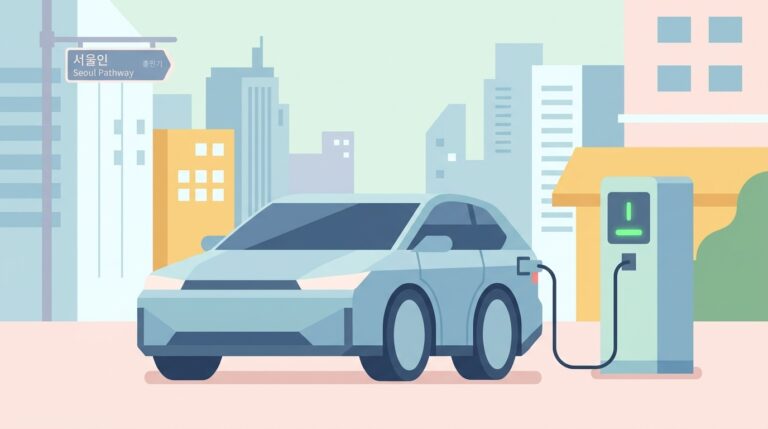
안녕하세요! 매일한글 에디터입니다. Have you ever rented a sleek car in Seoul, pulled into a brightly lit underground parking garage in Gangnam, and felt relieved to find an empty parking slot—only to realize later that parking your non-EV vehicle there or staying over the time limit cost you a hefty 100,000 KRW fine? Driving in Korea offers unparalleled freedom, from scenic coastal highways in Jeju to the sophisticated infrastructure of smart cities. However, as South Korea aggressively transitions toward green mobility, eco-friendly vehicle infrastructure laws have become strictly enforced. Today, we are taking a deep dive into C2-level nuance, administrative Korean terminology, and the cultural landscape surrounding electric vehicle (EV) charging zone regulations.
Mastering these sophisticated terms will not only elevate your native-like fluency when dealing with municipal notices or car rental agencies but also save you from costly administrative missteps. Based on real feedback from advanced learners who navigate Korean roads daily, this guide breaks down the legal, social, and linguistic layers of driving in modern Korea.
1. 전기차 충전 방해 행위 (Jeon-gi-cha Chung-jeon Bang-hae Haeng-wi)
- Pronunciation: [jeon-gi-cha chung-jeon bang-hae haeng-wi] (Sounds like john-gee-cha choong-jeon bahng-hae haeng-we)
- Meaning: Act of obstructing electric vehicle charging (Literal) / Illegal blocking or misuse of EV charging spaces (Nuance)
- K-Culture Moment: Frequently seen in modern K-Dramas where a high-strung protagonist receives a automated municipal text notification after parking their luxury gas-powered sedan in an EV charger stall.
- Editor’s Insight: While ‘주차’ means standard parking, ‘충전 방해 행위’ is a formal legal term encompassing not just parking a internal combustion engine (ICE) car, but also leaving a fully charged EV connected past the legal grace period or blocking access with obstacles.
- Situation Spectrum:
- Casual: 🚫
- Semi-formal: ⚠️
- Formal: ✅
- 🤔 Think About It: How does the legal explicit definition of ‘obstruction’ in Korean public spaces reflect society’s high density and emphasis on collective efficiency?
2. 과태료가 부과되다 (Gwa-tae-ryo-ga Bu-gwa-doe-da)
- Pronunciation: [gwa-tae-ryo-ga bu-gwa-doe-da] (Pronounced naturally as gwa-tae-ryo-ga boo-gwa-dwae-da)
- Meaning: An administrative fine is imposed / levied
- K-Culture Moment: Heard in news broadcasts covering urban enforcement or discussed between rental agency staff and foreign drivers reviewing security deposit deductions.
- Editor’s Insight: Crucial distinction for C2 speakers: ‘과태료’ (gwa-tae-ryo) is a civil administrative fine for administrative infractions without criminal records, whereas ‘벌금’ (beol-geum) is a criminal fine imposed by judicial ruling. Using ‘과태료가 부과되었다’ demonstrates advanced legal precision.
- Situation Spectrum:
- Casual: 🚫
- Semi-formal: ⚠️
- Formal: ✅
- 🤔 Think About It: Why is distinguishing between civil infractions and criminal penalties essential when discussing civic responsibilities in Korean society?
3. 계도 기간 및 단속 (Gye-do Gi-gan Mit Dan-sok)
- Pronunciation: [gye-do gi-gan mit dan-sok] (gyae-do gee-gahn meet dahn-sok)
- Meaning: Grace/Graceful guidance period and official enforcement crackdown
- K-Culture Moment: Often displayed on banner banners (현수막) draped across public parking garages or municipal websites announcing new urban policies.
- Editor’s Insight: ‘계도 기간’ refers to an educational phase where authorities issue warnings rather than financial penalties. Once this transitions to ‘단속’, strict enforcement via automated cameras and citizen smartphone reports begins instantly.
- Situation Spectrum:
- Casual: 🚫
- Semi-formal: ⚠️
- Formal: ✅
- 🤔 Think About It: How do transition periods like ‘계도 기간’ reflect Korean administrative culture’s balance between public education and rapid policy adoption?
Situation 1: Parking Space Confusion
- 📖 교과서 한국어: 전기차 구역에 주차하면 벌금을 냅니다. (If you park in the EV zone, you pay a criminal fine.)
- 🗣️ 진짜 한국어: 전기차 충전 구역에 일반 차량을 대시면 과태료 부과 대상이 됩니다. (Parking a conventional vehicle in an EV charging zone renders you subject to administrative fines.)
- 💡 왜 다를까?: Native speakers use precise legal terms (‘과태료’ instead of ‘벌금’, ‘일반 차량’ instead of basic car terms) in public rules to maintain legal accuracy and professional demeanor.
Situation 2: Citizen Reporting via Smartphone
- 📖 교과서 한국어: 누가 내 차를 사진 찍어서 신고했습니다. (Someone took a picture of my car and reported it.)
- 🗣️ 진짜 한국어: 주민이 안전신문고 앱으로 과태료 부과 건을 신고했더라고요. (A local resident filed a report regarding a fineable violation via the Safety Code app.)
- 💡 왜 다를까?: Korea’s high civic digitalization means official app names like ‘안전신문고’ (Anjeon Sinmun-go) are part of everyday vocabulary when discussing parking enforcement.
4-1. Nunchi & Civic Etiquette in Public Garages
In South Korea, parking in an EV charging spot without active charging isn’t merely an administrative violation; it triggers intense public disapproval. Korean culture relies heavily on Nunchi (눈치)—social awareness of surroundings and collective harmony. When driving, this manifests as double-checking signage, keeping hazard lights on briefly if adjusting position, and respecting public utility boundaries.
4-2. Culture Code: Smart Governance & The “Safety Code” App
South Korea’s modern public order is powered by smart technology. Under the public reporting initiative, any citizen can capture two timestamped photos of a parking violation using the 안전신문고 앱 다운로드 (Safety Code App) and submit it in seconds. This crowdsourced civil surveillance means enforcement is omnipresent, making awareness of EV regulation essential for anyone behind the wheel.
Setting: A administrative dispute desk at a district office (구청) or car rental station in Seoul.
Characters:
* Min-soo (민수): C2 Foreign Driver who rented a vehicle.
* Officer Park (박 주무관): A polite yet strict district administrative officer.
- Turn 1 (민수): 안녕하세요. 전기차 충전 구역 주차 과태료 통지서를 받고 문의하러 왔습니다.
(An-nyeong-ha-se-yo. Jeon-gi-cha chung-jeon gu-yeok ju-cha gwa-tae-ryo tong-ji-seo-reul bat-go mun-ui-ha-reo wat-seum-ni-da.)
Hello. I came to inquire after receiving an EV charging zone parking fine notice.[🎭 Polished, serious tone with formal posture] -
Turn 2 (박 주무관): 네, 신분증과 통지서를 보여주시겠습니까? 확인해 드리겠습니다.
(Ne, sin-bun-jeung-gwa tong-ji-seo-reul bo-yeo-ju-si-get-seum-ni-ka? Hwag-in-hae deu-ri-get-seum-ni-da.)
Yes, could you show me your ID and notice? I will verify it for you.[🎭 Typing on government computer terminal] -
Turn 3 (민수): 저는 플러그인 하이브리드 차량이었는데, 충전이 끝난 후 1시간 정도 세워두었습니다.
(Jeo-neun pleu-geu-in ha-i-beu-ri-deu cha-ryang-i-eot-neun-de, chung-jeon-i kkeut-nan hu han-si-gan jeong-do se-wo-du-ot-seum-ni-da.)
My vehicle was a plug-in hybrid, and I left it parked for about an hour after charging was completed.[🎭 Explaining clearly with calm tone] -
Turn 4 (박 주무관): 아, 급속 충전기는 1시간, 완속 충전기는 14시간 초과 주차 시 단속 대상이 됩니다.
(A, geup-sok chung-jeon-gi-neun han-si-gan, wan-sok chung-jeon-gi-neun sip-sa-si-gan cho-gwa ju-cha si dan-sok dae-sang-i doem-ni-da.)
Ah, rapid chargers trigger enforcement after 1 hour overstay, while slow chargers allow up to 14 hours.[🎭 Pointing politely to regulation chart] -
Turn 5 (민수): 그렇군요. 저는 계도 기간인 줄 착각했습니다. 즉시 납부하면 감경 혜택이 있나요?
(Geu-reot-gun-yo. Jeo-neun gye-do gi-gan-in jul chak-gak-haet-seum-ni-da. Jeuk-si nap-bu-ha-myeon gam-gyeong hye-taeg-i in-na-yo?)
I see. I mistakenly assumed it was still a grace period. Is there a reduction benefit for prompt payment?[🎭 Expressing accountability with respect] -
Turn 6 (박 주무관): 네, 의견 제출 기한 내에 자진 납부하시면 20% 감경된 금액으로 처리 가능합니다.
(Ne, ui-gyeon je-chul gi-han nae-e ja-jin nap-bu-ha-si-myeon i-sip-pro gam-gyeong-doen geum-aek-eu-ro cheo-ri ga-neung-ham-ni-da.)
Yes, if you make a voluntary payment within the opinion submission deadline, a 20% reduced amount applies.[🎭 Handing over payment slip] -
Turn 7 (민수): 상세히 설명해 주셔서 감사합니다. 앞으로는 충전 완료 즉시 차를 이동시키겠습니다.
(Sang-se-hi seol-myeong-hae ju-syeo-seo gam-sa-ham-ni-da. Ap-eu-ro-neun chung-jeon wan-ryo jeuk-si cha-reul i-dong-si-ki-get-seum-ni-da.)
Thank you for the detailed explanation. In the future, I will move the car immediately upon completion.[🎭 Slight bow showing gratitude] -
Turn 8 (박 주무관): 협조해 주셔서 감사합니다. 안전 운전하십시오.
(Hyeop-jo-hae ju-syeo-seo gam-sa-ham-ni-da. An-jeon un-jeon-ha-sip-si-o.)
Thank you for your cooperation. Drive safely.[🎭 Friendly professional smile]
🔀 Interactive Choice Point
How would you handle receiving an administrative notice for parking obstruction?
* Option A: Argue emotionally that the sign was unclear and demand cancellation. -> Feedback (Bad): Escalating emotionally with Korean civil servants often leads to official formal processing without leniency.
* Option B: Inquire politely using legal vocabulary (자진 납부, 감경 혜택) about early payment discounts. -> Feedback (Best): Demonstrating C2 linguistic composure and civil understanding secures the standard 20% administrative discount smoothly.
* Option C: Ignore the notice until returning the rental car. -> Feedback (Risk): Late penalties apply, and rental agencies charge heavy administrative processing surcharges onto your credit card.
Practice these high-level driving phrases with exaggerated emotion and natural pauses (/).
- [😠 단호하고 확실하게] 전기차 충전 구역에 / 일반 차를 대시면 / 과태료 부과 대상입니다!
(Jeon-gi-cha chung-jeon gu-yeok-e / il-ban cha-reul dae-si-myeon / gwa-tae-ryo bu-gwa dae-sang-im-ni-da!) -
[🥺 아쉽지만 공손하게] 계도 기간인 줄 알고 / 주차했는데 / 자진 납부 할인은 가능한가요?
(Gye-do gi-gan-in jul al-go / ju-cha-haet-neun-de / ja-jin nap-bu hal-in-eun ga-neung-han-ga-yo?) -
[😊 정중하고 명쾌하게] 충전이 완료되는 대로 / 바로 차를 / 이동시키도록 하겠습니다.
(Chung-jeon-i wan-ryo-doe-neun dae-ro / ba-ro cha-reul / i-dong-si-ki-do-rok ha-get-seum-ni-da.)
- 과태료 (Gwa-tae-ryo) | Administrative Fine | Civil financial penalty levied by local government for non-criminal regulatory violations.
- 완속/급속 충전기 (Wan-sok/Geup-sok Chung-jeon-gi) | Slow / Rapid EV Charger | Rapid chargers (급속) carry strict 1-hour overstay limits; slow chargers (완속) allow up to 14 hours.
- 단속 대상 (Dan-sok Dae-sang) | Subject to Enforcement | Legal classification indicating a vehicle is actively violating traffic or parking rules.
- 자진 납부 감경 (Ja-jin Nap-bu Gam-gyeong) | Voluntary Payment Reduction | A legal provision offering a 20% reduction on administrative fines if paid within the early response period.
Survival Expressions TOP 3
- 전기차 전용 구역인가요? (Jeon-gi-cha jeon-yong gu-yeok-in-ga-yo?) – Is this exclusively for electric vehicles?
- Pro Tip: Ask parking garage attendants before turning off your ignition to avoid accidental citations.
- 주차 가능 시간이 어떻게 되나요? (Ju-cha ga-neung si-gan-i ot-toe-ke doe-na-yo?) – What is the allowed parking duration?
- 과태료 자진 납부 할인 기간이 언제까지예요? (Gwa-tae-ryo ja-jin nap-bu hal-in gi-gan-i eon-je-kka-ji-ye-yo?) – Until when is the early payment discount valid?
Editor’s Travel Note
When driving across Korea, rely on the 네이버 지도 앱 다운로드 (Naver Map App) or Kakao Navi. They provide real-time updates on active EV charging stations, indicating whether chargers are rapid (급속) or slow (완속), and display real-time availability so you never park incorrectly.
South Korea’s rapid enforcement of EV regulations reflects a deeper societal commitment: public convenience and technological shift must be matched by collective civic order. While Western infrastructure often relies on physical barriers or passive traffic wardens, Korea leverages transparent digital monitoring paired with civic reporting apps. This creates an environment where respect for shared rules is digitized and real-time. Understanding these legal nuances bridges the gap between being a tourist driver and navigating Korea with native cultural intelligence.
💬 Your Turn: Have you ever encountered unexpected parking rules or unique road regulations while driving in Korea? Share your story in the comments below!
Q: What happens if an ICE (gasoline/diesel) car parks in an EV charging spot?
A: Parking a conventional internal combustion engine vehicle in a designated EV charging zone results in an immediate administrative fine (과태료) of 100,000 KRW under the Eco-Friendly Vehicles Act.
Q: Is overstaying in an EV spot after charging finishes also illegal?
A: Yes. Occupying a rapid charger stall after 1 hour or a slow charger stall after 14 hours is defined legally as ‘charging obstruction’ (충전 방해 행위) and incurs a 100,000 KRW fine.
Q: Can foreigners pay administrative fines online or get the voluntary discount?
A: Yes, fines can be paid via virtual bank transfers listed on the notice or through official portals. Paying within the preliminary opinion window secures a 20% discount.
🚨 Common Mistakes Warning Board
| Common Foreign Driver Mistake | Risk Level | Correct Action (정답) |
|---|---|---|
| Thinking hazard lights permit temporary EV zone parking | 🚨 HIGH | Never park in EV zones unless actively charging, even for a minute. |
| Leaving an EV plugged in overnight at a rapid charger | 🚨 HIGH | Move the car within 1 hour when using rapid chargers (급속). |
| Assuming rental cars are exempt from municipal camera fines | 🚨 HIGH | Fines are forwarded directly to rental agencies with added service fees. |
- Bronze Mission: Read the Phase 6 Shadowing Drill aloud 3 times focusing on correct legal terminology pronunciation.
- Silver Mission: Share this guide on social media with fellow travelers planning a Korean road trip.
- Gold Mission: Spot an EV charging station in Korea (or online via Naver Maps) and correctly identify whether it is 급속 (rapid) or 완속 (slow) by reading the signage.
🎮 K-Culture Mission: Watch a contemporary Korean drama scene involving driving, and post in the comments if you spot road signage or parking banners featuring terms like ‘단속’ or ‘전용’!
Quiz 1. Situation Judgment
You parked your gasoline rental car in an EV charging stall with hazard lights on for 15 minutes to buy coffee. A citizen reported it. What is the correct legal outcome?
(A) No fine because hazard lights were on.
(B) An administrative fine (과태료) of 100,000 KRW is imposed for charging obstruction.
(C) A criminal record and prison time.
Click to reveal Answer & Explanation
Correct Answer: (B)
Explanation: Emergency lights do not exempt vehicles from EV obstruction laws. Parking any non-charging vehicle in an EV spot warrants a 100,000 KRW administrative fine (과태료).
Quiz 2. Fill in the Blank
과태료 통지서를 받은 후 기한 내에 ( ) 납부하면 20% 감경 혜택을 받을 수 있습니다.
Click to reveal Answer & Explanation
Correct Answer: 자진 (Ja-jin / Voluntary)
Explanation: ‘자진 납부’ refers to voluntarily paying an administrative fine during the initial notification period to receive a statutory discount.
Quiz 3. True / False Culture Check
In Korea, ‘과태료’ (Gwa-tae-ryo) and ‘벌금’ (Beol-geum) are identical terms meaning administrative parking tickets.
Click to reveal Answer & Explanation
Correct Answer: False
Explanation: ‘과태료’ is a civil administrative fine without criminal records, whereas ‘벌금’ is a formal criminal penalty imposed by judicial court rulings.







