

Phase 1: Empathy (Story-Immersive Opening)
안녕하세요! 매일한글 에디터입니다.
Have you ever stood in front of your closet in Seoul, looking at a stack of barely worn jackets or books, wondering, “How can I give these a second life in Korea?” You might have heard of 아름다운 가게 (Beautiful Store), Korea’s most beloved social enterprise for donation and upcycling. But when you walk inside carrying a box, your heart beats a little faster. You want to ask if your items are acceptable, whether you can get a donation receipt for tax deduction (기부금 영수증), and how the process works without sounding overly formal or awkward.
Don’t worry! Many of our intermediate learners share this exact pain point. You know basic Korean, but navigating real-world administrative or voluntary interactions feels like a big step. Today, based on actual feedback from our global community, I’ll guide you through natural, polite B2-level phrases so you can donate your items with complete confidence and experience the warm heart of Korean sharing culture (나눔 문화).
Phase 2: Deep Dive into 3 Essential Expressions
1. 사용감이 살짝 있는데 기부 가능할까요?
- Pronunciation: [Sayonggami saljjak inneunde gibu ganeunghalkkayo?] (Say-ong-gam-ee sal-jjak in-neun-de gi-bu ga-neung-hal-kka-yo?)
- Meaning: “It shows a bit of wear, but is it okay to donate?”
- K-Culture Moment: You bring a nice coat that you wore last winter. It’s clean, but not brand new. You show it to the volunteer at the counter while asking this.
- Editor’s Insight: 사용감 (use-feel/wear and tear) is a crucial word in Korean second-hand markets (like 당근마켓) and donation spots. Adding 살짝 (slightly) shows modesty and consideration for the store’s quality guidelines.
- Situation Spectrum: Casual ⚠️ / Semi-formal ✅ / Formal ✅
- 🤔 Think About It: In your home country, do people carefully ask about item condition before donating, or do they just drop items off in collection bins?
2. 기부금 영수증 발급받을 수 있나요?
- Pronunciation: [Gibugeum yeongsujeung balgeupbateul su innayo?]
- Meaning: “Can I receive a donation tax receipt?”
- K-Culture Moment: After the volunteer inspects your items, you provide your registration number or telephone number to register your tax receipt.
- Editor’s Insight: In Korea, item donations are tax-deductible! The store calculates the estimated resale value and issues an official receipt linked to your tax profile (Year-end Tax Settlement / 연말정산).
- Situation Spectrum: Casual 🚫 / Semi-formal ✅ / Formal ✅
- 🤔 Think About It: How does tax deduction for charitable donations work in your country compared to Korea’s digital system?
3. 직접 매장으로 가져다 드리면 될까요?
- Pronunciation: [Jikjeop maejangeuro gajyoda deurimyeon doelkkayo?]
- Meaning: “Should I bring them directly to the store?”
- K-Culture Moment: Calling or messaging the local branch before carrying heavy boxes of books or clothes.
- Editor’s Insight: 가져다 드리다 is a polite compound verb combining 가져오다/가다 (to bring/take) and 드리다 (to give politely). Using this demonstrates high-level fluency and cultural politeness.
- Situation Spectrum: Casual 🚫 / Semi-formal ✅ / Formal ✅
- 🤔 Think About It: Why does Korean use compound honorific verbs like ~해 드리다 to show respect during voluntary service?
Phase 3: Textbook Korean vs. Real Korean
Situation 1: Explaining what you brought
- 📖 Textbook Korean: 물품을 기증하러 왔습니다. (I have come to donate goods.)
- 🗣️ Real Korean: 안녕하세요! 이거 기부하려고 가져왔는데요. (Hi! I brought these to donate.)
- 💡 Why the difference? 기증하러 왔습니다 sounds like a textbook script. Real Koreans prefer the conversational ~하려고 가져왔는데요 with a soft ending (~는데요).
Situation 2: Asking about donation criteria
- 📖 Textbook Korean: 기능에 문제가 없는지 확인해 주십시오. (Please check if there is no functional issue.)
- 🗣️ Real Korean: 작동은 잘 되는데, 한번 확인해 보시겠어요? (It works well, but would you like to take a look?)
- 💡 Why the difference? Softening requests with ~해 보시겠어요? creates a warm, cooperative atmosphere with volunteers.
Phase 4: K-Culture Deep Dive & Non-Verbal Manners
4-1. Nunchi & Gestures
When presenting your items at Beautiful Store:
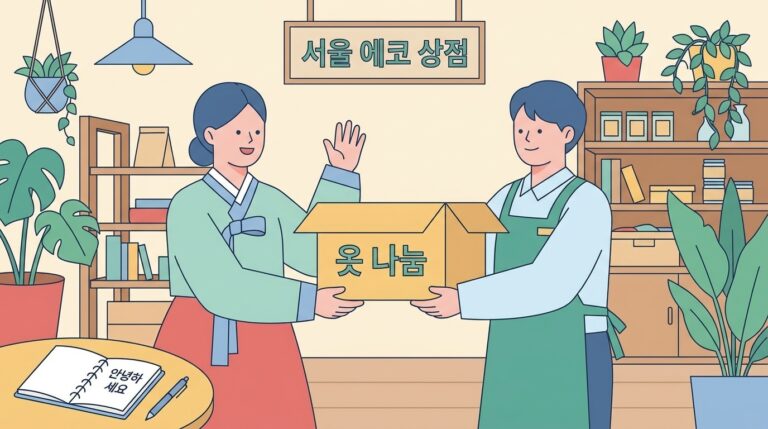
1. Two-Handed Delivery: Hand over folded clothes or items using both hands or with your left hand supporting your right wrist.
2. Modest Eye Contact: Maintain gentle eye contact and nod slightly while saying “확인 부탁드립니다” (Please check them).
3. Sorting Courtesy: Don’t bring dirty or broken items. In Korea, donating clean items reflects your respect for the recipient (정 and 예의).
4-2. Culture Code Analysis: Environment & Upcycling
In Korea, volunteering isn’t just charity—it’s part of everyday ESG living and 나눔 (sharing culture). Beautiful Store operates over 100 branches across South Korea. By donating items, you actively participate in eco-friendly circular economy efforts that popular K-celebrities also champion in eco-campaigns.
Phase 5: Practical Roleplay Scenario
Setting: Beautiful Store Anguk Branch in Seoul
Characters:
* You (Intermediate Korean Learner): Bringing a bag of clothes and books
* Staff (Min-soo, Volunteer): Warm and helpful store manager
- You: 안녕하세요! 물품 기부하려고 가지고 왔는데요.
(Annyeonghaseyo! Mulpum gibuharyeogo gajigo wanneundeyo.)
🎭 Action: Smiling and placing the clean bag gently on the donation counter using both hands.
(Hello! I brought some items to donate.) -
Staff: 어서 오세요! 반갑습니다. 어떤 물품 가져오셨어요?
(Eoseo oseyeo! Bangapseumnida. Eotteon mulpum gajyeo-osyeosseoyo?)
🎭 Action: Greeting warmly with a bow.
(Welcome! Glad to see you. What kind of items did you bring?) -
You: 옷 몇 가지랑 책인데요, 사용감이 살짝 있는데 괜찮을까요?
(Ot myeot gajirang chaegindeyo, sayonggami saljjak inneunde gwaenchanheuljkayo?)
🎭 Action: Unzipping the bag slightly to display neatly folded clothes.
(Some clothes and books. They show a bit of wear, will that be okay?) -
Staff: 아, 깨끗하게 잘 정돈해 주셨네요! 이 정도면 아주 훌륭합니다.
(A, kkaekkeuthage jal jeongdonhae jusyeotneyeo! I jeongdomyeon aju hullyunghamnida.)
🎭 Action: Inspecting the collar and seams gently.
(Ah, you packed them so neatly! This condition is excellent.) -
You: 다행이네요! 혹시 기부금 영수증도 발급받을 수 있나요?
(Dahaengineyo! Hoksi gibugeum yeongsujeungdo balgeupbateul su innayo?)
🎭 Action: Tilting head slightly with a hopeful polite smile.
(What a relief! By any chance, can I also receive a donation receipt?) -
Staff: 네, 그럼요! 휴대폰 번호 입력해 주시면 등록해 드릴게요.
(Ne, geureomyo! Hyudaepon beonho imnyeokhae jusimyeon deongnokhae deurilgeyo.)
🎭 Action: Pointing to the digital keypad on the counter.
(Yes, of course! If you enter your phone number, I will register it for you.) -
You: 네, 입력했어요. 좋은 곳에 쓰였으면 좋겠어요.
(Ne, imnyeokhaesseoyo. Joeun gose ssyeosseumyeon jokgesseoyo.)
🎭 Action: Entering the phone number and placing hands together.
(Yes, I entered it. I hope these items are put to good use.) -
Staff: 따뜻한 마음 감사드립니다. 좋은 하루 보내세요!
(Tattteut-han maeum gamsadreimnida. Joeun haru bonaeseyeo!)
🎭 Action: Handing a small eco-sticker as a token of gratitude.
(Thank you for your warm heart. Have a great day!)
🔀 Interactive Choice Point
Staff asks: “태그가 없는 새 옷도 있는데, 이것도 같이 기부하시나요?” (There’s a new shirt without a tag, are you donating this too?)
- Choice A: “네, 안 입는 거라 같이 기부할게요!”
- Feedback (Best! ✅): Very natural, polite, and clear! Expresses intent seamlessly.
- Choice B: “이거 버리려고요.”
- Feedback (Bad! 🚫): 버리다 means “to throw away.” Saying you are throwing it away at a donation counter can sound disrespectful to the purpose of charity.
- Choice C: “그냥 드립니다.”
- Feedback (Risk! ⚠️): Grammatically okay, but sounds blunt and transactional. Better to say “네, 함께 기부할게요.”
Phase 6: 10-Second Emotion Shadowing Drill
Practice these lines out loud with exact rhythm and feeling:
[😊 Expressing relief & friendliness]
사용감이 살짝 있는데 / 괜찮을까요?
(Sayonggami saljjak inneunde / gwaenchanheuljkayo?)-
[🙋♂️ Polite inquiry]
혹시 / 기부금 영수증도 / 발급받을 수 있나요?
(Hoksi / gibugeum yeongsujeungdo / balgeupbateul su innayo?) -
[❤️ Warm sincerity]
작은 도움이 되었으면 / 좋겠어요.
(Jageun doumi doeyeosseumyeon / jokgesseoyo.)
Phase 7: K-Culture Mini Dictionary
- 기부금 영수증 (Gibugeum Yeongsujeung) | Donation Tax Receipt | Essential document used during Korean year-end tax settlement (연말정산) to get tax credits for charitable contributions.
- 물품 기증 (Mulpum Gijeong) | Goods Donation | The formal term used by institutions when giving physical items (clothes, electronics, books) instead of cash.
- 아름다운 가게 (Areumdaun Gage) | Beautiful Store | South Korea’s iconic social enterprise and charity shop network operating across major cities.
- 사용감 (Sayonggam) | Signs of Use / Wear | Used extensively in donation and re-commerce context to describe an item’s condition naturally.
Phase 8: Traveler & Resident Survival Kit
Top 3 Phrases
- 이것도 기부 가능한가요? (Is this also available for donation?)
- 봉투에 담아왔어요. (I brought them in a bag.)
- 감사합니다. 수고하세요! (Thank you. Keep up the good work!)
Editor’s Travel Note
Looking for the nearest branch in Seoul or Busan? Use 네이버 지도 앱 다운로드 and search for “아름다운가게”. Make sure to visit between 10:30 AM and 6:00 PM (closed on Sundays and public holidays in most branches!).
Phase 9: One Step Deeper (Humanities Essay)
In Korean culture, giving is closely tied to the concept of 정 (Jeong)—a deep emotional bond of warmth and community care. Donating goods isn’t seen merely as getting rid of unused items; it is considered 나눔 (sharing wealth and warmth with neighbors). When you take care to wash, fold, and present your items nicely before handing them to Beautiful Store staff, you demonstrate a deep understanding of Korean social harmony and mutual respect.
💬 Your Turn: Have you ever donated items in your home country or in Korea? What was your experience like? Leave a comment below!
Phase 10: FAQ & Common Mistakes
Q: 외국인도 기부금 영수증을 발급받을 수 있나요?
A: 네! 외국인 등록번호(ARC)나 국세청에 등록된 휴대폰 번호가 있다면 기부금 영수증 발급이 가능합니다.
Q: 속옷이나 계절에 맞지 않는 옷도 기부할 수 있나요?
A: 입었던 속옷이나 오염이 심한 옷은 기부가 불가능합니다. 하지만 계절이 지난 옷이라도 상태가 깨끗하다면 기증이 가능합니다.
Q: 수량이 많으면 방문 수거도 되나요?
A: 네, 보통 라면상자 3박스 이상 분량이면 아름다운 가게 홈페이지나 고객센터를 통해 방문 수거를 신청할 수 있습니다.
🚨 Common Mistakes TOP 3
- Mistake: Calling donation 버리다 (throwing away).
Correct Action: Always use 기부하다 or 기증하다. - Mistake: Handing over items with one hand.
Correct Action: Use both hands to show respect. - Mistake: Bringing unwashed or damaged items.
Correct Action: Inspect items at home beforehand to respect the volunteers’ time.
Phase 11: Action Mission
- Bronze Mission: Practice saying “사용감이 살짝 있는데 괜찮을까요?” 3 times out loud.
- Silver Mission: Share a photo of clothes you want to donate on Instagram and tag
#매일한글 #아름다운가게. - Gold Mission: Visit a local Beautiful Store in Korea and successfully complete a donation using today’s phrases!
🎮 K-Culture Mission: Look out for donation box scenes in Korean modern daily life dramas (like Warm and Cozy or reality shows) and listen for the verb 기부하다!
Phase 12: Interactive Quiz Challenge
1. What is the most polite way to ask if an item with minor wear can be donated?
A) 이거 그냥 버릴게요.
B) 사용감이 살짝 있는데 기부 가능할까요?
C) 이거 가져가세요.
🔍 Click to reveal answer and explanation
Answer: B
Explanation: 사용감이 살짝 있는데 기부 가능할까요? is polite, considerate, and uses standard B2 conversational Korean perfectly.
2. Fill in the blank:
“혹시 기부금 __________ 발급받을 수 있나요?”
(Hint: Tax receipt)
🔍 Click to reveal answer and explanation
Answer: 영수증
Explanation: 기부금 영수증 means donation tax receipt.
3. True or False: In Korea, handing over donated items with one hand is considered polite standard etiquette.
🔍 Click to reveal answer and explanation
Answer: False
Explanation: Using both hands shows courtesy and gratitude in Korean non-verbal etiquette.







