

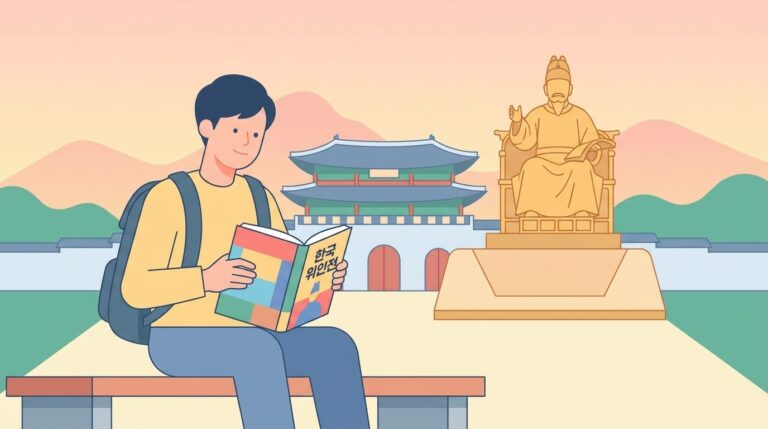
Phase 1: Empathy (Storytelling Opening)
안녕하세요! 매일한글 에디터입니다. 👋
Have you ever stood in front of the massive gold statue of King Sejong in Gwanghwamun Square, holding a simple children’s biography, only to feel instantly frozen? You want to understand why this hero is so beloved in Korea, but when you open a Korean biography (위인전), you are hit with formal historical terms and tricky grammar that textbooks never prepared you for!
It can feel intimidating to read about historical heroes in Korean when you are at an A2 level. You might wonder: “Do I need to memorize ancient Korean to understand these stories?” The short answer is: No!
By mastering a few core A2-level patterns, you can comfortably read beginner biographies, discuss Korea’s greatest figures, and connect deeply with Korean heritage sites. This guide is built directly on real feedback from foreign learners who wanted to transition from basic everyday Korean to meaningful cultural reading. Let’s make reading Korean history enjoyable and stress-free together!
Phase 2: Core Expressions Deep Dive
1. 훌륭한 사람이에요 (Hullyunghan sarami-eyo)
- Pronunciation: [Hool-loong-han sa-ram-ee-yeo] (Sounds like “who-look-han sa-ram-ee-yeo”)
- Meaning: Literal: “Is a great person” / Real Nuance: “They are an admirable/great figure.”
- K-Culture Moment: Standing with a Korean friend in front of Admiral Yi Sun-sin’s statue and explaining why he is respected.
- Editor’s Insight: This is the cleanest, most respectful A2 phrase to describe any historical hero without needing complex archaic honorifics.
- Situation Spectrum: Casual (✅) | Semi-formal (✅) | Formal (✅)
- 🤔 Think About It: How do you describe national heroes in your home country? Is the focus on military victory, wisdom, or kindness?
2. ~을/를 만들어냈어요 (~eul/reul mandeoranaesseoyo)
- Pronunciation: [eul/reul man-deor-ae-naess-eo-yo] (Flows like “man-der-ae-nae-sseo-yo”)
- Meaning: Literal: “Made out/created” / Real Nuance: “Created or invented (through dedication)”
- K-Culture Moment: Explaining to a friend that King Sejong created Hangul (Korean Alphabet) for his people.
- Editor’s Insight: Standard ‘만들었어요’ just means “made something.” Adding ‘~어 내다’ emphasizes overcoming difficulty to achieve or create something noble!
- Situation Spectrum: Casual (✅) | Semi-formal (✅) | Formal (✅)
- 🤔 Think About It: Why do you think Korea celebrates the invention of its alphabet as a major national holiday (Hangul Day)?
3. 역사적인 인물이에요 (Yeoksajeogin inmurieyo)
- Pronunciation: [Yook-sa-jeok-in in-moor-ee-yeo] (Sounds like “yohk-sah-juck-in in-moor-ee-yeo”)
- Meaning: Literal: “Historical person” / Real Nuance: “Is an important historical figure.”
- K-Culture Moment: Browsing books in Kyobo Bookstore in Gwanghwamun and spotting the biography section.
- Editor’s Insight: ‘인물’ is a elevated word for person used when discussing influential people in history or drama plots.
- Situation Spectrum: Casual (⚠️) | Semi-formal (✅) | Formal (✅)
- 🤔 Think About It: Who is the first historical figure that comes to your mind when you think of Korean history?
Phase 3: Textbook Korean vs. Real Native Korean
Situation 1: Introducing a Historical Figure to a Friend
- 📖 Textbook Korean: “이 사람은 세종대왕입니다. 한글을 만들었습니다.”
- 🗣️ Real Native Korean: “이분이 바로 한글을 만드신 세종대왕이에요!”
- 💡 Why is it different?: Natives naturally add warmth and honorific forms (
이분,만드신) to express sincere respect toward historical heroes rather than sounding like a cold Wikipedia entry.
Situation 2: Asking if someone has read a hero’s biography
- 📖 Textbook Korean: “위인전을 읽었습니까?”
- 🗣️ Real Native Korean: “세종대왕 위인전 읽어 봤어요?”
- 💡 Why is it different?: Native speakers use the soft experience pattern
~아/어 보다(to try doing) to start engaging, friendly conversations about books.
Phase 4: K-Culture Deep Dive & Non-Verbal Manners
4-1. Nunchi & Respectful Gestures at Historical Sites
When visiting historical shrines or reading biographies at heritage sites like Gwanghwamun or Hyeungmu Shrine:
* Two-Handed Respect: When receiving a historical guide pamphlet or buying a biography book, always receive it with both hands.
* Soft Pointing: Avoid pointing at historical statues or portraits with a single index finger. Instead, open your hand with the palm facing slightly upward to point politely.
4-2. Culture Code: The Legendary Duo of Korean History
If you open any Korean children’s biography set (위인전집), the first two figures are almost always King Sejong (세종대왕) and Admiral Yi Sun-sin (이순신 장군).
* King Sejong: Famous for creating Hangul out of deep love for his people so everyone could read and write. (You can see him on the 10,000 KRW bill!)
* Admiral Yi Sun-sin: The legendary naval commander who invented the Turtle Ship (거북선) and defended Korea against immense odds. (Featured on the 100 KRW coin!)
Phase 5: Real-Life Roleplay Scenario
Setting: Gwanghwamun Plaza History Exhibition Hall
Characters: You (A2 Korean Learner) & Subin (Friendly Historical Site Guide)
- 수빈 (Subin): 안녕하세요! 세종대왕 동상 보러 오셨나요?
(An-nyeong-ha-se-yo! Se-jong-dae-wang dong-sang bo-reo o-syeot-na-yo?)
Hello! Did you come to see the King Sejong statue?
🎭 Smiling warmly and pointing toward the golden statue -
You: 네! 이분의 위인전을 읽고 싶어요.
(Ne! I-bun-ui wi-in-jeon-eul il-go sip-eo-yo.)
Yes! I want to read a biography about this person.
🎭 Holding up a simple Korean storybook -
수빈 (Subin): 와, 대단해요! 세종대왕은 정말 훌륭한 사람이에요.
(Wa, dae-dan-hae-yo! Se-jong-dae-wang-eun jeong-mal hul-lyung-han sa-ram-i-e-yo.)
Wow, amazing! King Sejong is really a great person.
🎭 Giving a thumbs-up with an admiring look -
You: 맞아요. 한글을 만들어내서 정말 감사해요.
(Ma-ja-yo. Han-geul-eul man-deor-ae-nae-seo jeong-mal gam-sa-hae-yo.)
That’s right. I’m so thankful that he created Hangul.
🎭 Nodding enthusiastically -
수빈 (Subin): 맞아요. 이 책은 초보자가 읽기 아주 쉬워요.
(Ma-ja-yo. I chaek-eun cho-bo-ja-ga ilk-gi a-ju swi-wo-yo.)
Exactly. This book is very easy for beginners to read.
🎭 Tapping the book cover gently -
You: 역사적인 인물에 대해 더 알고 싶어요.
(Yeok-sa-jeok-in in-mul-e dae-hae deo al-go sip-eo-yo.)
I want to know more about historical figures.
🎭 Looking curious and excited -
수빈 (Subin): 그럼 이순신 장군 위인전도 읽어 보세요!
(Geu-reom I-sun-sin jang-gun wi-in-jeon-do il-geo bo-se-yo!)
Then try reading Admiral Yi Sun-sin’s biography too!
🎭 Handing you another colorful booklet -
You: 네, 고맙습니다! 열심히 읽을게요.
(Ne, go-map-seum-ni-da! Yeol-sim-hi il-geul-ge-yo.)
Yes, thank you! I will read it hard.
🎭 Bowing slightly with two hands on the book
🔀 Interactive Choice Point
The guide asks: “세종대왕이 왜 한글을 만들었는지 아세요?” (Do you know why King Sejong created Hangul?) How do you respond in A2 Korean?
- Option A: 백성을 사랑해서 만들었어요. (He made it because he loved the common people.)
- Option B: 몰라요. 시험에 나와요? (I don’t know. Is it on the test?)
- Option C: 그냥 심심해서 만들었어요. (He just made it because he was bored.)
[Feedback]
- Option A (Best): ⭐⭐⭐ Brilliant! Showing understanding of Sejong's famous motivation (loving the people) will delight any Korean speaker!
- Option B (Bad): ⭐ Cold and dry. It misses the cultural magic of historical exploration.
- Option C (Risk): ❌ Uh oh! King Sejong spent years researching with scholars despite health issues—it definitely wasn't out of boredom!
Phase 6: 10-Second Emotion Shadowing Drill
Practice saying these lines with natural rhythm and full emotion!
[😊 Proud and Amazed]
세종대왕은 / 정말 / 훌륭한 인물이에요!
(Se-jong-dae-wang-eun / jeong-mal / hul-lyung-han in-mul-i-e-yo!)-
[🥺 Respectful and Touched]
백성을 위해 / 한글을 / 만들어냈어요.
(Baek-seong-eul wi-hae / han-geul-eul / man-deor-ae-nae-sseo-yo.) -
[✨ Enthusiastic and Curious]
쉬운 위인전을 / 더 / 읽어 보고 싶어요!
(Swi-un wi-in-jeon-eul / deo / il-geo bo-go sip-eo-yo!)
Phase 7: K-Culture Mini Dictionary
- 위인전 (Wi-in-jeon) | Biography of a Great Person
Usage: Books written for readers (often categorized by difficulty) detailing achievements of national heroes. - 업적 (Eop-jeok) | Great Achievement / Contribution
Usage: The notable positive deeds or inventions left behind by historical figures. - 유적지 (Yujeokji) | Historical Site / Heritage Landmark
Usage: Places like royal palaces, battlefields, or birthplaces preserved for historical value. - 동상 (Dongsang) | Statue
Usage: Bronze or golden statues built to honor heroic figures in public squares.
Phase 8: Traveler’s Survival Kit
Top 3 Survival Phrases
- 이 동상은 누구예요? (I dong-sang-eun nu-gu-ye-yo?) – Who is this statue?
- Pro Tip: Use this at public plazas or memorial parks!
- 쉬운 위인전 책 추천해 주세요. (Swi-un wi-in-jeon chaek chu-cheon-hae ju-se-yo.) – Please recommend an easy biography book.
- Pro Tip: Perfect for bookstore clerks at Kyobo or Aladin secondhand shops.
- 한국어 설명서 있어요? (Han-guk-eo seol-myeong-seo is-seo-yo?) – Is there a Korean brochure?
- Pro Tip: Great for gathering simple Korean reading materials at museums.
Editor’s Travel Note
When visiting historical sites like Gwanghwamun Plaza or Deoksugung Palace, download the Naver Map App to easily check open hours and audio guide availability. Don’t forget to check the basement exhibition hall below the King Sejong statue (“The Story of King Sejong”) for interactive free exhibits!
Phase 9: One Step Deeper (Cultural Reflection)
In Korea, historical heroes are not just figures trapped in dusty textbooks; they are integrated into daily life. When you buy street food with cash, you hold King Sejong (10,000 KRW) or Yi I (5,000 KRW) in your hand. When you meet friends in downtown Seoul, you meet under Admiral Yi’s gaze. Respect for historical contributors forms a core part of Korean collective identity. When foreign learners show interest in reading biographies, Koreans feel deeply touched by your genuine effort to understand their roots.
💬 Your Turn: Who is a historical hero from your home country that you would like to explain in Korean? Tell us in the comments below!
Phase 10: FAQ & Common Mistakes
Q: Are children’s biographies (어린이 위인전) good for A2 adults?
A: Yes, absolutely! Children’s biographies use clear A2/B1 sentence structures, helpful illustrations, and essential vocabulary without overly dense academic terms. They are the ultimate secret weapon for adult learners!
Q: Do I need to learn historical honorific grammar like ~시옵소서 to read about history?
A: Not at all! Modern biography books for general readers use standard polite endings like ~했어요 or ~했습니다.
Q: Where can I buy easy Korean biographies outside of Korea?
A: You can find digital e-books on Google Play Books, Ridibooks, or physical copies shipped internationally via Kyobo Book Centre.
🚨 Common Mistakes Warning Board
| Mistake | Why It Happens | Correct Action |
|---|---|---|
| Calling a historical hero “이 사람” | Sounds too casual/disrespectful for national heroes | Use “이분” (This respected person) |
| Saying “만들었어요” instead of “만들어냈어요” | Misses the nuance of extraordinary effort | Use “만들어냈어요” for heroic inventions |
| Confusing “유적지” (Historical site) with “유물” (Artifact) | Similar roots | Remember: 지 (地) means ground/site! |
Phase 11: Action Mission & Engagement
- Bronze Mission: Read Phase 6 emotional shadowing sentences out loud 3 times!
- Silver Mission: Look up the 10,000 KRW bill or 100 KRW coin and write down the hero’s name in Korean in your notebook.
- Gold Mission: Visit a bookstore or online store, find one Korean biography cover, and type the title in Korean in our comment section!
🎮 K-Culture Mission: Watch a scene from the movie The Admiral: Roaring Currents or the drama Deep Rooted Tree, and see if you can spot the names ‘이순신’ or ‘세종대왕’ in Korean subtitles!
Phase 12: Interactive Quiz Challenge
Q1. Situation Quiz
You want to tell a Korean guide that King Sejong created Hangul through great effort. What is the best expression?
1. 세종대왕이 한글을 샀어요.
2. 세종대왕이 한글을 만들어냈어요.
3. 세종대왕이 한글을버렸어요.
Click to reveal answer
Answer: 2
Explanation: ‘만들어냈어요’ accurately conveys creating something significant through dedication.
Q2. Fill-in-the-Blank
“이분은 정말 훌륭한 ________이에요.” (This person is really a great historical figure.)
1. 동상 (Dongsang)
2. 인물 (Inmul)
3. 지도 (Jido)
Click to reveal answer
Answer: 2
Explanation: ‘인물’ means an influential figure or person in history.
Q3. True / False Cultural Quiz
King Sejong is featured on the Korean 100 KRW coin. (True / False?)
Click to reveal answer
Answer: False
Explanation: King Sejong is on the 10,000 KRW bill! Admiral Yi Sun-sin is featured on the 100 KRW coin.







