

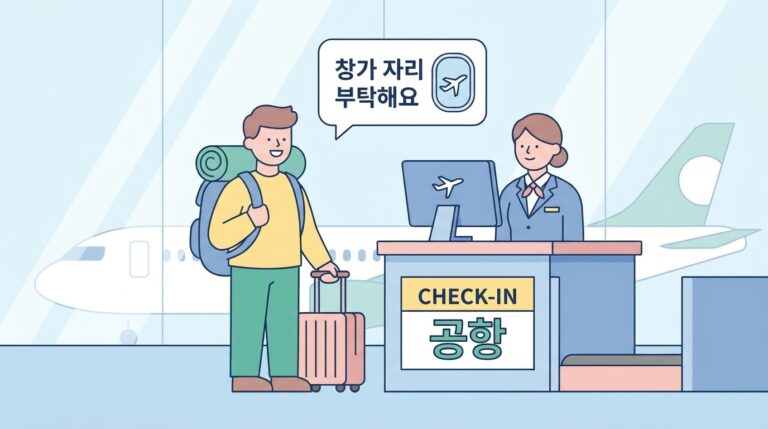
안녕하세요! 매일한글 에디터입니다. Welcome back to Daily Hangul! Imagine this: You’ve just landed at Incheon International Airport after a long flight, or you’re checking in for your domestic flight to Jeju Island. You really want to look out the window to catch that magical first view of Korea’s mountains or cityscape. But when you step up to the airline counter, your mind goes completely blank! You know what you want to ask in English, but you hesitate, worrying if the staff will understand. You end up with a middle seat near the restroom… sound familiar? Don’t worry! Getting your dream seat in Korea is actually super easy once you know one simple phrase. In this guide, based on real feedback from hundreds of beginner learners, you’ll master how to request a window seat naturally and confidently like a true insider!
Phase 2: Core Expressions Deep Dive
1. 창가 자리 주세요 (Chang-ga ja-ri ju-se-yo)
- Pronunciation: [Chahn-gah jah-ree joo-seh-yo] (Sounds like “Chan-gah” as in ‘Chan’ + ‘gah’, “jah-ree” like ‘jotting down a note’ without the t, and “joo-seh-yo” like ‘juice’ + ‘say-yo’)
- Meaning: Literally “Window seat please give.” -> “Please give me a window seat.”
- K-Culture Moment: You often hear travelers say this at check-in counters in K-Dramas right before embarking on a romantic trip to Jeju Island!
- Editor’s Insight: ‘창가’ (chang-ga) means ‘window side’, ‘자리’ (ja-ri) means ‘seat’, and ‘주세요’ (ju-se-yo) is the magic word for “please give me”. You can attach ‘주세요’ to almost anything in Korea to get what you want polite and easy!
- Situation Spectrum: Casual ⚠️ / Semi-formal ✅ / Formal ✅
- 🤔 Think About It: In English, we ask “Can I have…?”, but in Korean, you directly state the item followed by “Please give me” (주세요). Simple and clear, right?
2. 복도 자리 주세요 (Bok-do ja-ri ju-se-yo)
- Pronunciation: [Bohk-doh jah-ree joo-seh-yo] (Sounds like “Bohk” as in ‘poke’ with a ‘b’, “doh” like ‘door’)
- Meaning: “Please give me an aisle seat.”
- K-Culture Moment: Used by seasoned K-Pop tour travelers who prefer quick access to stretch their legs during short flights!
- Editor’s Insight: ‘복도’ (bok-do) means ‘aisle’ or ‘hallway’. If you prefer easy restroom access over views, remember this word!
- Situation Spectrum: Casual ⚠️ / Semi-formal ✅ / Formal ✅
- 🤔 Think About It: Notice how sentence structures stay identical—you just swap ‘창가’ (window side) for ‘복도’ (aisle)!
3. 여권 보여 주세요 (Yeo-gwon bo-yeo ju-se-yo)
- Pronunciation: [Yuh-gwohn boh-yuh joo-seh-yo]
- Meaning: “Please show me your passport.”
- K-Culture Moment: The very first phrase airline staff or immigration officers will say to you at Incheon Airport!
- Editor’s Insight: ‘여권’ (yeo-gwon) means ‘passport’, and ‘보여 주세요’ means ‘please show’. Recognizing this phrase will save you from airport check-in anxiety.
- Situation Spectrum: Casual 🚫 / Semi-formal ✅ / Formal ✅
- 🤔 Think About It: Understanding staff requests helps you feel instantly relaxed and ready to respond politely.
Phase 3: Textbook Korean vs. Real Native Korean
Situation 1: Requesting a window seat
* 📖 Textbook Korean: “창가 쪽 좌석으로 부탁드립니다.” (Chang-ga jjok jwa-seok-eu-ro bu-tak-deu-rim-ni-da.)
* 🗣️ Real Native Korean: “창가 자리로 주세요!” (Chang-ga ja-ri-ro ju-se-yo!)
* 💡 Why is it different? While the textbook version is extremely formal, local staff at counters prefer quick, clear, and friendly expressions like “창가 자리로 주세요!”.
Situation 2: Asking if a window seat is available
* 📖 Textbook Korean: “창가 쪽 좌석이 남아 있습니까?” (Chang-ga jjok jwa-seok-i nam-a it-seum-ni-kka?)
* 🗣️ Real Native Korean: “창가 자리 있어요?” (Chang-ga ja-ri it-seo-yo?)
* 💡 Why is it different? Native speakers use short ‘있어요?’ (Is there…?) questions daily. It sounds warm, natural, and polite enough for all A1 beginners!
Phase 4: K-Culture Deep Dive & Non-Verbal Manners
4-1. Nunchi (눈치) & Gestures at the Airport
- Two-Handed Courtesy: When handing over your passport or receiving your boarding pass, hand it over using both hands or support your right wrist with your left hand. This shows great respect!
- Eye Contact & Nods: Make gentle eye contact and give a small 15-degree head bow when saying “주세요” (ju-se-yo). It instantly builds rapport with airport staff.
4-2. Culture Code: Incheon Airport Efficiency
Incheon Airport is world-famous for speed and kindness. Airport employees work fast and efficiently. Using concise phrases like “창가 자리 주세요” helps them help you faster, making your flight check-in super smooth!
Phase 5: Real-Life Roleplay Scenario
Setting: Airline Check-in Counter at Incheon International Airport (Terminal 1).
Characters: You (Traveler) & Min-ji (Friendly Airline Staff).
- Min-ji: 안녕하세요! 여권 보여 주세요. (An-nyeong-ha-se-yo! Yeo-gwon bo-yeo ju-se-yo.) 🎭 [Smiling warmly, holding out hands]
Translation: Hello! Please show me your passport. - You: 네, 여기 있어요. (Ne, yeo-gi it-seo-yo.) 🎭 [Handing passport with both hands]
Translation: Yes, here it is. - Min-ji: 감사합니다. 좌석 선호가 있으신가요? (Gam-sa-ham-ni-da. Jwa-seok seon-ho-ga it-seu-sin-ga-yo?) 🎭 [Typing on computer]
Translation: Thank you. Do you have a seat preference? - You: 창가 자리 있어요? (Chang-ga ja-ri it-seo-yo?) 🎭 [Looking hopeful with a polite smile]
Translation: Do you have a window seat? - Min-ji: 네, 가능합니다! 창가 자리로 드릴까요? (Ne, ga-neung-ham-ni-da! Chang-ga ja-ri-ro deu-ril-kka-yo?) 🎭 [Nodding cheerfully]
Translation: Yes, it’s available! Shall I give you a window seat? - You: 네! 창가 자리 주세요. (Ne! Chang-ga ja-ri ju-se-yo.) 🎭 [Nodding happily]
Translation: Yes! Window seat please. - Min-ji: 네, 여기 탑승권 있습니다. 즐거운 여행 되세요! (Ne, yeo-gi tap-seung-gwon it-seum-ni-da. Jeul-geo-un yeo-haeng doe-se-yo!) 🎭 [Handing boarding pass with both hands]
Translation: Here is your boarding pass. Have a nice trip! - You: 감사합니다! (Gam-sa-ham-ni-da!) 🎭 [Bowing head lightly]
Translation: Thank you!
🔀 Interactive Branching Choice:
What do you say if there are NO window seats left?
* Option A: “복도 자리 주세요.” (Bok-do ja-ri ju-se-yo.)
* Option B: “아니요, 안 돼요!” (A-ni-yo, an dwae-yo!)
* Option C: “그냥 아무거나 주세요.” (Geu-nyang a-mu-geo-na ju-se-yo.)
Feedback:
* Option A (BEST): Perfect! Pivoting smoothly to an aisle seat using polite Korean.
* Option B (BAD): Too blunt and aggressive! Avoid saying “No, you can’t!” to staff.
* Option C (RISK): A bit dismissive/casual. Option A is much better.
Phase 6: 10-Second Emotion Shadowing Drill
Practice reading these out loud with emotion! Slashes (/) represent natural pauses.
[😊 Excitement & Hope]창가 자리 / 있어요? (Chang-ga ja-ri / it-seo-yo?)[🙏 Polite & Friendly]창가 자리 / 주세요! (Chang-ga ja-ri / ju-se-yo!)[💖 Grateful & Happy]네, / 감사합니다! (Ne, / gam-sa-ham-ni-da!)
Phase 7: K-Culture Mini Dictionary
- 탑승권 (Tap-seung-gwon) | Boarding Pass | Essential travel word. Staff will say “탑승권 보여 주세요” (Please show boarding pass).
- 짐 (Jim) | Luggage / Baggage | Used when weighing your bags at check-in counter.
- 창가 (Chang-ga) | Window Side | Useful at restaurants too if you want a table by the window!
- 복도 (Bok-do) | Aisle | Useful on trains (KTX) and airplanes.
Phase 8: Traveler’s Survival Kit
Top 3 Survival Expressions:
- 창가 자리 주세요. (Chang-ga ja-ri ju-se-yo.) – Window seat please.
- 복도 자리 주세요. (Bok-do ja-ri ju-se-yo.) – Aisle seat please.
- 여기 있어요. (Yeo-gi it-seo-yo.) – Here it is.
Editor’s Travel Note:
Before flying to Korea, make sure you download Naver Map for local transit and Kakao T for taxis. When you check Naver Map App for route guidance, knowing basic direction terms makes exploring super fun!
Phase 9: One Step Deeper
In Korean culture, asking for favors directly can sometimes sound too bold, but adding ‘주세요’ (ju-se-yo) turns any request into a warm, polite interaction. It shows that you respect the listener while clearly expressing your request. Learning this harmony of clarity and respect is the secret key to opening Korean hearts!
💬 Your Turn: Have you ever tried booking or asking for a specific seat while traveling? Drop a comment below and share your airport experience!
Phase 10: FAQ & Common Mistakes
Q: Can I use “창가 자리 주세요” at restaurants too?
A: Yes! If a restaurant has nice window seating, you can point to the window area and say “창가 자리 주세요” to get a window-side table.
Q: What if I want two window seats together?
A: You can say “창가 자리 두 개 주세요” (Chang-ga ja-ri du gae ju-se-yo).
Q: Is “주세요” formal enough for airport staff?
A: Absolutely! “주세요” is polite standard Korean (존댓말), perfectly suitable for everyday public interactions.
🚨 Common Mistakes Alert:
- ❌ Mistake 1: Saying only “창가” (Chang-ga) without “주세요”. (Sounds blunt and rude!)
- 👉 Correct Action: Always append “주세요” -> “창가 자리 주세요”.
- ❌ Mistake 2: Using one hand to hand over your passport.
- 👉 Correct Action: Always use both hands when handing items to elders or staff.
Phase 11: Action Mission
- 🥉 Bronze Mission: Practice saying “창가 자리 주세요” 3 times in front of your mirror.
- 🥈 Silver Mission: Post an audio clip practicing this sentence on Instagram/X and tag
@DailyHangul! - 🥇 Gold Mission: Use “창가 자리 주세요” directly at the airport counter or at a Korean restaurant on your next trip!
🎮 K-Culture Mission: Watch a travel vlog or Korean drama set in an airport, and listen closely for when characters ask for seats or hand over passports!
Phase 12: Interactive Quiz Challenge
Q1. How do you say “Aisle seat please” in Korean?
a) 창가 자리 주세요
b) 복도 자리 주세요
c) 여권 주세요
🔍 Click to see Answer & Explanation
Answer: b) 복도 자리 주세요 (Bok-do ja-ri ju-se-yo)
Explanation: ‘복도’ means aisle, while ‘창가’ means window!
Q2. True or False: Handing your passport with one hand is preferred in Korea.
🔍 Click to see Answer & Explanation
Answer: False!
Explanation: In Korea, handing items with both hands shows politeness and good manners.







