

Phase 1: Empathy (Story Opening)
안녕하세요! 매일한글 에디터입니다. 👋
Imagine this scenario: You wake up in Seoul, ready for an exciting road trip to Gangwon-do or an important morning meeting. You ride the elevator down to the underground parking garage of a modern Korean apartment building, only to find another car parked directly behind yours, blocking you completely! There’s no driver inside, and the parking space is totally full.
Don’t panic! Welcome to the daily reality of urban South Korea: 이중 주차 (I-jung ju-cha – Double Parking).
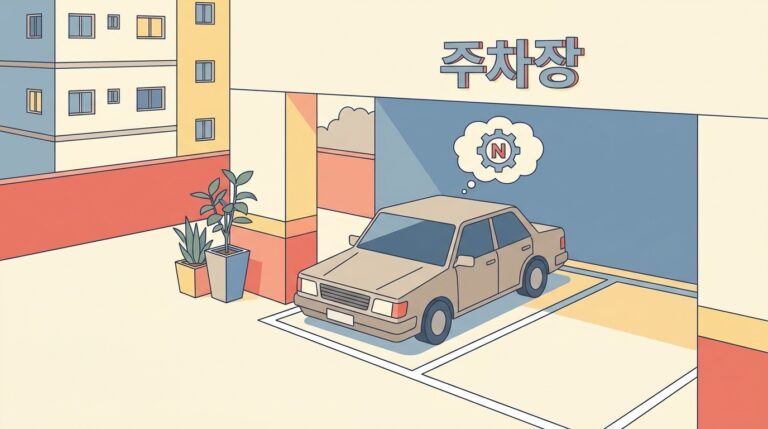
In Korea’s high-density apartment complexes, space is precious. Rather than being a rude act, double parking is a collective social system governed by strict implicit rules—like leaving your gear in Neutral (N단) so others can physically push your car out of the way, or leaving a glowing phone number plate on your dashboard.
Many of our daily learners at Daily Hangul told us they froze in panic when faced with a double-parked car. But after mastering just three core expressions and understanding the underlying cultural etiquette, our students handle this situation like true Seoul locals! Today, I’m sharing our proven step-by-step guide so you can handle parking blockades smoothly, politely, and with total confidence.
Phase 2: Key Expressions Deep Dive
1. 차 좀 빼주세요 (Cha jom ppae-ju-seo-yo)
- Pronunciation: [Cha jom ppae-joo-seh-yo] (Sounds like “Cha” as in Chai tea, “jom” like jolt without ‘lt’, “ppae” like a crisp double ‘p’ sound)
- Meaning: Literal: “Please take the car out.” | Real Nuance: “Could you please move your car for me?”
- K-Culture Moment: Seen daily in suburban Korean apartment dramas when a resident calls a neighbor at 8:00 AM before driving to work.
- Editor’s Insight: The word ‘좀’ (jom) is a magic politeness softener in Korean. Saying “차 빼주세요” sounds demanding, but adding “좀” turns it into a courteous request.
- Situation Spectrum: Casual 🚫 | Semi-formal ✅ | Formal ✅
- 🤔 Think About It: How does your home country handle limited parking, and how does the Korean balance of direct request and politeness compare to your language?
2. 이중 주차했어요 (I-jung ju-cha-haess-eo-yo)
- Pronunciation: [Ee-joong joo-cha-haess-eo-yo]
- Meaning: Literal: “I did double parking.” | Real Nuance: “I’ve double-parked (in front of another vehicle).”
- K-Culture Moment: When calling an apartment security guard (경비 아저씨) to explain why your car is positioned parallel to parked rows late at night.
- Editor’s Insight: Using the past tense ‘-했어요’ informs the listener of the situation calmly without making excuses.
- Situation Spectrum: Casual ⚠️ | Semi-formal ✅ | Formal ✅
- 🤔 Think About It: In Korea, double parking requires mutual trust. What invisible social contracts exist in your culture’s public spaces?
3. 사이드 브레이크 채웠나요? (Sa-i-deu beu-re-i-keu chae-won-na-yo?)
- Pronunciation: [Sah-ee-deu beuh-ray-ee-keu chae-won-nah-yo?]
- Meaning: Literal: “Did you engage the side brake?” | Real Nuance: “Is the emergency brake engaged? (Can I push your car?)”
- K-Culture Moment: A neighbor rolling up their sleeves in an underground garage, testing whether a parked car can be manually pushed forward or backward.
- Editor’s Insight: In Korean apartment etiquette, double parking requires leaving the emergency brake off and setting gear to Neutral. Asking this helps determine if you need to push or call the owner.
- Situation Spectrum: Casual ⚠️ | Semi-formal ✅ | Formal ✅
- 🤔 Think About It: Would manually pushing someone else’s car be acceptable in your country, or would it be considered boundary-crossing?
Phase 3: Textbook Korean vs. Real Native Korean
Situation 1: Asking someone to move their blocking car
- 📖 Textbook Korean: 제 차를 이동시켜 주실 수 있나요? (Je cha-reul i-dong-si-kyeo ju-sil su in-na-yo? – Are you able to relocate my vehicle?)
- 🗣️ Real Native Korean: 차 좀 빼주실 수 있으세요? (Cha jom ppae-ju-sil su is-seu-se-yo? – Could you possibly move your car for me?)
- 💡 Why the difference?: Dictionary Korean uses heavy Sino-Korean words like 이동 (relocation). Native Koreans use dynamic spoken verbs like 빼다 (pull out/remove) combined with double honorific endings (-실 수 있으세요) for extra warmth.
Situation 2: Explaining that you left the transmission in Neutral
- 📖 Textbook Korean: 주차 기어를 중립으로 설정하였습니다. (Ju-cha gi-eo-reul jung-rip-eu-ro seol-jeong-ha-yeoss-seub-ni-da. – I set the parking gear to neutral.)
- 🗣️ Real Native Korean: N단으로 놓아뒀어요 / 사이드 풀어놨어요 (N-dan-eu-ro no-a-dwoss-eo-yo / Sa-i-deu pul-eo-nwas-seo-yo – I left it in N gear / I unlocked the handbrake)
- 💡 Why the difference?: Spoken Korean shortens terms naturally. Native drivers refer to neutral gear simply as “N단” (N-stage) and emergency brakes as “사이드” (side brake).
Phase 4: K-Culture Deep Dive & Non-Verbal Manners
4-1. 눈치 (Nunchi) & Physical Etiquette
- The Slight Bow & Wave: When someone comes downstairs in their slippers to move their car for you, standard etiquette requires a slight head nod (about 15 degrees) and a raised hand of appreciation.
- Hazard Light Flash (비상등): If you are temporarily stopping behind a double-parked car while waiting for the owner, switch on your hazard lights. This signals to other drivers that you are waiting and not permanently parked.
- Dashboard Number Display (주차 전화번호판): Never double-park without displaying your personal mobile phone number clearly on the front windshield!
4-2. Cultural Code: High Trust & Community Living
Korea’s apartment culture relies heavily on 공동체 의식 (Community Mindset). Because real estate is dense, millions share parking garages daily. Pushing a 1.5-ton sedan manually in neutral gear is considered normal and helpful! It demonstrates a high-trust society where citizens respect shared functional rules.
Phase 5: Real Roleplay Scenario
Setting: Underground Parking B2 of Mapo Apartment Complex, Seoul. 8:15 AM.
Characters:
* Minjun (You): An intermediate learner trying to leave for a day trip.
* Mr. Park (NPC): Resident owner of a double-parked SUV.
- Turn 1 (Minjun): 🎭 (Looking frustrated, holding smartphone) 안녕하세요, 혹시 104동 502호 차주님 되시나요? (An-nyeong-ha-se-yo, hok-si il-gong-sa-dong o-gong-i-ho cha-ju-nim doe-si-na-yo? – Hello, are you by chance the car owner from Bldg 104, Apt 502?)
- Turn 2 (Mr. Park): 🎭 (Answering telephone warmly) 네, 맞는데요. 무슨 일 있으신가요? (Ne, mat-neun-de-yo. Mu-seun il is-seu-sin-ga-yo? – Yes, that’s right. Is something the matter?)
- Turn 3 (Minjun): 🎭 (Politely pointing at the vehicle) 아, 제가 지금 나가야 하는데 차가 막혀 있어서요. 차 좀 빼주실 수 있으세요? (A, je-ga ji-geum na-ga-ya han-deun-de cha-ga mak-hyeo is-seo-seo-yo. Cha jom ppae-ju-sil su is-seu-se-yo? – Ah, I need to head out now but my car is blocked. Could you move your car for me?)
- Turn 4 (Mr. Park): 🎭 (Apologetic tone) 아이고, 죄송합니다! 혹시 차 안 밀리나요? N단으로 해놨는데요. (A-i-go, joe-song-ham-ni-da! Hok-si cha an mil-li-na-yo? N-dan-eu-ro hae-nwas-neun-de-yo. – Oh dear, I’m sorry! Does the car not push? I put it in N gear.)
- Turn 5 (Minjun): 🎭 (Checking the emergency brake inside the window) 아, 사이드 브레이크가 채워져 있는 것 같아요. (A, sa-i-deu beu-re-i-keu-ga chae-wo-jyeo in-neun geot gat-a-yo. – Ah, I think the handbrake is engaged.)
- Turn 6 (Mr. Park): 🎭 (Hurtling out of breath) 아구, 제가 실수했네요! 지금 바로 내려가겠습니다! 1분만 기다려주세요! (A-gu, je-ga sil-su-haen-ne-yo! Ji-geum ba-ro nae-ryeo-ga-geass-seub-ni-da! Il-bun-man gi-da-ryeo-ju-se-yo! – Oh, I made a mistake! I will come down right now! Please wait one minute!)
- Turn 7 (Mr. Park arrives 1 min later): 🎭 (Bowing quickly and shifting car) 정말 죄송합니다! 많이 바쁘신가요? (Jeong-mal joe-song-ham-ni-da! Ma-ni ba-ppeu-sin-ga-yo? – I am truly sorry! Are you in a big hurry?)
- Turn 8 (Minjun): 🎭 (Smiling warmly and nodding) 아닙니다, 괜찮습니다. 감사해요! (A-nib-ni-da, gwaen-chan-seub-ni-da. Gam-sa-hae-yo! – Not at all, it’s fine. Thank you!)
🔀 Interactive Branching Choice
When you see a double-parked car blocking you, what is your first action?
* Option A: Press the horn loudly until someone comes down.
* Option B: Check if the car gear is in Neutral and try gently pushing the bumper with both hands.
* Option C: Call the police immediately to report an illegal blockage.
Feedback:
* Option A (BAD): Honking in apartment garages causes immense noise pollution and will anger neighbors!
* Option B (BEST): Correct! If gear is in Neutral (N단), pushing the car 1 meter is the standard resident protocol in Korea.
* Option C (RISK): Police do not mediate private apartment parking spaces in Korea unless an illegal accident occurs.
Phase 6: 10-Second Emotion Shadowing Drill
Practice these lines with rhythm, pauses (/), and specified emotional tones:
[🥺 Urgent yet Polite]
저기요… / 차 좀 / 빼주실 수 있으세요? / 제가 지금 급해서요.
(Jeo-gi-yo… / cha jom / ppae-ju-sil su is-seu-se-yo? / je-ga ji-geum geub-hae-seo-yo.)-
[😊 Relieved & Friendly]
아! / N단으로 해놓으셨군요! / 제가 밀고 나갈게요!
(A! / N-dan-eu-ro hae-no-eu-syeoss-goon-yo! / je-ga mil-go na-gal-ge-yo!) -
[🙏 Courteous Appreciation]
바쁘신데 / 내려와 주셔서 / 정말 감사합니다!
(Ba-ppeu-sin-de / nae-ryeo-wa ju-syeo-seo / jeong-mal gam-sa-ham-ni-da!)
Phase 7: K-Culture Mini Dictionary
- 이중 주차 (I-jung ju-cha) | Double Parking | Parking parallel to locked cars in designated apartment lanes when all spots are occupied.
- N단 주차 (N-dan ju-cha) | Neutral Parking | Parking with automatic transmission set to ‘N’ (Neutral) so external physical force can slide the vehicle.
- 주차 전화번호판 (Ju-cha jeon-hwa-beon-ho-pan) | Parking Contact Plate | A temporary phone number card placed inside windshields for easy contact.
- 경비 아저씨 (Gyeong-bi a-jeos-si) | Apartment Security Guard | The neighborhood hero who manages facility access, packages, and resolves parking blockages.
Phase 8: Traveler’s Survival Kit
Survival Phrases TOP 3
- 차 좀 빼주세요. (Cha jom ppae-ju-seo-yo.) — Please move your car.
- N단에 놓으셨어요? (N-dan-e no-eu-syeoss-eo-yo?) — Did you put it in Neutral?
- 제가 좀 밀어도 될까요? (Je-ga jom mil-eo-do doel-kka-yo?) — May I push your car slightly?
Editor’s Travel Note
When renting a car in South Korea, always confirm how to put the automatic gear in Neutral when the engine is turned off (Shift Lock Release button). To navigate Korean parking structures efficiently, use the 네이버 지도 앱 다운로드 to check real-time parking lot status before arrival.
Phase 9: One Step Deeper (Thinking Question)
In modern Korean cities, individual freedom closely intersects with high-density communal living. Double parking operates not on chaos, but on mutual accountability—evidenced by unlocked handbrakes and displayed phone numbers. It shows how Korean society creates order out of spatial constraints through subtle social agreements.
💬 Your Turn: How would residents in your hometown react if someone pushed a parked car with their hands? Have you ever experienced double parking? Share your stories in the comments below!
Phase 10: FAQ & Common Mistakes
Q: What if the double-parked car doesn’t have a phone number on the windshield?
A: Contact the apartment guard office (경비실) or security guard (경비 아저씨). They maintain resident vehicle registries and can locate the driver for you.
Q: Can I push ANY double-parked car in Korea?
A: Only push cars parked on flat, horizontal ground! Never push cars on garage ramps or inclines, as they can roll uncontrollably.
Q: What gear mode should I leave my rental car in if I must double-park?
A: Turn off the engine, hold the ‘Shift Lock Release’ button near the gear stick, and shift from ‘P’ to ‘N’. Leave the handbrake off.
🚨 Common Mistakes Warning
- Mistake: Pulling the electronic handbrake (EPB) while double parking.
Correct Action: Keep EPB released so neighbors can push your car. - Mistake: Speaking loudly or angrily on the phone to the driver.
Correct Action: Use polite honorifics (-세요) as double parking is an accepted local community reality. - Mistake: Honking the horn repeatedly in an underground structure.
Correct Action: Always call the number on the windshield first or seek help from the guard office.
Phase 11: Action Mission
- 🥉 Bronze Level: Pronounce “차 좀 빼주세요” 3 times out loud focusing on the soft ‘좀’ tone.
- 🥈 Silver Level: Practice setting your rental or simulated vehicle to neutral gear using the shift-lock button.
- 🥇 Gold Level: Successfully identify and read a Korean contact plate (주차 전화번호판) on a vehicle in Korea.
- 🎮 K-Culture Mission: Watch an episode of a Korean slice-of-life drama (like Reply 1988 or Hospital Playlist) and spot a parking scene or apartment security interaction!
Phase 12: Interactive Quiz Challenge
Q1. What is the correct gear position when double parking in a Korean apartment complex?
A) P (Park)
B) R (Reverse)
C) N (Neutral)
Click to reveal answer
Answer: C) N (Neutral). This allows other drivers to manually push your vehicle out of the way if you are blocking them.
Q2. Fill in the blank: “차 ( _____ ) 빼주실 수 있으세요?”
A) 잘
B) 좀
C) 안
Click to reveal answer
Answer: B) 좀. ‘좀’ acts as a polite word meaning ‘please / kindly’ to soften your request.
Q3. True or False: You should press your horn continuously if a double-parked car blocks your way.
Click to reveal answer
Answer: False! Honking in apartment garages is considered bad manners. You should call the number on the windshield or push the car if it’s in Neutral.







