

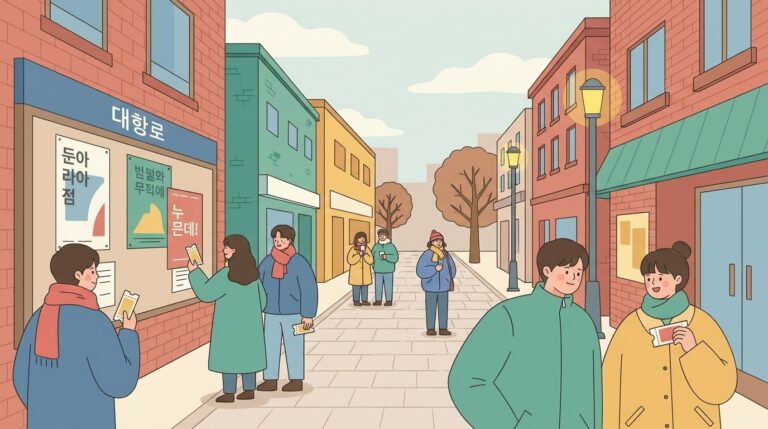
Unlocking Daehangno: How to Enjoy Small Theater Plays in Seoul Like a Native
Phase 1: 공감 (Story-driven Opening)
안녕하세요! 매일한글 에디터입니다. (Hello! I’m your Daily Hangul editor!)
Imagine this: You’re walking through the vibrant brick-lined streets of Daehangno (대학로), Seoul’s famous theater district. Ticket booths line the alleyways, colorful posters showcase indie plays, and cheerful staff hand out flyers. You finally pick a cozy small theater (소극장) hidden in a basement, excited to experience authentic Korean performing arts.
But suddenly, panic sets in at the ticket booth! The staff speaks fast native Korean: “예매하셨나요? 아니면 현장 구매이신가요?” (Did you reserve beforehand, or are you buying on-site?). You stumble through your translation app, missing the subtle queue instructions, and end up sitting in the wrong section—or worse, missing the actor sign-off after the show because you didn’t know what toe-geun-gil (퇴근길) meant!
If you’ve ever felt intimidated by local cultural venues in Korea, you are definitely not alone. Many intermediate Korean learners struggle not with basic grammar, but with the fast-paced, context-heavy language used in live cultural scenes. This guide is built on real feedback from real language learners just like you, designed to give you instant confidence, cultural intuition, and local theater savvy. Ready to step into the curtain call with ease?
Phase 2: 핵심 표현 3선 심층 분석 (3 Core Expressions)
1. 예매 내역 확인해 주세요 (Yemae naeyeok hwagin-hae juseyo)
- Pronunciation: [Ye-mae nae-yeok hwa-gin-hae ju-se-yo] (Sounds like “Ye-may” + “nay-yuck” + “hwa-gin-hae” + “ju-say-yo”)
- Meaning: Literal: “Please check my reservation details.” | Real Niuance: “Hi, I booked online, here is my order confirmation/phone number.”
- K-Culture Moment: Saying this at the tiny box office (매표소) while showing your smartphone screen with your Interpark or Melon Ticket confirmation code.
- Editor’s Insight: Theater staff in Daehangno handle dozens of tickets per minute before showtime. Using this clear, polite phrase immediately tells them you already paid and just need your physical paper ticket (현장 수령).
- Situation Spectrum: Casual 🚫 / Semi-formal ✅ / Formal ✅
- 🤔 Think About It: In your home country, do you usually show a barcode or just state your name? Why do Korean theater booths strictly verify the last 4 digits of your phone number alongside your booking name?
2. 배우님 퇴근길 어디서 해요? (Baeunim toegeunggil eodiseo haeyo?)
- Pronunciation: [Bae-u-nim toe-geun-gil eo-di-seo hae-yo?]
- Meaning: Literal: “Where is the actor’s work-exit path happening?” | Real Niuance: “Where is the fan meet-and-greet / exit greeting taking place after the show?”
- K-Culture Moment: After the curtain call, asking fellow playgoers outside the venue where fans gather to briefly chat with or gift the actors.
- Editor’s Insight: Toe-geun-gil (퇴근길, literally ‘the journey off work’) is a unique Korean performance culture where actors briefly greet fans outside the venue after changing out of costume. Adding the honorific -nim (배우님) shows respect.
- Situation Spectrum: Casual ✅ / Semi-formal ✅ / Formal ⚠️
- 🤔 Think About It: How does your culture handle post-show fan interactions compared to Korea’s organized yet cozy toe-geun-gil etiquette?
3. 커튼콜 때 사진 찍어도 돼요? (Keoteunkol ttae sajin jjigeodo dwaeyo?)
- Pronunciation: [Keo-teun-kol ttae sa-jin jji-geo-do dwae-yo?]
- Meaning: Literal: “May I take photos during the curtain call?” | Real Niuance: “Is photo/video recording allowed specifically during the final bows?”
- K-Culture Moment: Asking the house usher standing at the entrance before entering the dark auditorium.
- Editor’s Insight: Korean small theaters strictly prohibit any recording during the play (시체관극 culture, where audience members sit as quiet as corpses), but many indie plays allow photos/videos exclusively during the curtain call (curtain call day).
- Situation Spectrum: Casual 🚫 / Semi-formal ✅ / Formal ✅
- 🤔 Think About It: Why are Korean theater fans so sensitive to camera noises and audience movement during performance hours?
Phase 3: 교과서 한국어 vs 진짜 한국어 (Textbook vs Native)
Situation 1: Asking if tickets are still available on-site
- 📖 교과서 한국어: “오늘 연극 표가 있습니까?” (Is there a play ticket today?)
- 🗣️ 진짜 한국어: “오늘 회차 현장표 아직 남아있나요?” (Are there any remaining on-site tickets for today’s session?)
- 💡 왜 다를까?: Korean theater culture breaks shows down into specific performance slots called hoe-cha (회차). Asking specifically about hyeon-jang-pyo (on-site tickets) shows you understand how Korean ticketing systems work!
Situation 2: Expressing deep emotional immersion after the play
- 📖 교과서 한국어: “연극이 아주 재미있었습니다.” (The play was very interesting.)
- 🗣️ 진짜 한국어: “와, 배우들 연기합 대박이다… 몰입감 미쳤어요!” (Wow, the actors’ chemistry was insane… The immersion was crazy!)
- 💡 왜 다를까?: Intermediate speakers elevate their speech by using modern conversational words like yeon-gi-hap (acting synergy/chemistry) and mo-rip-gam (sense of immersion).
Phase 4: K-Culture 딥다이브 & 비언어적 매너 (Deep-Dive & Manners)
4-1. 눈치 (Nunchi) & Theater Etiquette
- The Secret Silence Rule (Siche-gwangeuk): In Daehangno indie theaters, seats are very close together. Whispering during the play, unwrapping candy wrappers, or leaning forward (허리 숙이기) blocking the view of the person behind you is considered a major breach of etiquette. Read the nunchi in the room—keep your back flat against your seat!
- Expressive Body Language: When entering late (if allowed), lower your upper body at a 45-degree angle and make a gentle hand-waving gesture to show apology to sitting audience members.
4-2. Daehangno Cultural Code
- Daehangno has over 130 small theaters packed into one neighborhood—the highest density of theater spaces in the world! From romantic comedies like Rooftop House Cat (옥탑방 고양이) to deep psychological dramas, indie theater culture is where top film star talents (like Kim Seon-ho or Park So-dam) polished their skills.
Phase 5: 실전 롤플레이 시나리오 (Interactive Roleplay)
Setting: A cozy box office desk in Daehangno 30 minutes before showtime.
Character: Box Office Staff Member (친절한 티켓박스 직원)
- Turn 1 (Staff): 안녕하세요! <어쩌다 로맨스> 예매하신 분이신가요?
(Hello! Are you here for the reservation of ‘Accidental Romance’?) - Turn 2 (You): 🎭 (Handing over your phone screen) 네, 예매 내역 확인해 주세요. 이름은 홍길동이에요.
(Yes, please check my reservation details. My name is Hong Gil-dong.) - Turn 3 (Staff): 확인되셨습니다! 뒷자리 핸드폰 번호 네 자리 말씀해 주시겠어요?
(Confirmed! Could you give me the last 4 digits of your phone number?) - Turn 4 (You): 🎭 (Clear tone) 1234예요.
(It’s 1234.) - Turn 5 (Staff): 네, 1열 12번 좌석입니다. 오늘 커튼콜 때 촬영 가능한 날이에요!
(Yes, seat row 1, number 12. Photography is allowed during today’s curtain call!) - Turn 6 (You): 🎭 (Surprised and happy) 아, 진짜요? 그럼 공연 중간에는 절대 찍으면 안 되죠?
(Ah, really? So during the show I definitely shouldn’t take photos, right?) - Turn 7 (Staff): 네! 공연 중에는 폰 전원을 꺼주시면 감사하겠습니다. 즐거운 관람 되세요!
(Yes! We’d appreciate it if you turn off your phone during the show. Enjoy the performance!) - Turn 8 (You): 🎭 (Bow head slightly) 감사합니다. 재밌게 볼게요!
(Thank you. I’ll enjoy it!)
🔀 인터랙티브 분기점 (Interactive Choice Point)
After the play ends, you want to get an autograph from the main actor. What do you do?
- Choice A: Walk up directly to the stage as soon as the lights go on and shout the actor’s name.
- Choice B: Ask the theater usher: “오늘 배우님 퇴근길 진행하나요?” (Is there a worker-exit greeting today?)
- Choice C: Leave the theater quietly and message the actor on Instagram immediately.
Feedback:
* Choice A (Risk 🚨): Stopping actors on stage breaks venue safety rules and will startle the staff!
* Choice B (Best ✅): Perfect! Not all shows hold toe-geun-gil due to schedules or weather. Asking staff politely gets you the exact location outside!
* Choice C (Bad ⚠️): Harmless, but you miss out on the rich real-life community vibe of meeting the actor outside in person!
Phase 6: 10초 감정 섀도잉 드릴 (Emotion Shadowing Drill)
[😊 Excitement]오늘 공연 / 진짜 기대돼요! / 얼른 들어가요!
(O-neul gong-yeon / jin-jja gi-dae-dwae-yo! / Eol-leun deu-leo-ga-yo!)[🤫 Polite Whisper]혹시 / 실례지만 / 조금만 옆으로 / 앉아주실 수 있나요?
(Hok-si / sil-lye-ji-man / jo-geum-man yeop-eu-ro / an-ja-ju-sil su in-na-yo?)[😍 Deeply Impressed]배우님 연기합이 / 너무 대박이었어요! / 또 보러 올게요!
(Bae-u-nim yeon-gi-ha-bi / neo-mu dae-ba-gi-eot-seo-yo! / Tto bo-leo ol-ge-yo!)
Phase 7: K-Culture 미니 사전 (4 Essential Keywords)
- 대학로 (Daehangno): Seoul’s Broadway. A bustling cultural neighborhood located around Hyehwa Station (Line 4).
- 인터파크 (Interpark): The primary ticketing platform in Korea used for booking plays, musicals, and concerts.
- 캐스팅 보드 (Casting Board): A display board at the entrance showcasing the photos of actors performing for that specific time slot.
- 퇴근길 (Toe-geun-gil): Post-show informal fan meetup zone near the exit where actors express gratitude to attendees.
Phase 8: 여행자를 위한 생존 키트 (Traveler’s Survival Kit)
Top 3 Survival Expressions
- 표 혹시 취소표 나왔나요? (Pyo hok-si chwi-so-pyo na-wat-na-yo? / Did any cancelled tickets pop up?)
👉 Pro Tip: Popular plays sell out fast, but arriving 15 minutes before showtime often yields last-minute cancellation tickets! - 자리가 어디인지 알려주실 수 있나요? (Ja-ri-ga eo-di-in-ji al-lyeo-ju-sil su in-na-yo? / Could you tell me where my seat is?)
👉 Pro Tip: Small theater seating layouts can be maze-like in basement venues. - 팸플릿 하나만 얻을 수 있을까요? (Paem-pleul ha-na-man eod-eul su is-seul-kka-yo? / Can I get one brochure?)
👉 Pro Tip: Play pamphlets make great souvenirs and often include story synopses in English!
Editor’s Travel Note
Before heading to Hyehwa Station, make sure to download the Naver Map App for local navigation. Daehangno small theaters are tucked inside small alleyways that global map apps often miss! Also, use the Interpark Ticket Booking Portal to secure early-bird discounts (조기예매 할인).
Phase 9: 한 발 더 깊이 (A Step Deeper)
Korean theatrical art relies heavily on Jeong (정) and shared human emotional resonance. Small theaters in Daehangno break the invisible ‘fourth wall’ between audience and performers much more intimately than massive grand halls. When you participate respectfully in theater culture—clapping in rhythm, staying attentive, and waiting patiently at toe-geun-gil—you aren’t just a tourist; you become part of Korea’s living arts community.
💬 Your Turn: Have you ever watched a live play in another language? What performance in Daehangno are you most excited to see? Drop a comment below!
Phase 10: FAQ & 오해 방지 (FAQ Schema)
Q: Do Daehangno plays offer English subtitles?
A: Most small theater indie plays do not offer real-time subtitles. However, popular non-verbal performances or hit musicals (like Only You or Finding Mr. Destiny) frequently provide multi-language subtitle screens. Check booking sites beforehand!
Q: What happens if I arrive 5 minutes late to a small theater play?
A: In Korea, late entry is strictly restricted to prevent disturbing actors and viewers. If you miss showtime, you may be denied entry or forced to wait until a specific scene transition.
Q: Can I bring coffee or drinks into the auditorium?
A: Generally, only bottled water with a tight cap is allowed inside Korean small theater halls. Sweet drinks or noisy snacks are prohibited.
🚨 Common Mistakes TOP 3
- Mistake: Leaning forward during the show.
Correct Action: Keep your back glued to the chair backrest so you don’t block the person behind you. - Mistake: Taking photos during the play because there’s no flash.
Correct Action: Never record during the performance. Save your camera for designated curtain calls. - Mistake: Calling actors by their first name casually.
Correct Action: Always attach -nim (e.g., 배우님 – Bae-u-nim) when speaking to or addressing actors.
Phase 11: 액션 미션 & 참여 유도 (Action Missions)
- 🥉 Bronze Mission: Practice saying “예매 내역 확인해 주세요” out loud three times with smooth phrasing.
- 🥈 Silver Mission: Visit an online ticket portal, find a current play in Daehangno, and identify its casting board online.
- 🥇 Gold Mission: Purchase an indie theater ticket in Daehangno, ask the usher about curtain call photography in Korean, and enjoy the show!
🎮 K-Culture Mission: Watch a clip of a Korean theater curtain call on YouTube. Can you spot how the audience claps in unison to the background music beat?
Phase 12: 인터랙티브 퀴즈 챌린지 (Interactive Quiz)
Question 1: Situation Judgment
You arrived at the Daehangno theater and want your paper ticket. What is the most natural native Korean phrase to use?
* A) 표 주세요. (Pyo ju-se-yo.)
* B) 예매 내역 확인해 주세요. (Yemae naeyeok hwagin-hae juseyo.)
* C) 영수증 보여드릴게요. (Yeong-su-jeung bo-yeo-deu-ril-ge-yo.)
🔍 Click to reveal answer & explanation
Correct Answer: B
Explanation: While A is understandable, option B is the polished, native B2-level phrase that explicitly asks the clerk to verify your booking code.
Question 2: Fill-in-the-Blank
After the performance, fans wait outside at the ____________ (work-exit path) to greet actors politely.
🔍 Click to reveal answer & explanation
Correct Answer: 퇴근길 (Toe-geun-gil)
Explanation: Toe-geun-gil refers to the informal post-show artist exit gathering.
Question 3: True / False Culture Quiz
In Daehangno small theaters, it is acceptable to lean your upper body forward as long as you don’t talk.
🔍 Click to reveal answer & explanation
Correct Answer: False
Explanation: Leaning forward blocks the sightlines of seated audience members directly behind you. Always keep your back against your seat!







