

Phase 1: Empathy (Storytelling Opening)
안녕하세요! 매일한글 에디터입니다. (Hello! This is your Daily Hangul editor.)
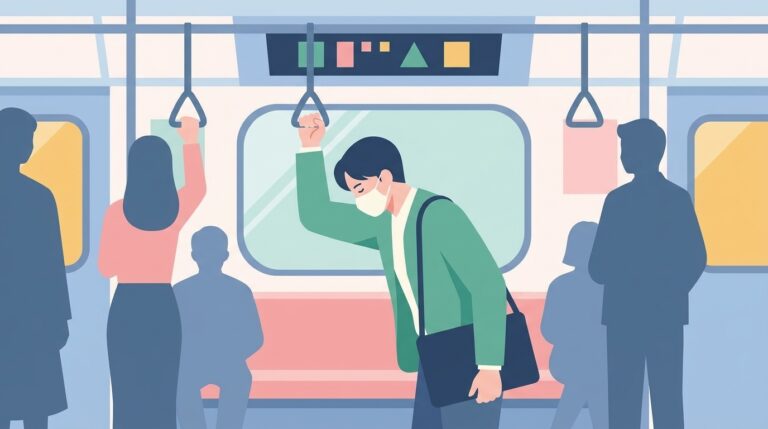
Picture this: It’s 8:15 AM at Gangnam Station. You step onto the platform, and a sea of commuters wearing noise-canceling headphones surges toward the incoming train. Before you even decide whether to board, the sheer wave of people pushes you inside. You are now shoulder-to-shoulder, nose-to-backpack with strangers. Welcome to 지옥철 (Jiok-cheol)—the notorious ‘Hell Subway’ of Seoul’s peak morning commute!
If you’ve ever found yourself stuck in the middle of a packed train cart desperately needing to get off at the next stop, you know the sudden freeze of panic. What do I say without sounding rude? How do I politely ask people to let me through?
Don’t worry! In today’s guide, built on real feedback from intermediate learners and years of surviving Seoul’s commute, you’ll master natural, authentic Korean expressions to handle the rush hour crowd like a local. By the end of this lesson, you’ll navigate any crowded train with total confidence!
Phase 2: Core Expressions Deep Dive
1. 잠시만요, 내릴게요! (Jam-si-man-yo, nael-il-geyo!)
- Pronunciation: [Jam-shi-man-yo, nae-ril-gae-yo] (Sounds like “Jahm-she-mahn-yo, neh-ril-gae-yo”)
- Meaning: Literally “Just a moment, I will get off!” / Nuance: “Excuse me, getting off!”
- K-Culture Moment: In K-Dramas, you’ll often see the protagonist squeezing through a packed subway car while repeatedly bowing their head and saying this phrase to clear a path.
- Editor’s Insight: Combining 잠시만요 (Excuse me / Just a second) with 내릴게요 (I will get off) is the absolute golden key for Korean subways. It signals intent clearly while maintaining polite distance.
- Situation Spectrum:
- Casual: 내릴게! (⚠️ Only with close friends)
- Semi-formal: 잠시만요, 내릴게요! (✅ Perfect for subway crowds)
- Formal: 잠시만 도와주십시오, 내리겠습니다. (🚫 Too stiff for a moving train)
- 🤔 Think About It: In English, we often say “Excuse me” and wait for people to move. Why do you think Koreans combine an explicit action verb (“I will get off”) with a polite request in high-density spaces?
2. 조금만 밀지 말아주세요 (Jo-geum-man mil-ji ma-ra-ju-se-yo)
- Pronunciation: [Jo-geum-man mil-ji ma-ra-ju-se-yo] (Sounds like “Jo-geum-mahn meel-jee mah-rah-joo-seh-yo”)
- Meaning: Literally “Please don’t push even a little” / Nuance: “Please be careful not to push so hard.”
- K-Culture Moment: Heard during peak hours at major transfer stations like Yeouido or Express Bus Terminal when station attendants (안전요원) try to keep order on crowded platforms.
- Editor’s Insight: Adding 조금만 (just a little) softens the command into a gentle request, making it sound polite rather than aggressive even when setting a firm boundary.
- Situation Spectrum:
- Casual: 밀지 마! (🚫 Sounds like initiating a fight)
- Semi-formal: 조금만 밀지 말아주세요. (✅ Polite & firm)
- Formal: 밀지 말아주시기 바랍니다. (✅ Announcements/Attendants)
- 🤔 Think About It: How does adding softening words like ‘조금만’ change the interpersonal boundary when you feel uncomfortable in a crowd?
3. 앞에 공간 있어요? (Ape gong-gan it-seo-yo?)
- Pronunciation: [Ah-peh gong-gan eet-seo-yo?]
- Meaning: Literally “Is there space in front?” / Nuance: “Can we move up a bit?”
- K-Culture Moment: You’ll hear this when people are stuck near the doors and can’t push further in because the center aisle looks full.
- Editor’s Insight: Instead of demanding people move, asking if space exists shifts the problem from individual behavior to shared situational awareness.
- Situation Spectrum:
- Casual: 앞에 자리 있어? (⚠️ Friends only)
- Semi-formal: 앞에 공간 있어요? (✅ Great for commuters)
- Formal: 안쪽으로 들어가 주시겠습니까? (✅ Formal train announcement)
- 🤔 Think About It: Asking about the environment (“Is there space?”) instead of commanding the person (“Move in!”) reflects Korean indirect communication etiquette.
Phase 3: Textbook Korean vs. Real Native Korean
Situation 1: Asking someone to move aside near the door
- 📖 Textbook Korean: 저기 실례지만 길을 좀 비켜 주시겠습니까? (Excuse me, would you please move out of the way?)
- 🗣️ Real Native Korean: 잠시만요! 지나갈게요~ (Excuse me! Passing through~)
- 💡 Why it differs: Textbook Korean is too long for fast-moving rush hour situations. Native speakers use short, high-energy verbs combined with rhythm to move quickly.
Situation 2: Expressing how packed the subway car is
- 📖 Textbook Korean: 지하철에 사람이 매우 많습니다. (There are very many people on the subway.)
- 🗣️ Real Native Korean: 오늘 지하철 완전 지옥철이다, 발 딛을 틈이 없어! (Today’s subway is a total Hell-subway, there’s not even room to step!)
- 💡 Why it differs: Expressive slang like 지옥철 and idioms like 발 딛을 틈이 없다 capture the emotional reality of the commute far better than neutral adjectives.
Phase 4: K-Culture Deep Dive & Non-verbal Manners
4-1. Nunchi (눈치) & Body Gestures
In a packed Korean subway, spoken language is only half the communication. Nunchi (tact/situational awareness) rules the ride:
1. The Chopping Hand Gesture (손날 인사): Hold your hand vertically like a gentle knife edge and wave it softly up and down while saying “잠시만요”. This visually carves a path through the crowd.
2. Head Tilt & Eye Contact: Avoid staring directly into eyes. A slight 15-degree head bow while squeezing past shows deep respect.
3. Backpack Etiquette (백팩 에티켓): Take off your backpack and hold it down by your legs or wear it on your front (백팩 앞으로 매기). Leaving a big bag on your back during rush hour is considered a major lack of Nunchi!
4-2. Cultural Code: The ‘지옥철’ Commute Phenomenon
Korean commuting culture revolves around efficiency and collective order. Despite hundreds of people packed tight, subways are surprisingly quiet because phone calls are kept to a minimum and headphones are universally used. Embracing this unspoken rule shows you truly understand modern Seoul lifestyle.
Phase 5: Real-Life Roleplay Scenario
Setting: 8:20 AM on Subway Line 2 heading toward Gangnam. You are trapped 3 rows deep from the exit door, and your stop is approaching.
Character: Friendly commuter NPC standing near the door with large headphones.
- Turn 1 (You): 저기요, 이번 역이 강남역인가요?
(Jeogi-yo, ibeon yeoki Gangnam-yeok-in-ga-yo? / Excuse me, is this stop Gangnam Station?) - Turn 2 (Commuter): 네, 맞아요. 강남역이에요.
(Ne, ma-ja-yo. Gangnam-yeok-i-e-yo. / Yes, that’s right. It’s Gangnam Station.) - Turn 3 (You): 🎭 [Politely bowing head, gesturing hand] 아, 감사합니다! 저 이번에 내릴게요!
(A, gam-sa-ham-ni-da! Jeo ibeon-e nael-il-geyo! / Ah, thank you! I’m getting off at this stop!) - Turn 4 (Commuter): 🎭 [Looking worried at the crowd] 아이구, 사람 많은데… 안쪽으로 살짝 움직여 보세요.
(Aigu, sa-ram man-eun-de… an-jjok-eu-ro sal-jjak um-jik-yeo bo-se-yo. / Oh dear, it’s packed… try moving slightly inward.) - Turn 5 (You): 🎭 [Squeezing forward gently] 죄송합니다, 잠시만 지나갈게요!
(Jwe-song-ham-ni-da, jam-si-man ji-na-gal-geyo! / Sorry, just passing through for a second!) - Turn 6 (Commuter): 🎭 [Stepping slightly side-to-side] 네, 제 앞쪽으로 오세요!
(Ne, je ap-jjok-eu-ro o-se-yo! / Yes, come in front of me!) - Turn 7 (You): 🎭 [Reaching the door safety handrail] 정말 감사합니다!
(Jeong-mal gam-sa-ham-ni-da! / Thank you so much!) - Turn 8 (Commuter): 조심히 내리세요!
(Jo-shim-hi nael-i-se-yo! / Get off safely!)
🔀 Interactive Branching Choice
When the train stops and doors open, but people in front aren’t moving yet, what do you do?
- Option A: Push forcefully while staying silent.
- Option B: Say clearly, “잠시만요, 내릴게요!” with a soft hand gesture.
- Option C: Shout loudly, “길 비키세요!” (Move out of the way!).
Feedback:
* Option A (BAD): 🚫 Pushing silently can cause friction or annoyance among tired commuters.
* Option B (BEST): ✅ Polite, clear, and culturally perfect! People will instantly clear a pathway.
* Option C (RISK): ⚠️ Using imperative commands sounds aggressive and rude in public spaces.
Phase 6: 10-Second Emotion Shadowing Drill
Practice reading these out loud with rhythm (/ = pause) and emotion!
[😰 Anxious & Urgent]저 이번에 / 내릴게요! / 잠시만요!
(Jeo ibeon-e / nael-il-geyo! / Jam-si-man-yo!)[😮💨 Relieved & Polite]감사합니다 / 지나갈게요~
(Gam-sa-ham-ni-da / ji-na-gal-geyo~)[😤 Firm yet Soft]조금만 / 밀지 말아주세요 / 부탁드립니다.
(Jo-geum-man / mil-ji ma-ra-ju-se-yo / bu-tak-deu-rim-ni-da.)
Phase 7: K-Culture Mini Dictionary
| Word (한글 + Romanization) | English Translation | Real Life Usage & Insight |
|---|---|---|
| 지옥철 (Ji-ok-cheol) | Hellish Rush Hour Subway | Portmanteau of 지옥 (Hell) + 지하철 (Subway). Used when describing 8 AM – 9 AM trains. |
| 환승역 (Hwan-seung-yeok) | Transfer Station | Stations like Gangnam or Hongdae where crowd density peaks during commute hours. |
| 막차 (Mak-cha) | Last Train | The final train of the night (usually around midnight). As chaotic as morning rush! |
| 끼어들기 (Ggi-eo-deul-gi) | Line Cutting / Squeezing in | Strongly discouraged on subway platforms; always look for queue lines marked on floors. |
Phase 8: Traveler’s Survival Kit
Top 3 Survival Phrases
- 이거 강남 가나요? (I-geo Gang-nam ga-na-yo?) – Does this go to Gangnam?
- 반대편에서 타야 돼요? (Ban-dae-pyeon-e-seo ta-ya dwae-yo?) – Do I need to catch it on the opposite side?
- 몇 번 출구예요? (Myeot beon chul-gu-ye-yo?) – Which exit is it?
Editor’s Travel Note
Navigating Seoul’s underground complex can feel like a maze. Make sure you get the Naver Map App Download before riding. For transit cards, top up your T-Money card at any convenience store cashier using cash, or link your local mobile payment service!
Phase 9: One Step Deeper (Reflection)
In Korean culture, high-density public spaces test the fine line between personal space and collective harmony. When thousands of people compress into a single train, language shifts from detailed explanation to high-speed politeness markers like -요 and 잠시만요. Language isn’t just vocabulary; it’s a social shock absorber that keeps urban life running smoothly.
💬 Your Turn: Have you ever experienced rush hour subway rides in Seoul or your hometown? How do people negotiate space in your culture? Share your story in the comments below!
Phase 10: FAQ & Common Mistakes
Q: Can I use “실례합니다” instead of “잠시만요” when getting off?
A: Yes, but 실례합니다 sounds slightly formal or textbook-like in high-speed subway situations. 잠시만요 or 내릴게요 is far more natural and immediately understood by native commuters.
Q: What if someone doesn’t move after I say “내릴게요”?
A: Gently use the vertical hand gesture (손날 인사) and repeat slightly louder with “죄송합니다, 잠시만요!”. Usually, commuters around you will help nudge space open.
Q: Is it okay to eat or drink inside the Korean subway?
A: While not strictly illegal on trains, eating or drinking unsealed beverages is socially frowned upon during rush hour to prevent spills.
🚨 Common Mistakes TOP 3
- Mistake: Shouting “비켜요!” (Move!)
Correct Action: Use 잠시만요, 내릴게요 (Excuse me, getting off). - Mistake: Wearing a large backpack on your back in a packed cart.
Correct Action: Carry it on your front or hold it by your ankles. - Mistake: Sitting in pink seat zones designated for pregnant women (임산부 배려석).
Correct Action: Keep those seats empty even if the train is full unless you require it.
Phase 11: Action Mission
- 🥉 Bronze Mission: Practice saying “잠시만요, 내릴게요!” 5 times aloud in front of your mirror with proper hand gestures.
- 🥈 Silver Mission: Record an audio clip of your shadowing drill (Phase 6) and share it with a study buddy or native Korean language tutor.
- 🥇 Gold Mission: Ride a Korean subway line during your next trip, use 내릴게요 successfully to exit, and comment your experience on our blog!
🎮 K-Culture Mission: Watch a clip of a Korean drama showing a morning commute scene (e.g., My Liberation Notes) and spot how many times people say “잠시만요” or use body language!
Phase 12: Interactive Quiz Challenge
Q1. What is the most polite and natural way to say “I am getting off” in a crowded subway?
1) 비켜 주세요!
2) 내릴게요!
3) 나가라!
🔍 Click to see Answer & Explanation
Answer: 2) 내릴게요!
Explanation: “내릴게요” clearly states your intention politely using the gentle ending -ㄹ게요.
Q2. True or False: You should keep your large backpack on your back during rush hour in Seoul subways.
🔍 Click to see Answer & Explanation
Answer: False
Explanation: You should wear your backpack on your front or hold it low to respect others’ personal space.







