

How to Spot and Report Voice Phishing Scams in Korea Like a Native
안녕하세요! 매일한글 에디터입니다.
Imagine sitting at a cozy cafe in Hongdae when your phone rings. The caller ID says “Seoul Central District Prosecutors’ Office” or your local bank. A strict, authoritative voice on the other end claims: “Your bank account has been compromised in an illegal money-laundering scheme. Transfer your funds to a safe government holding account immediately, or face arrest.”
Your heart drops. In fast-paced Korean, terms like 수사 (investigation) and 계좌 동결 (account freezing) fly past your ears. If you have ever watched K-dramas like Vincenzo or One Dollar Lawyer, you know that voice phishing (보이스피싱) schemes in Korea can be insanely sophisticated. For expats and foreign residents, these calls are especially terrifying because scam artists deliberately exploit language barriers and fear of visa trouble.
Don’t panic! Today, we are going to master the real-world intermediate (B2) Korean expressions you need to spot voice phishing, shut down scammers, and get immediate help from Korean financial authorities and police. This guide is crafted directly from real expat experiences and official Korean security protocols.
Phase 2: Core Expressions Deep Dive
1. 수상한 전화를 받았어요 (Susanghan jeonhwa-reul bada-sseo-yo)
- Pronunciation: [soo-sang-han jeon-hwa-reul ba-da-sseh-yo] (Sounds like “soo-song” + “jeon-hwa”)
- Meaning: Direct: “I received a suspicious call.” / Nuance: Alerting a bank clerk, police officer, or friend that you suspect financial fraud.
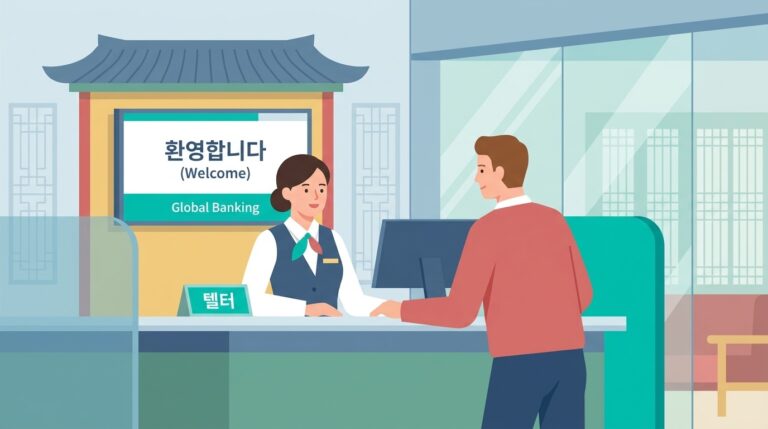
- K-Culture Moment: In Korean thrillers, characters whisper this to a bank teller while showing their phone screen under the counter.
- Editor’s Insight: “수상하다” means suspicious or sketchy. Using this phrase immediately signals to Korean bank staff that they need to step in and assist you.
- Situation Spectrum: Casual ⚠️ | Semi-formal ✅ | Formal ✅
- 🤔 Think About It: In your home country, do banks have direct emergency walk-in protocols for phone scams like Korean bank branches do?
2. 계좌를 동결해 주세요 (Gyejwa-reul donggyeol-hae juseyo)
- Pronunciation: [gyeh-jwa-reul dong-gyeol-hae joo-seh-yo] (Donggyeol sounds like “dong-gyeol”)
- Meaning: Direct: “Please freeze my bank account.” / Nuance: An urgent request to halt all outgoing transactions from your account instantly.
- K-Culture Moment: Bank tellers frantically punching keys on their keyboards after a panicked customer rushes to the window.
- Editor’s Insight: “동결” comes from Hanja (凍結), literally meaning “frozen solid.” In Korea’s lightning-fast banking system, asking for payment suspension (지급정지) or account freezing can save your savings within minutes.
- Situation Spectrum: Casual 🚫 | Semi-formal ✅ | Formal ✅
- 🤔 Think About It: Korea’s Palli-palli (ballpark fast) digital banking allows immediate freezes. How quickly can you block transactions in your native banking system?
3. 보이스피싱 신고를 하려고 합니다 (Boiseu-pising sin-go-reul ha-ryeogo ham-nida)
- Pronunciation: [bo-i-seu-pee-sing sheen-go-reul ha-ryeo-go ham-ni-da]
- Meaning: Direct: “I would like to report a voice phishing scam.” / Nuance: The official opening line when dialing 112 (Police) or 1332 (Financial Supervisory Service).
- K-Culture Moment: The classic hero hotline scene where a citizen gives an official report to bust a cybercrime syndicate.
- Editor’s Insight: “신고” (reporting crime/emergencies) is distinct from “보고” (business reporting). Use this word when dealing with law enforcement.
- Situation Spectrum: Casual 🚫 | Semi-formal ⚠️ | Formal ✅
- 🤔 Think About It: Notice how Korea uses the English loanword “보이스피싱” (Voice Phishing) directly in legal and financial regulations!
Phase 3: Textbook Korean vs. Real Native Korean
Situation 1: Spotting a scammer on the phone
- 📖 Textbook Korean: 이 전화는 사기인 것 같습니다. (This phone call appears to be a fraud.)
- 🗣️ Real Native Korean: 이거 순 보이스피싱 같은데요? (This feels totally like voice phishing.)
- 💡 Why the difference?: Native speakers use the modifier “순” (pure/utterly) to express immediate skepticism, and favor the direct term “보이스피싱” over the generic word “사기” (fraud).
Situation 2: Verifying with bank staff
- 📖 Textbook Korean: 정말 은행에서 전화하신 것 맞습니까? (Is it true that you called from the bank?)
- 🗣️ Real Native Korean: 창구 통해서 직접 확인해 볼게요. (I will double-check directly through the bank counter.)
- 💡 Why the difference?: Korean culture highly respects face-to-face confirmation at bank counters (“창구”). Scammers hate this phrase because it means you are hanging up immediately.
Phase 4: K-Culture Deep Dive & Non-Verbal Etiquette
4-1. Nunchi & Silent Gestures
If you are on a suspicious call inside a bank or public area, cross your index fingers to make an “X” gesture toward a bank security officer or teller while holding the phone to your ear. Tellers in Korea are trained to recognize this non-verbal signal and will discreetly write notes on paper or notify security without alerting the voice on the phone.
4-2. Culture Code: Korea’s Cyber-Safety War
In Korea, government agencies like the Financial Supervisory Service (금감원) regularly send nationwide emergency broadcasts and KakaoTalk alerts warning about scam tactics. Because almost all Korean banking happens on smartphones via apps like KakaoBank or Toss, fast financial self-defense is considered an essential civic skill.
Phase 5: Interactive Roleplay Scenario
Setting: You rush into a KB Kookmin Bank branch in Yeouido after receiving an urgent phone call asking for your resident registration number.
NPC Character: Min-woo (Friendly Bank Teller in his late 20s)
- Turn 1 (Min-woo): 🎭 Looking up from his desk with a warm smile “손님, 무슨 일 있으신가요? 얼굴색이 안 좋아 보이세요.” (Customer, is everything alright? You look pale.)
- Turn 2 (You): 🎭 Showing your ringing phone nervously “방금 검찰이라고 하면서 / 계좌가 범죄에 쓰였다고 전화가 왔어요.” (I just got a call from someone claiming to be a prosecutor saying my account was used in a crime.)
- Turn 3 (Min-woo): 🎭 Leaning forward, tone turning sharp and protective “절대 돈 보내시면 안 됩니다! 혹시 주민등록번호나 비밀번호를 알려주셨나요?” (You must never send money! Did you happen to tell them your ID number or password?)
- Turn 4 (You): 🎭 Taking a deep breath “아니요, 아직 안 알려줬어요. 바로 지급정지 신청을 하고 싶어요.” (No, I haven’t given it yet. I want to apply for a suspension of payment right away.)
- Turn 5 (Min-woo): 🎭 Nodding rapidly while pulling up a system screen “정말 다행입니다! 계좌 동결 처리부터 해드릴게요. 신분증 보여주시겠어요?” (Thank goodness! I’ll freeze your accounts first. May I see your ID card?)
- Turn 6 (You): 🎭 Handing over your Alien Registration Card (ARC) “여기 외국인등록증 있어요. 경찰에도 신고해야 하나요?” (Here is my Alien Registration Card. Should I report this to the police as well?)
- Turn 7 (Min-woo): 🎭 Scanning the card quickly “네, 바로 112로 보이스피싱 신고를 하시면 됩니다. 저희가 신고서 작성을 도와드릴게요.” (Yes, you can report voice phishing to 112 right now. We will help you write the statement.)
- Turn 8 (You): 🎭 Sighing with relief “빠르게 도와주셔서 감사합니다. 정말 큰일 날 뻔했네요.” (Thank you for helping me so quickly. That was a close call.)
🔀 Interactive Decision Point
Suppose the scammer on the phone says: “Do not hang up or talk to anyone at the bank, or you will be arrested immediately!” What do you do?
- Option A: Stay on the line, walk out of the bank, and follow their instructions to avoid legal trouble.
- Option B: Hang up immediately, show your phone screen to the bank teller, and say: “수상한 전화를 받았어요.”
- Option C: Start arguing with the scammer in Korean on speakerphone inside the bank.
Feedback:
* Option A (BAD/RISK): 🚫 Scammers use intimidation to isolate you. Government agencies and banks in Korea will NEVER threaten you over the phone or forbid you from hanging up.
* Option B (BEST): ✅ Perfect! Hanging up breaks the mental trap. Korean bank staff will immediately verify the situation for you.
* Option C (RISK): ⚠️ Engaging with scammers wastes precious time when you should be freezing your accounts or reporting to 112.
Phase 6: 10-Second Emotion Shadowing Drill
Practice these lines out loud! Pay attention to the pauses marked by / and the emotional cues.
[🚨 Panic & Urgency]“잠깐만요! / 지금 계좌를 동결해야 해요!”
(Jam-kkan-man-yo! / Ji-geum gye-jwa-reul dong-gyeol-hae-ya hae-yo!)-
[🛡️ Firm & Decisive]“정부 기관은 / 전화로 돈을 요구하지 않습니다!”
(Jeong-bu gi-gwan-eun / jeon-hwa-ro don-eul yo-gu-ha-ji an-seum-ni-da!) -
[😮💨 Relieved]“다행히 돈은 안 보냈어요. / 바로 신고할게요.”
(Da-haeng-hi don-eun an bo-nae-sseo-yo. / Ba-ro sin-go-hal-ge-yo.)
Phase 7: K-Culture Mini Dictionary
- 지급정지 (Jigeup-jeongji) | Suspension of Payment
- Immediate lock placed on bank accounts to stop fraudulent withdrawals after a scam.
- 금융감독원 (Geum-yung-gam-dog-won) | Financial Supervisory Service (FSS)
- The top financial watchdog in Korea. Often called “금감원” (Geum-gam-won) for short.
- 대포통장 (Daepo-tongjang) | Illegal Burner Account
- Stolen or rented bank accounts used by crime syndicates to collect laundered money.
- 스미싱 (Smishing) | SMS Phishing
- Text messages containing malicious link URLs (e.g., fake delivery updates or tax refunds).
Phase 8: Expat Survival Kit
Top 3 Emergency Phone Numbers
- 112: Korean National Police Agency (경찰청) – Emergency Crime & Phishing Hotline
- 1332: Financial Supervisory Service (금융감독원) – Financial Scam Reporting & Consultation
- 1345: Immigration Contact Center (외국인 종합안내센터) – Multilingual Support for Foreigners
Editor’s Travel Note
When living or traveling in Korea, make sure to install and set up essential safety services. You can download the National Police Agency Cyber Bureau App for real-time URL checking. Also, enable caller ID features on apps like KakaoTalk or Naver to automatically flag suspected scam numbers.
Phase 9: One Step Deeper
Korea’s hyper-connected financial system is a double-edged sword. You can send thousands of dollars to a friend in two seconds using fingerprint identification on your smartphone, but that same convenience makes speed crucial when fraud occurs. Korean society places high collective responsibility on financial institutions, which is why tellers, police, and telecom companies work closely together. Don’t feel embarrassed if you fall victim or get confused—speaking up quickly is respected and encouraged in Korea.
💬 Your Turn: Have you ever received a suspicious text or call while living in Korea? How did you handle it? Share your story in the comments below!
Phase 10: FAQ & Common Mistakes
Q: Will Korean police or banks ever ask for my banking password over the phone?
A: Never. No prosecutor, police officer, or bank representative in Korea will ever request your password, PIN, or transfer of funds over the phone.
Q: What should I do if I already transferred money to a scammer?
A: Immediately call 112 or your bank’s customer service number. Request an emergency suspension of payment (지급정지). If done quickly, the recipient’s bank account will be frozen before the scammer can withdraw it.
Q: Can I get English help when calling 112 or 1332?
A: Yes! If you call 1345 (Immigration Hotline), you can request a 3-way translation call connecting you directly with 112 police dispatchers.
🚨 Common Mistakes Warning Board
- Mistake 1: Clicking links in SMS messages about unexpected package deliveries (택배 배송 오류).
- Correct Action: Delete the text immediately and never click unknown
.apkdownload links.
- Correct Action: Delete the text immediately and never click unknown
- Mistake 2: Believing callers who claim your ARC (Alien Registration Card) will be revoked unless you pay a fine.
- Correct Action: Hang up and call the Immigration Hotline at 1345 directly to verify your visa status.
- Mistake 3: Trying to handle the situation silently out of embarrassment.
- Correct Action: Walk into the nearest bank branch immediately and inform the staff using: “보이스피싱 신고 도와주세요!”
Phase 11: Action Mission
- Bronze Level: Practice saying “지급정지 신청해 주세요” three times out loud until fluent.
- Silver Level: Save 112 and 1332 as emergency phone contacts on your smartphone today.
- Gold Level: Share this guide with a fellow expat friend in Korea and explain what “대포통장” means.
🎮 K-Culture Mission: Watch an episode of a Korean legal drama (like Extraordinary Attorney Woo or One Dollar Lawyer) and spot how legal professionals talk about financial crime!
Phase 12: Interactive Quiz Challenge
Test your intermediate Korean financial safety knowledge below!
1. Fill in the blank: If a suspicious person calls you claiming to be a prosecutor, you should immediately ask for an account suspension by saying “계좌를 ______해 주세요.”
(a) 삭제 (b) 동결 (c) 개설
Click here for Answer & Explanation
Correct Answer: (b) 동결 (Donggyeol)
* Explanation: 동결 means to freeze (an account). 삭제 means delete, and 개설 means open.
2. True or False: The Financial Supervisory Service (금융감독원) will frequently call citizens to demand cash transfers to secure emergency holdings.
Click here for Answer & Explanation
Correct Answer: FALSE
* Explanation: Government authorities in Korea will NEVER demand money transfers via telephone calls.







