

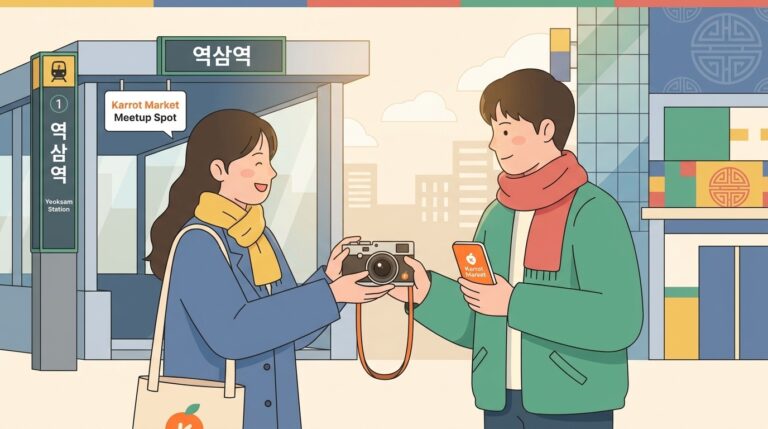
Phase 1: Empathy
안녕하세요! I’m your Daily Hangul editor. Have you ever tried selling a favorite item on Korean second-hand apps like Karrot Market (당근마켓) or Joonggonara (중고나라)? You list your vintage jacket or K-pop album at a reasonable price, and within minutes, a notification pops up: “10,000 won으로 네고 가능할까요?” (Can you negotiate it down to 10,000 won?)
You want to sell it, but the discount offer is way too low! Saying a harsh “No” feels aggressive in Korean culture, yet accepting it leaves you feeling cheated. As an intermediate learner (B2), you need a strategy that lets you protect your price while keeping the interaction friendly and maintaining your high Manner Temperature (매너온도).
In this guide, based on feedback from over 500 foreign residents in Korea, we will master the subtle art of 정중한 거절 (polite refusal) during second-hand price negotiations. By the end of this lesson, you will handle lower offers like a seasoned local!
Phase 2: Core Expressions Deep Dive
1. 죄송하지만 네고는 어렵습니다
- Pronunciation: [Joesonghajiman nego-neun eoryeopsbnida] (Jwe-song-ha-ji-man ne-go-neun uh-ryup-seum-ni-da)
- Meaning: “I am sorry, but price negotiation is difficult.”
- K-Culture Moment: The quintessential response sent in Karrot Market chat threads when a buyer immediately asks for a discount.
- Editor’s Insight: Notice the word 어렵습니다 (it is difficult) instead of 안 됩니다 (it is not allowed). In Korean business and daily trade, framing a refusal as a “difficulty” rather than a hard stop cushions the emotional blow.
- Situation Spectrum: Casual 🚫 / Semi-formal ✅ / Formal ✅
- 🤔 Think About It: Why do you think Korean culture favors saying “it is difficult” over a direct refusal?
2. 이미 가격을 낮춘 상태라 더 이상 할인은 힘듭니다
- Pronunciation: [Imi gagyeogeul natchun sangtaera deo isang harineun himdeumnida] (I-mi ga-gyeok-eul nat-chun sang-tae-ra deo i-sang ha-rin-eun him-deum-ni-da)
- Meaning: “I have already lowered the price, so further discount is hard.”
- K-Culture Moment: Used when buyers try to push for an extra discount on an item you already discounted on the app.
- Editor’s Insight: Providing a logical pretext (이미 가격을 낮춤 – already lowered) gives the buyer a valid reason without creating an awkward confrontation.
- Situation Spectrum: Casual ⚠️ / Semi-formal ✅ / Formal ✅
- 🤔 Think About It: Does stating a clear reason make a refusal feel more respectful in your culture as well?
3. 직거래 시 소정의 덤을 챙겨드릴 테니 이 가격으로 부탁드려요
- Pronunciation: [Jikgeorae si sojeongui deomeul chaenggyeodeuril teni i gagyeogeuro butakdeuryeoyo] (Jik-geor-ae si so-jeong-ui deom-eul chaeng-gyeo-deu-ril te-ni i ga-gyeok-eu-ro bu-tak-deu-ryeo-yo)
- Meaning: “I’ll throw in a small bonus item if we deal in person, so please accept this price.”
- K-Culture Moment: Leveraging Korea’s 덤 (deom – free bonus) culture to turn a price refusal into a win-win deal.
- Editor’s Insight: Instead of discounting cash, offering a small related extra (like a phone case or free stickers) satisfies the buyer’s emotional desire for a deal.
- Situation Spectrum: Casual ⚠️ / Semi-formal ✅ / Formal ⚠️
- 🤔 Think About It: How does the concept of ‘Deom’ show the warmth (Jeong) inherent in Korean transactions?
Phase 3: Textbook Korean vs Real Korean
Situation 1: Declining a discount request outright
- 📖 교과서 한국어: 깎아줄 수 없습니다. (I cannot discount it.)
- 🗣️ 진짜 한국어: 죄송해요, 네고는 사양할게요! (Sorry, I’ll pass on negotiation!)
- 💡 왜 다를까?: “사양하다” (to decline politely) is a refined B2 word frequently used in second-hand apps to decline offers without sounding cold.
Situation 2: When the buyer’s offer is way too low
- 📖 교과서 한국어: 다른 가격에는 안 팝니다. (I won’t sell at another price.)
- 🗣️ 진짜 한국어: 희망 가격과 차이가 커서 거래가 어려울 것 같아요. (The gap with my target price is a bit large, so trade might be tough.)
- 💡 왜 다를까?: Rather than accusing the buyer of lowballing, indirect framing focuses on the gap in target prices.
Phase 4: K-Culture Deep Dive & Non-Verbal Manners
4-1. Nunchi (눈치) & Digital Etiquette
When messaging in trade apps, text alone can feel sharp. Koreans soften digital refusals using polite tone-enders and emojis:
* Add a soft ending like ~요 or ^^ (e.g., “네고는 어려워요^^;;”).
* During 직거래 (in-person trade), if a buyer tries to negotiate cash on the spot, hand over the item with both hands while smiling gently and bowing slightly as you restate your price polite and firm.
4-2. Cultural Code: Manner Temperature (매너온도)
On apps like Karrot Market, every user starts at 36.5°C. Unpolite refusals or ghosting can lead to bad reviews, lowering your temperature. Refusing promptly and politely actually earns positive evaluation tags such as “친절하고 매너가 좋아요” (Kind and good manners).
Phase 5: Real-Life Roleplay Scenario
Setting: Karrot Market Chat Room
Characters: Alex (Seller – Foreign Student) & Minji (Buyer – Local Resident)
- Minji: 안녕하세요! 카메라 잘 봤습니다. 혹시 2만 원만 네고 가능할까요?
(Hello! I liked the camera. By any chance, could you discount it by 20,000 won?) - Alex: 🎭 [손가락을 망설이며 타이핑하며] 안녕하세요, 민지 님! 관심을 가져주셔서 감사합니다.
(Hello, Minji! Thank you for your interest.) - Minji: 상태가 좋아 보여서 꼭 사고 싶어서 그래요! 빠르게 직거래할게요.
(It looks in good condition so I really want to buy it! I can trade in person quickly.) - Alex: 🎭 [정중하지만 단호한 표정으로] 마음은 감사하지만, 이미 가격을 낮춘 상태라 더 이상 할인은 힘듭니다.
(I appreciate the thought, but since I’ve already reduced the price, further discount is hard.) - Minji: 아, 그렇군요… 그럼 조금만도 안 될까요?
(Ah, I see… Then not even a little bit?) - Alex: 🎭 [미소를 지으며 대안을 제시하며] 네고는 어렵지만, 직거래 오시면 카메라 케이스를 덤으로 챙겨드릴게요!
(Negotiation is tough, but if you come for in-person trade, I’ll throw in a camera case as a bonus!) - Minji: 와, 진짜요? 그럼 그 가격에 사겠습니다! 어디서 만날까요?
(Wow, really? Then I’ll buy it at that price! Where shall we meet?) - Alex: 🎭 [안도하며 안부 인사를 보낸다] 감사합니다! 역 앞 카페에서 만나요.
(Thank you! Let’s meet at the cafe in front of the station.)
🔀 Interactive Branching Choice:
If the buyer asks for a discount again after your first refusal, what do you send?
* Option A: “안 된다고 했잖아요. 글 읽으세요.” (I told you no. Read the post.)
* Option B: “죄송하지만 제시한 가격으로만 판매 진행하고 있습니다!” (I’m sorry, but I am only proceeding with the listed price!)
* Option C: (Ignore and block immediately)
Feedback:
* Option A (Bad): Extremely aggressive. Expect a low Manner Temperature rating!
* Option B (Best): Polite, clear, and sets firm boundaries while staying courteous.
* Option C (Risk): Leaving buyers hanging without closing the conversation can result in negative ratings for ghosting.
Phase 6: 10-Second Emotion Shadowing Drill
Practice these lines with the indicated emotional tempo and pauses (/):
[🥺 죄송하고 정중하게]
죄송하지만 / 네고 문의는 / 사양하겠습니다.
(Joesonghajiman / nego mun-ineun / sayanghagessseumnida.)-
[😊 친절하지만 단호하게]
이미 최저가라 / 더 이상의 할인은 / 어렵습니다^^
(Imi choejeogara / deo isang-ui harin-eun / eoryeopsbnida) -
[🎁 따뜻하고 센스 있게]
네고 대신 / 소정의 덤을 / 챙겨드릴게요!
(Nego daesin / sojeong-ui deom-eul / chaenggyeodeurilgeyo!)
Phase 7: K-Culture Mini Dictionary
- 네고 (Nego) | Short for ‘Negotiation’. Refers specifically to price haggling in second-hand transactions.
- 직거래 (Jikgeorae) | In-person direct deal (as opposed to shipping via courier).
- 당근하다 (Danggeun-hada) | Verb meaning “to trade on Karrot Market”. (e.g., “나 어제 노트북 당근했어!”)
- 덤 (Deom) | Extra items or gifts given for free out of goodwill during a transaction.
Phase 8: Traveler’s Survival Kit
Survival Expressions TOP 3
- 네고 사양합니다. (No price negotiation please.) – Place this in your item description beforehand!
- 계좌이체 가능한가요? (Is bank transfer possible?) – Crucial for fast payment on the spot.
- 약속 장소에 도착했어요. (I have arrived at the meeting location.)
Editor’s Travel Note:
When arranging an in-person trade (직거래), safety and convenience come first! Always meet in public places such as subway exit gates. Use 네이버 지도 앱 다운로드 to share exact station exits or landmark coordinates with your buyer.
Phase 9: One Step Deeper (Cultural Reflection)
In many Western cultures, asking for a discount is seen as a standard bargaining opening, and a firm “No” is straightforward business. However, in Korean society, where maintaining relational harmony and saving face (체면) is essential, direct refusals can feel like personal rejection. By framing your refusal around external constraints (e.g., already low price) or offering small gestures (덤), you preserve mutual respect. Language is not just words; it is a bridge of consideration.
💬 Your Turn: How do people politely decline discounts in your home culture? Share your stories in the comments below!
Phase 10: FAQ & Common Mistakes
Q: What if a buyer asks for a discount right in front of me during an in-person trade?
A: Stay calm and politely say: “글에 올려둔 대로 이 가격 이하로는 어려워요. 죄송합니다^^” (As posted in the listing, below this price is difficult. Sorry!). Keeping a gentle smile prevents awkwardness.
Q: Can I put “네고 불가” (No Nego) in my listing header?
A: Yes! Adding [네고 불가] at the beginning of your title sets expectations early and cuts down unnecessary inquiry messages.
Q: Is it okay to unmatch or leave the chat if they keep asking?
A: If you have already stated your polite refusal twice and they persist, it is completely fine to say: “추후 인하하게 되면 연락드리겠습니다.” (I’ll contact you if I lower it later) and close the chat.
🚨 Common Mistakes TOP 3
- Mistake: Sending a cold single word like “안돼요” (No).
- Correct Action: Use soft sentences like “죄송하지만 어렵습니다” (Sorry, but it’s difficult).
- Mistake: Ignoring discount requests completely (Ghosting).
- Correct Action: Send a quick standard refusal template right away.
- Mistake: Lowering the price at the scene because of pressure.
- Correct Action: Hold your boundary politely using the ‘Deom’ strategy instead.
Phase 11: Action Mission
- 🥉 Bronze Mission: Read the 3 core expressions out loud 3 times with emotional shadowing.
- 🥈 Silver Mission: Write a sample listing refusal sentence in Korean and post it in our comment section.
- 🥇 Gold Mission: Try listing a real item on Karrot or Joonggonara and politely handle a negotiation inquiry using today’s expressions!
🎮 K-Culture Mission: Watch a modern Korean vlog or K-drama scene involving second-hand trade and spot when the character uses the word ‘네고’!
Phase 12: Interactive Quiz Challenge
1. Situation Quiz
Which response is the most polite and natural when someone asks for a price discount on Karrot Market?
– A) 안 깎아줘요. (I won’t discount it.)
– B) 죄송하지만 이미 가격을 낮춰서 네고는 어렵습니다! (Sorry, but since I already lowered the price, nego is difficult!)
– C) 읽고 답장 안 함. (Read and ignore.)
Click for Answer & Explanation
Option B is correct! It provides a clear, soft, and polite rationale that respects the buyer while keeping your price intact.
2. Fill-in-the-blank
“네고는 힘들지만, 오시면 소정의 ( )을 챙겨드릴게요!”
– A) 덤 (Deom)
– B) 밥 (Bap)
– C) 벌 (Beol)
Click for Answer & Explanation
Answer is A) 덤. ‘덤’ means a small extra gift included to sweeten the deal!
3. True / False
In Korean second-hand apps, directly saying “어렵습니다” (It is difficult) is considered more polite than saying “안 됩니다” (It cannot be done).
Click for Answer & Explanation
Answer is True! Softening refusals with “difficult” is a key social nuance in B2-level Korean communication.







