

Navigating the Gaming Disorder Controversy in Korea: C2 Advanced Discussion Guide
안녕하세요! Editor here from Daily Hangul, your dedicated native cultural navigator. If you have ever tuned into a heated debate on Korean television regarding esports and gaming regulation, or discussed the WHO’s classification of ‘gaming disorder’ with native friends in Seoul, you know that superficial vocabulary won’t cut it.
South Korea stands at a fascinating crossroads: it is universally recognized as the world’s esports mecca—home to global legends like Faker and round-the-clock PC Bang culture—yet it also hosts some of the world’s fiercest policy debates over digital health, academic pressure, and industry regulation. Navigating this delicate topic requires precision, cultural sensitivity, and high-level rhetorical finesse. Based on feedback from our C2-level learners who lead panel discussions, work in media, or engage with policy in Korea, this guide equips you with advanced expressions to discuss the disease code classification debate like a native intellect.
Phase 2: Core 3 High-Level Expressions
1. 과몰입 (Gwamolip)
- Pronunciation: [Gwa-mo-rip] (Sounds like GWAH + MO + REEP – rhythmically similar to ‘over-steep’)
- Meaning: Hyper-fixation / Over-immersion. While dictionary definitions often blend this with addiction (중독), in sophisticated debate, 과몰입 is preferred because it describes the behavioral state without pre-judging it as a psychological illness.
- K-Culture Moment: Frequently used in debate shows like 100-Minute Debate (100분 토론) when industry experts argue that high gaming hours are a temporary symptom of stress rather than a permanent psychiatric pathology.
- Editor’s Insight: Using 게임 중독 (gaming addiction) immediately sides with the medical framing. Using 게임 과몰입 demonstrates neutral, analytical sophistication.
- Situation Spectrum: Casual ⚠️ | Semi-formal ✅ | Formal ✅
- 🤔 Think About It: How does changing terminology from ‘addiction’ to ‘over-immersion’ alter societal responsibility in your culture?
2. 찬반 양론이 팽팽하다 (Chanban yangroni paengpaenghada)
- Pronunciation: [Chan-ban yang-ron-i paeng-paeng-ha-da] (PAENG-PAENG mimics the sound of a tightly stretched rubber band about to snap)
- Meaning: Debates are fiercely divided / Tightly contested on both sides.
- K-Culture Moment: News anchors on KBS or JTBC use this phrase when reporting on public hearings regarding the adoption of the ICD-11 disease code for gaming.
- Editor’s Insight: 팽팽하다 evokes a sense of equal tension. It implies that neither side has established a consensus yet, making it ideal for objective introductory remarks.
- Situation Spectrum: Casual 🚫 | Semi-formal ✅ | Formal ✅
- 🤔 Think About It: Is public opinion in your country equally divided regarding digital media consumption among youth?
3. 낙인 효과 (Nagin hyogwa)
- Pronunciation: [Na-gin hyo-gwa] (NA-GIN comes from the historical act of branding/marking)
- Meaning: The Stigma Effect / Stigmatization.
- K-Culture Moment: Korean game developers and academic researchers invoke this term to warn that labeling gamers as ‘patients’ will destroy the nation’s creative gaming ecosystem.
- Editor’s Insight: This is a key C2 sociological term. Expressing concern over 낙인 효과 moves the discussion from emotional arguments to structural social impact.
- Situation Spectrum: Casual 🚫 | Semi-formal ✅ | Formal ✅
- 🤔 Think About It: Can medical labeling sometimes cause more harm than good in competitive education systems?
Phase 3: Textbook Korean vs. Real Native Korean
Situation 1: Expressing concern over government regulations
- 📖 Textbook Korean: 정부가 게임을 너무 규제하면 안 됩니다. (Government should not regulate games too much.)
- 🗣️ Real Native Korean: 일방적인 규제는 산업의 위축과 사회적 낙인 효과를 초래할 수 있습니다.
- 💡 Why the difference? Advanced formal discussions favor abstract nouns (위축, 초래) and passive/objective phrasing to maintain professionalism rather than using direct personal commands.
Situation 2: Summarizing the core argument of the gaming industry
- 📖 Textbook Korean: 게임은 좋은 점도 있고 나쁜 점도 있습니다. (Games have good points and bad points.)
- 🗣️ Real Native Korean: 게임의 순기능과 역기능을 균형 있게 바라볼 필요가 있습니다.
- 💡 Why the difference? Using Sino-Korean pair words like 순기능 (positive functions) and 역기능 (adverse/side effects) elevates your stance from casual opinion to scholarly discourse.
Phase 4: K-Culture Deep Dive & Non-Verbal Manners
4-1. Nunchi & Gesture Protocol in Korean Debates
When debating contentious topics like medical disease codes in Korea, direct blunt disagreement (틀렸습니다 – You are wrong) is culturally taboo even in formal settings.
* Eye Contact & Head Tilting: Begin with a slight nod and soft gaze, saying “말씀하신 취지는 이해하지만…” (I understand the intent of what you said, but…).
* Hand Gestures: Keep palms open facing upward when gesturing toward an opponent’s argument. Pointing fingers or chopping hands flatly signals aggression.
4-2. The Dual Identity of Korean Gaming Culture
To understand this debate, you must understand Korea’s historical context. On one hand, Korea pioneered global esports, building infrastructure through high-speed broadband and PC Bangs (PC방) in the late 1990s. Gamers like Faker (Lee Sang-hyeok) are national icons celebrated alongside Olympic athletes.
On the other hand, Korea’s intense educational environment created severe parental anxiety around screen time, leading to past legislation like the controversial 2011 Shutdown Law (셧다운제). The proposed adoption of the WHO disease code reignites this fundamental societal conflict: Is gaming an elite cultural export or a public health hazard?
Phase 5: Interactive Debate Scenario
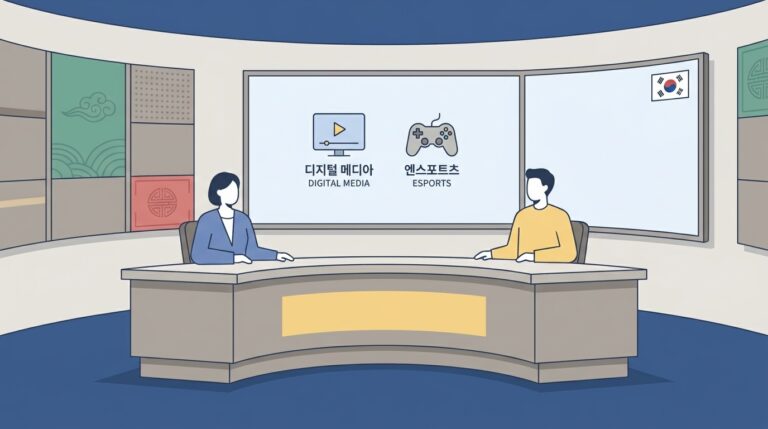
Setting: A live media studio during a roundtable discussion between a Cultural Policy Analyst (Min-jun) and a Medical Specialist (Dr. Park).
- Turn 1 (Min-jun): 🎭 [Looking calm, hands folded] 게임 중독의 질병 코드 등재를 둘러싸고 사회적 논란이 뜨겁습니다. (The debate surrounding the disease code registration for gaming disorder is intense.)
- Turn 2 (Dr. Park): 🎭 [Nodding gravely, leaning forward] 과도한 게임 이용으로 인한 정신적, 신체적 폐해는 더 이상 방치할 수 없는 수준입니다. (The mental and physical harm caused by excessive gaming can no longer be neglected.)
- Turn 3 (Min-jun): 🎭 [Slight polite bow of the head] 의료적 개입의 필요성에는 공감하지만, 과몰입의 원인을 단순 질병으로 규정하는 것은 성급합니다. (I sympathize with the need for medical intervention, but defining the cause of over-immersion simply as a disease is premature.)
- Turn 4 (Dr. Park): 🎭 [Adjusting glasses] 하지만 질병 코드가 부여되어야 체계적인 치료 시스템이 구축될 수 있습니다. (However, only when a disease code is assigned can a systematic treatment infrastructure be established.)
- Turn 5 (Min-jun): 🎭 [Gesturing open-palmed] 자칫 게임 산업 전체에 낙인 효과를 씌워 콘텐츠 수출 강국의 입지를 흔들 수 있다는 우려도 큽니다. (There is high concern that it might place a stigma effect on the entire gaming industry, shaking our standing as a content export powerhouse.)
- Turn 6 (Dr. Park): 🎭 [Sighs softly, tone moderating] 산업적 측면도 중요하지만, 청소년의 건강권 보장이 최우선 과제 아닐까요? (Industrial aspects are important, but isn’t guaranteeing youth health rights the top priority?)
- Turn 7 (Min-jun): 🎭 [Maintaining steady eye contact] 건강권 보장과 산업 진흥이 대립하기보다는, 순기능을 강화하는 자율 규제안이 먼저 논의되어야 합니다. (Rather than health rights and industry promotion conflicting, self-regulatory measures reinforcing positive functions should be discussed first.)
- Turn 8 (Dr. Park): 🎭 [Nodding slowly] 결국 정교한 사회적 합의점을 도출하는 것이 시급하겠군요. (In the end, deriving a delicate social consensus is urgent.)
🔀 Interactive Choice Point
How would you intervene at Turn 7 to support the industry without sounding dismissive of health concerns?
* Choice A: “의사 선생님들의 주장은 완전히 틀렸으며 게임 산업을 망치려는 시도입니다.” (Doctors’ arguments are completely wrong and an attempt to ruin the game industry.)
* Choice B: “의료계의 우려도 타당하나, 원인과 결과를 혼동하지 말고 문화적 맥락을 종합적으로 고려해야 합니다.” (The medical community’s concerns are valid, but we must not confuse cause and effect and should comprehensively consider the cultural context.)
* Choice C: “그냥 아이들이 공부를 안 해서 생긴 문제인데 질병으로 만듭니까?” (Isn’t this just a problem caused by kids not studying, why turn it into a disease?)
Feedback:
- Choice A (Risk/Bad): Extremely aggressive. Uses direct judgment (틀렸습니다) which violates native C2 debate etiquette.
- Choice B (Best): Excellent. Validates the counterpart’s perspective (타당하나) while introducing critical counter-arguments using advanced academic vocabulary.
- Choice C (Bad): Overly casual and dismissive. Reduces a complex structural policy debate to personal opinion.
Phase 6: 10-Second Emotion Shadowing Drill
Practicing native debate intonation requires controlled pauses (/) and subtle emotional gravity.
[🤔 신중하고 논리적으로 / Thoughtfully and logically]
질병 코드 등재는 / 단편적인 접근이 아닌 / 사회적 합의가 필요한 / 복잡한 사안입니다.
(Jilbyeong kode deungjaeneun / danpyeonjeogin jeokgeun-i anin / sahwejeok hab-uiga pil-yohan / bokjap-han sa-an-imnida.)-
[😠 단호하지만 격식 있게 / Firmly yet formally]
근본적인 원인에 대한 연구 없이 / 낙인 효과를 강요해서는 / 안 됩니다.
(Geunbonjeogin won-ine daehan yeongu eobs-i / nagin hyogwareul gang-yohaeseoneun / an doemnida.)
Phase 7: K-Culture Mini Dictionary
- 셧다운제 (Shut Down Law / Seos-da-un-je): A former regulation in Korea restricting youth under 16 from playing online games between midnight and 6 AM. Symbolizes historical regulatory approaches.
- 순기능 / 역기능 (Positive vs. Adverse Functions / Sun-gi-neung vs. Yeok-gi-neung): Key dual terms used across Korean socio-political analyses to weigh benefits against negative side effects.
- 프레임 (Framing Effect / Peu-re-im): Borrowed from English ‘Frame’, widely used in Korean political discourse (e.g., “게임 중독 프레임” – Framing gaming as an addiction).
- e스포츠 강국 (Esports Powerhouse / e-seu-po-cheu gang-guk): National pride phrase referring to Korea’s global dominant status in competitive gaming.
Phase 8: Traveler & Resident Survival Kit
Top 3 Practical Phrases
- “PC방 몇 시간 이용 가능해요?” (How many hours can I use at the PC Bang?) – Useful when visiting gaming lounges.
- “본인 인증을 해야 하나요?” (Do I need real-name identity verification?) – Crucial for foreigners trying to play online games on Korean servers.
- “게임 산업 규제에 대해 어떻게 생각하세요?” (What are your thoughts on gaming industry regulations?) – Great conversation starter with Korean university students.
Editor’s Travel & Tech Note
If you want to experience the epicenter of Korean gaming firsthand, visit a high-end esports arena like LoL PARK in Jongno, Seoul. To navigate without getting lost, rely on Naver Map Application rather than standard global maps, as it provides precise exit details and real-time transit routes tailored to Korea.
Phase 9: One Step Deeper (Humanities & Society)
In South Korea, discussions surrounding youth behavior often reflect the hyper-competitive educational system. When children spend long hours gaming, society frequently debates whether the game itself is addictive or whether youth are seeking an escape from extreme academic pressure. Understanding Korean linguistic nuances in this debate means recognizing that terms like 과몰입 carry deep empathy for student stress, whereas 질병 shifts responsibility onto physiological disorder. To master Korean at C2, one must master these socio-cultural undercurrents.
💬 Your Turn: Do you think high-technology adoption inherently leads to over-regulation in modern societies? Share your thoughts in Korean in the comments below!
Phase 10: Structured FAQ & Common Mistakes
Q: Is ‘게임 중독’ an offensive term to use in Korea?
A: It is not inherently offensive, but in academic, media, or professional contexts, using 게임 중독 demonstrates bias toward the psychiatric classification. Use 게임 이용 장애 (Gaming Disorder – official medical translation) or 게임 과몰입 (Over-immersion – neutral socio-cultural term).
Q: Why do Koreans use Sino-Korean words like ‘순기능’ instead of ‘좋은 점’?
A: Sino-Korean words compress complex abstract ideas into precise two-syllable terms, which is required for formal debate, official reporting, and high-level writing (C1-C2 level).
Q: Has Korea officially adopted the WHO gaming disorder code?
A: As of now, the decision remains deferred pending ongoing research by a joint government-civic committee evaluating the balance between medical necessity and economic/cultural impact.
🚨 Common Mistakes Warning Board
- ❌ Mistake: “저는 게임 중독이 나쁘다고 생각합니다.” (Too simplistic for C2 discussions).
- ⭕ Correct Action: “게임 과몰입 현상을 단순한 개인의 질병으로 치부하기에는 유의미한 사회적 원인이 존재합니다.”
- ❌ Mistake: Calling all internet cafes “Game Cafe”.
- ⭕ Correct Action: Always use the official Korean cultural term PC방 (PC Bang).
Phase 11: Action Missions
- Bronze Mission (Self-Practice): Record yourself reading the two 10-Second Shadowing sentences with correct pauses (
/). - Silver Mission (Social Sharing): Write a 2-sentence opinion on gaming culture using the words 과몰입 and 순기능, and share it on your social media or language exchange group.
- Gold Mission (Real-life Application): Watch a clip of a Korean debate show on YouTube (search:
게임 질병코드 토론) and identify three Sino-Korean vocabulary words used by panel speakers.
🎮 K-Culture Mission: Watch the esports documentary The Kings Avatar or clips of Faker’s interviews. Listen closely to how commentators discuss player focus (집중력) versus exhaustion (피로도).
Phase 12: Interactive Quiz Challenge
1. Fill in the Blank
- 게임을 단순한 질병으로 규정하면 게임 산업 전반에 ( ) 효과를 불러일으킬 위험이 있습니다.
- A) 순기능
- B) 낙인
- C) 자율
🔍 Click to view Answer & Explanation
Answer: B) 낙인
Explanation: 낙인 효과 (Stigma effect) refers to the negative societal branding that occurs when gaming is categorized primarily as a medical illness.
2. True / False Cultural Context Quiz
- True or False: In formal Korean debates, directly telling your opponent “당신 생각이 틀렸습니다” (Your thinking is wrong) is considered standard persuasive practice.
🔍 Click to view Answer & Explanation
Answer: False
Explanation: Native C2 debate protocol requires indirect softening phrases such as “말씀하신 취지는 이해하지만…” (While I understand your intent…) to preserve societal Nunchi and polite etiquette.







