

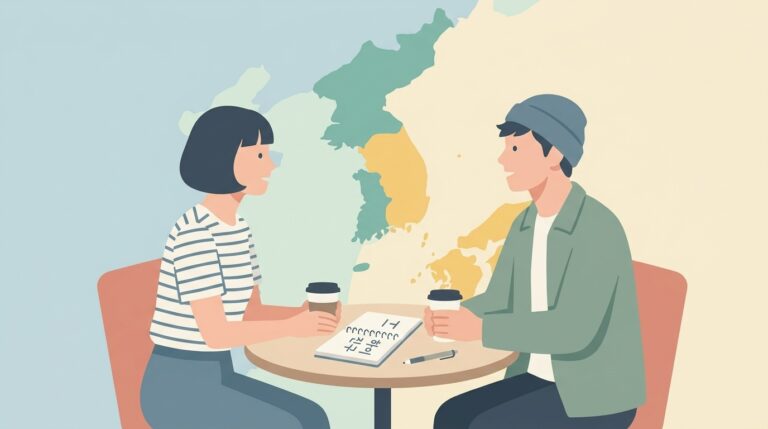
Master B2 Korean: Navigating Discussions on Inter-Korean Relations and Reunification
Phase 1: Empathy (Story-Driven Opening)
안녕하세요! 매일한글 에디터입니다.
Imagine sitting at a cozy café in Hongdae with your Korean university friends. The news playing on the TV overhead mentions a recent cultural exchange near the DMZ, or perhaps someone brings up the hit drama Crash Landing on You (사랑의 불시착). Naturally, the conversation shifts toward a deeper topic: How do people in South Korea today actually feel about reunification and North Korea?
If you’ve ever felt your heart beat a little faster when sensitive societal topics come up in Korean, you are not alone! Many B2-level learners possess solid grammar skills but hesitate when entering conversations about Korean politics and society. You want to express thoughtful, balanced views without sounding overly academic, blunt, or culturally insensitive.
This guide was created directly from real learner feedback and cultural insights from native Koreans. By mastering these intermediate expressions and understanding generational perspectives, you’ll gain the confidence to share your thoughts naturally and build deeper, more meaningful friendships in Korea.
Phase 2: Core Expressions Deep Dive
1. 통일에 대해 어떻게 생각해요? (Tong-ir-e dae-hae eo-tteo-ke saeng-ga-khae-yo?)
- Pronunciation: [Tong-il-ae dae-hae oh-ttoh-keh saeng-gahk-hae-yo?] (rhymes with “tongue” + “ill”)
- Meaning: “What do you think about reunification?” (Literal vs. Gentle opening question)
- K-Culture Moment: Used in college seminars, news debates, or late-night talk shows when discussing national identity and long-term goals.
- Editor’s Insight: Using “어떻게 생각해요?” (How do you think?) is much softer and more inviting than asking “정치적 의견이 뭐예요?” (What is your political opinion?). It opens up a safe space for personal reflection.
- Situation Spectrum: Casual ⚠️ | Semi-formal ✅ | Formal ✅
- 🤔 Think About It: In your culture, how do people open conversations about complex historical or political topics without putting others on the spot?
2. 세대마다 시각 차이가 있는 것 같아요. (Se-dae-ma-da si-gak cha-i-ga in-neun geot ga-ta-yo.)
- Pronunciation: [Seh-dae-mah-dah see-gahk chah-ee-gah een-neun geot gah-tah-yo]
- Meaning: “I think there is a difference in perspective across generations.”
- K-Culture Moment: Frequently heard on news commentary panels or podcast discussions analyzing changing youth demographics in Seoul.
- Editor’s Insight: Expressing an observation rather than taking an extreme side is a hallmark of polite, mature Korean discourse at the B2 level.
- Situation Spectrum: Casual ✅ | Semi-formal ✅ | Formal ✅
- 🤔 Think About It: How has your home country’s younger generation shifted in its view of historical national goals compared to older generations?
3. 평화로운 관계를 유지하는 게 중요한 것 같아요. (Pyeong-hwa-ro-un gwan-gye-reul yu-ji-ha-neun ge jung-yo-han geot ga-ta-yo.)
- Pronunciation: [Pyeong-hwah-roh-oon gwahn-gyeh-reul yoo-jee-hah-neun geh joong-yoh-hahn geot gah-tah-yo]
- Meaning: “I think maintaining a peaceful relationship is what’s important.”
- K-Culture Moment: Mentioned in contemporary Korean dramas and civilian interviews reflect the prevailing pragmatic mindset among younger Koreans.
- Editor’s Insight: Softening your opinion with “~인 것 같아요” (It seems like / I think that) keeps your stance conversational and diplomatic.
- Situation Spectrum: Casual ✅ | Semi-formal ✅ | Formal ✅
- 🤔 Think About It: Why might pragmatic stability be prioritized over immediate emotional union in modern society?
Phase 3: Textbook Korean vs. Real Korean
Situation 1: Expressing realistic priorities regarding inter-Korean relations
- 📖 Textbook Korean: 남북한은 빠른 시일 내에 평화 통일을 지향해야 합니다. (North and South Korea must aim for peaceful reunification as soon as possible.)
- 🗣️ Real Korean: 사실 당장 통일하는 것보다 일단 평화롭게 지내는 게 먼저인 것 같아요. (Honestly, rather than immediate reunification, I think staying peaceful first is the priority.)
- 💡 Why the difference? While older generations often view reunification as an absolute moral imperative, many Gen MZ Koreans hold pragmatic views focusing on economic stability and peaceful coexistence.
Situation 2: Bringing up a sensitive topic politely
- 📖 Textbook Korean: 당신의 정치적 견해는 무엇입니까? (What is your political view?)
- 🗣️ Real Korean: 이 문제는 조심스럽긴 한데, 요즘 분위기는 어때요? (This issue is a bit sensitive, but how is the atmosphere these days?)
- 💡 Why the difference? Direct questions about political alignment feel intrusive. Phrases like “조심스럽긴 한데” (It’s a bit sensitive, but…) show cultural sensitivity and respect.
Phase 4: K-Culture Deep Dive & Non-Verbal Manners
4-1. Nunchi & Gestures
When discussing political topics like South-North relations in Korea:
* Attentive Listening: Nod slightly (고개 끄덕임) while maintaining calm eye contact. Avoid aggressive hand gesturing.
* Tone Softening: Keep your vocal pitch stable. End sentences with intermediate qualifiers like “~것 같아요” or “~라고 보기도 해요”.
* Respecting Divergent Views: If someone shares an opposing perspective, acknowledge it with “아, 그렇게 볼 수도 있겠네요” (Ah, it could be seen that way too) before offering your view.
4-2. Culture Code Analysis: Crash Landing on You & Gen MZ Pragmatism
Media like Crash Landing on You (사랑의 불시착) highlighted human warmth across borders, sparking global interest. However, everyday real-world attitudes among South Koreans—especially younger people—are deeply pragmatic (실리주의). Discussions often balance cultural affinity with concerns about economic integration costs, societal adjustment, and security.
Phase 5: Practical Interactive Roleplay
Scenario: You are chatting with your Korean friend, Min-jun (민준), at a local café after watching a news documentary about South-North relations.
- Turn 1 (Min-jun): 아까 뉴스 봤어? 요즘 남북 관계 얘기가 많이 나오네.
(Did you see the news earlier? There’s a lot of talk about inter-Korean relations lately.) - Turn 2 (You): 🎭 [Nodding thoughtfully] 응, 봤어. 솔직히 이 문제는 좀 조심스럽긴 한데, 관심이 많이 가.
(Yeah, I saw it. Honestly, this issue is a bit sensitive, but I’m very interested.) - Turn 3 (Min-jun): 맞아. 사실 내 주변 친구들도 생각하는 게 다 달라서 흥미로워. 너는 어떻게 생각해?
(Right. Actually, even among my friends, everyone thinks differently, so it’s interesting. What do you think?) - Turn 4 (You): 🎭 [Speaking calmly with a reflective tone] 세대마다 시각 차이가 있는 것 같아. 맞지?
(I think there’s a difference in perspective across generations. Right?) - Turn 5 (Min-jun): 맞아! 어르신들은 통일을 당연하게 생각하시는데, 우리 또래는 경제적 부담도 걱정하거든.
(Exactly! Older generations take reunification for granted, but people our age worry about economic burdens too.) - Turn 6 (You): 🎭 [Slightly nodding in agreement] 이해돼. 당장 통일보다는 평화로운 관계를 유지하는 게 더 중요한 것 같아.
(I understand. Rather than immediate reunification, maintaining a peaceful relationship seems more important.) - Turn 7 (Min-jun): 진짜 공감해! 일단 서로 안전하게 교류하는 게 우선이지. 한국 사회를 정말 잘 이해하고 있네!
(I really agree! Exchanging safely with each other first is priority. You really understand Korean society well!) - Turn 8 (You): 🎭 [Smiling warmly] 고마워. 한국 친구들이랑 이야기하면서 많이 배우고 있어.
(Thanks. I’m learning a lot while talking with Korean friends.)
🔀 Interactive Choice Point
How would you respond if Min-jun asks: “외국인 눈에는 남북한 관계가 어떻게 보여?” (How do inter-Korean relations look to foreigners?)
- Option A: “무조건 빨리 통일해야 한다고 생각해!” (I think they must reunify quickly no matter what!)
- Feedback (Bad): Too prescriptive! Expressing definitive demands on complex domestic issues can sound dismissive of real economic and social nuances.
- Option B: “복잡한 문제지만, 평화와 안전이 최우선이라는 점은 세계 어디서나 비슷하게 느끼는 것 같아요.” (It’s a complex issue, but I feel that peace and safety being top priorities is felt similarly everywhere in the world.)
- Feedback (Best): Empathetic, balanced, and articulate! Uses standard B2 intermediate qualifiers appropriately.
- Option C: “정치 문제는 관심 없어서 잘 모르겠어요.” (I don’t care about politics so I don’t really know.)
- Feedback (Risk): Shuts down a meaningful, friendly dialogue prematurely.
Phase 6: 10-Second Emotion Shadowing Drill
Practice these pause points / and emotional tones aloud!
[🤔 신중하고 조심스럽게 / Thoughtfully and carefully]
솔직히 / 이 문제는 / 좀 조심스럽긴 한데, / 평화가 제일 중요한 것 같아요.
(Sol-jig-hi / i mun-je-neun / jom jo-sim-seu-reop-gin han-de, / pyeong-hwa-ga je-il jung-yo-han geot ga-ta-yo.)-
[💡 공감하며 차분하게 / Empathetically and calmly]
세대마다 / 생각의 차이가 있다는 점이 / 참 흥미로운 것 같아요.
(Se-dae-ma-da / saeng-ga-ge cha-i-ga it-da-neun jeom-i / cham heung-mi-ro-un geot ga-ta-yo.)
Phase 7: K-Culture Mini Dictionary
- 통일 (Tong-il) | Reunification | The political or social unification of divided territories. Widely used in news, history, and civic discussions.
- 남북관계 (Nam-bug-gwan-gye) | Inter-Korean Relations | Refers specifically to bilateral politics, defense, and economic dialogue between South and North Korea.
- 실리주의 (Sil-li-ju-ui) | Pragmatism | A mindset prioritizing practical, tangible benefits over idealist ideology. Very helpful for discussing youth perspectives in Korea.
- 비무장지대 (Bi-mu-jang-ji-dae / DMZ) | Demilitarized Zone | The border buffer zone. Frequently visited in cultural tourism and historical educational contexts.
Phase 8: Traveler & Culture Survival Kit
Survival Expressions TOP 3
- DMZ 투어 예약하고 싶은데요. (DMZ tu-eo ye-ya-kha-go sip-eun-de-yo.) — “I’d like to book a DMZ tour.”
- 역사적 배경에 대해 더 알고 싶어요. (Yeok-sa-jeok bae-gyeong-e dae-hae deo al-go sip-eo-yo.) — “I’d like to learn more about the historical background.”
- 평화와 안전이 가장 중요하죠. (Pyeong-hwa-wa an-jeon-i ga-jang jung-yo-ha-jo.) — “Peace and safety are the most important, right?”
Editor’s Travel Note
If you plan to explore historical sites like the DMZ or the Odusan Unification Tower, check official travel portals beforehand. You can explore regional transportation routes and tour guidelines on the 한국관광공사 공식 여행 정보 가이드 website. Remember to bring your original passport on any border or security-related tours!
Phase 9: A Step Deeper (Reflective Essay)
Language reflects societal change. For decades after the Korean War, reunification was framed primarily as a non-negotiable emotional duty (민족적 당위성). Today, South Korea’s younger generations view the topic through the lens of economic sustainability, peace maintenance, and global security. Understanding this shift allows intermediate Korean learners to move past clichéd textbook scripts and engage in respectful, real-world discussions with Koreans across different age groups.
💬 Your Turn: How are historical or societal unification/reunification topics discussed in your native country? Share your thoughts in the comments below in Korean using the expression ~인 것 같아요!
Phase 10: FAQ & Common Mistakes
Q: Is it rude to ask Korean friends about North Korea?
A: It is not inherently rude, but direct political interrogation can feel uncomfortable. Framing your question softly using “요즘 분위기는 어때요?” (How is the atmosphere these days?) or referencing general cultural topics makes the conversation natural and comfortable.
Q: Do young Koreans completely oppose reunification?
A: No, opinions are diverse. Many prioritize peaceful coexistence, practical economic stability, and security over immediate full integration.
Q: What is the best way to sound respectful during political discussions?
A: Soften your conclusions using B2 expressions like “~에 따르면” (according to…), “~시각도 있더라고요” (there are also perspectives that…), and “~게 중요해 보여요” (it seems important to…).
🚨 Common Mistakes
- Mistake 1: Saying “너는 북한 편이야, 남한 편이야?” (Are you on North’s side or South’s side?)
- Correct Action: Avoid binary polarizing traps. Use: “남북 관계에 대해 어떻게 생각해?”
- Mistake 2: Using overly aggressive formal verbs like “주장한다” (I demand/assert) in casual conversation.
- Correct Action: Use natural B2 conversational frames like “~라고 생각하는 편이에요” (I tend to think that…).
- Mistake 3: Assuming everyone in Korea holds identical views.
- Correct Action: Acknowledge diverse viewpoints using “사람마다 의견이 다를 수 있겠네요” (Opinions could differ depending on the person).
Phase 11: Action Mission
- 🥉 Bronze Mission: Record yourself shadowing the 2 emotion shadowing sentences in Phase 6 three times with smooth pause timing.
- 🥈 Silver Mission: Write a 2-sentence comment below stating your opinion on peace using “~인 것 같아요”.
- 🥇 Gold Mission: Ask a Korean language exchange partner or tutor: “요즘 한국의 젊은 세대는 남북 관계에 대해 어떻게 생각하는 편이에요?”
- 🎮 K-Culture Mission: Watch a contemporary Korean news clip or documentary excerpt about inter-Korean exchanges and spot at least 2 key terms learned today!
Phase 12: Interactive Quiz Challenge
Quiz 1. Situation Judgment
Which sentence is the most natural and polite way to state an opinion on a sensitive societal issue in Korean?
A) 내 말이 무조건 맞으니까 들어봐.
B) 이 문제는 조심스럽지만, 평화로운 관계 유지가 중요한 것 같아요.
C) 왜 당신은 정치에 관심이 없습니까?
🔍 Show Answer & Explanation
Answer: B
Explanation: Option B uses polite softening markers (“조심스럽지만”, “~인 것 같아요”) ideal for B2 intermediate communication.
Quiz 2. Fill in the Blank
세대마다 ________ 차이가 있는 것 같아요. (I think there is a difference in perspective across generations.)
Fill in the blank with the correct noun for “perspective/viewpoint”:
(Hint: 시 _ )
🔍 Show Answer & Explanation
Answer: 시각 (Si-gak)
Explanation: “시각” means perspective or point of view.
Quiz 3. True or False
In modern Korean society, using intermediate qualifiers like “~인 것 같아요” makes your speech sound hesitant and should always be avoided in conversation. (True / False)
🔍 Show Answer & Explanation
Answer: False
Explanation: In Korean polite conversation, “~인 것 같아요” is an essential cultural buffer used to express views diplomatically without sounding dictatorial.







