

How to Give Gifts in Korea Without Feeling Awkward
안녕하세요! I’m your lead editor at Daily Hangul! As your friendly local guide, I’m thrilled to take you through one of the sweetest aspects of Korean culture: gift-giving etiquette. Have you ever wanted to hand someone a small present in Korea, but hesitated because you weren’t sure what to say?
Picture this: You are invited to a Korean host family’s house or meeting a new colleague in Seoul. You brought a lovely box of cookies or a souvenir from your home country. You hand it over with a big smile, saying “Here!” in English, or translating “This is my gift for you!” directly into Korean. Surprisingly, your Korean host looks a tiny bit embarrassed or overly flustered!
Why does this happen? In Korea, modesty and consideration (정, Jeong) are central to gift-giving. Saying “I bought you this awesome gift!” can accidentally make the recipient feel burdened to return something equally grand. Instead, native Koreans use a graceful, humble phrase that makes everyone feel warm and comfortable: “작은 성의예요” (Jageun seong-ui-yeyo)—which translates to “It’s just a small token of my appreciation.”
Based on feedback from hundreds of beginner learners who faced this exact dilemma, this guide will make you feel confident, polite, and totally natural when handing over any gift in Korea!
Phase 2: Core Expressions Deep Dive
1. 작은 성의예요 (Jageun seong-ui-yeyo)
- Pronunciation: [jahg-eun seong-wee-ye-yo] (Sounds like “jahg-eun song-we-ye-yo”)
- Meaning: Literal: “It is a small sincerity.” | Actual Nuance: “It’s just a small token of my appreciation.”
- K-Culture Moment: You’ll hear this whenever a K-drama character visits a lover’s parents’ house with a neatly wrapped fruit basket or set of traditional tea.
- Editor’s Insight: The word “성의” (seong-ui) means “sincerity” or “heart.” By calling it “small,” you relieve the other person of any pressure while emphasizing that your heart is in it.
- Situation Spectrum: Casual ⚠️ | Semi-formal ✅ | Formal ✅
- 🤔 Think About It: Why do you think Korean culture values humbling one’s own gesture over boasting about a gift’s value?
2. 별거 아니에요 (Byeolgeani-eyo)
- Pronunciation: [byeol-geo ah-ni-e-yo] (Sounds like “byol-guh ah-nee-eh-yo”)
- Meaning: Literal: “It’s nothing special.” | Actual Nuance: “It’s just a little something!”
- K-Culture Moment: A colleague hands you a warm canned coffee on a chilly overtime workday in an office K-drama.
- Editor’s Insight: This is the ultimate everyday phrase among friends, classmates, or co-workers when exchanging casual snacks or souvenirs.
- Situation Spectrum: Casual ✅ | Semi-formal ✅ | Formal ⚠️
- 🤔 Think About It: Do you have a phrase in your native language that downplays a favor or gift to make the recipient comfortable?
3. 부담 갖지 말고 받으세요 (Budam gat-ji malgo badeuseyo)
- Pronunciation: [boo-dam gat-ji mal-go bah-deu-seh-yo]
- Meaning: Literal: “Don’t hold burden and receive it.” | Actual Nuance: “Please accept it without feeling burdened.”
- K-Culture Moment: When a senior mentor or neighbor offers a valuable housewarming present in a slice-of-life drama.
- Editor’s Insight: Koreans worry about making others feel obligated to reciprocate. Saying this directly gives the receiver total peace of mind.
- Situation Spectrum: Casual ⚠️ | Semi-formal ✅ | Formal ✅
- 🤔 Think About It: How does reassurance play a role in hospitality in your own culture?
Phase 3: Textbook Korean vs. Real Korean
Scenario 1: Handing a souvenir to your host family
- 📖 Textbook Korean: 이것은 당신을 위한 선물입니다. (Igeoseun dangsineul wihaan seonmurimnida. – This is a gift for you.)
- 🗣️ Real Korean: 이거 작은 성의예요. 받으세요! (Igeo jageun seong-ui-yeyo. Badeuseyo! – This is just a small token. Please take it!)
- 💡 Why the difference? Textbook Korean often uses “당신” (dangsin) for “you,” which sounds awkward or aggressive in spoken Korean! Real Koreans state that it’s a small token and gently offer it.
Scenario 2: Giving a friend some snacks from your hometown
- 📖 Textbook Korean: 저는 당신에게 과자를 줍니다. (Jeoneun dangsinege gwajareul jumda. – I give you snacks.)
- 🗣️ Real Korean: 별거 아닌데, 한번 드셔보세요! (Byeolgeu aninde, hanbeon deosyeoboseyo! – It’s nothing special, but try some!)
- 💡 Why the difference? Native speakers rarely describe their own action (“I give you”). Instead, they encourage the other person to enjoy or try the gift!
Phase 4: K-Culture Deep Dive & Etiquette
4-1. Nunchi & Non-Verbal Gestures
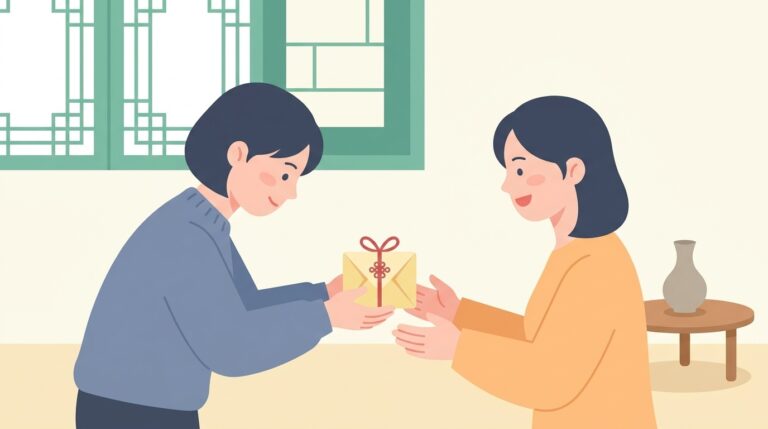
When handing over a gift in Korea, always use two hands (두 손)! Giving or receiving anything—whether it’s a present, a credit card, or a glass of water—with one hand can seem dismissive. Place both hands on the gift, bow your head slightly (about 15 to 30 degrees), and make gentle eye contact.
4-2. Culture Code: The Power of ‘Jeong’ (정)
Gift culture in Korea isn’t about expensive price tags; it’s about sharing warm human affection (Jeong). Whether it’s buying a mobile coffee voucher on KakaoTalk or bringing a small box of bakery goods when visiting an office, small gifts grease the wheels of Korean social relationships.
Phase 5: Real-Life Roleplay Scenario
Setting: You are visiting your Korean language teacher (Minji) at her office after graduation to hand her a small thank-you gift.
- Turn 1 (You): 선생님, 안녕하세요! (Seonsaengnim, annyeonghaseyo! – Teacher, hello!)
🎭 [Smiling warmly and bowing slightly] - Turn 2 (Minji): 어머, 왔어요? 어서 와요! (Eomeo, wasseoyo? Eoseo wayo! – Oh, you arrived? Welcome!)
🎭 [Surprised and welcoming] - Turn 3 (You): 그동안 감사했어요. 이거 작은 성의예요. (Gedeongan gamsahaesseoyo. Igeo jageun seong-ui-yeyo. – Thank you for everything. This is a small token of my gratitude.)
🎭 [Offering the wrapped box with BOTH hands] - Turn 4 (Minji): 어머나, 뭘 이런 걸 가져왔어요? 안 그래도 되는데! (Eomeona, mwol ireon geol gajyeowasseoyo? An geraedo doeneunde! – Oh my, why did you bring something like this? You really didn’t have to!)
🎭 [Waving hands playfully in modest refusal] - Turn 5 (You): 부담 갖지 말고 받으세요. (Budam gat-ji malgo badeuseyo. – Please accept it without feeling burdened.)
🎭 [Nodding encouragingly with a sincere smile] - Turn 6 (Minji): 정말 고마워요. 잘 마실게요! (Jeongmal gomawoyo. Jal masilgeyo! – Thank you so much. I’ll enjoy drinking it!)
🎭 [Receiving the gift with both hands] - Turn 7 (You): 별거 아니지만 맛있게 드세요. (Byeolgeu anijiman masitge deuseyo. – It’s nothing much, but please enjoy it.)
🎭 [Light bow of head] - Turn 8 (Minji): 네, 정말 감동이에요! (Ne, jeongmal gamdong-ieyo! – Yes, I’m truly touched!)
🎭 [Holding gift close to chest with a big smile]
🔀 Interactive Choice Point
When Teacher Minji says “An geraedo doeneunde!” (You didn’t have to bring anything!), how do you respond?
* Choice A: “네, 안 가져올 걸 그랬네요.” (Yeah, maybe I shouldn’t have brought it.)
* Choice B: “부담 갖지 말고 받으세요!” (Please accept it without feeling burdened!)
* Choice C: “이거 아주 비싼 거예요!” (This is very expensive!)
Feedback:
* Choice A (Risk): Yikes! Taking her polite modesty literally will make the situation super awkward!
* Choice B (Best): Perfect! Reassuring her shows high cultural fluency and great etiquette.
* Choice C (Bad): Oops! Boasting about price burdens the receiver and breaks Korean cultural norms.
Phase 6: 10-Second Emotion Shadowing Drill
Practice these lines out loud! Pay attention to the / pauses and emotion tags:
[😊 Humble & Warm]이거 / 작은 성의예요. / 받으세요. (Igeo / jageun seong-ui-yeyo. / Badeuseyo.)[🤗 Friendly & Reassuring]별거 아니니까 / 부담 갖지 말고 / 받으세요! (Byeolgeu aninikka / budam gat-ji malgo / badeuseyo!)[🥺 Sincere & Grateful]그동안 감사했습니다, / 맛있게 드세요! (Geudongan gamsahaessneunida, / masitge deuseyo!)
Phase 7: K-Culture Mini Dictionary
- 정 (Jeong): Deep emotional warmth, affection, and bonding that connects people in Korean society.
- 눈치 (Nunchi): The quick gauge of social context and feelings to act appropriately and politely.
- 손짓 (Sonjit): Hand gestures. In Korea, using two hands signifies respect and warm intention.
- 성의 (Seong-ui): Sincerity, heart, or genuine effort put into an action or gift.
Phase 8: Traveler’s Survival Kit
Top 3 Quick Survival Phrases
- 이거 선물이에요! (Igeo seonmurieyo!) – This is a gift! (Simple & friendly)
- 작은 성의예요. (Jageun seong-ui-yeyo.) – It’s a small token of appreciation.
- 맛있게 드세요! (Masitge deuseyo!) – Please enjoy eating this! (For food gifts)
Editor’s Travel Note
When traveling in South Korea, digital gifts are extremely common! You can send coffee coupons or cake vouchers via mobile messaging. Learn more by checking the KakaoTalk Gift feature navigation guide to send digital appreciation to Korean friends effortlessly!
Phase 9: One Step Deeper
In many Western cultures, enthusiasm about a gift’s quality (“Look what I got you!”) shows your excitement to share. In Korea, however, humbling the gift puts the spotlight on the relationship rather than the object. By calling your gift “small” or “nothing special,” you elevate the recipient’s dignity and ensure they feel zero pressure.
💬 Your Turn: Have you ever experienced a culture where gift etiquette surprised you? Leave a comment below and share your story!
Phase 10: FAQ & Common Mistakes
Q: Can I use “작은 성의예요” with my close friends of the same age?
A: It sounds a bit formal for close friends! For close peers, say “별거 아니야, 먹어봐!” (It’s nothing special, try it!) in casual tone.
Q: What if someone refuses my gift once or twice when I offer it?
A: Don’t panic! Refusing once or twice out of modesty (양보, Yangbo) is standard etiquette. Simply smile and say “부담 갖지 말고 받으세요!” and offer it again gently.
Q: What should I say when handing someone a birthday present?
A: You can combine birthday wishes with modesty: “생일 축하해요! 별거 아니지만 받으세요!” (Happy Birthday! It’s nothing special, but please accept it!)
🚨 Common Mistakes TOP 3
- Mistake: Handing over a gift using only one hand.
- Correct Action: Always hold the gift with BOTH hands!
- Mistake: Saying “이거 진짜 비싸요!” (This is really expensive!)
- Correct Action: Say “작은 성의예요” (It’s a small token) to keep things humble.
- Mistake: Translating “This is for you” as “당신을 위한 것입니다”.
- Correct Action: Avoid “당신”! Use the person’s title or simply say “이거 받으세요!” (Please take this!).
Phase 11: Action Mission
- 🥉 Bronze Mission: Practice saying “이거 작은 성의예요” 3 times out loud using two-handed gestures in front of a mirror!
- 🥈 Silver Mission: Post a picture of a gift you want to give on social media with the caption: “이거 작은 성의예요! #DailyHangul”
- 🥇 Gold Mission: Use “작은 성의예요” or “별거 아니에요” in real life when handing a snack or souvenir to a Korean speaker or friend!
- 🎮 K-Culture Mission: Watch a episode of your favorite K-drama and spot a scene where characters exchange gifts with two hands!
Phase 12: Interactive Quiz Challenge
Test your knowledge! Click the toggles below to check answers.
1. Which phrase means “Please accept it without feeling burdened”?
* A) 이것은 비쌉니다.
* B) 부담 갖지 말고 받으세요.
* C) 당신을 위해 샀습니다.
🔍 Click to view Answer & Explanation
Answer: B) 부담 갖지 말고 받으세요.
Explanation: “부담” means burden, and “갖지 말고” means don’t hold/have. Option A means “This is expensive” and Option C uses the unnatural word “당신”.
2. True or False: In Korea, handing a gift with one hand is considered polite if you smile.
🔍 Click to view Answer & Explanation
Answer: False!
Explanation: Using two hands (두 손) is crucial for proper Korean gift etiquette, regardless of your facial expression!
3. Fill in the blank: “이거 _____ 성의예요.” (It’s a small token of appreciation.)
🔍 Click to view Answer & Explanation
Answer: 작은 (jageun – small)
Explanation: “작은” comes from “작다” (to be small), making the whole phrase humble and warm.







