

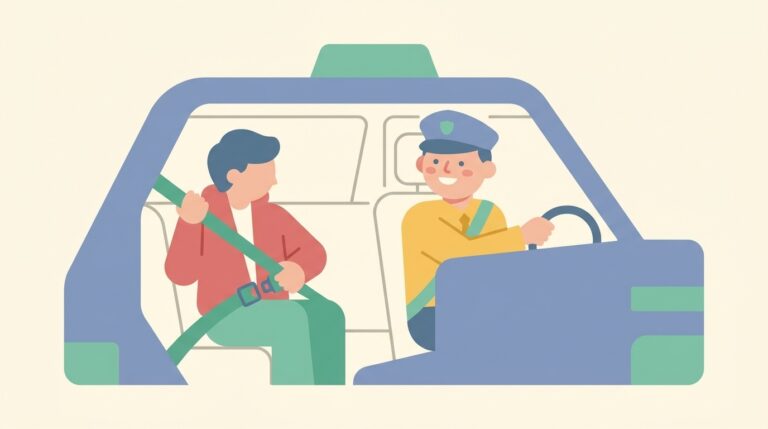
Fasten Your Seatbelt! Essential Korean Safety Phrases for Your Trip
안녕하세요! I’m your Daily Hangul editor, your 10-year local culture navigator! Have you ever taken a taxi from Incheon Airport or jumped on an express bus to Busan, only to hear the driver quickly say something right before stepping on the gas? You hear a beep, look around, and notice everyone clicking their seatbelts into place! In Korea, safety rules are strictly followed on public transport, and knowing quick safety phrases can save you from awkward moments or sudden bumps on the road. Based on real learner feedback, today we are mastering how to understand and respond to safety prompts in Korean smoothly and confidently—even if you are a absolute beginner (A1)!
Phase 2: Core Expressions Deep Dive
1. 안전벨트 매세요 (Anjeon-belteu mae-se-yo)
- Pronunciation: [An-jeon-bel-teu mae-se-yo] (Sounds like “Ahn-jeon belt-too mae-say-yo”)
- Meaning: Direct Translation: “Please tie/fasten the safety belt.” | Actual Nuance: “Please put on your seatbelt.”
- K-Culture Moment: You will hear this exact phrase from taxi drivers, intercity bus drivers, or automatic voice announcements as soon as you sit down.
- Editor’s Insight: ‘안전’ (anjeon) means safety, ‘벨트’ (belteu) is belt, and ‘매다’ (maeda) means to fasten/tie. Adding ‘-세요’ makes it a polite instruction!
- Situation Spectrum: Casual ⚠️ | Semi-formal ✅ | Formal ✅
- 🤔 Think About It: How does your home country remind passengers to wear seatbelts compared to Korea’s polite driver announcements?
2. 안전벨트 맸어요? (Anjeon-belteu maes-seo-yo?)
- Pronunciation: [An-jeon-bel-teu maes-seo-yo?]
- Meaning: Direct Translation: “Did you tie the safety belt?” | Actual Nuance: “Did you put your seatbelt on?”
- K-Culture Moment: A friendly driver or a Korean travel buddy checking on you before starting the journey.
- Editor’s Insight: ‘맸어요’ is the past tense of ‘매다’. Changing your intonation at the end turns it into a friendly question!
- Situation Spectrum: Casual ✅ | Semi-formal ✅ | Formal ⚠️
- 🤔 Think About It: Notice how Korean verbs change their ending to show past tense easily!
3. 조심하세요 (Jo-sim-ha-se-yo)
- Pronunciation: [Jo-sim-ha-se-yo] (Sounds like “Cho-shim-ha-say-yo”)
- Meaning: Direct Translation: “Do caution.” | Actual Nuance: “Be careful” or “Watch out!”
- K-Culture Moment: Said when a bus stops suddenly, when getting off a vehicle, or when stepping onto slippery stairs.
- Editor’s Insight: A versatile phrase used across all daily safety contexts in Korea!
- Situation Spectrum: Casual ⚠️ | Semi-formal ✅ | Formal ✅
- 🤔 Think About It: In English we say “take care” or “watch out”; Korean unifies this into one extremely warm word!
Phase 3: Textbook Korean vs. Real Korean
Situation 1: Driver asking you to fasten your belt
- 📖 Textbook Korean: 안전벨트를 착용하여 주시기 바랍니다. (Anjeonbelteureul chakyonghayeo jusigi baramda.) – “It is requested that you wear your seatbelt.”
- 🗣️ Real Korean: 손님, 안전벨트 매 주세요~ (Sonnim, anjeonbelteu mae juseyo~)
- 💡 Why the difference? Drivers prefer warm, direct, and conversational phrasing rather than rigid formal legal notices.
Situation 2: Telling the driver you are done
- 📖 Textbook Korean: 착용을 완료하였습니다. (Chakyongeul wanryohayeosseumnida.) – “I have completed wearing it.”
- 🗣️ Real Korean: 맸어요! / 매었어요! (Maesseoyo!)
- 💡 Why the difference? Real life needs short, clear answers so the driver knows it’s safe to start driving!
Phase 4: K-Culture Deep Dive & Non-Verbal Manners
4-1. Nunchi & Gestures
When a driver says “안전벨트 매세요”, a polite nod while reaching for the belt shows great Nunchi (quick social awareness). If you’ve already buckled up, simply point gently to your shoulder belt and say “맸어요!” with a slight smile.
4-2. Culture Code: Safety Rules on Korean Roads
In South Korea, wearing seatbelts in all seats (including rear seats in taxis and all seats on express buses) has been strictly mandatory by law since 2018. Taxi drivers can face fines if passengers do not buckle up, so they will always check before pressing the start button!
Phase 5: Real-Life Roleplay Scenario
Setting: You just got into a taxi at Seoul Station heading to Hongdae with Driver Kim (김 기사님).
- Driver Kim: 안녕하세요! 어디로 가세요? (An-nyeong-ha-se-yo! O-di-ro ga-se-yo?)
- 🎭 Gesture: Smiles and adjusts the rearview mirror.
- “Hello! Where are you going?”
- You: 홍대로 가 주세요. (Hong-dae-ro ga ju-se-yo.)
- 🎭 Gesture: Pointing forward politely.
- “Please take me to Hongdae.”
- Driver Kim: 네, 알겠습니다. 손님, 출발하기 전에 안전벨트 매세요! (Ne, al-geos-seum-ni-da. Son-nim, chul-bal-ha-gi jeon-e an-jeon-bel-teu mae-se-yo!)
- 🎭 Gesture: Looks back to check.
- “Yes, understood. Passenger, please put on your seatbelt before we start!”
- You: 아, 네! 어디 있어요? (A, ne! O-di it-seo-yo?)
- 🎭 Gesture: Looking around the seat.
- “Ah, yes! Where is it?”
- Driver Kim: 오른쪽에 있어요. (O-reun-jjok-e it-seo-yo.)
- 🎭 Gesture: Points to your right side.
- “It’s on your right side.”
- You: 아, 찾았어요! (A, cha-jas-seo-yo!)
- 🎭 Gesture: Clicks the belt buckle in.
- “Ah, I found it!”
- Driver Kim: 다 맸어요? (Da maes-seo-yo?)
- 🎭 Gesture: Turns key and starts engine.
- “Did you fasten it all?”
- You: 네, 다 맸어요! 출발해 주세요! (Ne, da maes-seo-yo! Chul-bal-hae ju-se-yo!)
- 🎭 Gesture: Bright smile and nod.
- “Yes, all buckled up! Please depart!”
🔀 Interactive Choice Point
Driver Kim asks: “손님, 안전벨트 매셨어요?” What do you respond?
* Option A: 네, 다 맸어요! (Ne, da maes-seo-yo!)
* Option B: 괜찮아요, 안 매요. (Gwaenchanayo, an maeyo.)
* Option C: 몰라요. (Mollayo.)
Feedback:
* Option A (BEST): Perfect! Clear, polite, and reassuring for the driver.
* Option B (RISK): Oh no! Taxi drivers cannot drive legally without passengers buckled up.
* Option C (BAD): Too blunt and unhelpful in a safety situation.
Phase 6: 10-Second Emotion Shadowing Drill
[😊 Polite & Ready]네, / 안전벨트 / 맸어요! (Ne, / an-jeon-bel-teu / maes-seo-yo!)[🚨 Urgent & Alert]조심하세요! / 차가 / 멈춰요! (Jo-sim-ha-se-yo! / Cha-ga / meom-chwo-yo!)[🙋 Friendly Request]기사님, / 안전벨트 / 매 주세요! (Gi-sa-nim, / an-jeon-bel-teu / mae ju-se-yo!)
Phase 7: K-Culture Mini Dictionary
- 안전 (Anjeon) | Safety | Used in signs, announcements, and emergency notices throughout Korea.
- 벨트 (Belteu) | Belt | Borrowed English word used specifically for seatbelts or waist belts.
- 택시 (Taeksi) | Taxi | Essential mode of travel; highly affordable and safe across Korean cities.
- 출발 (Chulbal) | Departure / Starting | You hear this when buses or trains are about to set off.
Phase 8: Survival Kit for Travelers
Top 3 Survival Phrases
- 안전벨트 매세요. (Anjeonbelteu maeseyo.) – Please put on your seatbelt.
- 여기 세워 주세요. (Yeogi seowo juseyo.) – Please pull over here.
- 천천히 가 주세요. (Cheoncheonhi ga juseyo.) – Please drive slowly.
Editor’s Travel Note
When navigating Korea, using the right navigation apps makes traveling stress-free. Download the Naver Map App for iOS and Android to check public transit routes, taxi fare estimates, and live bus updates in English!
Phase 9: One Step Deeper
In Korea, prompt safety announcements reflect a collective care culture (Jeong). When a bus driver urges passengers to buckle up or hold onto handrails, it stems from a shared responsibility to keep everyone on board safe from harm. Safety isn’t just an individual choice—it’s a courteous gesture toward everyone sharing the ride.
💬 Your Turn: Have you ever experienced a unique safety rule while traveling abroad? Tell us in the comments below!
Phase 10: FAQ & Common Mistakes
Q: Do back-seat taxi passengers really need seatbelts in Korea?
A: Yes! Korean traffic law requires all passengers in all seats (front and back) to wear seatbelts at all times.
Q: Is ‘벨트’ the only word for seatbelt?
A: While ‘안전벨트’ (safety belt) is official, people often just say ‘벨트’ (belt) in casual chat.
Q: What should I say if the seatbelt is broken?
A: Say “벨트가 안 돼요” (Belteuga an dwaeyo – The belt isn’t working).
🚨 Common Mistakes Board
- Mistake: Saying “벨트 닫았어요” (I closed the belt).
- Correct Action: Say “벨트 맸어요” (I tied/fastened the belt).
- Mistake: Ignoring driver’s safety prompt because you are in the backseat.
- Correct Action: Buckle up immediately and say “맸어요!”
- Mistake: Confusing ‘매다’ (fasten/tie) with ‘메다’ (carry on shoulder).
- Correct Action: Remember: seatbelts are ALWAYS ‘매다’!
Phase 11: Action Mission
- Bronze: Practice saying “안전벨트 맸어요!” 3 times out loud.
- Silver: Say the phrase aloud in your next taxi ride or virtual practice session.
- Gold: Teach a fellow learner how to say “Fasten your seatbelt” in Korean!
🎮 K-Culture Mission: Watch a K-drama taxi scene and spot if the characters put on their seatbelts immediately after getting in!
Phase 12: Interactive Quiz Challenge
-
Situation Quiz: You get into a taxi and the driver says “안전벨트 매세요!” What should you do?
Click to reveal answer
Fasten your seatbelt immediately and say “네, 맸어요!” (Yes, I fastened it!).
-
Fill-in-the-blank: 안전___ 매세요 (Anjeon-___ mae-se-yo)
Click to reveal answer
Answer: 벨트 (belteu)
-
True / False: In Korea, backseat passengers do not need to wear seatbelts.
Click to reveal answer
Answer: False! By law, all seats require seatbelts in South Korea.







