

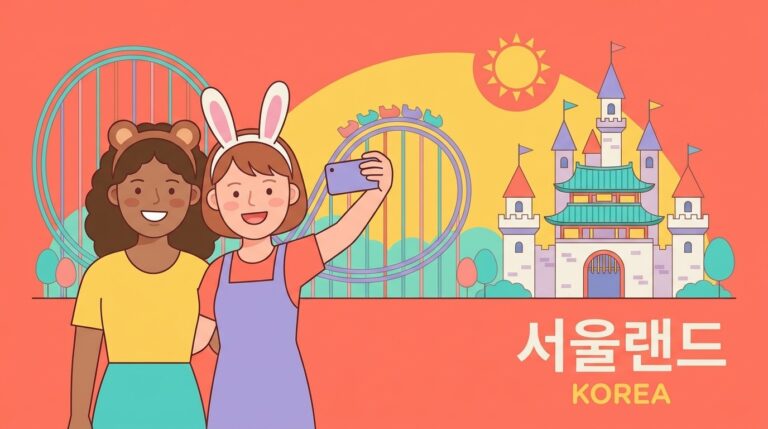
Phase 1: Empathy & Storytelling
안녕하세요! I’m your Daily Hangul editor and local cultural navigator!
Picture this: You are standing right in front of the giant T-Express roller coaster at Everland, or under the magical fairytale castle at Lotte World in Seoul. You’ve got your cute animal ear headband on, the smell of buttered corn is in the air, and your heart is pounding with excitement! But as you approach the entrance, a friendly theme park staff member steps up and starts talking fast in Korean. Suddenly, your mind goes blank. “How long is the wait?” “Can I ride this if I’m afraid of heights?” “Do I need a special ticket?”
Many of our A2 Korean learners tell us that theme parks are their favorite places to visit in Korea, but also where they feel the most flustered when trying to speak. Talking while excited, screaming on rides, and navigating lines require quick, natural expressions—not stiff textbook grammar!
Don’t worry! In this lesson, based on real feedback from over 500 foreign travelers, we’re going to master the exact, easy-to-use Korean phrases you need to conquer any Korean amusement park like a local. By the end of this guide, you’ll order ride passes, ask about wait times, and react with pure joy on the rides with total confidence!
Phase 2: Core Expressions
1. 얼마나 기다려야 해요? (Eol-ma-na gi-da-ryeo-ya hae-yo?)
- Pronunciation: [Eol-ma-na gi-da-ryeo-ya hae-yo?] (Sounds like: “All-mah-nah key-dah-ryuh-yah hay-yo?”)
- Meaning: “How long do I have to wait?” (Literal: How much must I wait?)
- K-Culture Moment: You’ll hear this constantly in lines at Lotte World. When the queue wraps around the corner, visitors ask the staff at the line entrance.
- Editor’s Insight: ‘얼마나’ (eol-ma-na) means “how much/long,” and ‘-야 돼요/해요’ expresses necessity (“have to”). It’s polite, natural, and gets you a direct numerical answer from staff!
- Situation Spectrum: Casual ⚠️ | Semi-formal ✅ | Formal ✅
- 🤔 Think About It: In English, we often ask “What’s the wait time?” In Korean, asking through an action verb (“How long do I have to wait?”) sounds much more direct and conversational. How does your language express wait times?
2. 이거 진짜 재밌어요! (I-geo jin-jja jae-mmit-seo-yo!)
- Pronunciation: [I-geo jin-jja jae-mmit-seo-yo!] (Sounds like: “Ee-geo jeen-jjah jae-meet-suh-yo!”)
- Meaning: “This is really fun!”
- K-Culture Moment: Coming off the Atlantis ride, breathlessly telling your friends or recording a vlog for your social media.
- Editor’s Insight: ‘이거’ is the spoken short form of ‘이것’ (this). ‘진짜’ (jin-jja) is the ultimate Korean word for “really/truly.” Combine them with ‘재밌어요’ (it’s fun) for an instant, authentic emotional reaction!
- Situation Spectrum: Casual ✅ | Semi-formal ✅ | Formal ⚠️
- 🤔 Think About It: Notice how Koreans use ‘진짜’ in almost every enthusiastic sentence. Is there a single word in your language that gets used as often as ‘진짜’?
3. 키 제한 있어요? (Ki je-han it-seo-yo?)
- Pronunciation: [Ki je-han it-seo-yo?] (Sounds like: “Kee jay-hahn eet-suh-yo?”)
- Meaning: “Is there a height restriction?”
- K-Culture Moment: Checking if a younger sibling or shorter friend can join you on a thrill ride.
- Editor’s Insight: ‘키’ means height (for people), ‘제한’ means limit/restriction, and ‘있어요?’ means “is there?”. Super simple, direct, and essential for safety!
- Situation Spectrum: Casual ⚠️ | Semi-formal ✅ | Formal ✅
- 🤔 Think About It: In English, we say “height limit,” combining noun + noun. Korean does the same here (‘키’ + ‘제한’). Doesn’t that make it wonderfully easy to remember?
Phase 3: Textbook Korean vs. Real Native Korean
Situation 1: Suggesting to ride something together
- 📖 Textbook Korean: “저는 이 놀이기구를 타고 싶습니다.” (I want to ride this amusement ride.)
- 🗣️ Real Native Korean: “우리 이거 타자!” (Let’s ride this! – Casual) or “이거 타요!” (Let me/us ride this! – Semi-formal)
- 💡 Why the difference? Textbook phrasing sounds like a written survey response. At a fun theme park, native speakers use short, upbeat suggestions like “~타자!” (Let’s ride!).
Situation 2: Expressing that a queue is super long
- 📖 Textbook Korean: “대기 시간이 길어서 기다릴 수 없습니다.” (The waiting time is long, so I cannot wait.)
- 🗣️ Real Native Korean: “줄 대박 길다!” (The line is crazy long!)
- 💡 Why the difference? ‘대박’ (dae-bak) adds realistic excitement/shock. ‘줄’ (line) is used far more often than ‘대기 시간’ (waiting time) in everyday chatter.
Phase 4: K-Culture Deep Dive & Non-Verbal Etiquette
4-1. Nunchi & Theme Park Manners
- Headband Etiquette: Wearing animal ear headbands (머리띠) is practically mandatory at Korean parks! However, if you are sitting on a theater-style ride or watching a parade, check your 눈치 (Nunchi – situational awareness): take off tall headbands if they block the view of the person behind you.
- Photo Spot Etiquette: Korean theme parks have designated photogenic spots. People line up patiently. When it’s your turn, take 3-4 quick photos, pose with a classic finger heart, and move promptly so the next person can shoot!
4-2. Cultural Insight: The K-Theme Park Date & Uniform Culture
If you visit Lotte World, you’ll notice thousands of teenagers and young adults wearing high school uniforms—even if they graduated years ago! Rental shops right outside the park allow anyone to rent trendy Korean school uniforms (교복) for the day. It’s a iconic K-Culture nostalgia date trend featured in countless K-Dramas like True Beauty.
Phase 5: Real-Life Roleplay Scenario
Setting: Outside the entrance of the giant roller coaster at Everland.
Characters: You (Learner) & Staff Member (알바생 – Park Employee)
- Staff: 안녕하세요! 몇 분이세요? (An-nyeong-ha-se-yo! Myeong-bun-i-se-yo?)
🎭 Smiling warmly while holding a counting clicker.
(Hello! How many people in your party?) - You: 두 명이에요. 얼마나 기다려야 해요? (Du myeong-i-e-yo. Eol-ma-na gi-da-ryeo-ya hae-yo?)
🎭 Pointing two fingers politely.
(Two people. How long do we have to wait?) - Staff: 지금 40분 정도 걸려요. 스마트 줄서기 하셨어요? (Ji-geum sa-sip-bun jeong-do geol-ryeo-yo. Seu-ma-teu jul-seo-gi ha-syeot-seo-yo?)
🎭 Checking the queue screen board.
(It takes about 40 minutes now. Did you use the Smart Queueing?) - You: 아니요, 안 했어요. 그냥 기다릴게요! (A-ni-yo, an haet-seo-yo. Geu-nyang gi-da-ril-ge-yo!)
🎭 Nodding cheerfully.
(No, I didn’t. We’ll just wait in line!) - Staff: 네, 이쪽 줄로 서주세요. 주머니 속 물건은 모두 빼주세요! (Ne, i-jjok jul-ro seo-ju-se-yo. Ju-meo-ni sok mul-geon-eun mo-du ppae-ju-se-yo!)
🎭 Gesturing toward the queuing line lane.
(Okay, please stand in this line. Please remove all items from your pockets!) - You: 네, 알겠습니다! 가방은 가지고 타요? (Ne, al-get-seum-ni-da! Ga-bang-eun ga-ji-go ta-yo?)
🎭 Holding your backpack strap.
(Yes, understood! Do we ride with our bags?) - Staff: 아니요, 승강장 물품보관함에 두시면 돼요. (A-ni-yo, seung-gang-jang mul-pum-bo-gwan-ham-e du-si-myeon dwae-yo.)
🎭 Pointing to the storage cubbies near the ride car.
(No, you can put them in the storage lockers on the boarding platform.) - You: 아, 감사합니다! 재미있게 탈게요! (A, gam-sa-ham-ni-da! Jae-mi-it-ge tal-ge-yo!)
🎭 Bowing slightly with a big smile.
(Ah, thank you! We’ll have fun!)
🔀 Interactive Choice Point
The staff member tells you: “이 놀이기구는 키 140cm 이상만 탈 수 있어요.” (This ride is only for 140cm and taller.)
What do you respond?
* Option A: “저 165cm예요! 문제없어요!” (I’m 165cm! No problem!)
* Option B: “왜요? 저는 어른이에요!” (Why? I’m an adult!)
* Option C: “몰라요. 그냥 탈게요.” (I don’t know. I’ll just ride.)
Feedback:
* Option A (BEST): ✅ Polite, confident, and answers with relevant info! The staff will smile and let you right through.
* Option B (BAD): ⚠️ A bit defensive and argumentative in tone.
* Option C (RISK): 🚫 Unpolite and dismissive. Park safety rules are strictly enforced in Korea!
Phase 6: 10-Second Emotion Shadowing Drill
Practice reading these out loud with emotion! Pay attention to the / pause markers.
-
[😊 Excitement & Eagerness]
우와, / 이거 / 진짜 / 재밌겠다!
(U-wa, / i-geo / jin-jja / jae-mmit-get-da!)
“Wow, this looks so much fun!” -
[😱 Playful Fear]
너무 / 높은데… / 조금 / 무서워요!
(Neo-mu / nop-eun-de… / jo-geum / mu-seo-wo-yo!)
“It’s so high… I’m a bit scared!” -
[🎉 Post-Ride Thrill]
대박! / 한 번 / 더 / 타자!
(Dae-bak! / Han beon / deo / ta-ja!)
“Awesome! Let’s ride it one more time!”
Phase 7: K-Culture Mini Dictionary
- 머리띠 (Meo-ri-tti) | Animal Ear Headband | Essential accessory sold everywhere in Korean parks to get into the playful spirit.
- 자유이용권 (Ja-yu-i-yong-gwon) | All-Day Pass / Unlimited Ride Ticket | The standard entry ticket that gives access to most rides.
- 대기 시간 (Dae-gi si-gan) | Wait Time | Displayed on digital screens across theme parks.
- 탑승 (Tap-seung) | Boarding / Riding | You’ll see signs reading ‘탑승구’ (Boarding Gate) or hear staff say ‘탑승해 주세요’ (Please board).
Phase 8: Traveler’s Survival Kit
Top 3 Survival Phrases
Frequently Asked Questions (FAQ)
Q: What does "얼마나 기다려야 해요? (Eol-ma-na gi-da-ryeo-ya hae-yo?)" mean in Korean and how do you pronounce it?
A: In Korean, "얼마나 기다려야 해요? (Eol-ma-na gi-da-ryeo-ya hae-yo?)" is pronounced [Eol-ma-na gi-da-ryeo-ya hae-yo?] and means: "How long do I have to wait?" (Literal: How much must I wait?)
Q: What does "이거 진짜 재밌어요! (I-geo jin-jja jae-mmit-seo-yo!)" mean in Korean and how do you pronounce it?
A: In Korean, "이거 진짜 재밌어요! (I-geo jin-jja jae-mmit-seo-yo!)" is pronounced [I-geo jin-jja jae-mmit-seo-yo!] and means: "This is really fun!"
Q: What does "키 제한 있어요? (Ki je-han it-seo-yo?)" mean in Korean and how do you pronounce it?
A: In Korean, "키 제한 있어요? (Ki je-han it-seo-yo?)" is pronounced [Ki je-han it-seo-yo?] and means: "Is there a height restriction?"







