

What Should We Order? How to Ask a Korean Friend for Food Delivery Recommendations
안녕하세요! I’m your chief editor at Daily Hangul (매일한글), your 10-year local cultural navigator and trusty Korean bestie! 🇰🇷✨
Phase 1: Empathy — Friday Night in Seoul, Delivery App Open!
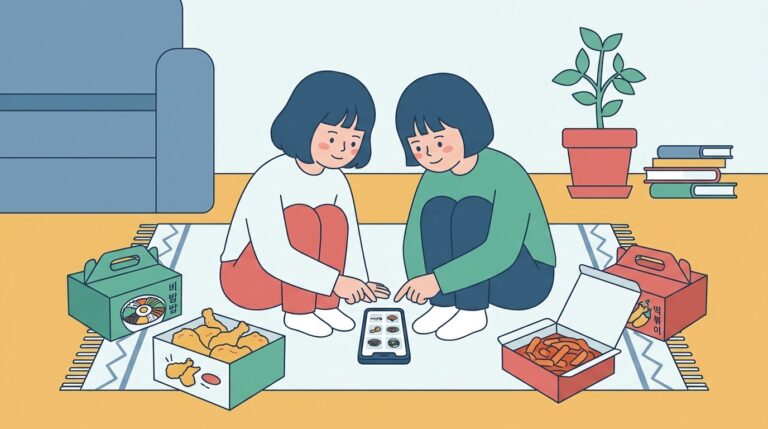
Imagine this: It’s 10:00 PM on a Friday. You’re hanging out at your Korean friend’s cozy apartment in Hongdae. You’re both starving after a long week. Your friend whips out their phone, opens Baedaluiminjok (배달의민족 – Korea’s #1 food delivery app), and hands you the screen.
There are hundreds of options: Fried Chicken, Tteokbokki, Jokbal, Bossam, Rose Pasta, Malatang… You want to ask your friend for a recommendation, but all you can remember from your old textbook is:
“무엇을 추천합니까?” (What do you recommend?) — which sounds like you’re interviewing a hotel concierge! 😅
Don’t worry! Delivery culture (배달 문화) is a huge part of modern Korean social bonding. Learning how to naturally ask “What’s good here?” or “What are you craving?” will instantly bridge the gap between sounding like a robot and feeling like an insider. Today, we’re unpacking B1-level natural conversational phrases that real Koreans use every single night!
Phase 2: Core Expressions Deep Dive
1. 뭐 맛있는 거 없어? (Mwo mas-issneun geo eops-eo?)
- Pronunciation: [Mwo mah-sish-neun geo eop-seo?] (Think: “Mwo” like ‘more’ without ‘r’, “mah-sish-neun” like ‘my-shirt-noon’)
- Meaning: Literal: “Is there nothing delicious?” ➔ Actual Niuance: “Anything good to eat? / What do you recommend?”
- K-Culture Moment: You’ll hear this in almost every K-Drama when roommates lounge on the couch after work and open a food delivery app.
- Editor’s Insight: Koreans often use negative questions (“Isn’t there…?”) to invite suggestions in a friendly, low-pressure way.
- Situation Spectrum: Casual ✅ | Semi-formal ⚠️ | Formal 🚫
- 🤔 Think About It: In your native language, do you use negative phrasing to sound softer when asking for advice?
2. 여기 뭐가 제일 잘나가? (Yeogi mwo-ga jeil jal-naga?)
- Pronunciation: [Yeo-gi mwo-ga je-il jal-na-ga?]
- Meaning: Literal: “What goes out best here?” ➔ Actual Niuance: “What’s the best-seller / signature dish here?”
- K-Culture Moment: Used when browsing a new delivery place on an app or asking a friend who has ordered from that specific place before.
- Editor’s Insight: “Jal naga” (잘나가) literally means “sells well / goes out fast.” It taps into Korea’s fast-paced trend culture.
- Situation Spectrum: Casual ✅ | Semi-formal ✅ | Formal ⚠️
- 🤔 Think About It: How does highlighting popularity reflect the collective trust Koreans place in crowd reviews?
3. 실패 없는 메뉴로 추천해줘! (Silpae eobsneun menyu-ro chucheon-haejwo!)
- Pronunciation: [Shil-pae eop-neun me-nyu-ro chu-cheon-hae-jwo!]
- Meaning: Literal: “Recommend a menu without failure!” ➔ Actual Niuance: “Give me a safe bet / fail-proof menu recommendation!”
- K-Culture Moment: When everyone is starving and nobody wants to take a risky gamble on an experimental fusion dish.
- Editor’s Insight: Adding “실패 없는” (fail-proof) shows great conversational fluency and playful trust in your friend’s taste.
- Situation Spectrum: Casual ✅ | Semi-formal ⚠️ | Formal 🚫
- 🤔 Think About It: Why is picking a “safe bet” food option so essential for group harmony (Nunchi) in Korea?
Phase 3: Textbook Korean vs. Real Korean
Situation 1: Asking what your friend feels like eating
- 📖 Textbook: 어떤 메뉴를 추천하시겠습니까? (Eotteon menyu-reul chucheon-hasigessseubnikka?)
- 🗣️ Real Korean: 오늘 뭐 땡겨? (Oneul mwo ttaeng-gyeo?)
- 💡 Why the difference? Ttaeng-gi-da (땡기다) is an informal verb meaning “to crave.” It’s 100x more natural among friends than the formal verb chucheon-hada (추천하다).
Situation 2: Asking if the food is too spicy
- 📖 Textbook: 음식의 매운 정도는 어떻습니까? (Eumsig-ui mae-un jeong-do-neun eotteos-seubnikka?)
- 🗣️ Real Korean: 이거 맵찔이도 먹을 수 있어? (Igeo maep-jjil-i-do meog-eul su iss-eo?)
- 💡 Why the difference? Maep-jjil-i (맵찔이) is popular Korean slang for someone with low spice tolerance. Asking this shows high cultural awareness!
Phase 4: K-Culture Deep Dive & Non-Verbal Manners
4-1. Nunchi & Gestures
When looking at a phone screen together to choose food:
* The Lean-In: Sit side-by-side, lean in slightly, and tap the screen together while tilting your head thoughtfully.
* The Quick Agreement: When your friend suggests a popular menu, nod quickly two or three times saying “어어, 그거 좋지!” (Oh yeah, that sounds good!).
4-2. Culture Code: Late-Night Snacks (야식) & 1/N Payment
In Korea, delivery culture isn’t just about convenience—it’s a social ritual called 야식 (Yasik – Late-night snack). Also, when splitting the bill, young Koreans usually do N분의 1 (N-bun-ui-il) or N빵 (N-ppang). One person pays via app, and everyone transfers their share instantly using banking apps like KakaoPay or Toss!
Phase 5: Real-Life Roleplay Scenario
Setting: Friday night at your friend Minjun’s place. You’re both looking at the Baemin app on the couch.
- Minjun: 출출하다! 야식으로 치킨 시켜 먹을까? (Chul-chul-hada! Yasig-euro chikin sikyeo meog-eul-kka? / I’m getting peckish! Shall we order chicken for a late snack?)
- You: 🎭 (Nodding enthusiastically while looking at his screen) 좋지! 근데 여기 뭐가 제일 잘나가? (Joh-ji! Geunde yeogi mwo-ga jeil jal-naga? / Sounds awesome! But what’s the bestseller here?)
- Minjun: 여기 허니간장치킨이 대표 메뉴야! (Yeogi heoni-ganjang-chikin-i daepyo menyu-ya! / Their Honey Soy Sauce chicken is the signature dish here!)
- You: 🎭 (Tapping your chin thoughtfully) 실패 없는 메뉴로 추천해줘. 매운 것도 괜찮고! (Silpae eobsneun menyu-ro chucheon-haejwo. Mae-un geot-do gwaenchanh-go! / Give me a safe bet recommendation. I don’t mind spicy either!)
- Minjun: 그럼 맵단 조합으로 반반 시킬까? (Geureom maep-dan joh-ab-euro ban-ban sikil-kka? / Then shall we order half-and-half with a spicy-sweet combo?)
- You: 🎭 (Smiling bright) 완벽해! 사이드 메뉴도 맛있는 거 없어? (Wanbyeok-hae! Saideu menyu-do mas-issneun geo eops-eo? / Perfect! Any good side dishes too?)
- Minjun: 치즈볼 추가하면 꿀조합이지! (Chijeu-bol chuga-hamyeon ggul-joh-ab-iji! / Adding cheese balls is the ultimate combo!)
- You: 🎭 (Giving a thumbs up) 대박, 바로 주문하자! (Daebak, baro jumun-haja! / Awesome, let’s order right away!)
🔀 Interactive Branching: How would you reply when Minjun asks if you want spicy chicken?
- Choice A: “상관없습니다. 아무거나 주문하십시오.” ➔ ❌ Bad: Too formal! Sounds like you’re talking to your boss.
- Choice B: “나 맵찔이라 너무 매운 건 못 먹어!” ➔ ✅ Best: Uses natural slang (Maep-jjil-i) and sets clear expectations playfully!
- Choice C: “음식이 매우면 저는 안 먹겠습니다.” ➔ ⚠️ Risk: Sounds overly blunt and might kill the cozy vibe.
Phase 6: 10-Second Emotion Shadowing Drill
Practice saying these with full emotional expression!
- [😊 Excited & Cravings Rising]
오늘 / 뭐 / 땡겨?
(O-neul / mwo / ttaeng-gyeo?) -
[🥺 Curiously begging for recommendations]
여기 / 뭐가 / 제일 잘나가?
(Yeo-gi / mwo-ga / je-il jal-na-ga?) -
[😋 Enthusiastic & Confident]
실패 없는 메뉴로 / 추천해줘!
(Sil-pae eop-neun me-nyu-ro / chu-cheon-hae-jwo!)
Phase 7: K-Culture Mini Dictionary
- 야식 (Yasik) | Late-night snack culture | Food ordered late at night, typically between 10 PM and 2 AM.
- 맵찔이 (Maepjjiri) | Weak spicy eater | Cute slang for people who can’t handle spicy food well.
- 꿀조합 (Ggul-joh-ap) | Honey combination | The perfect flavor/item pairing (e.g., spicy tteokbokki + fried hotdog).
- 반반 (Ban-ban) | Half and Half | Ordering two flavors in one portion (e.g., half fried, half seasoned chicken).
Phase 8: Traveler’s Survival Kit
Survival Phrases TOP 3
- 메뉴 추천 좀 해주세요! (Menyu chucheon jom hae-juseyo!) — Please recommend a menu! (Semi-formal)
- 이거 많이 매워요? (Igeo mani maewoyo?) — Is this very spicy?
- 1/N로 계산해요! (N-bun-ui-il-ro gyesan-haeyo!) — Let’s split the bill!
Editor’s Travel Note
When traveling in Korea, you can use apps like Yogiyo or Coupang Eats. Make sure to download the Naver Map app for location checking to find local delivery hubs near your Airbnb!
Phase 9: One Step Deeper — The Power of “Ban-ban”
In Korean culture, ordering food is rarely a solo decision when you’re in a group. The famous “반반 (Half-and-Half)” concept was born out of deep consideration for everyone’s preferences. By asking your friend “What’s good here?”, you aren’t just looking for food advice—you’re showing that you value shared enjoyment and group harmony.
💬 Your Turn: What is your go-to late-night food delivery in your country? Tell me in the comments below in Korean!
Phase 10: FAQ & Common Mistakes
Q: Can I use “뭐 맛있는 거 없어?” with my boss or elder?
A: No! It is casual speech (* 반말 / Banmal ). For elders or supervisors, use polite forms like “맛있는 메뉴 추천해 주시겠어요?” (Mas-issneun menyu chucheon-hae jusigess-eoyo?*).
Q: What if I really can’t eat spicy food at all?
A: Tell your friend directly: “나 매운 거 아예 못 먹어!” (Na mae-un geo aye mot meog-eo! – I can’t eat spicy food at all!). They will happily pick a savory soy or garlic flavor.
Q: How do I ask for the most popular menu at a physical store counter?
A: Say “여기 제일 잘나가는 메뉴가 뭐예요?” (Yeogi jeil jal-naganeun menyu-ga mwo-yeyo?).
🚨 Common Mistakes TOP 3
- Saying “추천하세요” ➔ Correction: Sounds like a command! Use “추천해 주세요” or “추천해줘”.
- Translating “What do you want?” as “너 뭐 원해?” ➔ Correction: Unnatural! Say “뭐 먹고 싶어?” or “뭐 땡겨?”.
- Using textbook vocabulary like “음식점” during casual chat ➔ Correction: Just say “여기” (here) or specific food names.
Phase 11: Action Mission
- 🥉 Bronze Mission: Say “오늘 뭐 땡겨?” out loud 3 times in front of the mirror with high energy!
- 🥈 Silver Mission: Comment your favorite Korean delivery dish on your SNS using
#매일한글 #KoreanDelivery. - 🥇 Gold Mission: Next time you eat out with a Korean friend, ask “여기 뭐가 제일 잘나가?” before opening the menu!
🎮 K-Culture Mission: Watch a scene from a realistic Korean vlog or K-drama where characters order food at night. Count how many times you hear “땡겨” or “추천”!
Phase 12: Interactive Quiz Challenge
Q1. How do you casually ask a close friend what they crave today?
* A) 오늘 무엇을 원하십니까?
* B) 오늘 뭐 땡겨?
* C) 식사를 시작합시다.
🔍 Click to view Answer & Explanation
Answer: B) 오늘 뭐 땡겨?
Explanation: “땡겨” is the natural conversational verb for cravings among friends!
Q2. True or False: “맵찔이” means someone who loves super spicy food.
🔍 Click to view Answer & Explanation
Answer: False
Explanation: “맵찔이” means someone who CANNOT handle spicy food well!







