

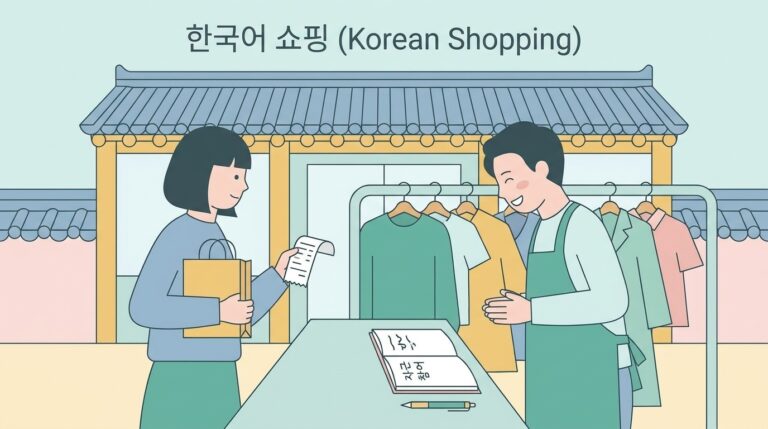
Phase 1: Empathy & Storytelling
안녕하세요! I’m your lead editor at Daily Hangul, your 10-year local cultural navigator!
Picture this: You are exploring the trendy boutique streets of Hongdae or Seongsu-dong. You find an amazing Korean oversized jacket, buy it excitedly, and head back to your hotel. But when you try it on again, you realize the sleeves are way too long or it doesn’t fit the way you thought. Panic sets in! You want to take it back, but you’re worried about how to ask for a refund in Korean without causing an awkward situation.
Don’t stress at all! Navigating returns in a foreign language can feel intimidating, but asking about store policies in Korea is actually very straightforward once you know a few magic phrases. Based on real feedback from hundreds of beginner learners just like you, this guide is designed to give you instant confidence. By learning these simple phrases, you’ll save money, avoid shopping stress, and feel like a true Seoul local!
Phase 2: Core Expressions Deep Dive
1. 환불돼요? (Hwanbul-dwaeyo?)
- Pronunciation: hwan-bool-dwae-yo (Sounds like: “Hwan-bool dway-yo”)
- Meaning: Direct: “Is a refund possible?” / Real Nuance: “Can I get a refund for this?”
- K-Culture Moment: You’ll hear this at fashion boutiques in Myeongdong when shoppers double-check return policies before paying.
- Editor’s Insight: Combining the noun 환불 (refund) with the magic verb -돼요? (is it okay/possible?) creates a polite, perfectly casual request suitable for A1 beginners.
- Situation Spectrum: Casual ⚠️ | Semi-formal ✅ | Formal ✅
- 🤔 Think About It: In your home country, do shoppers ask about refunds before or after purchasing?
2. 영수증 있어요 (Yeongsujeung issoyo)
- Pronunciation: young-soo-jeung eess-oh-yo (Sounds like: “Young-soo-jung eess-oh-yo”)
- Meaning: Direct: “There is a receipt.” / Real Nuance: “I have the receipt right here.”
- K-Culture Moment: Handing over a folded paper slip along with your payment card at the counter.
- Editor’s Insight: In Korea, showing your receipt (영수증) makes the refund process 10 times faster. Cashiers will always ask for it first!
- Situation Spectrum: Casual ⚠️ | Semi-formal ✅ | Formal ✅
- 🤔 Think About It: Why is keeping physical receipts still so useful in high-tech Korea?
3. 며칠까지 돼요? (Myeochil-kkaji dwaeyo?)
- Pronunciation: myeo-cheel-kka-jee dwae-yo (Sounds like: “Myeo-cheel kkah-jee dway-yo”)
- Meaning: Direct: “Until how many days is it possible?” / Real Nuance: “What is the deadline for returns?”
- K-Culture Moment: Asking the cashier while they pack your clothes into a shiny shopping bag.
- Editor’s Insight: 며칠 means “how many days” and 까지 means “until”. It’s the ultimate phrase for planning your travel itinerary around returns.
- Situation Spectrum: Casual ⚠️ | Semi-formal ✅ | Formal ✅
- 🤔 Think About It: How does knowing the return timeframe help you plan your sightseeing days?
Phase 3: Textbook Korean vs Real Korean
Situation 1: Asking if a refund is possible
- 📖 교과서 한국어: 환불 규정이 어떻게 됩니까? (Hwanbul gyujeong-i eotteokge doepnika? – What is the refund policy?)
- 🗣️ 진짜 한국어: 이거 환불돼요? (Igeo hwanbul-dwaeyo? – Can I refund this?)
- 💡 왜 다를까?: Textbooks teach formal business phrasing. In real shops, locals keep it simple and natural with 이거 (this) + 환불돼요?.
Situation 2: Asking for the time limit
- 📖 교과서 한국어: 반품 가능 기간이 언제까지입니까? (Banpum ganeung gigan-i eonje-kkaji-ipnika? – When is the return period until?)
- 🗣️ 진짜 한국어: 며칠까지 돼요? (Myeochil-kkaji dwaeyo? – Until when can I do this?)
- 💡 왜 다를까?: Real life conversation drops complex nouns like “return period” (반품 가능 기간) in favor of quick verbal short-cuts.
Phase 4: K-Culture Deep Dive & Non-verbal Manners
4-1. Nunchi & Gestures
- Two-Handed Delivery: When handing your payment card and receipt to the clerk, hold them with both hands. This shows respect and creates instant goodwill!
- Tag Courtesy: Make sure the paper price tag (택 – taek) is still firmly attached. Attempting a return without the tag makes the interaction much harder.
4-2. Culture Code: Korean Clothing Store Return Rules
Most underground shopping malls (like Express Bus Terminal Mall) or small boutiques have a “7-day return policy with receipt”. However, sale items or white garments are often exchange-only or non-refundable. Always ask “환불돼요?” at the counter before buying!
Phase 5: Real-Life Roleplay Scenario
Setting: A stylish clothing boutique in Seongsu-dong.
Characters: You (Customer) & Staff (점원 – Jeomwon)
- 점원: 어서 오세요! 도와드릴까요?
(Eoseo oseyeo! Dowadeureilkkal-yo?)
(Welcome! Can I help you?)
🎭 Hands joined, smiling warmly at you. -
You: 저기요, 이거 환불돼요?
(Jeogiyo, igeo hwanbul-dwaeyo?)
(Excuse me, can I get a refund for this?)
🎭 Pointing gently to the shirt in your shopping bag. -
점원: 영수증 있으세요?
(Yeongsujeung isseuseyo?)
(Do you have the receipt?)
🎭 Tilting head slightly with a polite tone. -
You: 네, 영수증 있어요. 여기요.
(Ne, yeongsujeung issoyo. Yeogiyo.)
(Yes, I have the receipt. Here it is.)
🎭 Handing over the receipt using both hands. -
점원: 결제하신 카드도 같이 주세요.
(Gyeoljehasin kadeudo gachi juseyo.)
(Please give me the payment card used as well.)
🎭 Reaching out hands to receive the card. -
You: 네, 여기 카드요.
(Ne, yeogi kadeuyo.)
(Yes, here is the card.)
🎭 Handing the credit card over politely. -
점원: 네, 환불 처리해 드렸습니다!
(Ne, hwanbul cheorihae deuryeossseumnida!)
(Okay, the refund has been processed!)
🎭 Printing the cancellation receipt. -
You: 감사합니다! 수고하세요!
(Gamsahamnida! Sugohaseyo!)
(Thank you! Have a good day!)
🎭 Nodding head lightly while leaving.
𔔀 Interactive Branching Choice
Scenario: The cashier asks, “영수증 있으세요?” (Do you have the receipt?), but you left it in your hotel room!
- Option A: “없어요. 그냥 해 주세요!” (I don’t have it. Just do it anyway!)
- Option B: “죄송해요, 방에 있어요. 나중에 다시 올게요!” (I’m sorry, it’s in my room. I’ll come back later!)
- Option C: “영수증 없으면 안 돼요?” (Is it not possible without a receipt?)
Feedback:
* Option A (BAD 🚫): Sounding demanding without a receipt can break Korean etiquette and won’t work.
* Option B (BEST ✅): Extremely polite! It acknowledges store policy and maintains positive rapport.
* Option C (RISK ⚠️): Grammatically fine, but might cause awkwardness if the policy is strict.
Phase 6: 10-Second Emotion Shadowing Drill
Practice these lines with the indicated emotional markers and pauses (/):
[🥺 Hopeful & Polite]
저기요… / 이거 / 환불돼요?
(Jeogiyo… / igeo / hwanbul-dwaeyo?)-
[😊 Helpful & Confident]
네! / 영수증 / 있어요!
(Ne! / yeongsujeung / issoyo!) -
[🤔 Curious & Friendly]
환불은 / 며칠까지 / 돼요?
(Hwanbul-eun / myeochil-kkaji / dwaeyo?)
Phase 7: K-Culture Mini Dictionary
- 영수증 (Yeongsujeung) | Receipt | The vital piece of paper required for any refund or exchange in Korea.
- 교환 (Gyohwan) | Exchange | Swap for a different size or color when refunds aren’t available.
- 택 (Taek) | Price Tag | The clothes tag. Keep it attached if you plan to return something!
- 결제 카드 (Gyeolje Kadeu) | Payment Card | The exact credit/debit card used for the original purchase.
Phase 8: Traveler’s Survival Kit
TOP 3 Survival Phrases
- 이거 교환돼요? (Igeo gyohwan-dwaeyo?) – Can I exchange this?
- 영수증 여기 있어요. (Yeongsujeung yeogi issoyo.) – Here is the receipt.
- 카드 결제했어요. (Kadeu gyeolje-haesseoyo.) – I paid by card.
Editor’s Travel Note
Always keep your paper receipts inside your shopping bag until you return home! If you need help navigating to major shopping complexes like Dongdaemun or Hongdae, make sure to use Naver Map App Download instead of Google Maps, as it offers the most accurate local shop listings in Korea.
Phase 9: “One Step Deeper” (Thought Question)
In Korean retail culture, politeness flows both ways. Notice how shoppers often say “수고하세요!” (Keep up the good work / Have a good day) when leaving a shop. Korean communication values harmony (화합) and smooth social interactions over blunt demands. When you ask for a refund with a friendly tone and proper gestures, staff will go out of their way to help you!
💬 Your Turn: Have you ever tried returning an item in another country? How was the experience compared to shopping in Korea? Tell us in the comments below!
Phase 10: FAQ & Common Mistakes
Q: Can I get a refund if I lost my paper receipt?
A: Most smaller shops require the physical receipt. However, major stores (like ZARA or SPAO) may look up your purchase if you show the card transaction on your banking app.
Q: Is cash refund possible if I paid by card?
A: No. In Korea, refunds must be processed back to the original payment method (same credit/debit card).
Q: Can I return clothes bought at street markets?
A: Street market stalls and underground mall shops often have a “No Refund, Exchange Only” policy. Always ask “환불돼요?” before paying!
🚨 Common Mistakes TOP 3
- Removing the tag first: Removing clothing tags (택) invalidates refunds instantly.
Correct Action: Leave tags intact until you are 100% sure you’ll keep the item. - Forgetting the original credit card: Trying to process a refund with a different card than the one used.
Correct Action: Bring the exact same card used at purchase. - Using overly blunt language: Saying “환불해 줘” (Give me a refund – informal).
Correct Action: Always add -요 (환불돼요?) for polite interaction.
Phase 11: Action Mission & Engagement
- 🥉 Bronze Mission: Practice saying “이거 환불돼요?” out loud 3 times in front of a mirror.
- 🥈 Silver Mission: Write down a mini dialogue in Korean using the phrase “영수증 있어요” in your study notes and share it on Instagram tagging @DailyHangul!
- 🥇 Gold Mission: Visit a clothing shop during your next trip to Korea and successfully ask about their exchange/refund timeframe using “며칠까지 돼요?”.
🎮 K-Culture Mission: Watch a K-drama shopping scene this week and spot when characters hand over their credit card or receipt with both hands!
Phase 12: Interactive Quiz Challenge
Question 1 (Situation Judgment)
You want to ask if a shirt can be returned. What is the most natural A1-level phrase?
a) 이거 환불돼요?
b) 이거 진짜 싸네요!
c) 이거 얼마예요?
Click for Answer & Explanation
Correct Answer: a) 이거 환불돼요?
Explanation: “이거 환불돼요?” means “Can I get a refund for this?”. Option b means “This is really cheap!” and Option c means “How much is this?”.
Question 2 (Fill in the Blank)
Fill in the blank: “I have the receipt” = “____ 있어요.”
Click for Answer & Explanation
Correct Answer: 영수증 (Yeongsujeung)
Explanation: 영수증 means receipt. The full sentence is “영수증 있어요” (Yeongsujeung issoyo).
Question 3 (True or False Cultural Quiz)
True or False: Handing your card to a store clerk using both hands is considered polite in Korea.
Click for Answer & Explanation
Correct Answer: True!
Explanation: Using both hands shows respect and proper etiquette in Korean culture.







