

안녕하세요! 매일한글 에디터입니다. ☀️
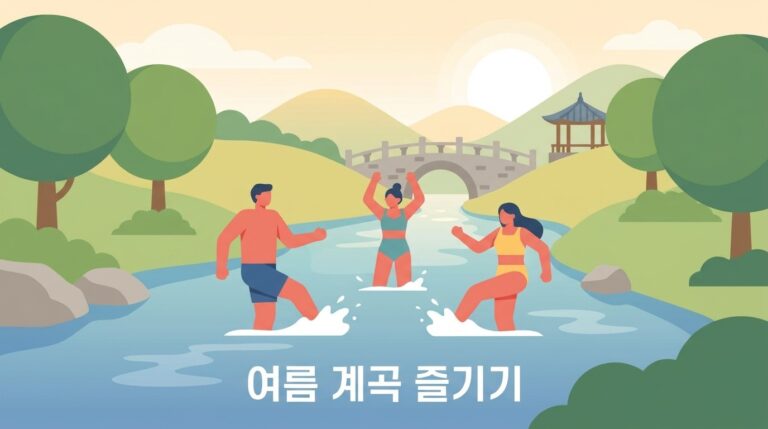
Summer in Korea can get extremely hot and humid, but locals have an ancient yet super trendy secret weapon to beat the heat: heading to a refreshing mountain stream valley, known as 계곡 (Gyegok)! Picture this: chilling with your friends on a raised wooden platform under lush green trees, dipping your feet in ice-cold mountain spring water, and enjoying delicious food while listening to the soothing sounds of nature.
However, visiting a Korean stream spot can feel a bit intimidating if you don’t know the local culture or practical phrases. How do you rent a spot? Is it safe to jump in? How do you order food by the water? Based on real feedback from international learners, we’ve crafted this B1-level guide packed with authentic phrases, cultural insights, and interactive drills so you can navigate Korean water play like a true insider!
Phase 2: Core Expressions Deep Dive
1. 발만 담그고 갈게요
- Pronunciation: [Bal-man dam-geu-go gal-geyo] (Sounds like Bal as in ‘ball’ + man + dam-geu-go + gal-geyo)
- Meaning: Direct: “I’ll just dip my feet and leave.” | Nuance: Politely asking if you can stay briefly near the stream edge without paying full facility fees.
- K-Culture Moment: You’ll hear this in reality shows like 2 Days 1 Night when cast members look for a fast cool-down spot during hot summer trips.
- Editor’s Insight: Stream-side restaurants often rent out platform tables for hours. If you’re just passing through, this phrase shows courtesy and saves you money!
- Situation Spectrum: Casual ✅ | Semi-formal ✅ | Formal ⚠️
- 🤔 Think About It: How does quick spot-sharing work during summer trips in your home country?
2. 시원하게 물놀이해요
- Pronunciation: [Si-won-ha-ge mul-no-ri-hae-yo]
- Meaning: Direct: “Let’s play in the water refreshingly!” | Nuance: A friendly invitation to plunge into the water together and have fun.
- K-Culture Moment: Commonly spoken by characters in summer K-Dramas right before jumping into the river or pool.
- Editor’s Insight: “시원하다” literally means cool, but in Korean emotion, it expresses deep satisfaction and bodily relief.
- Situation Spectrum: Casual ✅ | Semi-formal ✅ | Formal 🚫
- 🤔 Think About It: Why do Koreans use “시원하다” (cool/refreshing) to describe hot soups as well as icy stream water?
3. 구명조끼 대여돼요?
- Pronunciation: [Gu-myeong-jjok-ki dae-yeo-dwae-yo?]
- Meaning: Direct: “Are life jackets available for rent?” | Nuance: Practical safety query before swimming in deeper stream pools.
- K-Culture Moment: Essential line in travel vlogs set around popular mountain streams in Gangwon-do or Gapyeong.
- Editor’s Insight: Mixing Sino-Korean nouns (대여 – rental) with simple standard verbs (돼요) makes your spoken Korean sound natural and efficient.
- Situation Spectrum: Casual ⚠️ | Semi-formal ✅ | Formal ✅
- 🤔 Think About It: How does safety vocabulary reflect a country’s outdoor travel infrastructure?
Phase 3: Textbook Korean vs. Real Korean
Situation 1: Checking water conditions
- 📖 Textbook Korean: “여기에서 수영할 수 있습니까?” (Is it possible to swim here?)
- 🗣️ 진짜 한국어: “여기 물 깊어요? 들어가도 돼요?” (Is the water deep here? Can I go in?)
- 💡 왜 다를까?: Native speakers rarely use overly formal textbook verbs like ‘수영하다’ at stream sites; they focus on practical safety and permission questions.
Situation 2: Using stream-side platform tables
- 📖 Textbook Korean: “식당 자리를 예약하고 싶습니다.” (I would like to reserve a restaurant table.)
- 🗣️ 진짜 한국어: “평상 쓰려면 백숙 주문해야 돼요?” (Do we need to order boiled chicken soup to use the platform?)
- 💡 왜 다를까?: Stream culture connects seating usage (평상) directly with signature summer dishes like baeksuk.
Phase 4: K-Culture Deep Dive & Non-verbal Manners
4-1. Nunchi (눈치) & Gestures
- Shoe Manners: Always remove your sandals before stepping onto low wooden platforms (평상).
- Polite Spot Checking: Make eye contact, nod lightly, and ask before putting down your mat near another group.
4-2. Culture Code: 계곡 백숙 (Stream-side Chicken Soup)
In Korea, summer water play goes hand-in-hand with eating whole boiled chicken soup with medicinal herbs (백숙). It embodies Iyeolchiyeol (이열치열) — fighting heat with hot nourishment to restore energy!
Phase 5: Roleplay Scenario
Setting: A cozy stream-side rest area in Gapyeong.
Characters: You (Traveler) & Min-su (Stream Restaurant Staff)
- You: 안녕하세요! 여기 평상 잠깐 앉아도 돼요? (Hello! Can we sit on this platform briefly?)
- Min-su: 🎭 (Smiling while holding a tray) 안녕하세요! 식사 주문하시면 자유롭게 쓰실 수 있어요.
- You: 아, 그래요? 어떤 메뉴가 제일 인기 많아요? (Ah, I see! Which menu is most popular?)
- Min-su: 🎭 (Points to a boiling pot) 능이버섯 백숙이 제일 잘 나가요!
- You: 그럼 백숙 하나 주세요. 그리고 구명조끼도 대여돼요? (Then please give us one chicken soup. And can we rent life jackets too?)
- Min-su: 네, 매점 옆에서 사이즈 맞춰서 빌려드려요.
- You: 감사합니다! 수건도 혹시 받을 수 있을까요? (Thank you! Could we also get some extra towels?)
- Min-su: 🎭 (Nods cheerfully) 그럼요, 음식 나올 때 같이 가져다드릴게요! 시원하게 물놀이하세요!
🔀 Interactive Choice Point
What would you say if the restaurant staff asks if you want your table set right next to the water?
* A: “네, 물가 바로 옆으로 해 주세요!” (Best – Direct and enthusiastic)
* B: “아무거나 상관없습니다.” (Bad – Too distant and robotic)
* C: “계곡에 그냥 테이블을 던져주세요.” (Risk – Incorrect verb usage sounds absurd!)
Phase 6: 10-Second Emotion Shadowing Drill
- [😊 Excited & Joyful]: 와/ 진짜/ 시원하다! / 같이/ 물에/ 들어갈래요?
- [🥺 Cute & Pleading]: 너무/ 더운데/ 발만/ 잠깐/ 담그면/ 안 돼요?
- [😎 Cool & Confident]: 걱정 마세요/ 구명조끼/ 입어서/ 안전해요!
Phase 7: K-Culture Mini Dictionary
- 계곡 (Gyegok) | Mountain Stream Valley | Fresh natural water ravines surrounded by forest.
- 평상 (Pyeong-sang) | Wooden Platform | Raised wide wooden benches used for dining and lounging.
- 백숙 (Baeksuk) | Herbal Chicken Soup | Nourishing traditional dish eaten during hot summer days.
- 물놀이 (Mul-no-ri) | Water Play | General fun activity involving splashing or swimming in water.
Phase 8: Traveler’s Survival Kit
Survival Expressions TOP 3
- 물 깊이 어때요? (How deep is the water?)
- 미끄러우니까 조심하세요. (It’s slippery, so please be careful.)
- 쓰레기 버리는 곳이 어디예요? (Where is the trash disposal area?)
Editor’s Travel Note
When heading to remote stream spots, public transport options can be limited. Before leaving, search for routes using 네이버 지도 앱 다운로드 to check live bus schedules and taxis.
Phase 9: A Step Deeper
Korean stream trips showcase the deep-rooted community culture (정, Jeong). Sharing food on a single large wooden platform and looking out for nearby swimmers safety reflect how Koreans value collective enjoyment over isolated relaxation.
💬 Your Turn: Have you ever visited a natural stream in Korea? What is your favorite summer way to cool down? Tell us in the comments below!
Phase 10: FAQ & Common Mistakes
Q: Can I bring my own food to a stream in Korea?
A: Public areas in streams allow personal food, but if you sit on private restaurant platforms (평상), you are expected to order their food.
Q: Is swimming allowed in every mountain valley stream?
A: No. Certain designated national park streams prohibit entering the water to protect nature. Look for signs saying “입수 금지” (No Entry).
Q: How much does life jacket rental usually cost?
A: It usually ranges from 3,000 to 5,000 KRW per day at municipal rental booths.
🚨 Common Mistakes TOP 3
- Wearing outdoor shoes onto wooden platforms (Correct Action: Take shoes off at the rim).
- Leaving trash behind by the river bed (Correct Action: Bring trash bags and carry your waste back).
- Jumping into natural pools without checking depth (Correct Action: Always ask “여기 물 깊어요?” first).
Phase 11: Action Mission
- Bronze: Read Phase 6 Shadowing lines out loud 3 times.
- Silver: Post a comment using the sentence “시원하게 물놀이해요!”.
- Gold: Plan a summer trip itinerary using Naver Maps and practice ordering at a Korean restaurant!
🎮 K-Culture Mission: Watch a summer travel episode of a Korean variety show and spot the word “계곡”!
Phase 12: Interactive Quiz Challenge
- What does “발만 담그고 갈게요” mean?
- A) I will swim all day.
- B) I will just dip my feet briefly.
- C) I will buy new shoes.
- True or False: You should keep your shoes on when stepping onto a 평상 (Pyeong-sang).
퀴즈 정답 확인하기 (Click to reveal answers)
- Answer: B) I will just dip my feet briefly.
- Answer: False! Always remove your shoes before stepping onto a platform.







