

Phase 1: 공감 (스토리 몰입형 오프닝)
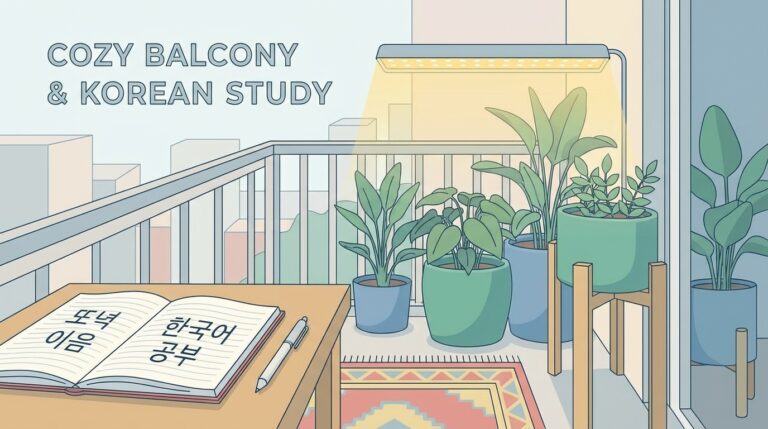
안녕하세요! 매일한글 에디터입니다. Have you ever brought home a beautiful foliage plant in Korea, placed it lovingly in your room, only to watch it stretch frantically toward the window, looking tall, thin, and sad? In Korea’s densely populated urban apartment layouts—where South-facing windows (남향) command a high premium—indoor plant enthusiasts (식집사) often face the frustration of limited sunlight.
When standard sunlight isn’t enough, Korean indoor gardeners turn to LED grow lights (식물등). But discussing light spectrums, stem elongation, and light intensity in advanced Korean requires more than basic plant words. You need nuanced C1 level expressions to discuss environmental needs, troubleshoot legginess, and share tips with fellow green thumbs at local plant pop-ups in Seongsu-dong or Karrot Market community boards. This guide will elevate your Korean plant vocabulary from simple terms to fluent, natural conversations that sound like a seasoned Korean plant curator.
Phase 2: 핵심 표현 3선 심층 분석
1. 웃자라다 (Ut-jarada)
- Pronunciation: [oot-jah-rah-dah] (Sounds like oot as in ‘oops’, jah-rah like ‘jar-ah’, dah)
- Meaning: Literally “to grow over/excessively,” used specifically when a plant stretches unnaturally tall and weak due to lack of light (to grow leggy).
- K-Culture Moment: Frequently used on Korean YouTube vlogs when plant owners explain why they bought grow lights for winter.
- Editor’s Insight: Beyond horticulture, Koreans occasionally use this metaphorically to describe rapid, ungrounded growth or premature development, but its primary everyday home is gardening.
- Situation Spectrum: Casual ✅ | Semi-formal ✅ | Formal ✅
- 🤔 Think About It: How does your language distinguish between healthy growth (잘 자라다) and weak, light-deprived growth (웃자라다)? Notice how Korean creates a specific compound verb to capture plant vitality.
2. 볕이 잘 들다 (Byeot-i jal deulda)
- Pronunciation: [byeot-ee jal deul-dah] (Byeot rhymes with ‘yacht’ with a sharp ‘t’ ending)
- Meaning: Literally “sunlight enters well,” meaning a space receives abundant natural light.
- K-Culture Moment: Essential vocabulary when viewing real estate (부동산) or describing ideal balcony setups for house plants.
- Editor’s Insight: 볕 refers specifically to warm rays of sunlight felt on a surface, whereas 햇빛 is sunlight as a general phenomenon. Saying 볕이 들다 evokes warmth and natural illumination.
- Situation Spectrum: Casual ✅ | Semi-formal ✅ | Formal ✅
- 🤔 Think About It: In Korean real estate, light orientation determines apartment value. Why do you think sunlight orientation plays such an crucial role in Korean home architecture?
3. 식물등을 켜주다/틀어주다 (Sikmul-deung-eul kyeo-juda / teul-eo-juda)
- Pronunciation: [sik-mool-deung-eul kyeo-joo-dah / teul-eoh-joo-dah]
- Meaning: To switch on grow lights for plants. Using -주다 emphasizes doing an action for the benefit of the plant.
- K-Culture Moment: Used by 식집사 (plant butler) creators sharing night routines of switching on LED grow lights on timer plugs.
- Editor’s Insight: Adding -해 주다 shows affection toward plants, treating them almost as living companions rather than decor objects.
- Situation Spectrum: Casual ✅ | Semi-formal ✅ | Formal ⚠️
- 🤔 Think About It: Notice how Korean verb endings reflect affection (-주다). How do grammar structures in your native language express care toward living things?
Phase 3: 교과서 한국어 vs 진짜 한국어
Situation 1: Explaining why an indoor plant looks weak
- 📖 교과서 한국어: 일조량이 부족하여 식물의 줄기가 약해졌습니다. (The plant stems have weakened due to insufficient sunshine hours.)
- 🗣️ 진짜 한국어: 볕이 안 들어서 줄기가 웃자랐어요. (It’s not getting enough sun, so it grew leggy.)
- 💡 왜 다를까? Textbook Korean uses formal botanical terms like 일조량 (sunlight duration), whereas native speakers naturally use descriptive verbs like 웃자라다 and light noun 볕.
Situation 2: Recommending indoor grow lights
- 📖 교과서 한국어: 실내 인공 조명을 사용하면 성장에 도움이 됩니다. (Using indoor artificial lights aids plant growth.)
- 🗣️ 진짜 한국어: 식물등 하나 틀어주면 확실히 짱짱하게 자라요. (If you turn on a grow light, it’ll definitely grow nice and sturdy.)
- 💡 왜 다를까? Natives use vivid colloquial qualifiers like 짱짱하게 (sturdily/firmly) to convey healthy, compact growth under strong PPFD grow lights.
Phase 4: K-Culture 딥다이브 & 비언어적 매너
4-1. 눈치(Nunchi) & Gestures
When showing photos of your plants to a Korean plant shop owner or friend, use both hands to hold your phone and tilt it toward them while slightly nodding. If pointing out leggy stems or pale leaves, gently cup your hand under the leaf image rather than pointing a harsh single index finger. This shows attentiveness and care.
4-2. Cultural Code: The Rise of 식집사 (Sik-jipsa)
In recent years, the word 식집사 (Plant Butler—a blend of 식물 plant and 집사 butler, originally used for cat owners) has taken over Korean lifestyle media. Korean apartment living often lacks private backyards. Thus, young city dwellers transform living rooms and window sills into miniature indoor oases (홈가드닝). Grow lights are no longer viewed as industrial farming equipment; stylish aesthetic bar lights and spotlights are integral interior decor elements (플랜테리어 – Plant Interior).
Phase 5: 실전 롤플레이 시나리오
Setting: A stylish botanical café and plant shop in Yeonnam-dong. You are consulting the owner (사장님) about your drooping Monstera.
- 사장님: 어서 오세요! 식물 둘러보러 오셨나요?
(Eoseo oseoyo! Sikmul dulleoboreoseo osyeonnayo?)
“Welcome! Are you here to look around at some plants?” -
Learner: 네, 그런데 제가 집에서 키우는 몬스테라 때문에 고민이라서요.
(Ne, geureonde jega jib-eoseo kiuneun monseutera ttaemune gomin-iraseoyo.)
🎭[Showing photos on phone with both hands]
“Yes, but I’m worried about the Monstera I’m growing at home.” -
사장님: 어디 볼게요. 아, 줄기가 마디 사이만 길어지고 잎이 얇아졌네요.
(Eodi beolgyeyo. A, julgiga madi saiman gireojigo ip-i yalbageojneaneu.)
“Let me see. Ah, the spaces between nodes are long and the leaves look thin.” -
Learner: 맞아요! 볕이 잘 안 들어서 웃자란 것 같아요.
(Maj-ayo! Byeot-i jal an deureoseo ut-jaran geot gat-ayo.)
🎭[Sighs slightly with concerned eye contact]
“Exactly! I think it grew leggy because it doesn’t get enough sunlight.” -
사장님: 방 향향이 어떻게 되세요? 남향이 아니면 겨울엔 햇빛만으론 부족하죠.
(Bang hyanghyang-i eotteokke doeseyo? Namhyang-i animyeon gyeoureun haesbitmaneuron bujokhajyo.)
“Which direction does your room face? If it’s not South-facing, sunlight alone isn’t enough in winter.” -
Learner: 북향이라 볕이 거의 안 들어요. 식물등을 틀어주면 좀 나아질까요?
(Bukhyeong-ira byeot-i geoei an deureoyo. Sikmul-deung-eul teul-eo-jumeon jom na-ajilkkayo?)
🎭[Leaning forward with curious expression]
“It faces North, so light barely comes in. Would it improve if I turn on a grow light?” -
사장님: 그럼요! LED 식물등을 하루 8시간 정도 켜주시면 잎도 두꺼워지고 짱짱해집니다.
(Geureomyo! LED sikmul-deung-eul haru pal-sigan jeongdo kyeo-jusimyeon ipdo dukkeoweojigo jjangjjang-haejimnida.)
“Of course! If you turn on an LED grow light for about 8 hours a day, the leaves will get thicker and sturdy.” -
Learner: 아하, 그렇군요! 그럼 여기서 추천해주실 만한 식물등이 있나요?
(Aha, geureohgunyo! Geureom yeogiseo chucheon-hae-jusil man-han sikmul-deung-i unnayo?)
🎭[Nodding smilingly with gratitude]
“Aha, I see! Do you have any grow lights you’d recommend here?”
🔀 Interactive Choice Point
The shop owner asks: “어떤 타입의 조명을 원하세요? Stand형이 좋으세요, 클립형이 좋으세요?”
- Option A: “아무거나 상관없어요. 제일 싸고 효과 좋은 걸로 주세요.” (Whatever, I don’t care. Just give me the cheapest effective one.)
- Option B: “집 인테리어랑 어울리는 스탠드형으로 보여주실 수 있나요?” (Could you show me stand-type ones that match my home interior?)
- Option C: “식물등 효과가 진짜 있는지 검증된 데이터가 있나요?” (Do you have verified data proving grow lights actually work?)
Feedback:
* Option A (Risk): Slightly blunt in semi-formal context. Dismisses design aesthetic which is crucial in Korean home gardening culture.
* Option B (Best): Polite C1 phrasing. Balances interior aesthetics (인테리어) with functionality, matching contemporary Korean lifestyle conversations.
* Option C (Bad): Too defensive and overly academic for a relaxed retail interaction.
Phase 6: 10초 감정 섀도잉 드릴
Practicing native rhythm and pauses (/ indicates pause):
[🥺 아쉽고 걱정스럽게 - Regretful & Concerned]
볕이 잘 안 들어서 / 줄기가 자꾸 / 웃자라요.
(Byeot-i jal an deureoseo / julgi-ga jakku / ut-jarayo.)-
[😊 기대감 가득하게 - Full of Hope & Excitement]
식물등 하나 / 틀어줬더니 / 새 잎이 짱짱하게 / 올라왔어요!
(Sikmul-deung hana / teul-eo-jwotdoni / sae ip-i jjangjjang-hage / olla-wasseoyo!)
Phase 7: K-Culture 미니 사전 (핵심 키워드 4개)
- 식집사 (Sik-jipsa) | Plant Butler | Someone dedicated to caring for house plants like family pets.
- 웃자람 (Ut-jaram) | Legginess / Spindly growth | Weak, stretched stem growth resulting from insufficient PAR light.
- 플랜테리어 (Planterior) | Plant + Interior | Decorating indoor spaces aesthetically using plants and design grow lights.
- 영양제 (Yeongyang-je) | Plant Supplements / Fertilizer | Liquid nutrient drops or spikes frequently given alongside grow light care.
Phase 8: 여행자를 위한 생존 키트
Survival Expressions TOP 3
- 식물등 타이머 기능 되나요? (Sikmul-deung taimeogineung doenayoo?) – Does this grow light have a timer function?
- 반음지에서도 잘 자라는 식물인가요? (Baneumji-eseodo jal jaraneun sikmul-ingayo?) – Does this plant grow well in partial shade?
- 분갈이 흙도 같이 판매하시나요? (Bungari heuk-do gachi panmae-hasinayo?) – Do you also sell repotting soil mix?
Editor’s Travel Note
When visiting famous plant markets like Yangjae Flower Market or local boutique plant shops in Seoul, use the Naver Map App Download to search for 식물편집숍 (Botanical Concept Store) or 화훼단지 (Flower Market Complex). Most boutique stores accept local cards, Kakao Pay, and Naver Pay seamlessly.
Phase 9: “한 발 더 깊이” (생각 질문)
In modern Korean cities dominated by high-rise concrete apartments, cultivating greenery indoors is more than a hobby—it’s a conscious effort to restore emotional rhythm and natural touch (리프레시). Utilizing LED technology to nurture plants indoors reflects Korea’s unique harmony between fast-paced tech convenience and nature appreciation.
💬 Your Turn: Does your culture view artificial grow lights as natural plant care, or is natural sunshine considered irreplaceable? Share your thoughts in Korean in the comments below!
Phase 10: FAQ & 오해 방지
Q: Can I use regular white LED home light bulbs instead of specialized grow lights (식물등)?
A: Regular bulbs provide light, but specialized grow lights emit targeted photosynthetic wavelengths (red & blue spectrums or full-spectrum warm white). Korean gardeners specifically ask for 스펙트럼 식물등 to ensure leaf density.
Q: What is the exact nuance difference between 자라다 and 웃자라다?
A: 자라다 is neutral/healthy growth (“growing well”). 웃자라다 is always negative, describing unhealthy stretched growth due to deficient light intensity.
Q: How do I express turning lights on/off naturally?
A: While 조명을 켜다/끄다 is dictionary-correct, native speakers frequently say 식물등을 틀어주다/꺼주다, using 틀다 (to turn on/run a device).
🚨 흔한 실수 (Common Mistakes) TOP 3
- ❌ ** Saying “식물이 키가 너무 크다” when it’s leggy.**
👉 Correct Action: Use “식물이 웃자랐다”. Simply saying “it’s tall” sounds positive rather than light-deprived. - ❌ Overusing textbook term “인공 조명” in casual shop chat.
👉 Correct Action: Say “식물등”. 인공 조명 sounds like a technical industrial engineering report. - ❌ Saying “햇빛을 켜다”
👉 Correct Action: Say “식물등을 켜다/틀다” for lamps, and “볕이 들다” for natural light.
Phase 11: 액션 미션 & 참여 유도
- 🥉 Bronze Mission: Read the Phase 6 shadowing drills out loud 3 times using proper emotional pauses.
- 🥈 Silver Mission: Post a picture of your houseplant on social media with the caption: “볕이 안 들어서 식물등이 필요해요! #식집사 #매일한글”
- 🥇 Gold Mission: Visit a local plant shop or online Korean community board and ask a question using 웃자라다 and 볕이 잘 들다.
🎮 K-Culture Mission: Search Instagram or YouTube for the hashtag #식집사 or #식물등. Find 2 posts and identify how they talk about light setup!
Phase 12: 인터랙티브 퀴즈 챌린지
Q1. Fill in the blank:
햇빛이 모자라서 줄기만 길고 약하게 자라는 현상을 한국어로 ______ (이)라고 합니다.
🔍 정답 및 해설 보기 (Click to see Answer)
정답: 웃자람 (또는 웃자라다)
해설: Light-deprived stem stretching is specifically called 웃자람 (noun) or 웃자라다 (verb) in Korean horticulture.
Q2. True or False:
Korean expression “볕이 들다” uses the word ‘볕’ to describe warm sunlight rays shining into a space.
🔍 정답 및 해설 보기 (Click to see Answer)
정답: True
해설: 볕 specifically refers to sunlight rays entering a indoor space or warming a spot, distinct from general atmospheric sunlight (햇빛).






