

Phase 1: Empathy & Storytelling
안녕하세요! 매일한글 에디터입니다.
Have you ever ordered a delicious late-night dish of Jjimdak or Tteokbokki in Seoul, only to feel a wave of shock when unpacking the delivery? Right next to your steaming meal sits a mountain of plastic containers, clear lids, side dish trays, and plastic wrap. In Korea, while delivery culture is second to none in convenience, dealing with plastic packaging waste (플라스틱 포장 쓰레기) is a major daily topic. If you’ve ever stood in front of an apartment recycling zone (bunrisugeo-jang) feeling overwhelmed by where to put a rinsed plastic coffee cup versus a labeled PET bottle, you are definitely not alone!
At the C1 level, discussing environmental issues and plastic pollution isn’t just about simple vocabulary like “trash” or “recycle.” It’s about expressing nuanced opinions on civic responsibility, sustainability, and policy implementation in fluent Korean. Today’s guide is built from real learner experiences and feedback from eco-conscious expats living in Korea. By mastering these high-level expressions, you will be able to passionately debate climate action, navigate Korea’s strict recycling etiquette, and participate in local zero-waste initiatives with total confidence!
Phase 2: Core Expressions Deep Dive
1. 분리배출을 철저히 하다 (Bunri-baechul-eul cheoljeo-hi hada)
- Pronunciation: [Bun-ri-bae-chul-eul cheol-jeo-hi ha-da] (Sounds like Boon-ree-bae-chool-eul chuhl-juh-hee ha-dah)
- Meaning: Literally “To thoroughly separate and discharge recyclables.” Unlike simple 재활용 (recycling), 분리배출 emphasizes the actor’s civic duty to sort items correctly before disposal.
- K-Culture Moment: In modern K-Dramas or reality shows set in residential complexes, you’ll often see characters meticulously washing plastic containers and removing vinyl labels before taking out the trash on dedicated recycling days.
- Editor’s Insight: Use 분리배출 when discussing system actions or individual habits. Saying 분리배출을 철저히 해야 돼요 demonstrates an advanced understanding of Korean civic systems.
- Situation Spectrum: Casual ⚠️ | Semi-formal ✅ | Formal ✅
- 🤔 Think About It: Does your home country place the primary burden of waste sorting on individual citizens or centralized facilities? How does this influence everyday vocabulary?
2. 일회용품 사용을 지양하다 (Irhwe-yongpum sayong-eul jiyang-hada)
- Pronunciation: [Il-hwe-yong-pum sa-yong-eul ji-yang-ha-da] (Sounds like Eel-hway-yong-poom sah-yong-eul jee-yahng-hah-dah)
- Meaning: Direct translation: “To avoid/refrain from using single-use items.” (Note: Do not confuse 지양하다 [to refrain] with 지향하다 [to aim for]).
- K-Culture Moment: Seen on banners in zero-waste cafes in Seongsu-dong or mentioned in eco-campaigns sponsored by K-Pop fandoms planting trees and reducing plastic merch packaging.
- Editor’s Insight: 지양하다 is a sophisticated C1-level verb used in formal discussions, essays, and editorial settings to advocate against negative habits politely yet firmly.
- Situation Spectrum: Casual 🚫 | Semi-formal ✅ | Formal ✅
- 🤔 Think About It: Why do you think Korean official policy uses academic Sino-Korean terms like 지양 instead of simple imperatives like 쓰지 마세요?
3. 용기내 챌린지에 동참하다 (Yong-gine chael-lin-ji-e dongcham-hada)
- Pronunciation: [Yong-gi-nae chael-lin-ji-e dong-cham-ha-da] (Sounds like Yong-gee-nae chal-leen-jee-eh dong-chahm-hah-dah)
- Meaning: “To participate in the Container/Courage Challenge.” A clever Korean pun on 용기 (which means both “container/receptacle” and “courage”). It means taking your own reusable container to restaurants to buy food without plastic packaging.
- K-Culture Moment: Popularized by Korean eco-influencer social media posts and Korean celebrities bringing multi-tiered lunch boxes to local street food stalls.
- Editor’s Insight: Using puns (언어유희) like this shows culturally grounded fluency. It carries a warm, proactive, and trendy connotation.
- Situation Spectrum: Casual ✅ | Semi-formal ✅ | Formal ⚠️
- 🤔 Think About It: How does wordplay encourage public participation in environmental movements in your culture?
Phase 3: Textbook Korean vs. Real Korean
Situation 1: Declining plastic cutlery on delivery apps
- 📖 Textbook Korean: 일회용 수저를 제공하지 마십시오. (Ir-hwe-yong su-jeo-reul je-gong-ha-ji ma-sip-si-o. – Do not provide disposable cutlery.)
- 🗣️ Real Korean: 일회용 수저는 안 주셔도 돼요! 수저 미포함으로 체크했어요. (Ir-hwe-yong su-jeo-neun an ju-syeo-do dwae-yo! Su-jeo mi-po-ham-eu-ro chek-keu-haess-eo-yo. – You don’t need to give plastic cutlery! I checked the ‘no cutlery’ box.)
- 💡 Why the difference? Modern Koreans rely on pre-set checkboxes on apps like Baemin or Yogiyo. When talking to restaurant owners directly, using soft honorific expressions like ~안 주셔도 돼요 avoids sounding demanding while prioritizing eco-friendly choices.
Situation 2: Asking how to clean plastic waste for recycling
- 📖 Textbook Korean: 플라스틱 용기를 씻어서 버려야 합니까? (Peul-la-seu-tik yong-gi-reul ssis-eo-seo beo-ryeo-ya hap-ni-kka? – Must I wash plastic containers before throwing them away?)
- 🗣️ Real Korean: 이 플라스틱 용기, 양념 안 묻어나게 물로 헹궈서 버려야 되죠? (I peul-la-seu-tik yong-gi, yang-nyeom an mud-eo-na-ge mul-ro heng-gwo-seo beo-ryeo-ya dwae-jo? – I need to rinse this plastic container with water so the sauce doesn’t stain, right?)
- 💡 Why the difference? C1 speakers speak with contextual precision. In Korea, food-stained plastic (like red pepper oil) cannot be recycled. Mentioning specific actions like 양념 안 묻어나게 헹구다 (rinse so sauce doesn’t stain) shows authentic cultural familiarity.
Phase 4: K-Culture Deep Dive & Non-verbal Etiquette
4-1. Nunchi & Recycling Etiquette
When using residential sorting spaces in Korea, visual presentation and body language matter deeply. Apartment complex caretakers (경비아저씨) keep a watchful eye on sorting habits.
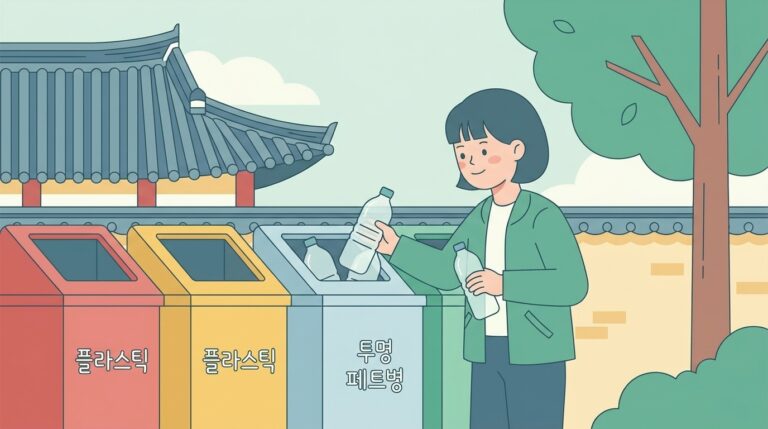
* Etiquette Tip: Always peel off clear plastic labels from water bottles and crush the bottle flat before tossing it in the transparent PET bin. Leaving labels on or throwing dirty containers away creates extra labor for elderly maintenance staff. A respectful nod and saying “수고하십니다” (Sugo-hasim-nida – Thank you for your hard work) goes a very long way.
4-2. Cultural Code: Label-Free & Eco-Merch
In Korea, major beverage brands now sell 라벨프리 (Label-Free) bottled drinks to reduce plastic pollution. Meanwhile, K-Pop companies are facing consumer pressure regarding plastic waste from physical CD albums and photocards. Fandoms actively initiate 친환경 플로깅 (Eco-friendly plogging—jogging while picking up trash) in the name of their favorite idols, demonstrating how fan culture drives green initiatives in modern Korean society.
Phase 5: Interactive Roleplay Scenario
Setting: An eco-friendly zero-waste grocery cafe in Mangwon-dong, Seoul. You are chatting with Min-jun, an eco-activist manager.
Characters:
* 민준 (Min-jun): Eco-cafe owner, passionate about zero-waste living.
* You (C1 Korean Learner): Eco-conscious resident seeking to reduce plastic footprints.
Dialogue
- 민준: 🎭 (반갑게 웃으며 손님을 맞이한다) 안녕하세요! 오늘 용기를 직접 가져오셨네요? (An-nyeong-ha-se-yo! O-neul yong-gi-reul jik-jeob ga-jyeo-o-syeos-nae-yo? / Hello! Did you bring your own containers today?)
- You: 🎭 (뿌듯한 표정으로 밀폐용기를 내밀며) 네! 일회용 플라스틱 사용을 줄이려고 ‘용기내 챌린지’에 동참하는 중이에요. (Ne! Ir-hwe-yong peul-la-seu-tik sa-yong-eul jul-i-ryeo-go ‘yong-gi-nae chael-lin-ji’e dong-cham-ha-neun jung-i-e-yo. / Yes! I’m participating in the ‘Container Challenge’ to reduce single-use plastic usage.)
- 민준: 🎭 (감탄하며 고개를 끄덕인다) 와, 대단하시네요! 사실 배달 음식 때문에 플라스틱 쓰레기가 엄청나잖아요. (Wa, dae-dan-ha-si-nae-yo! Sa-sil bae-dal eum-sik ttae-mun-e peul-la-seu-tik sseu-rae-gi-ga eom-cheong-na-jan-a-yo. / Wow, that’s impressive! Honestly, delivery food creates an immense amount of plastic trash.)
- You: 🎭 (진지한 눈빛으로 공감하며) 맞아요. 특히 성상별 분리배출이 잘 안 되면 재활용률이 떨어진다고 들었어요. (Ma-ja-yo. Teuk-hi seong-sang-byeol bun-ri-bae-chul-i jal an dwae-myeon jae-hwal-yong-ryul-i tteol-eo-jin-da-go deul-eoss-eo-yo. / Exactly. I heard that if material-based sorting isn’t done properly, recycling efficiency drops.)
- 민준: 🎭 (손뼉을 치며) 정확히 알고 계시네요! 페트병 라벨 떼는 것도 은근히 번거로운데 잘하고 계신가요? (Jeong-hwak-hi alg-o gye-si-nae-yo! Pe-teu-byeong ra-bel tte-neun geos-do eun-geun-hi beon-geo-roun-de jal-ha-go gye-sin-ga-yo? / You know your stuff! Peeling off PET bottle labels is quite tedious, are you managing that well?)
- You: 🎭 (자신감 있는 목소리로) 물론이죠. 라벨은 비닐로, 병은 페트 전용함에 엄격하게 구분해서 버려요. (Mul-ron-i-jo. Ra-bel-eun bi-nil-ro, byeong-eun pe-teu jeon-yong-ham-e eom-gyeok-ha-ge gu-bun-hae-seo beo-ryeo-yo. / Of course. I strictly separate labels into vinyl and bottles into the PET bin.)
- 민준: 🎭 (엄지를 치켜세우며) C1 실력자다우시네요! 우리 동네 환경 파수꾼으로 임명해야겠습니다. (C1 sil-ryeok-ja-da-u-si-nae-yo! U-ri dong-ne hwan-gyeong pa-su-kkun-eu-ro im-myeong-hae-ya-gess-seub-ni-da. / Truly worthy of a C1 advanced speaker! I should appoint you as our neighborhood environmental guardian.)
- You: 🎭 (미소를 지으며) 과찬이세요! 지속 가능한 사회를 위해 모두가 노력해야죠. (Gwa-chan-i-se-yo! Ji-sok ga-neung-han sa-hoe-reul wi-hae mo-du-ga no-ryeok-hae-ya-jo. / You flatter me! Everyone must make an effort for a sustainable society.)
🔀 Interactive Choice Point
Min-jun asks: *
Frequently Asked Questions (FAQ)
Q: What does "분리배출을 철저히 하다 (Bunri-baechul-eul cheoljeo-hi hada)" mean in Korean and how do you pronounce it?
A: In Korean, "분리배출을 철저히 하다 (Bunri-baechul-eul cheoljeo-hi hada)" is pronounced [Bun-ri-bae-chul-eul cheol-jeo-hi ha-da] and means: Literally "To thoroughly separate and discharge recyclables." Unlike simple 재활용 (recycling), 분리배출 emphasizes the actor's civic duty to sort items correctly before disposal.
Q: What does "일회용품 사용을 지양하다 (Irhwe-yongpum sayong-eul jiyang-hada)" mean in Korean and how do you pronounce it?
A: In Korean, "일회용품 사용을 지양하다 (Irhwe-yongpum sayong-eul jiyang-hada)" is pronounced [Il-hwe-yong-pum sa-yong-eul ji-yang-ha-da] and means: Direct translation: "To avoid/refrain from using single-use items." (Note: Do not confuse 지양하다 [to refrain] with 지향하다 [to aim for]).
Q: What does "용기내 챌린지에 동참하다 (Yong-gine chael-lin-ji-e dongcham-hada)" mean in Korean and how do you pronounce it?
A: In Korean, "용기내 챌린지에 동참하다 (Yong-gine chael-lin-ji-e dongcham-hada)" is pronounced [Yong-gi-nae chael-lin-ji-e dong-cham-ha-da] and means: "To participate in the Container/Courage Challenge." A clever Korean pun on 용기 (which means both "container/receptacle" and "courage"). It means taking your own reusable container to restaurants to buy food without plastic packaging.







