

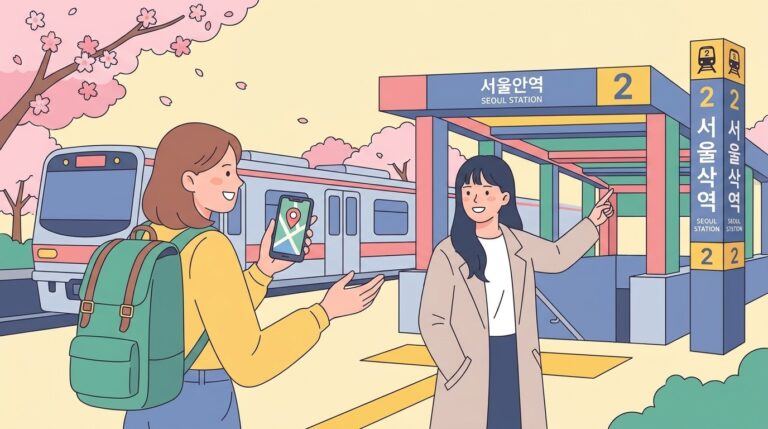
Lost in Seoul? How to Ask for Help in Korean Like a Pro!
안녕하세요! I’m your Daily Hangul editor and local culture navigator! Today, we are tackling a situation every traveler faces at least once: getting lost in a vibrant, bustling city like Seoul. Don’t worry! With just a few simple phrases, asking for directions can turn into a delightful local interaction.
Phase 1: Empathy (Getting Lost in Hongdae!)
안녕하세요! Welcome back to Daily Hangul! Imagine this: You just landed in Seoul, ready to explore the bustling, energetic streets of Hongdae. You want to visit that trendy cafe you saved on Instagram, but after walking out of Exit 9, you realize every alley looks surprisingly similar. Your phone battery is low, and your GPS dot is spinning erratically. Panic sets in!
Take a deep breath! Getting lost in Korea isn’t a disaster—it’s actually one of the best ways to experience warm Korean hospitality. Many of our learners tell us that their favorite travel memories started with asking a friendly local for directions. Today, we’ve prepared an easy, beginner-friendly (A2 level) guide based on real student experiences so you can turn any wrong turn into a fun memory.
Phase 2: Top 3 Essential Expressions
1. 저기요, 길을 잃었어요. (Jeogiyo, gileul ireosseoyo.)
- Pronunciation: Jug-yee-yo, gil-eul eer-oss-uh-yo (Think of ‘Jug’ like a water jug, and ‘gil’ like ‘gill’ of a fish!)
- Meaning: Literally “Excuse me over there, I lost my way.” -> “Excuse me, I’m lost.”
- K-Culture Moment: You hear “Jeogiyo!” constantly in K-dramas when a character calls a waiter or gets someone’s attention on the street.
- Editor’s Insight: Jeogiyo literally means “Hey over there,” but politely. It is the absolute best conversation starter in Korea.
- Situation Spectrum: Casual 🚫 / Semi-formal ✅ / Formal ✅
- 🤔 Think About It: In English, we say “I am lost.” In Korean, we say “I lost the road.” Notice how Korean focuses on the action regarding the path!
2. ~이/가 어디에 있어요? (~i/ga eodie isseoyo?)
- Pronunciation: [Location]-i/ga uh-dee-eh ees-suh-yo? (‘Uh-dee’ sounds like ‘a dee-p’ dive!)
- Meaning: “Where is [Location]?”
- K-Culture Moment: Used by travel vloggers searching for hidden street food stalls in Gwangjang Market.
- Editor’s Insight: Attach -i if the place name ends with a consonant (e.g., Hongdae-yeok-i), or -ga if it ends with a vowel (e.g., Namsan Tower-ga).
- Situation Spectrum: Casual ⚠️ / Semi-formal ✅ / Formal ✅
- 🤔 Think About It: Koreans drop subject pronouns (like ‘you’ or ‘I’) constantly to keep speech efficient and polite!
3. 여기서 멀어요? (Yeogiseo meoreoyo?)
- Pronunciation: Yuh-gi-seo muhl-uh-yo? (‘Muhl’ sounds similar to ‘mull’ over a decision!)
- Meaning: “Is it far from here?”
- K-Culture Moment: When characters in reality shows are on a walking tour and get tired!
- Editor’s Insight: If it’s close, they will answer “Aniyo, gakkawoyo” (No, it’s close). Super useful to decide whether to walk or catch a taxi!
- Situation Spectrum: Casual 🚫 / Semi-formal ✅ / Formal ✅
- 🤔 Think About It: In Korea, distance is often answered in walking minutes (e.g., “5 minutes walk!”) rather than physical distance.
Phase 3: Textbook Korean vs. Real Korean
Situation 1: Calling someone over politely
- 📖 Textbook: 신례합니다. (Sillyehamnida. – Excuse me.)
- 🗣️ Real Life: 저기요~ (Jeogiyo~ – Excuse me!)
- 💡 Why the difference? Sillyehamnida is very formal and rarely used on the street unless bumping into someone. Jeogiyo is friendly and universally used.
Situation 2: Asking where the subway station is
- 📖 Textbook: 지하철역이 어디에 있습니까? (Jihacheolyeogi eodie isseumnika?)
- 🗣️ Real Life: 지하철역 어디예요? (Jihacheolyeok eodiyeyo?)
- 💡 Why the difference? Modern spoken Korean drops formal ending particles in everyday casual encounters while maintaining politeness with -yo.
Phase 4: K-Culture Deep Dive & Non-Verbal Manners
4-1. Nunchi & Gestures
When asking for directions, slight head tilts and open-palm gestures go a long way! Never point directly at someone’s face with a single index finger. Instead, gesture towards your phone map using both hands or an open palm. A slight head bow when saying “Jeogiyo” immediately signals respect.
4-2. Culture Code: The “Station Exit” Magic
In K-Travel culture, directions are always centered around subway exit numbers! Koreans won’t say “Turn left at the bank”; they will say “Go out Exit 3.” Master exit numbers, and you’ll never get lost!
Phase 5: Real-Life Roleplay Scenario
Setting: Outside Hongdae Station. You are looking for a famous bakery.
NPC Character: A friendly college student wearing a stylish oversized trench coat.
- You: 저기요, 죄송한데요… (Jeogiyo, joesonghandeyo…)
🎭 [Action: Bow head slightly and show your phone map]
Translation: Excuse me, I’m sorry to bother you… - Student: 네? 무슨 일이에요? (Ne? Museun irieyo?)
🎭 [Action: Takes off one earbud and smiles]
Translation: Yes? What’s the matter? - You: 길을 잃었어요. 이 카페 어디에 있어요? (Gileul ireosseoyo. I kape eodie isseoyo?)
🎭 [Action: Point at the screen image]
Translation: I’m lost. Where is this cafe? - Student: 아, 여기요! 여기서 가까워요. (A, yeogiyo! Yeogiseo gakkawoyo.)
🎭 [Action: Nods warmly and inspects the map]
Translation: Ah, this place! It’s close from here. - You: 걸어서 갈 수 있어요? (Georeoseo gal su isseoyo?)
🎭 [Action: Tilt head with a curious expression]
Translation: Can I walk there? - Student: 네! 오른쪽으로 직진하세요. 5분 걸려요. (Ne! Oreunjogeuro jikjinhaseyo. Obun geollyeoyo.)
🎭 [Action: Points towards the right street]
Translation: Yes! Go straight to the right. It takes 5 minutes. - You: 아, 정말 감사합니다! (A, jeongmal gamsahamnida!)
🎭 [Action: Bright smile with a polite bow]
Translation: Ah, thank you so much! - Student: 아니에요, 즐거운 여행 되세요! (Anieyo, jeulgeoun yeohaeng doeseyo!)
🎭 [Action: Waves hand gently]
Translation: No problem, have a nice trip!
🔀 Interactive Choice Point!
What will you say after the student gives you directions?
* Option A: 감사합니다! (Gamsahamnida!)
* Option B: 고마워. (Gomawo.)
* Option C: (Silent thumbs up)
Feedback:
* Option A (BEST): Perfect! Polite and natural for an A2 learner.
* Option B (RISK): Gomawo is informal (banmal). Don’t use it with strangers, even if they look younger!
* Option C (BAD): Korean culture values verbal gratitude accompanied by a small bow.
Phase 6: 10-Second Emotion Shadowing Drill
[🥺 Softly & Politely]저기요… / 길을 잃었어요. (Jeogiyo… / gileul ireosseoyo.)[❓ Curiously]여기서 / 얼마나 걸려요? (Yeogiseo / eolmana geollyeoyo?)[😊 Relieved & Happy]아! / 정말 감사합니다! (A! / Jeongmal gamsahamnida!)
Phase 7: K-Culture Mini Dictionary
- 출구 (Chulgu) | Exit | Essential for subway navigation (e.g., 3번 출구 = Exit 3).
- 직진 (Jikjin) | Straight ahead | Used when telling someone to keep walking straight.
- 오른쪽 / 왼쪽 (Oreunjok / Oenjok) | Right side / Left side | Directional terms you’ll hear constantly.
- 지도 (Jido) | Map | Refers to navigation apps on your smartphone.
Phase 8: Traveler’s Survival Kit
Survival TOP 3
- 도와주세요! (Dowajuseyo!) – Please help me!
- 지하철역 (Jihacheolyeok) – Subway station.
- 여기 어디예요? (Yeogi eodiyeyo?) – Where am I right now?
Editor’s Travel Note
Google Maps doesn’t work well for walking routes in Korea due to local data privacy laws! Before your trip, make sure to download the Naver Map Navigation App or KakaoMap. They offer full English interfaces and pinpoint accurate walking directions!
Phase 9: A Step Deeper (Reflection)
In Korean culture, helping someone who is lost is considered a warm act of community care (Jeong). Don’t be afraid to ask elderly locals or students; people often go out of their way to walk with you for a block to show the right direction!
💬 Your Turn: Have you ever gotten lost in a foreign country? How did you ask for help? Let us know in the comments below!
Phase 10: FAQ & Common Mistakes
Q: Can I just use English with young people in Seoul?
A: Many young Koreans understand basic English, but starting with “Jeogiyo, gileul ireosseoyo” in Korean shows respect and makes them much more eager to help!
Q: What if I don’t understand their fast Korean explanation?
A: Simply say: 천천히 말씀해 주세요 (Cheoncheonhi malssamhae juseyo) – “Please speak slowly.”
Q: How do I know if a place is walkable?
A: Ask “걸어서 갈 수 있어요?” (Georeoseo gal su isseoyo?). If they wave their hand ‘no’, take a taxi or subway.
🚨 Common Mistakes TOP 3
- Mistake: Calling a stranger “Eonni” or “Oppa” for directions.
Correct Action: Stick to 저기요 (Jeogiyo). - Mistake: Using Gomawo (informal thanks) to a helpful local.
Correct Action: Always say 감사합니다 (Gamsahamnida). - Mistake: Pointing directly with one finger.
Correct Action: Point with an open palm or show your phone screen directly.
Phase 11: Action Mission
- 🥉 Bronze: Practice saying “저기요, 길을 잃었어요” 3 times out loud.
- 🥈 Silver: Share this article on social media and tag your Korean learning buddy!
- 🥇 Gold: Try asking for a spot’s location in Korean on your next trip or in online Korean practice!
🎮 K-Culture Mission: Watch a scene in your favorite K-drama where characters meet in Hongdae or Gangnam, and spot the exit numbers on subway signs!
Phase 12: Interactive Quiz Challenge
Q1. How do you call someone politely to ask for directions on the street?
a) 야! (Ya!)
b) 저기요 (Jeogiyo)
c) 오빠 (Oppa)
Click to reveal Answer & Explanation
b) 저기요 (Jeogiyo) is the correct polite phrase to get a stranger’s attention!
Q2. Complete the sentence: “Where is the station?” -> “역이 _____ 있어요?”
a) 어디에 (eodie)
b) 누구 (nugu)
c) 무엇 (mueot)
Click to reveal Answer & Explanation
a) 어디에 (eodie) means ‘where’.
Q3. True or False: Google Maps is the most accurate walking map app in Korea.
Click to reveal Answer & Explanation
False! You should download Naver Map or KakaoMap for accurate local navigation.







