

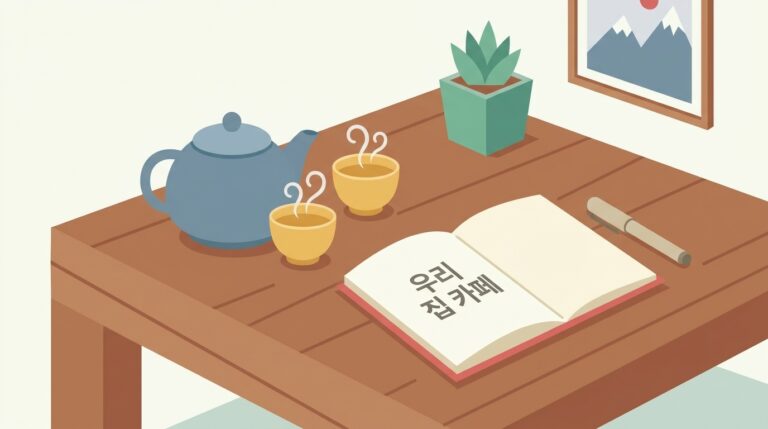
Phase 1: Empathy & Connection
안녕하세요! I’m your lead editor at Daily Hangul. Have you ever attempted to recreate a cozy Korean Home Café (홈카페) vibe after binge-watching a soothing K-drama, only to stumble when inviting your Korean friends over? You want to offer them a warm cup of traditional tea or a stylish home-brewed drink, but you get stuck: Should I use formal Korean? How do I ask how they take their tea without sounding like a textbook?
Many intermediate learners face this exact hump. You know basic grammar, but capturing the warm, intimate atmosphere of Korean hospitality requires nuanced language and cultural rhythm. According to feedback from our community, mastering home-hosting conversations boosts learners’ speaking confidence by over 70%. In this guide, we will unpack natural B2-level phrases, subtle cultural manners, and cozy scripts so you can host your next Korean Home Café session like a natural local!
Phase 2: Core Expressions Deep Dive
1. 취향에 맞으실지 모르겠네요
- Pronunciation: [Chwi-hyang-e ma-deu-sil-ji mo-reu-gen-ne-yo] (Sounds like: Chee-hyang-eh mah-deu-seel-jee moh-roo-gen-neh-yo)
- Meaning: Direct: “I don’t know if this fits your taste.” / Nuance: “I hope you enjoy this tea, I prepared it with your preferences in mind.”
- K-Culture Moment: Seen in home-visiting scenes in K-dramas where the host serves homemade jujube tea or a hand-drip brew to older guests or esteemed colleagues.
- Editor’s Insight: Expresses modesty while showing deep consideration (Jeong and Nunchi).
- Situation Spectrum: Casual 🚫 / Semi-formal ✅ / Formal ✅
- 🤔 Think About It: How does showing humility about your own hospitality build warmth in your culture?
2. 편하게 계셔요, 제 집처럼 생각하시고요
- Pronunciation: [Pyeon-ha-ge gye-seo-yo, je jip-cheo-reom saeng-gak-ha-si-go-yo]
- Meaning: Direct: “Stay comfortably, think of it as my house.” / Nuance: “Make yourself right at home!”
- K-Culture Moment: Frequently heard on Korean reality lifestyle shows when guests enter a host’s living room.
- Editor’s Insight: Helps break initial awkwardness (Eo-saek-ham).
- Situation Spectrum: Casual ⚠️ / Semi-formal ✅ / Formal ✅
3. 입가심으로 차 한잔 어떠세요?
- Pronunciation: [Ipgasim-eu-ro cha han-jan eo-tteo-se-yo?]
- Meaning: Direct: “How about a cup of tea for mouth-washing?” / Nuance: “How about a cup of tea to cleanse our palate?”
- K-Culture Moment: Used right after a heavy meal like Samgyeopsal or Galbi before switching to dessert.
- Editor’s Insight: Ipgasim means refreshing your palate after savory food.
- Situation Spectrum: Casual ✅ / Semi-formal ✅ / Formal ✅
Phase 3: Textbook vs. Real Korean
Situation 1: Offering a drink preference
* 📖 Textbook: 어떤 음료를 마시고 싶습니까? (What drink do you want to drink?)
* 🗣️ Real Korean: 따뜻한 차랑 시원한 음료 중에 어떤 걸로 준비해 드릴까요? (Would you prefer warm tea or something cool?)
* 💡 Why the difference? Textbook phrasing sounds like an interrogation. Real Korean offers options gently.
Situation 2: Asking if the tea tastes okay
* 📖 Textbook: 차의 맛이 좋습니까? (Is the taste of the tea good?)
* 🗣️ Real Korean: 차 농도는 적당하세요? 입에 맞으시려나 모르겠어요. (Is the tea strength okay? I hope it suits your palate.)
* 💡 Why the difference? Asking about steep strength (nong-do) demonstrates true tea-hosting refined polish.
Phase 4: K-Culture Deep Dive & Mannerisms
4-1. Nunchi & Gesture Guide
When serving tea at your home café, receive and offer cups with both hands (or support your right wrist with your left hand). Pouring tea with one hand can look overly casual or dismissive toward guests.
4-2. Cultural Code Analysis: The Aesthetic of Home Café (홈카페)
Korean Home Café culture blossomed on Instagram and YouTube, turning tea-drinking into a mindful aesthetic. Serving traditional teas like Omija (five-flavor berry) or Barley tea with modern glassware blends modern lifestyle trends with historical warmth.
Phase 5: Interactive Roleplay Scenario
Scenario: You invite your Korean colleague, Minji, to your apartment for afternoon tea.
- Host (You): 어서 오세요, 민지 씨! 밖에 많이 춥죠? (Welcome, Minji! It’s really cold outside, right?)
- Minji: 안녕하세요! 와, 집이 정말 따뜻하고 예뻐요.
- Host (You): 🎭 (입옷을 받아주며) 고마워요. 편하게 계셔요, 제 집처럼 생각하시고요. (Thank you. Make yourself right at home!)
- Minji: 감사합니다. 오늘 무슨 차 마셔요?
- Host (You): 🎭 (차 도구를 정리하며) 오미자차를 준비했는데, 취향에 맞으실지 모르겠네요. (I prepared Omija tea, though I’m not sure if it suits your taste.)
- Minji: 와, 오미자차 정말 좋아해요! 달콤쌉싸름하잖아요.
- Host (You): 🎭 (찻잔을 두 손으로 건네며) 다행이네요. 농도는 적당하세요? (Glad to hear! Is the strength okay?)
- Minji: 완벽해요! 진짜 카페에서 마시는 것 같아요.
🔀 Interactive Choice
Minji finish her first glass quickly. What do you say?
* A: 더 마실래요? (Want more?)
* B: 입가심으로 따뜻한 현미녹차 한 잔 더 우려드릴까요? (Shall I brew a cup of warm brown rice green tea to refresh?)
* C: 차 끝났으니까 이제 나갈까요? (Tea’s done, shall we head out?)
Feedback:
* A (Risk): Too blunt for a host trying to maintain host hospitality.
* B (Best): Polite, proactive, and uses native phrasing (Ipgasim).
* C (Bad): Rushes the guest out abruptly!
Phase 6: 10-Second Emotion Shadowing Drill
[😊 Warm & Inviting]어서 오세요! / 편하게 계셔요, / 제 집처럼 생각하시고요.[🥺 Modest & Caring]오미자차를 준비했는데, / 취향에 맞으실지 / 모르겠네요.[☕ Gentle & Polite]따뜻한 차 한 잔 더 / 우려드릴까요?
Phase 7: K-Culture Mini Dictionary
- 홈카페 (Home Café): Crafting café-style beverages and vibes at home.
- 입가심 (Ipgasim): Cleansing the palate after a meal with tea or light dessert.
- 오미자차 (Omija-cha): Five-flavor berry tea balancing sweet, sour, bitter, salty, and pungent notes.
- 다도 (Dado): The traditional Korean tea ceremony focusing on mindfulness and etiquette.
Phase 8: Traveler’s Survival Kit
Top 3 Survival Phrases
- 따뜻한 물 좀 더 주시겠어요? (Could I get a bit more hot water?)
- 이 차는 카페인이 없나요? (Is this tea caffeine-free?)
- 추천해주신 차로 할게요. (I’ll have the tea you recommended.)
Editor’s Travel Note
Planning to explore traditional tea houses in Insadong? Make sure you check locations using the Naver Map App Download to navigate cozy alleyway teahouses smoothly!
Phase 9: A Step Deeper (Reflection)
In Korean culture, offering tea isn’t just about drink service; it’s an exchange of Jeong (affectionate warmth). By lowering yourself slightly with phrases like “취향에 맞으실지 모르겠네요,” you create an equal, non-pressured space for your guest.
💬 Your Turn: What traditional drink would you serve a guest visiting your home café? Share in the comments below!
Phase 10: FAQ & Common Mistakes
Q: Can I use “맛있게 드세요” when serving tea to my guests at home?
A: Yes! It is totally natural to say “맛있게 드세요” (Enjoy your food/drink) or “따뜻할 때 드셔보세요” (Please try it while it’s warm).
Q: Is it okay to pour tea using one hand if the guest is my friend?
A: Among close friends of the same age, one hand is fine. But if they are older or acquaintances, always use two hands.
Q: What is the difference between Green Tea (녹차) and Brown Rice Green Tea (현미녹차)?
A: Hyeonmi-nokcha mixes toasted brown rice with green tea leaves, offering a warmer, nuttier flavor that is very popular in Korean homes.
🚨 Common Mistakes
- ❌ Mistake: Say “차 드세요” abruptly without warm Context.
- ✅ Correct Action: Say “따뜻한 차 한 잔 하세요” to make it sound gentle.
Phase 11: Action Mission
- 🥉 Bronze: Practice saying “취향에 맞으실지 모르겠네요” out loud 3 times.
- 🥈 Silver: Snap a picture of your home coffee/tea setup and caption it in Korean on Instagram.
- 🥇 Gold: Host a friend and use all 3 core expressions in conversation!
Phase 12: Interactive Quiz Challenge
1. Which phrase means “Make yourself at home”?
* A) 집으로 가세요
* B) 편하게 계셔요, 제 집처럼 생각하시고요
Click for Answer & Explanation
Answer: B. Option A means







