

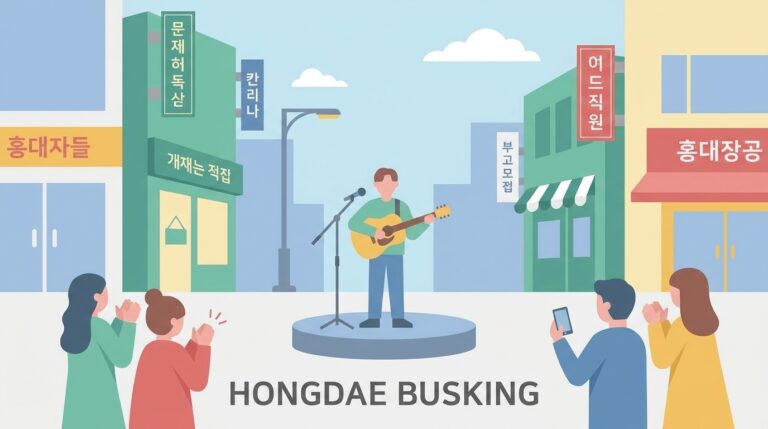
안녕하세요! 매일한글 에디터입니다. Have you ever dreamed of organizing or performing in an energetic busking show on the vibrant streets of Hongdae or Hyehwa? Stepping into the world of live street performance in Korea is thrilling, but C1-level professionals and advanced learners often hit a wall with nuanced, real-world industry terminology. You might know basic phrases, but managing crowds, coordinating with local artists, and handling sudden site logistics require advanced communicative polish. In this guide, we dive deep into the real-world Korean used behind the scenes of busking production—backed by authentic feedback from indie arts managers and outdoor event coordinators.
1. 관객을 사로잡다 (Gwan-gaek-eul sa-ro-jap-da)
- Pronunciation: [Gwan-gaek-eul sa-ro-jap-da] (Sounds like “Gwan-gaek” + “sah-roh-jahp-dah”, like captivating or capturing a heart)
- Meaning: Literally “to capture the audience”; nuanced as captivating the crowd through intense stage presence.
- K-Culture Moment: Often used by indie managers on K-Drama shows when an unannounced Hongdae street performer stops hundreds of passersby instantly.
- Editor’s Insight: Advanced speakers use this instead of simple terms like ‘인기가 있다’ (to be popular) to emphasize emotional engagement.
- Situation Spectrum: Casual ⚠️ / Semi-formal ✅ / Formal ✅
- 🤔 Think About It: How does your culture describe a performance that completely halts street traffic?
2. 현장 현황을 파악하다 (Hyeon-jang hyeon-hwang-eul pa-ak-ha-da)
- Pronunciation: [Hyeon-jang hyeon-hwang-eul pa-ak-ha-da] (Pronounce ‘pa-ak’ clearly like ‘pah-ahk’)
- Meaning: Literally “to grasp the site situation”; native nuance means assessing crowd density, noise limits, and technical setups on-site.
- K-Culture Moment: Used by busking production crews monitoring noise complaints or space permits in real-time.
- Editor’s Insight: Perfect for high-level professional coordination before turning on the amplifiers.
- Situation Spectrum: Casual 🚫 / Semi-formal ✅ / Formal ✅
- 🤔 Think About It: Why is on-site situational awareness crucial in densely populated Korean urban areas?
3. 호응을 유도하다 (Ho-eung-eul yu-do-ha-da)
- Pronunciation: [Ho-eung-eul yu-do-ha-da] (‘Ho-eung’ flows like ‘ho-eung’)
- Meaning: To induce/elicit enthusiastic audience responses (clapping, sing-alongs).
- K-Culture Moment: Street artists encouraging the classic Korean ‘떼창’ (singing along in unison) during an acoustic performance.
- Editor’s Insight: It highlights deliberate stagecraft rather than passive hope for audience reaction.
- Situation Spectrum: Casual ⚠️ / Semi-formal ✅ / Formal ✅
- 🤔 Think About It: How does ‘떼창’ reflect collective energy in Korean performing arts?
📖 교과서 한국어: “사람들을 모으고 공연을 시작합시다.”
🗣️ 진짜 한국어: “관객을 자연스럽게 사로잡으면서 호응을 유도해 볼까요?”
💡 왜 다를까?: Advanced production relies on nuanced leadership vocabulary rather than blunt directives.
📖 교과서 한국어: “여기 상황이 어떻습니까?”
🗣️ 진짜 한국어: “지금 현장 현황 빠르게 파악해 주실 수 있나요?”
💡 왜 다를까?: Professional Korean business contexts favor ‘현황 파악’ for rapid, actionable status updates.
4-1. Nunchi & Street Etiquette
Busking in Korea demands high ‘Nunchi’ (situational tact). Always gauge the distance between neighboring buskers and monitor local residential noise thresholds. Subtle head nods to nearby shopkeepers establish goodwill.
4-2. K-Culture Deep Dive: The Hongdae Busking Ecosystem
Hongdae isn’t just a street; it’s a structured stage with reservation systems managed by local cultural foundations. Understanding this balance between raw indie spirit and organized municipal management is key to successful event execution.
Setting: A bustling evening at Hongdae Busking Zone #2. You are managing an acoustic busking event with local coordinator Min-woo.
- Min-woo: “팀장님, 지금 관객들이 점점 모이고 있는데 소음 민원이 들어올까 봐 걱정되네요.”
(Manager, crowd is growing, but I’m worried about noise complaints.) - You: 🎭 (Checking the soundboard calmly) “우선 현장 현황부터 파악해 봅시다. 데시벨 측정기 확인했나요?”
(First, let’s assess the site situation. Did you check the decibel meter?) - Min-woo: “네, 현재 기준치 바로 밑입니다. 앰프 출력을 조금 낮출까요?”
(Yes, it’s just under the limit. Should we lower the amp output?) - You: 🎭 (Nodding thoughtfully) “출력은 유지하되, 아티스트에게 자연스럽게 호응을 유도하라고 전달해 주세요.”
(Keep the output, but tell the artist to naturally engage the crowd instead.) - Min-woo: “좋습니다! 관객들을 사로잡기에 딱 좋은 분위기네요.”
(Great! Perfect atmosphere to captivate the audience.) - You: 🎭 (Smiling with confidence) “좋아요, 돌발 상황에 대비해서 멘트도 미리 정리해 둡시다.”
(Good, let’s also prepare quick stage comments for any sudden variables.) - Min-woo: “알겠습니다. 바로 아티스트와 동선 점검하겠습니다.”
(Understood. I will check stage movement with the artist right away.) - You: 🎭 (Giving a thumbs up) “완벽해요. 멋진 공연 만들어 봅시다!”
(Perfect. Let’s make an awesome show!)
🔀 Interactive Choice: A resident approaches complaining about space blocking.
* Option A: “법적으로 허가받은 구역입니다.” (Strict compliance)
* Option B: “죄송합니다! 바로 동선을 정돈해서 통행에 불편이 없도록 조치하겠습니다.” (Diplomatic & Proactive)
* Option C: “조금만 참아주세요.” (Casual request)
Feedback: Option B is BEST! It exhibits peak professional Nunchi, mitigating conflict while keeping the performance running smoothly.
- [😊 Bright & confident] “우선 / 현장 현황부터 / 빠르게 파악해 봅시다!”
- [🔥 Energetic] “자연스럽게 / 관객의 호응을 / 유도해 보세요!”
- [✨ Inspiring] “오늘 무대로 / 관객들을 완전히 / 사로잡아 봅시다!”
- 떼창 (Tte-chang) | Mass Sing-along | A staple of Korean live music culture where the audience sings in harmony.
- 버스킹 Zone (Busking Zone) | Designated Performance Area | Mapped municipal zones reserved for licensed street performances.
- 소음 민원 (So-eum Min-won) | Noise Complaint | Administrative feedback regarding decibel limits in urban areas.
- 동선 (Dong-seon) | Movement Flow/Line | The calculated movement path for performers and audience clearance.
- “현장 현황 확인해 주세요.” (Please check the site status.)
- “소음 기준치를 준수해 주세요.” (Please follow the decibel limit.)
- “통행에 방해되지 않게 정돈해 주세요.” (Please arrange the area to keep pathways clear.)
Editor’s Travel Note: When organizing or watching street shows in Seoul, use the Smart Seoul Map to check public performance permits and active busking zones!
Korean performing arts thrive on dynamic interaction between artist, organizer, and community. Busking is not merely playing music outdoors; it is a shared cultural dialogue that respects urban harmony and collective emotion.
💬 Your Turn: Have you ever watched or managed a street performance in Korea? Share your favorite memory in the comments below!
Q: Can anyone set up an amp and perform in Hongdae?
A: No, most major busking zones require advance reservations via local district office portals to ensure safety and noise control.
Q: How do managers handle sudden crowd overspill?
A: Organizers deploy field staff to maintain a clear 2-meter pedestrian walkway using soft cues rather than aggressive shouting.
Q: What is the ideal decibel limit for Korean busking?
A: Generally, it is kept under 60–65 dB during evening hours depending on proximity to commercial or residential spaces.
🚨 Common Mistake: Demanding residents move away aggressively.
Correct Action: Acknowledge their concern immediately with polite honorifics and adjust equipment placement.
- Bronze: Practice saying “현장 현황을 파악하다” out loud 3 times.
- Silver: Record your voice practicing the 10-second Shadowing Drill and review your pauses.
- Gold: Visit a local busking performance and identify how the crew manages crowd movement.
🎮 K-Culture Mission: Watch a live busking clip on YouTube and write down one phrase the artist uses to induce audience response (호응 유도)!
Q1. Fill in the blank: 관객들의 반응을 이끌어내는 것을 ‘호응을 ___’라고 합니다.
정답 보기
정답: 유도하다 (To induce/elicit)
Q2. True/False: Korean busking zones allow unlimited volume levels as long as it is before midnight.
정답 보기
정답: False (Decibel limits apply strictly to protect public areas).







