

Master Doljanchi Wishes: Warm Korean Blessings for a Baby’s First Birthday
Phase 1: Empathy (Welcome to the Warmth of a Korean Doljanchi!)
안녕하세요! (Annyeonghaseyo!) Hello there, my dear friend and fellow Korean language explorer! It’s your Daily Hangul editor and local culture navigator here.
Imagine this: You’ve been invited to a Doljanchi (돌잔치)—the grand, heartwarming celebration of a Korean baby’s very first birthday. The room is filled with laughter, the sweet aroma of tteok (rice cakes), and colorful Hanbok fabrics. Suddenly, the baby’s parents guide you toward the guest book, or hand you a microphone during the feast. Everyone is sharing beautiful, heartfelt wishes (deokdam, 덕담) for the little one.
You want to say something deeper than just “Happy Birthday,” but your mind goes blank. “Is Saeng-il chukha-haeyo too casual? What do Korean aunties and uncles say to wish the baby a bright future?”
Don’t worry! Today, we are unlocking the secret, warm, and highly practical blessings that will make the baby’s family deeply touched. Based on years of helping Korean learners navigate these intimate family moments, I promise that by the end of this guide, you will be able to deliver a blessing that sounds incredibly natural and culturally respectful. Let’s dive in! 👋✨
Phase 2: Deep Dive into 3 Essential Blessings
Here are the top three blessings used by Korean family and friends. Let’s break down how they work, how to say them, and why they matter.
1. 건강하고 밝게 자라기를 바랄게. (Geon-gang-hago balk-ge jara-gireul baral-ge.)
- Pronunciation: Gun-gang-ha-go bahlk-ge ja-ra-gi-reul bah-ral-geh (Sounds like “gun” as in shotgun, “gahn” like gone, “bahlk” like bulk with an ‘ah’ sound)
- Meaning: I pray/hope you grow up healthy and bright.
- K-Culture Moment: This is the ultimate classic. You will hear this exact phrase whispered by grandmothers in K-dramas (like Reply 1988 or Hi Bye, Mama!) while kissing a baby’s forehead.
- Editor’s Insight: In Korean culture, being “bright” (balk-da, 밝다) doesn’t just mean smart; it means having a cheerful, sunny, and positive disposition that brings joy to those around them.
- Situation Spectrum: Casual ✅ | Semi-formal ✅ | Formal ⚠️
- 🤔 Think About It: In many Western cultures, we often wish for babies to become “successful” or “independent.” Why do you think Korean blessings focus so heavily on “health and brightness” first?
2. 첫돌을 진심으로 축하해! (Cheot-dol-eul jinsim-euro chukha-hae!)
- Pronunciation: Chut-dohl-eul jin-shim-eu-ro choo-kah-hae! (The ‘chut’ sounds like ‘chutney’, ‘dohl’ rhymes with ‘toll’)
- Meaning: Happy first birthday from the bottom of my heart!
- K-Culture Moment: Often written on the beautiful gold-stamped envelopes containing dol-banji (돌반지, 24K gold rings traditionally gifted to babies for financial security).
- Editor’s Insight: Cheot-dol (첫돌) literally means “first cycle” or “first anniversary of life.” Adding jinsim-euro (진심으로, sincerely/from the heart) instantly elevates your wish from a standard greeting to a deeply personal blessing.
- Situation Spectrum: Casual ✅ | Semi-formal ✅ | Formal ✅ (If you add chukha-haeyo / chukha-dril-yeo-yo)
- 🤔 Think About It: How does naming a specific milestone like cheot-dol change the feeling of a birthday greeting compared to a generic yearly birthday?
3. 앞으로 꽃길만 걷자! (Apeuro kkot-gil-man geot-ja!)
- Pronunciation: Ah-peu-ro kkoht-gil-mahn gut-jah! (‘Kkoht’ has a sharp, tense ‘K’ sound, like ‘coot’ but clipped. ‘Gut-ja’ rhymes with ‘nut-jah’)
- Meaning: May you only walk on flower paths from now on!
- K-Culture Moment: This is a modern, trendy blessing popularized by K-Pop fandoms and youth culture, now widely embraced by young parents at modern Doljanchis.
- Editor’s Insight: “Walking only on flower paths” is a beautiful metaphor meaning “may your life be smooth, peaceful, and filled with beautiful things, free of hardships.”
- Situation Spectrum: Casual ✅ | Semi-formal ⚠️ | Formal 🚫
- 🤔 Think About It: Can you think of a similar poetic metaphor in your native language that wishes someone a life free of obstacles?
Phase 3: Textbook Korean vs. Real-Life Korean
Let’s compare stiff, textbook sentences with what friendly Koreans actually say at a Doljanchi.
Scenario 1: Wishing the baby a great future
- 📖 Textbook Korean: 아기가 훌륭한 사람이 되기를 기원합니다. (Agiga hullyunghan sarami doegireul giwonhamnida. – “I pray the baby becomes a great person.”)
- 🗣️ Real-Life Korean: 우리 예쁜 아기, 훌륭하고 멋지게 잘 자라라! (Uri yeppeun agi, hullyunghago meotjige jal jarara! – “Our pretty baby, grow up wonderfully and coolly!”)
- 💡 Why the difference? The textbook version sounds like a formal written contract. Real-life Korean uses uri (우리, our) to show affection and closeness, even if the baby isn’t biologically yours!
Scenario 2: Congratulating the tired parents
- 📖 Textbook Korean: 자녀의 양육에 노고가 많으십니다. (Janyeoui yangyuge nogoga maneusimnida. – “You have put much labor into raising your child.”)
- 🗣️ Real-Life Korean: 그동안 키우느라 진짜 고생 많았어! (Geudongan kiuneura jinjja gosaeng manasseo! – “You really went through so much hard work raising the baby this past year!”)
- 💡 Why the difference? Raising a child for a year in Korea is recognized as a monumental community effort. Acknowledging the parents’ gosaeng (고생, hardship/sweet toil) with a warm hug is culturally highly appreciated.
Phase 4: K-Culture Deep Dive & Non-Verbal Etiquette
4-1. Nunchi (눈치) & Body Gestures at a Doljanchi
When you offer your blessing, your body language speaks volumes:
1. The Double-Hand Envelope Pass: When presenting the gift envelope (usually containing cash or a gold ring), always hold it with both hands. Slightly bow your head as you hand it to the parents.
2. Eye Contact with the Baby: Don’t just look at the parents. Lean down slightly, make soft eye contact with the baby, clap your hands gently, and say “Aigu, yeppuda~” (Aww, so pretty~).
4-2. The Cultural Heart: Doljabi (돌잡이)
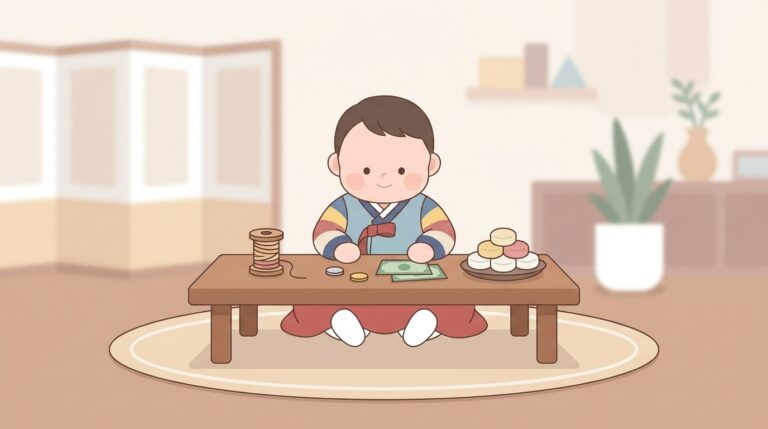
The highlight of any Doljanchi is the Doljabi (돌잡이). The baby is placed in front of various symbolic items (a thread for long life, money for wealth, a pencil for academic success, a stethoscope for medical career, etc.). Whichever item the baby grabs first is believed to predict their future!
* If the baby grabs the money (돈, don) or gold, shout: “* 부자 되겠다!” (Buja doegessda!* – “They’re going to be rich!”)
* If they grab the thread (실, sil), smile warmly and say: “건강하게 오래 살겠네~” (Geon-gang-hage orae salgenne~ – “They will live a long, healthy life!”)
Phase 5: Real-Life Roleplay Scenario
The Setting
You are attending the Doljanchi of Minji (your close Korean colleague’s baby girl). The venue is a beautiful, modern hanok-style restaurant in Seoul. Minji’s mother, Ji-young, approaches you holding the adorable baby dressed in a bright pink hanbok.
Characters
- Ji-young (Minji’s Mom): Proud, slightly exhausted, but absolutely glowing.
- You: A warm, respectful colleague who wants to deliver a perfect blessing.
Dialogue
- Ji-young: “어머, 와 주셔서 정말 감사해요! 오늘 민지 첫 생일이에요.”
(Eomeo, wa jusyeoseo jeongmal gamsahaeyo! Oneul Minji cheot saeng-ir-ieyo.)
“Oh, thank you so much for coming! Today is Minji’s first birthday.” -
You: “🎭 (Smiling warmly and bowing slightly) 초대해 주셔서 감사해요! 민지가 진짜 천사 같아요.”
(Chodaehae jusyeoseo gamsahaeyo! Minjiga jinjja cheonsa gat-ayo.)
“Thank you for inviting me! Minji really looks like an angel.” -
Ji-young: “감사해요. 벌써 일 년이 지났네요. 시간 참 빨라요, 그쵸?”
(Gamsahaeyo. Beolsseo il nyeon-i jinanneyo. Sigan cham ppallayo, geucho?)
“Thank you. A year has already passed. Time flies so fast, right?” -
You: “🎭 (Nodding sympathetically) 맞아요. 그동안 민지 키우느라 진짜 고생 많으셨어요.”
(Maj-ayo. Geudongan Minji kiuneura jinjja gosaeng maneusyeosseoyo.)
“That’s true. You’ve really worked so hard raising Minji this past year.” -
Ji-young: “🎭 (Teared up slightly with gratitude) 알아주시니 정말 감동이에요. 민지한테 덕담 한마디 해 주실래요?”
(Arajusini jeongmal gamdong-ieyo. Minjihante deokdam hanmadi hae jusillaeyo?)
“I’m so touched that you understand. Would you like to say a word of blessing to Minji?” -
You: “🎭 (Making gentle eye contact with the baby and waving tiny fingers) 민지야, 앞으로 건강하고 밝게 자라기를 바랄게!”
(Minji-ya, apeuro geon-gang-hago balk-ge jara-gireul baral-ge!)
“Minji, I hope you grow up healthy and bright from now on!” -
Ji-young: “우와, 한국어 덕담 너무 감동적이에요! 진짜 감사해요.”
(Uwa, Han-gugeo deokdam neomu gamdong-jeog-ieyo! Jinjja gamsahaeyo.)
“Wow, your Korean blessing is so moving! Thank you so much.” -
You: “🎭 (Handing over the gift envelope with both hands) 민지의 앞날에 꽃길만 가득하길 응원해요!”
(Minji-ui ap-nal-e kkot-gil-man gadeuk-hagil eung-won-haeyo!)
“I’m rooting for Minji’s future to be fully filled with flower paths!”
🔀 Interactive Choice Point
During the Doljabi, the baby picks up the gavel (판사봉, pansabong – representing a judge/lawyer). What do you say?
- A. “변호사 되겠다! 멋져요!” (Byeonhosa doegessda! Meotjyeoyo! – “She’ll be a lawyer! Cool!”)
- B. “아이구, 돈을 잡았어야 했는데 아쉽네요.” (Aigu, don-eul jab-asseoya haenneunde aswipneyo. – “Aw, she should have grabbed the money, what a pity.”)
- C. “아기가 진짜 똑똑하고 정의롭게 자라겠어요!” (Agiga jinjja ttokttokhago jeong-ui-ropge jaragesseoyo! – “The baby will grow up truly smart and righteous!”)
Feedback
- If you chose A (Best/Very Good): This is a fun, lighthearted reaction that matches the excitement of the crowd. Great job!
- If you chose B (Bad/Risk): Oh no! While Koreans joke about money, saying “it’s a pity” on a happy day might ruin the celebratory vibe.
- If you chose C (Superb/Perfect): Incredibly thoughtful! You connected the item to a beautiful character trait (righteous and smart). The parents will love you forever!
Phase 6: 10-Second Emotion Shadowing Drill
Practice saying these with the right musical flow and pauses (/). Follow the emotion guide!
- [😊 Filled with warm joy]
첫돌을 / 진심으로 / 축하해! / 우리 아기 / 사랑해~
(Cheot-dol-eul / jinsim-euro / chukha-hae! / uri agi / sarang-hae~) -
[🥺 Deeply empathetic and warm]
그동안 / 아기 키우느라 / 진짜 / 고생 많으셨어요!
(Geudongan / agi kiuneura / jinjja / gosaeng maneusyeosseoyo!) -
[✨ Cheerful, bright, and hopeful]
민지야, / 앞으로 / 꽃길만 / 걷자! / 화이팅!
(Minji-ya, / apeuro / kkot-gil-man / geot-ja! / hwaiting!)
Phase 7: K-Culture Mini Dictionary
- 돌잔치 (Doljanchi) | First Birthday Party | A traditional, highly significant Korean celebration marking a baby’s survival and growth through their fragile first year of life.
- 덕담 (Deokdam) | Words of Blessing | Well-wishes expressed to family and friends during key life events like New Year’s Day, weddings, or first birthdays.
- 돌잡이 (Doljabi) | The Fortune-Telling Game | The traditional highlight of the Doljanchi where the child selects an object that predicts their career or lifestyle.
- 돌반지 (Dolbanji) | First Birthday Gold Ring | A 24K pure gold ring gifted to the baby, symbolizing wishes for solid health and wealth.
Phase 8: Survivor Kit for Expats & Travelers
Survival Phrases TOP 3
- 축의금 봉투는 어디에 내요? (Chug-uigeum bongtuneun eodie naeyo?)
- “Where should I submit the congratulatory money envelope?”
- Pro Tip: Look for a desk near the entrance where guests sign the guestbook and submit envelopes.
- 사진 같이 찍어도 돼요? (Sajin gati jjigeodo dwaeyo?)
- “May I take a photo together with you?”
- Pro Tip: Ask this after the main ceremony is finished and the photo session starts.
- 음식이 정말 맛있네요! (Eumsigi jeongmal masinneyo!)
- “The food is delicious!”
- Pro Tip: Say this to the parents or grandparents; they usually spend a lot of effort choosing high-quality food for guests.
Editor’s Travel Note
If you need to buy a beautiful congratulatory card or a fancy envelope for a Doljanchi, search for “Artbox” or “Kyobo Hottracks” on the Naver Map App. They have beautifully designed envelopes labeled “축 첫돌” (Congratulating the First Birthday).
Phase 9: “Going Deeper” (Reflections on Korean Collectivism)
In Korea, a child’s first birthday is not just a personal family celebration; it is a community milestone. Historically, due to high infant mortality rates, surviving the first year (dol) was a major victory. The entire village would celebrate to share the joy and collectively take responsibility for the child’s future. When you say “Uri (Our) baby” and offer your deokdam, you are stepping into this beautiful circle of community love.
💬 Your Turn: Does your culture have a special celebration for a baby’s first year? What kind of wishes do you usually offer? Tell us in the comments below!
Phase 10: FAQ & Common Mistakes
Q: How much money should I put in the Doljanchi congratulatory envelope?
A: Generally, if you attend alone, 50,000 KRW to 100,000 KRW is standard. If you are very close colleagues or friends, or if you are attending with a partner, 100,000 KRW to 150,000 KRW is highly recommended.
Q: Can I use Banmal (casual language) to the baby in front of the parents?
A: Yes! It is absolutely natural and affectionate to speak casually (banmal) directly to the baby (e.g., “Minji-ya, jal jara!” – Minji, grow well!). However, make sure to switch to honorifics (jondetmal) when speaking to the parents.
Q: Is it okay to wear bright white clothes like at a wedding?
A: Yes, unlike Korean weddings where guests avoid wearing pure white to let the bride stand out, Doljanchi dress codes are much more relaxed. Just dress semi-formal/smart-casual and avoid looking overly sloppy.
🚨 Common Mistakes Alert
- Mistake 1: Writing “생일 축하해요” (Happy Birthday) on a formal envelope.
- Correct Action: Write “축 첫돌” (Congratulating the First Birthday) or “첫돌을 축하합니다” for a much more authentic touch.
- Mistake 2: Giving a gift with only one hand.
- Correct Action: Always use both hands to hand over cards, gifts, or money envelopes to show respect.
- Mistake 3: Not participating in the Doljabi raffle.
- Correct Action: Upon arrival, you’ll get a raffle ticket to put in a cup representing your guess for the Doljabi. Definitely join! It makes the ceremony so much fun.
Phase 11: Action Missions
- 🥉 Bronze Mission: Practice reading the phrase “건강하고 밝게 자라라!” out loud 5 times in front of the mirror with a big smile.
- 🥈 Silver Mission: Write a warm Korean congratulatory note in our comments section using at least one key word you learned today!
- 🥇 Gold Mission: Use these phrases at a real Korean friend’s baby shower, birthday, or Doljanchi, and share their reaction with us!
Phase 12: Interactive Quiz Challenge
Test your Doljanchi knowledge below!
1. Which phrase is the most natural way to wish the baby a bright and healthy future?
- A) 건강하고 슬프게 자라라. (Geon-gang-hago seulpeuge jarara.)
- B) 건강하고 밝게 자라기를 바랄게. (Geon-gang-hago balk-ge jara-gireul baral-ge.)
- C) 부자만 되고 공부는 하지 마라. (Bujaman doego gongbuneun haji mara.)
Reveal Answer & Explanation
Answer: B
Explanation: ‘밝게’ means bright/cheerful. Option A means “grow healthy and sad” (oh no!), and Option C says “just become rich and don’t study.”
2. True or False: In Korea, it is considered rude to call someone else’s child “우리 아기” (Our baby).
- True
- False
Reveal Answer & Explanation
Answer: False
Explanation: ‘우리’ (our) is a beautiful cultural expression of affection and community bonding. Calling a friend’s baby ‘우리 아기’ makes the parents feel incredibly close and touched.







