

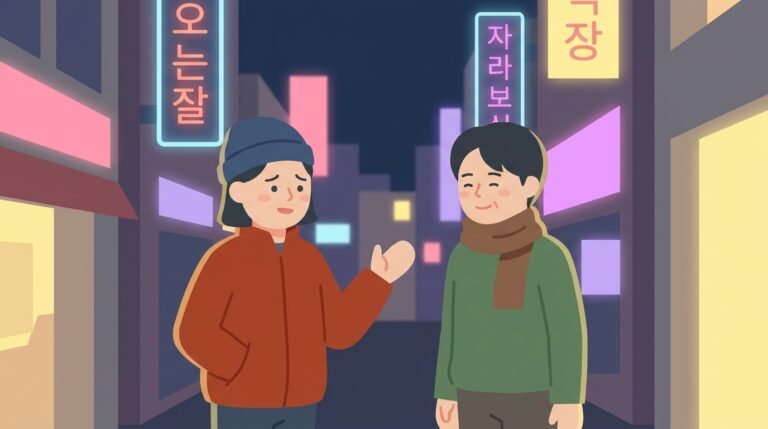
Can We Do Karaoke Next Time? How to Politely Cancel Noraebang Plans in Korean
안녕하세요! (An-nyeong-ha-se-yo!) It’s your favorite Daily Hangul editor and your personal K-Culture Navigator!
We’ve all been there: your Korean friends are super excited to hit the Noraebang (노래방 – karaoke room) to sing their hearts out to BTS, BLACKPINK, or some classic ballads. You want to go, but suddenly you are too tired, have another appointment, or just don’t feel up to it.
Canceling plans in Korea can feel a bit tricky because of the social culture of togetherness. You might worry, “Will I sound rude?” or “How do I say ‘no’ without hurting their feelings?” Don’t worry! Today, we are going to learn how to politely back out of a Noraebang plan like a natural-born Korean friend. This guide is based on real-world situations and is perfect for A2-level learners!
Phase 2: Top 3 Essential Expressions for Canceling Plans
1. 다음에 가도 돼요? (Da-eum-e ga-do dwae-yo?)
- Pronunciation: “Da-eum-ey gah-doh dwae-yo?” (Sounds like: dah-um-eh gah-do dway-yo)
- Meaning: Can we go next time?
- K-Culture Moment: In K-Dramas, when characters are suddenly overloaded with work or have a family emergency, they soft-cancel by saying this while making a puppy-dog face.
- Editor’s Insight: This is the safest, most polite way for an A2 learner to reschedule. It shows you do want to go, just not today.
- Situation Spectrum: Casual (✅ with close friends: 다음에 가도 돼?), Semi-formal (✅ 다음에 가도 돼요?), Formal (⚠️ 다음에 가도 괜찮을까요?)
- 🤔 Think About It: In many Western cultures, a simple “I can’t make it” is enough. In Korea, suggesting a “next time” (다음에) is crucial to show you care about the relationship.
2. 오늘은 제가 좀 피곤해서요… (O-neul-eun je-ga jom pi-gon-hae-seo-yo…)
- Pronunciation: “Oh-neul-eun je-gah jom pee-gohn-hae-seo-yo…”
- Meaning: Because I’m a bit tired today…
- K-Culture Moment: Often said by a tired office worker in a slice-of-life drama after a long day of work.
- Editor’s Insight: Notice how the sentence ends with ~서요 (because…). In Korean, leaving a sentence slightly unfinished makes it sound much softer and less demanding than saying “I am tired, so I won’t go.”
- Situation Spectrum: Casual (✅ 오늘은 나 좀 피곤해서…), Semi-formal (✅ 오늘은 제가 좀 피곤해서요…), Formal (🚫 too personal for formal work events)
3. 먼저 가세요. (Meon-jeo ga-se-yo.)
- Pronunciation: “Meon-jeo gah-seh-yo.”
- Meaning: Please go ahead without me. (Literally: You go first.)
- K-Culture Moment: You’ll hear this when a group is walking to a restaurant or Noraebang, and one person has to finish a task first.
- Editor’s Insight: This is perfect when you don’t want to ruin the mood for everyone else. It says, “Don’t wait for me, enjoy your night!”
- Situation Spectrum: Casual (✅ 먼저 가!), Semi-formal (✅ 먼저 가세요.), Formal (✅ 먼저 가십시오.)
Phase 3: Textbook Korean vs. Real Korean
Let’s compare how textbooks teach cancellations versus how real Koreans talk!
Situation A: Canceling because you have another commitment
- 📖 Textbook Korean: “저는 약속이 있어서 갈 수 없습니다.” (Jeo-neun yak-sok-i it-seo-seo gal su eop-seup-ni-da. – I cannot go because I have an appointment.) – Too stiff and robotic!
- 🗣️ Real Korean: “제가 오늘 약속이 있어서 다음에 가야 될 것 같아요.” (Je-ga o-neul yak-sok-i it-seo-seo da-eum-e ga-ya doel geot gat-ah-yo. – I have plans today, so I think I should go next time.)
- 💡 Why is it different? Koreans love using “~것 같아요” (it seems like/I think) to soften statements so they don’t sound too blunt.
Situation B: Being too tired to go out
- 📖 Textbook Korean: “저는 피곤합니다. 안 가겠습니다.” (Jeo-neun pi-gon-hap-ni-da. An ga-get-seup-ni-da. – I am tired. I will not go.) – Sounds angry and cold!
- 🗣️ Real Korean: “아쉽지만 오늘은 제가 피곤해서 먼저 들어갈게요!” (A-swip-ji-man o-neul-eun je-ga pi-gon-hae-seo meon-jeo deul-eo-gal-ge-yo! – It’s a pity, but since I’m tired today, I’ll head home first!)
- 💡 Why is it different? Adding “아쉽지만” (sadly/it’s a pity) shows that you actually wanted to join, which saves the other person’s feelings.
Phase 4: K-Culture Deep-Dive & Non-Verbal Manners
4-1. The “Nunchi” (눈치) of Canceling
When canceling, non-verbal cues are just as important as the words you use.
1. The Head Tilt and Slight Bow: When saying “죄송해요” (I’m sorry) or “다음에 가요” (Next time), tilt your head slightly and lower your shoulders. This physical show of regret is a huge part of Korean Nunchi (social sensing).
2. Hand Gesture: Bring your hands together in a gentle pleading/sorry gesture (like a mini-prayer) when delivering the news.
4-2. The Noraebang Culture
In Korea, Noraebang is often the “2nd round” (2차 – i-cha) of a night out. It is highly social. If you must cancel, try to let them know before they book the room. Noraebang venues usually charge by the hour upfront!
Phase 5: Real-Life Roleplay Scenario
Setting: You are out for dinner with your Korean classmate, Ji-a (지아). She is excited to go to a nearby Coin Noraebang (코인노래방), but you have a massive headache.
- Ji-a: “우리 밥 다 먹었으니까 코인노래방 갈까요? 신나게 노래 불러요!”
(U-ri bap da meog-eot-eu-ni-kka ko-in-no-rae-bang gal-kka-yo? Sin-na-ge no-rae bul-reo-yo!)
(🎭 Grinning widely and pointing down the street) - You: “아, 진짜 가고 싶은데…”
(Ah, jin-jja ga-go sip-eun-de…)
(🎭 Putting a hand on your temple with a sad face) - Ji-a: “어? 어디 아파요? 얼굴이 안 좋아요.”
(Eo? Eo-di a-pa-yo? Eol-gul-i an jo-a-yo.)
(🎭 Looking worried) - You: “네, 오늘 머리가 좀 아파서요.”
(Ne, o-neul meo-ri-ga jom a-pa-seo-yo.) - Ji-a: “앗, 정말요? 약 먹었어요? 그럼 노래방은 무리겠네요.”
(At, jeong-mal-yo? Yak meog-eot-eo-yo? Geu-reom no-rae-bang-eun mu-ri-get-nae-yo.) - You: “죄송해요. 다음에 꼭 같이 가요!”
(Joe-song-hae-yo. Da-eum-e kkok gat-i ga-yo!) - Ji-a: “괜찮아요! 얼른 집에 가서 쉬세요. 노래방은 다음에 가면 되죠.”
(Gwen-chan-a-yo! Eol-reun jip-e ga-seo swi-se-yo. No-rae-bang-eun da-eum-e ga-myeon doe-jyo.) - You: “고마워요. 조심히 들어가세요!”
(Go-ma-wo-yo. Jo-sim-hi deul-eo-ga-se-yo!)
🔀 Interactive Choice:
If Ji-a suddenly says, “Aww, just for 10 minutes?”, how do you respond?
* A) “안 돼요. 피곤해요.” (No. I’m tired.)
* B) “진짜 미안해요, 오늘은 약 먹고 자야 될 것 같아요.” (I’m really sorry, I think I need to take medicine and sleep today.)
* C) “다음에 제가 맛있는 거 살게요. 오늘은 먼저 들어갈게요!” (I’ll buy you something delicious next time. Today I’ll head home first!)
💡 Feedback:
- A (Bad): Too direct! It sounds like you are shutting her down angrily.
- B (Best): Polite, honest, and soft. Nobody can argue with needing sleep and medicine!
- C (Risk/Great): Very natural Korean style! Offering to buy food next time is an excellent way to maintain a strong relationship.
Phase 6: 10-Second Emotion Shadowing Drill
Practice saying these out loud with the right emotion and pauses (/)!
[🥺 Regretful and polite]
아쉽지만… / 오늘은 / 제가 / 먼저 / 들어갈게요.
(Ah-swip-ji-man… / oh-neul-eun / je-ga / meon-jeo / deul-eo-gal-ge-yo.)-
[🙏 Sorry but sweet]
미안해요! / 다음에 / 꼭 / 같이 / 가요!
(Mi-an-hae-yo! / da-eum-e / kkok / gat-i / gah-yo!)
Phase 7: K-Culture Mini-Dictionary
- 코인노래방 (Koin-noraebang): Coin Karaoke. A popular, cheap karaoke place where you pay per song (using coins or bills) instead of per hour.
- 2차 (I-cha): Second round. In Korean drinking/social culture, groups go to multiple places in one night. Noraebang is a classic “2차” spot.
- 칼퇴 (Kal-toe): “Sword-like leaving work.” Leaving work exactly on time. Used when you cancel social plans to go straight home.
- 약속 (Yak-sok): Plan, appointment, or promise. Used widely for any social gatherings.
Phase 8: Survivor’s Kit for Travelers
Survival Phrases TOP 3
- 저 오늘 가야 돼요. (Jeo o-neul ga-ya dwae-yo.) – I have to go home today. (Pro Tip: Use this when you need a firm exit.)
- 몸이 안 좋아 서요… (Mom-i an jo-a-seo-yo…) – Because I don’t feel well… (Pro Tip: Use this to get out of any unwanted plan politely.)
- 다음에 꼭 불러주세요! (Da-eum-e kkok bul-reo-ju-se-yo!) – Please invite me next time for sure! (Pro Tip: Keeps the friendship warm.)
📌 Editor’s Travel Note: If you need to navigate back to your hotel after canceling plans, make sure to use KakaoMap or Naver Map App instead of Google Maps, which does not work well for walking directions in Korea!
Phase 9: “A Step Deeper” (Cultural Insight)
In Korea, saying “no” directly can sometimes feel like a rejection of the relationship, not just the activity. That’s why Koreans use passive phrasing like “~것 같아요” (it seems to be) and promise a “next time” (다음에). It’s not about being dishonest; it’s about preserving Jeong (정)—the warm feeling of connection.
💬 Your Turn: Have you ever had to cancel plans with a Korean friend? What did you say? Let us know in the comments below!
Phase 10: FAQ & Common Mistakes
Q: Can I just say “No” (아니요) when invited to Noraebang?
A: It is better not to say just “아니요” (No) as it sounds cold. Instead, say “아, 저는 오늘 조금 힘들 것 같아요” (Oh, I think it might be a bit difficult for me today).
Q: What does “다음에 가요” actually mean? Is it a real promise?
A: Sometimes it is a real promise, and sometimes it is just a polite way to wrap up a conversation. If they follow up with a specific date later, it’s real!
Q: Is it okay to leave in the middle of a Noraebang session?
A: Yes! Just say, “저 먼저 들어갈게요, 재미있게 노세요!” (I’ll head out first, have fun!) and slip out quietly.
🚨 Common Mistakes Alert!
- Wrong: “나 안 가요.” (Na an ga-yo. – I am not going.) -> Correct: “저는 오늘 못 갈 것 같아요.” (Jeo-neun o-neul mot gal geot gat-ah-yo. – I don’t think I can make it today.)
- Wrong: “노래방 싫어해요.” (No-rae-bang sil-eo-hae-yo. – I hate karaoke.) -> Correct: “제가 노래를 잘 못해서 부끄러워요.” (Je-ga no-rae-reul jal mot-hae-seo bu-kkeu-reo-wo-yo. – I am shy because I’m not good at singing.)
Phase 11: Action Mission
- Bronze Medal: Say “다음에 가요” out loud 5 times in front of your mirror.
- Silver Medal: Write a message in the comments below using “오늘은 제가 좀 피곤해서요…”
- Gold Medal: Use one of today’s expressions next time you have to cancel or postpone plans with a Korean speaker!
Phase 12: Interactive Quiz Challenge
Q1. Which expression means “Can we go next time?”
- A) 먼저 가세요
- B) 다음에 가도 돼요?
- C) 피곤해요
Reveal Answer & Explanation
Correct Answer: B
다음에 가도 돼요? means “Can we go next time?” A means “Go ahead without me,” and C means “I’m tired.”
Q2. True or False: In Korea, leaving a sentence unfinished like “피곤해서요…” (Because I am tired…) is polite.
Reveal Answer & Explanation
Correct Answer: True
Yes! Unfinished sentences sound much softer and less aggressive in Korean social culture.







