

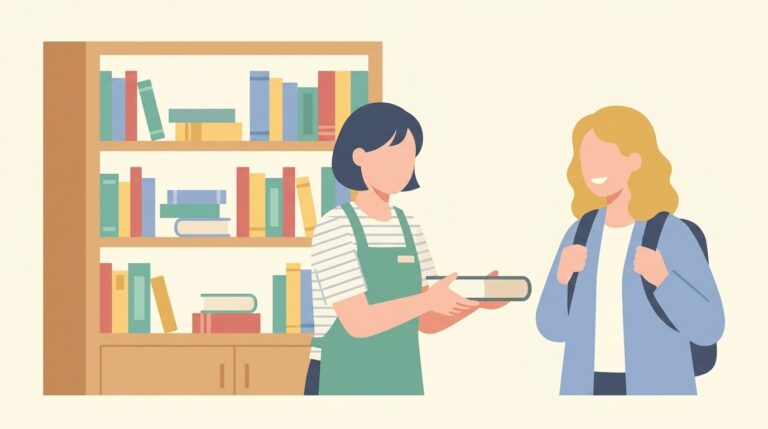
Shopping for the Perfect Korean Textbook: How to Find the Best Book at a Korean Bookstore
Phase 1: Empathy (Your Bookstore Adventure Awaits!)
안녕하세요! (An-nyeong-ha-se-yo!) I am your Chief Editor at Daily Hangul, your cozy Korean corner and local culture navigator!
Imagine walking into a massive, beautiful bookstore in Seoul like Kyobo Book Centre. The smell of fresh paper, the soft indie music playing, and shelves stacked with colorful Korean books. You want to buy a Korean textbook to take your A2 skills to the next level. But suddenly, you feel overwhelmed. “Which section is for Korean learners? How do I ask the staff for help without sounding too formal or robotic?”
If you have ever felt nervous about buying a book in Korean, don’t worry! This guide is based on real experiences from our global learners who wanted to buy textbooks in Seoul but didn’t know what to say. Today, you will learn the exact, natural phrases to find, compare, and purchase your perfect Korean study companion like a local.
Phase 2: Deep Dive into 3 Key Expressions
Let’s learn three super useful expressions you can use immediately at any bookstore.
1. 한국어 교재는 어디에 있어요? (Han-gug-eo gyo-jae-neun eo-di-e isseo-yo?)
- Pronunciation: “Han-gook-uh gyoh-jae-neun uh-dee-eh eet-suh-yo?” (Sounds like “Where is the Korean textbook?”)
- Meaning: Where are the Korean textbooks?
- K-Culture Moment: You will hear this pattern (
~은/는 어디에 있어요?) everywhere in Korean dramas when characters are searching for something in a store, whether it’s a specific book, ramen, or cosmetics. - Editor’s Insight:
교재(gyo-jae) means “textbook” or “study material.” It sounds much more specific and goal-oriented than just saying책(chaek – book). - Situation Spectrum:
- Casual: 한국어 교재 어디 있어? (⚠️ Only for close friends)
- Semi-formal: 한국어 교재는 어디에 있어요? (✅ Best for store staff)
- Formal: 한국어 교재는 어디에 있습니까? (🚫 Too stiff for a casual bookstore run)
- 🤔 Think About It: In English, we often say “Excuse me, where can I find…?” In Korean, we simply name the object first and add
어디에 있어요?(Where is it?). Korean is highly topic-prominent!
2. 추천해 주실 수 있어요? (Chu-cheon-hae ju-sil su isseo-yo?)
- Pronunciation: “Choo-chuhn-hae joo-shil soo eet-suh-yo?” (Sounds like “Can you recommend?”)
- Meaning: Can you recommend one?
- K-Culture Moment: When K-Pop idols visit local restaurants on variety shows, they always ask the owner, “추천해 주세요!” (Please recommend!). You can use this exact phrase with the bookstore staff to find the most popular books.
- Editor’s Insight: By adding
주실 수 있어요?(Can you do it for me?), you sound incredibly polite, warm, and natural. - Situation Spectrum:
- Casual: 추천해 줘! (⚠️)
- Semi-formal: 추천해 주실 수 있어요? (✅ Perfect)
- Formal: 추천해 주시겠습니까? (✅ Excellent for high-end customer service)
3. 이 책 샘플이 있어요? (I chaek saem-peul-i isseo-yo?)
- Pronunciation: “Ee chaek saem-peul-ee eet-suh-yo?” (Sounds like “Is there a sample of this book?”)
- Meaning: Is there a display/sample copy of this book that I can look at?
- K-Culture Moment: In Korea, many premium books are wrapped in plastic to keep them clean. If you want to preview the pages, you need to ask for a “sample” or “look-inside” copy.
- Editor’s Insight: The word
샘플(saem-peul) is the Konglish word for sample, but for books, staff might also call it견본품(gyeon-bon-pum) or simply point to an unwrapped book. - Situation Spectrum:
- Casual: 이거 샘플 있어? (⚠️)
- Semi-formal: 이 책 샘플이 있어요? (✅ Highly recommended)
- Formal: 이 도서의 견본이 있습니까? (🚫 Sounds like a business negotiation)
Phase 3: Textbook Korean vs. Real Korean
Let’s compare textbook phrases with how real Koreans actually talk!
Situation 1: Asking if a book is in stock
- 📖 Textbook Korean: “이 책을 보유하고 있습니까?” (I chaek-eul bo-yu-ha-go it-seup-ni-ka? – “Do you possess this book?”)
- 🗣️ Real Korean: “이 책 혹시 재고 있어요?” (I chaek hok-si jae-go isseo-yo? – “Do you perhaps have stock of this book?”)
- 💡 Why is it different? Nobody uses the word “possess” (보유) in casual shopping. Using
혹시(hok-si – perhaps/by any chance) before your question softens your tone instantly, making you sound like a polite local.
Situation 2: Looking around the shop
- 📖 Textbook Korean: “저는 지금 책을 구경하고 있습니다.” (Jeo-neun ji-geum chaek-eul gu-gyeong-ha-go it-seup-ni-da. – “I am currently spectating books.”)
- 🗣️ Real Korean: “그냥 좀 둘러볼게요.” (Geu-nyang jom dul-leo-bol-ge-yo. – “I’ll just look around a bit.”)
- 💡 Why is it different? When store clerks approach you to help, replying with
그냥 좀 둘러볼게요is the universal, polite way to say “Just browsing, thank you!”
Phase 4: K-Culture Deep Dive & Non-Verbal Manners
4-1. Nunchi (눈치) & Bookstore Gestures
When handing your book or credit card to the cashier, never use only one hand. Using both hands to give and receive items is a crucial sign of respect in Korea. If you are holding something else, you can support your right elbow with your left hand. This subtle gesture shows incredible Nunchi (situational quick-wittedness and manners) and will instantly earn you a warm smile from the staff!
4-2. Kyobo Hottracks: More than just Books
In Korea, large bookstores like Kyobo Book Centre have a sub-brand called Hottracks (핫트랙스). It is a paradise of cute Korean stationery, K-Pop albums, journals, and tech accessories. When you go buy your textbook, make sure to budget extra time (and money!) to explore the Hottracks section right next to the books.
Phase 5: Real-Life Roleplay Scenario
Setting: The bustling foreign language section of Kyobo Bookstore in Gwanghwamun, Seoul.
Your Partner: Min-ji (민지), a friendly bookstore staff member wearing a green apron.
- Min-ji: 🎭 (Approaches with a warm smile) 안녕하세요! 도움이 필요하신가요?
(An-nyeong-ha-se-yo! Do-um-i pil-yo-ha-sin-ga-yo?)
“Hello! Do you need any help?” - You: 🎭 (Politely bowing your head slightly) 네, 혹시 한국어 교재 코너가 어디에 있어요?
(Ne, hok-si han-gug-eo gyo-jae ko-neo-ga eo-di-e isseo-yo?)
“Yes, by any chance, where is the Korean textbook section?” - Min-ji: 🎭 (Pointing to the left aisle) 아, 한국어 공부 책들은 저기 E구역에 있어요. 같이 가실래요?
(Ah, han-gug-eo gong-bu chaek-deul-eun jeo-gi E-gu-yeok-e isseo-yo. Gat-i ga-sil-lae-yo?)
“Ah, the books for studying Korean are over there in Zone E. Shall we go together?” - You: 🎭 (Nodding happily) 와, 감사합니다! 제가 왕초보는 아니고, 초급 수준 책을 찾고 있어요.
(Wa, gam-sa-hap-ni-da! Je-ga wang-cho-bo-neun a-ni-go, cho-geup su-jun chaek-eul chat-go isseo-yo.)
“Wow, thank you! I am not a complete beginner (wang-cho-bo), I’m looking for a beginner-level (A2) book.” - Min-ji: 🎭 (Picking up a book) 이 책이 인기가 많아요. 오디오 파일도 있어요.
(I chaek-i in-gi-ga manh-a-yo. O-di-o pa-il-do isseo-yo.)
“This book is very popular. It also has audio files.” - You: 🎭 (Looking at the plastic wrap on the book) 혹시 이 책 샘플이 있어요? 안을 좀 보고 싶어요.
(Hok-si i chaek saem-peul-i isseo-yo? An-eul jom bo-go sip-eo-yo.)
“By any chance, is there a sample of this book? I want to look inside.” - Min-ji: 🎭 (Handing you an unwrapped copy) 네, 여기 있습니다! 마음껏 보세요.
(Ne, yeo-gi it-seup-ni-da! Ma-eum-kkeot bo-se-yo.)
“Yes, here it is! Please take your time looking at it.” - You: 🎭 (Using both hands to take the book) 감사합니다. 이걸로 살게요!
(Gam-sa-hap-ni-da. I-geol-lo sal-ge-yo!)
“Thank you. I will buy this one!”
🔀 Choose Your Adventure!
Min-ji asks you, “봉투 필요하세요?” (Do you need a bag?)
- Choice A: “아니요, 그냥 갈게요.” (No, I’ll just go.)
- 💡 Feedback (Best): Perfect! It means you will just carry it or put it in your backpack. Eco-friendly and very natural!
- Choice B: “네, 주세요.” (Yes, please give me.)
- 💡 Feedback (Good): Simple and clear. Note that bookstores in Korea charge a small fee (around 100~200 KRW) for paper or plastic bags.
- Choice C: “봉투는 필요 없습니다!” (A bag is not necessary!)
- 💡 Feedback (Risk): While grammatically correct, it sounds a bit too robotic and cold like a military statement. Stick to A or B!
Phase 6: 10-Second Emotion Shadowing Drill
Practice speaking like a native speaker with these emotional markers and pause points (/).
- [😊 Friendly and polite]
- 혹시 / 한국어 교재는 / 어디에 있어요?
- Hok-si / han-gug-eo gyo-jae-neun / eo-di-e isseo-yo?
- [🥺 Hoping for a recommendation]
- 초급 책 중에서 / 제일 좋은 거 / 추천해 주세요!
- Cho-geup chaek jung-e-seo / je-il jo-eun geo / chu-cheon-hae ju-se-yo!
- [💖 Happy and appreciative]
- 우와, / 너무 마음에 들어요! / 이걸로 살게요.
- U-wa, / neo-mu ma-eum-e deul-uh-yo! / I-geol-lo sal-ge-yo.
Phase 7: K-Culture Mini Dictionary
- 교재 (Gyo-jae) | Textbook / Study Materials | Used specifically for academic materials rather than general novels.
- 초급 (Cho-geup) | Beginner Level | Represents levels A1 and A2. Intermediate is 중급 (Jung-geup), and Advanced is 고급 (Go-geup).
- 재고 (Jae-go) | Stock / Inventory | Used to ask if a store has a certain item in the backroom.
- 베스트셀러 (Be-seu-teu-sel-leo) | Bestseller | Bookstores in Korea have huge, dedicated sections displaying their top bestsellers.
Phase 8: Survival Kit for Travelers
Survival Phrases TOP 3
- 이거 비닐 벗겨진 것 있어요? (I-geo bi-nil beot-gyeo-jin geot isseo-yo?)
- Pro Tip: “Is there a copy of this with the plastic vinyl wrapper removed?” Use this if you want to preview a wrapped book.
- 포인트 적립 하세요? (Po-in-teu jeok-rip ha-se-yo?)
- Pro Tip: The cashier will ask this, meaning “Do you want to collect membership points?” You can simply reply “없어요” (Eop-seo-yo – I don’t have one).
- 카드로 계산할게요. (Ka-deu-ro gye-san-hal-ge-yo.)
- Pro Tip: “I will pay by card.” Korea is almost entirely cashless now!
Editor’s Travel Note 🗺️
When visiting a Korean bookstore, download the Naver Map App instead of Google Maps, which does not update walking directions well in Seoul. Search for “교보문고” (Kyobo Bookstore) or “영풍문고” (YP Books) to find the nearest giant bookstore. Disclaimer: Store hours and stock availability may vary depending on the location.
Phase 9: Deep Thoughts (Korean “Nunchi” in Service)
In Korea, customer service is incredibly fast and efficient. Clerks will rarely follow you around or pressure you to buy books. This is a form of respect for your private space. However, they are always watching with keen Nunchi, ready to assist the second you make eye contact or look lost.
💬 Your Turn: How do bookstore employees treat customers in your country? Do they leave you alone, or do they offer help immediately? Let us know in the comments below!
Phase 10: FAQ & Avoiding Common Mistakes
Q: Can I sit down and read textbooks before buying them in Korea?
A: Yes! Big bookstores like Kyobo have huge wooden reading tables where you can sit and look through the books. However, please treat the books gently and do not write in them!
Q: What is the difference between 책 (Chaek) and 교재 (Gyo-jae)?
A: 책 is a general word for any book (novels, comics, poetry). 교재 refers specifically to educational textbooks, workbooks, or class materials.
Q: Do bookstores accept international credit cards?
A: Absolutely. Almost all bookstores in Korea accept foreign Visa, Mastercard, and mobile payments like Apple Pay (in selected locations).
🚨 Common Mistakes Warning Board
- Saying “책 빌려주세요” (Chaek bil-ryeo-ju-se-yo)
- Why it’s wrong: This means “Please lend me this book.” You cannot borrow books from a retail bookstore!
- Correct Action: Say “이 책 살게요” (I will buy this book) instead.
- Handing your payment card with one hand
- Why it’s wrong: It can appear impolite or too casual to the cashier.
- Correct Action: Present your card using both hands.
- Tearing open the plastic wrap yourself
- Why it’s wrong: Opening wrapped books without permission is considered bad manners.
- Correct Action: Ask the staff: “이 책 샘플이 있어요?”
Phase 11: Action Mission!
- Bronze Medal: Read the three key phrases out loud 5 times using our shadow training emotional guide.
- Silver Medal: Take a screenshot of our “Survival Kit” and save it in your phone’s photo album for your next trip to Korea.
- Gold Medal (K-Culture Mission): Watch a Korean vlog of someone visiting Seoul, find a bookstore scene, and listen for the word “책” or “교재”!
Phase 12: Interactive Quiz Challenge
Test your knowledge with these quick challenges!
1. Situation Quiz
You want to ask the bookstore clerk if they have a sample of a textbook. What should you say?
👉 Click to see the Answer & Explanation
Answer: “이 책 샘플이 있어요?” (I chaek saem-peul-i isseo-yo?)
Explanation: This translates to “Is there a sample of this book?” which is the natural way to ask to see an unwrapped copy.
2. Fill in the Blank
“한국어 교재는 _________ 있어요?” (Where are the Korean textbooks?)
👉 Click to see the Answer & Explanation
Answer: 어디에 (eo-di-e)
Explanation: “어디에” means “where” or “at where” in Korean.
3. True or False Culture Quiz
In Korea, it is polite to hand over your payment card with both hands.
👉 Click to see the Answer & Explanation
Answer: True (T)
Explanation: Using both hands to give and receive items shows respect and polite manners in Korean culture.






