

Finding a Nursing Room in Korea: A Friendly Guide for Parents Travelling with Babies
Phase 1: Empathy (Welcome, Parents!)
안녕하세요! (An-nyeong-ha-se-yo!) Welcome back to Daily Hangul, your friendly neighborhood guide to navigating Korea like a local. I’m your chief editor, and today we are tackling a topic that is close to my heart.
Imagine this: You are exploring a gorgeous, bustling shopping mall in Seoul, like the Starfield COEX Mall, with your beautiful baby. Suddenly, you hear that cry—the “I’m hungry right now!” or “My diaper needs changing!” cry. Your heart races. You look around, but everything is in Korean. Where is the nursing room?
Don’t panic! Korea is incredibly baby-friendly, and almost every major mall, department store, and subway station has a beautifully equipped nursing room. Today, I will teach you the super-easy, absolute survival Korean phrases to find a nursing room instantly. This guide is based on real-world feedback from expat parents who survived—and thrived—while traveling in Korea with toddlers. Let’s dive in!
Phase 2: Key Expressions Deep Dive (The Big Three)
As an A1 beginner, you only need three magic phrases to get help immediately. Let’s look at them closely.
1. 수유실 어디예요? (Su-yu-sil eo-di-yeo-yo?)
- Pronunciation: Soo-yoo-sheel eo-dee-yeo-yo? (Sounds like: “Sue-you-sheel” + “uh-dee-yuh-yo?”)
- Meaning: “Where is the nursing room?”
- K-Culture Moment: You will see signs with a baby bottle icon in department stores like Lotte or Hyundai. If you can’t find it, just walk up to any information desk and say this phrase.
- Editor’s Insight: “수유실 (su-yu-sil)” means nursing room/lactation room. “어디예요? (eo-di-ye-yo?)” means “Where is it?”. This is the most polite, direct, and useful phrase for any traveler.
- Situation Spectrum: Casual ⚠️ | Semi-formal ✅ | Formal ✅
- 🤔 Think About It: In Korea, public spaces are highly adapted for families. Asking for a nursing room is very common, so never feel shy to ask!
2. 아기 기저귀 갈아야 해요. (A-gi gi-jeo-gwi gal-a-ya hae-yo.)
- Pronunciation: Ah-gee gee-juh-gwee gahl-ah-yah hae-yo.
- Meaning: “I need to change my baby’s diaper.”
- K-Culture Moment: If you find a restroom but aren’t sure if it has a changing table, tell the staff this. They might guide you to a premium family restroom!
- Editor’s Insight: “아기 (a-gi)” means baby, “기저귀 (gi-jeo-gwi)” means diaper, and “갈아야 해요 (gal-a-ya hae-yo)” means “must change”.
- Situation Spectrum: Casual ⚠️ | Semi-formal ✅ | Formal ✅
- 🤔 Think About It: Did you know that many Korean subway stations have baby changing tables inside both the women’s and men’s restrooms? Korea values equal parenting!
3. 도와주세요. (Do-wa-ju-se-yo.)
- Pronunciation: Doh-wah-joo-seh-yo.
- Meaning: “Please help me.”
- K-Culture Moment: If you are carrying a heavy stroller down subway stairs because you can’t find the elevator, say this with a warm smile to passersby. Koreans will gladly assist!
- Editor’s Insight: This is a universal survival word. It is polite and instantly signals that you need a helping hand.
- Situation Spectrum: Casual 🚫 | Semi-formal ✅ | Formal ✅
- 🤔 Think About It: Asking for help in a foreign language builds a bridge of kindness. Koreans are generally very helpful toward visitors with young kids!
Phase 3: Textbook Korean vs. Real Korean
Let’s compare what textbooks teach you versus how Koreans actually talk in daily life.
Situation 1: Asking where the baby facility is
- 📖 Textbook Korean: “수유실이 어느 방향에 위치합니까?” (Su-yu-sir-i eo-neu bang-hyang-e wi-chi-hap-ni-kka? – “In which direction is the nursing room located?”)
- 🗣️ Real Korean: “수유실 어디예요?” (Su-yu-sil eo-di-yeo-yo? – “Where is the nursing room?”)
- 💡 Why the difference?: The textbook version is way too stiff and grammatical for a busy mall. Just say “수유실 어디예요?”—it is short, polite, and natural.
Situation 2: Asking if there is a changing table
- 📖 Textbook Korean: “기저귀 교환대가 구비되어 있습니까?” (Gi-jeo-gwi gyo-hwan-dae-ga gu-bi-deo-eo it-seup-ni-kka? – “Is a diaper changing table equipped?”)
- 🗣️ Real Korean: “기저귀 갈 곳 있어요?” (Gi-jeo-gwi gal got is-seo-yo? – “Is there a place to change diapers?”)
- 💡 Why the difference?: Real-life Korean prefers simple words like “갈 곳 (place to change)” over big Chinese-derived vocabulary like “교환대 (exchange platform)”.
Phase 4: K-Culture Deep Dive & Non-verbal Manners
4-1. Nunchi (눈치) & Gestures
- The Stroller Bow: When entering a crowded elevator with a stroller, slightly bow your head and say “죄송합니다 (Joe-song-hap-ni-da – I am sorry)” or “감사합니다 (Gam-sa-hap-ni-da – Thank you)”. This shows Nunchi (tact/awareness of others) and instantly warms up the room.
- Pointing politely: When asking for directions, do not point with a single finger. Use an open palm facing upward to point in the direction of the nursing room. It is much more respectful!
4-2. The Premium Korean Baby Room Culture
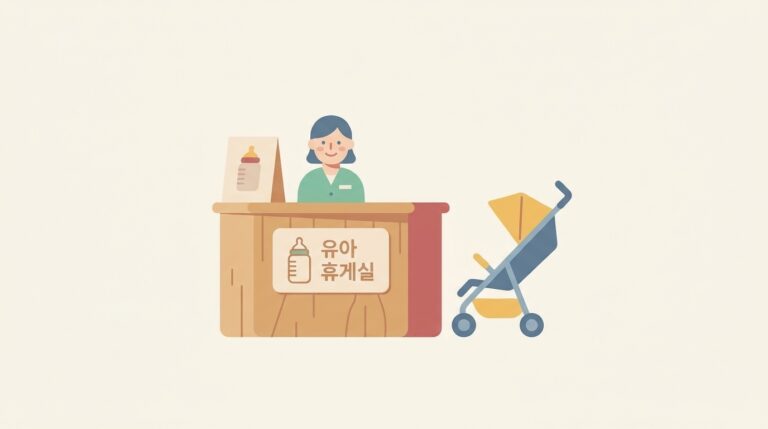
Korean department stores (like Shinsegae or Hyundai) have luxurious nursing rooms called “유아휴게실 (Yu-a hyu-ge-sil – Infant Lounge)”. These places are like 5-star hotels! They have bottle sterilizers, custom nursing cushions, private feeding booths, and sometimes even a receptionist. Keep an eye out for these spots!
Phase 5: Real-Life Roleplay Scenario
Setting: You are at a trendy department store in Seoul. Your baby starts crying. You approach an Information Desk Staff Member (NPC Min-ji).
- Staff (Min-ji): 안녕하세요! 도와드릴까요?
(An-nyeong-ha-se-yo! Do-wa-deu-ril-kka-yo?)
🎭 Smiling warmly with hands crossed
“Hello! How can I help you?” -
You: 저기… 수유실 어디예요?
(Jeo-gi… su-yu-sil eo-di-yeo-yo?)
🎭 Looking slightly worried, pointing to your baby
“Excuse me… where is the nursing room?” -
Staff (Min-ji): 아, 수유실이요? 5층에 있어요.
(Ah, su-yu-sil-i-yo? O-cheung-e is-seo-yo.)
🎭 Pointing upward with an open palm
“Ah, the nursing room? It is on the 5th floor.” -
You: 아기 기저귀 갈아야 해요.
(A-gi gi-jeo-gwi gal-a-ya hae-yo.)
🎭 Mimicking a diaper-changing motion
“I need to change my baby’s diaper.” -
Staff (Min-ji): 네, 5층 수유실 안에 기저귀 교환대가 있어요. 엘리베이터 저쪽에 있어요.
(Ne, o-cheung su-yu-sil an-e gi-jeo-gwi gyo-hwan-dae-ga is-seo-yo. El-li-be-i-teo jeo-jjo-g-e is-seo-yo.)
🎭 Pointing to the left toward the elevators
“Yes, there is a diaper changing table inside the 5th-floor nursing room. The elevator is over there.” -
You: 엘리베이터요? 감사합니다!
(El-li-be-i-teo-yo? Gam-sa-hap-ni-da!)
🎭 Bowing head slightly with a relieved smile
“The elevator? Thank you!” -
Staff (Min-ji): 아니에요. 좋은 하루 보내세요!
(An-i-e-yo. Jo-eun ha-ru bo-nae-se-yo!)
🎭 Waving nicely
“Not at all. Have a great day!”
🔀 Interactive Choice Point
How do you respond to Min-ji to show your final gratitude?
* A. “수유실 고마워!” (Su-yu-sil go-ma-wo!)
* B. “정말 감사합니다.” (Jeong-mal gam-sa-hap-ni-da.)
* C. “도와주세요!” (Do-wa-ju-se-yo!)
Feedback on your choice:
- A (Risk): Too casual! “고마워” is informal banmal. Use this only with close friends, not staff.
- B (Best): Perfect! It means “Thank you very much” in polite, warm formal Korean.
- C (Bad): Oops! This means “Please help me!”. Since she already helped you, saying this again will confuse her!
Phase 6: 10-Second Emotion Shadowing Drill
Let’s practice speaking with real emotions! The slashes / represent small pauses to catch your breath.
[🥺 Urgent & Worried]
저기… / 수유실 어디예요?
(Jeo-gi… / su-yu-sil eo-di-yeo-yo?)
“Excuse me… / where is the nursing room?”-
[😊 Relieved & Polite]
아, / 감사합니다!
(Ah, / gam-sa-hap-ni-da!)
“Ah, / thank you!”
Phase 7: K-Culture Mini-Dictionary
- 수유실 (Su-yu-sil) | Nursing Room | Found in malls, train stations, and airports for feeding and changing babies.
- 유모차 (Yu-mo-cha) | Stroller / Baby carriage | You can rent high-quality strollers for free at most major Korean department store customer centers!
- 엘리베이터 (El-li-be-i-teo) | Elevator | Critical for stroller travel. Look for the sign or ask “엘리베이터 어디예요?”
- 기저귀 (Gi-jeo-gwi) | Diaper | If you need to buy some urgently, head to a nearby convenience store (편의점 – Pyeon-ui-jeom) or mart.
Phase 8: Traveler’s Survival Kit
Survival Phrases TOP 3
- 유모차 빌릴 수 있어요? (Yu-mo-cha bil-ril su is-seo-yo?) – “Can I borrow a stroller?”
- 따뜻한 물 있어요? (Tta-tteut-han mul is-seo-yo?) – “Is there warm water?” (Useful for formula milk!)
- 엘리베이터 어디예요? (El-li-be-i-teo eo-di-yeo-yo?) – “Where is the elevator?”
💡 Editor’s Travel Note: To locate elevators and baby facilities easily, we highly recommend downloading the Naver Map App. It shows detailed floor guides for major buildings in Seoul! Note: Facility operating hours and stroller rental policies may vary depending on local conditions.
Phase 9: “Going Deeper” (Cultural Reflection)
In Korea, there is a beautiful, warm word called 정 (Jeong). It refers to a deep feeling of attachment, kindness, and community connection. When Koreans see a traveling family with a small baby, they often feel a wave of Jeong. Do not be surprised if an elderly grandmother coos at your baby on the subway or if a shopkeeper offers you extra tissues. Accepting this kindness with a simple “감사합니다” is a wonderful way to experience the heart of Korea.
💬 Your Turn: What is the baby care culture like in your home country? Leave a comment below and share your thoughts with our global community!
Phase 10: FAQ & Avoiding Mistakes
Q: Can men enter the “수유실” (Nursing Room)?
A: Generally, yes! Most modern Korean family lounges have a shared waiting area and diaper-changing zone open to both fathers and mothers. However, the specific private cubicles for breastfeeding (모유수유실 – Mo-yu su-yu-sil) are strictly reserved for mothers.
Q: What should I say if someone talks to my baby?
A: You can just smile and say “감사합니다 (Gam-sa-hap-ni-da – Thank you)” or “예쁘게 봐주셔서 감사합니다 (Ye-ppeu-ge bwa-ju-shyeo-seo gam-sa-hap-ni-da – Thank you for looking at my baby so kindly)”.
Q: Is baby formula or baby food easy to heat up in public?
A: Yes! Almost all department store nursing rooms have microwaves and hot water dispensers. You can politely ask the staff: “이유식 데워줄 수 있어요?” (I-yu-sik de-wo-jul su is-seo-yo? – Can you heat up the baby food?).
🚨 Common Mistakes Alert!
- Mistake: Throwing diapers in standard trash bins inside the nursing room.
- Correct Action: Always use the dedicated diaper disposal bins (기저귀 수거함) often equipped with diaper bags.
- Mistake: Using the stairs/escalator with a stroller.
- Correct Action: For safety, always seek out the elevator. Just ask “엘리베이터 어디예요?”.
- Mistake: Using informal language like “수유실 어디야?” to staff.
- Correct Action: Always end your sentence with “~요” (eo-di-ye-yo?) to remain polite.
Phase 11: Action Mission
- 🥉 Bronze Medal: Read the Phrase “수유실 어디예요?” out loud 3 times using the Emotion Shadowing drill.
- 🥈 Silver Medal: Take a screenshot of our “Traveler’s Survival Kit” so you can quickly use it during your next trip.
- 🥇 Gold Medal: Write a comment below using the phrase “수유실 어디예요?” to show us you’ve mastered it!
Phase 12: Interactive Quiz Challenge
Test your knowledge with these quick questions!
1. How do you ask “Where is the nursing room?” politely?
Click to see the answer
Answer: 수유실 어디예요? (Su-yu-sil eo-di-yeo-yo?)
Explanation: This is the perfect, polite phrase to use with any shop assistant or passerby.
2. True or False: “아기 (A-gi)” means diaper in Korean.
Click to see the answer
Answer: False!
Explanation: “아기” means baby. Diaper is “기저귀 (gi-jeo-gwi)”.






