

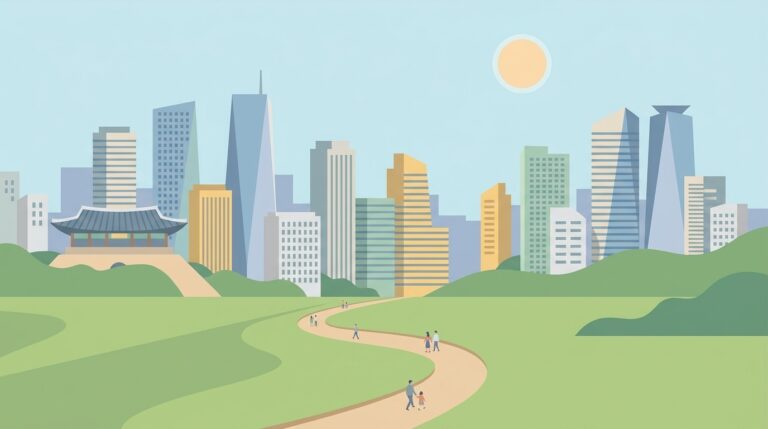
Step into Korea’s Visual Revolution: Public Design and Urban Aesthetics (C1)
Phase 1: Empathy – The Street is Korea’s Canvas
안녕하세요! Welcome back to another Masterclass with Daily Hangul. I’m your editor and local culture guide, and today we’re walking through a topic that is literally shaping the way we experience South Korea: Public Design and Urban Aesthetics (공공 디자인과 도시 미관).
Imagine walking through Euljiro in Seoul. One second, you’re looking at a dusty 40-year-old metal printing shop; the next, you turn a corner and see a sleek, LED-lit pedestrian plaza integrated with historical fortress walls. This isn’t an accident. It is a highly curated, deeply debated philosophy of urban regeneration.
As a C1 learner, you’re beyond basic survival phrases. You want to engage in intellectually stimulating debates with your Korean friends about why Seoul looks the way it does, or how a neighborhood’s vibe changes when public design steps in. Today, we’re going to master the high-level vocabulary, cultural subtexts, and idioms needed to discuss urban aesthetics like an expert architect. Ready? Let’s dive in.
Phase 2: Deep-Dive into Top 3 Expressions
To talk about urban aesthetics, you need more than just “예뻐요” (It’s pretty) or “멋져요” (It’s cool). Let’s unlock three highly sophisticated terms used by Korean design enthusiasts, media, and urban planners.
1. 삭막하다 (Sak-mak-ha-da)
- Pronunciation: sahng-mahk-ha-da (Sounds like ‘sock-mock’ but with a softer, breathy ‘k’ at the end)
- Meaning: Desolate, barren, bleak, or lifeless (specifically used to describe concrete jungles lacking green spaces or human touch).
- K-Culture Moment: In K-Dramas, when a protagonist moves from a cozy countryside village to a towering, grey apartment complex in Seoul, they often sigh: “여기 너무 삭막하다.” (It’s so bleak and lifeless here.)
- Editor’s Insight: While “춥다” (cold) describes temperature, “삭막하다” describes an emotional chill caused by surrounding architecture. Use this to criticize sterile urban spaces.
- Situation Spectrum: Casual (✅) / Semi-formal (✅) / Formal (✅)
- 🤔 Think About It: Does your hometown have areas that feel sak-mak-ha-da? How does public design try to cure this feeling in your culture?
2. 도시의 숨통을 트이다 (Dosi-ui sum-tong-eul teu-i-da)
- Pronunciation: doh-shee-ui soom-tong-eul tew-ee-da (Focus on the double ‘t’ in ‘tong’ for a crisp sound)
- Meaning: “To let the city breathe” / “To open up a breathing space in the city.”
- K-Culture Moment: Often used in news documentaries discussing the restoration of Cheonggyecheon Stream or the creation of the Seoul Forest park.
- Editor’s Insight: This is a beautiful metaphorical expression. “숨통” means windpipe or breath. When an old concrete highway is demolished to make a park, Koreans say it literally “opens the city’s windpipe.”
- Situation Spectrum: Casual (⚠️ – slightly dramatic) / Semi-formal (✅) / Formal (✅)
- 🤔 Think About It: Why is it crucial for high-density Asian metropolises to have urban “breathing spaces”?
3. 미관을 해치다 (Migwan-eul hae-chi-da)
- Pronunciation: mee-gwan-eul hae-chee-da (Smoothly slide from ‘gwan’ to ‘eul’)
- Meaning: To ruin/spoil the aesthetic beauty of the city; to be an eyesore.
- K-Culture Moment: Mentioned in local news petitions when residents complain about messy overhead power lines or chaotic commercial neon signs hanging off buildings.
- Editor’s Insight: This is the ultimate formal phrase to complain about poorly planned infrastructure. It shows a highly refined concern for public spaces.
- Situation Spectrum: Casual (⚠️) / Semi-formal (✅) / Formal (✅)
- 🤔 Think About It: What is the biggest “eyesore” (미관을 해치는 것) in your current city?
Phase 3: Textbook Korean vs. Real Korean
When discussing urban landscapes, textbooks often sound like an academic paper. Let’s look at how to bridge the gap.
Situation A: Describing a cluttered commercial street
- 📖 Textbook Korean: “간판이 너무 많아서 복잡해 보입니다.”
(There are too many signs, so it looks complicated.) - 🗣️ Real Korean: “간판들이 너무 난립해 있어서 정신없어요.”
(The signs are overflowing chaotically; it’s so dizzying.) - 💡 Why the difference? C1 speakers use “난립하다” (to spring up uncontrollably/chaotically) and “정신없다” (mindless/distracting) to vividly express the sensory overload of Korean neon-sign streets.
Situation B: Expressing admiration for a newly renovated public park
- 📖 Textbook Korean: “이 공원은 아주 친환경적이고 아름답습니다.”
(This park is very eco-friendly and beautiful.) - 🗣️ Real Korean: “자연이랑 도심이 아주 자연스럽게 어우러져서 힐링돼요.”
(Nature and the city center blend so naturally, it’s incredibly healing.) - 💡 Why the difference? Koreans love the verb “어우러지다” (to harmonize/blend beautifully). It moves the conversation from cold architectural evaluation to personal emotional healing.
Phase 4: K-Culture Deep-Dive & Non-Verbal Etiquette
4-1. The Body Language of Aesthetic Debate
When discussing public spaces or pointing out urban designs in Korea, never point with a single index finger. It can come across as aggressive or overly critical. Instead, open your palm flat, gesture gently toward the building or park, and tilt your head slightly while saying, “저기 보시면…” (If you look over there…).
4-2. The “Newtro” (뉴트로) Phenomenon
Korea’s public design isn’t just about glass skyscrapers. It’s driven by Newtro (New + Retro). Empty factories in Seongsu-dong or old hanoks in Ikseon-dong are preserved structurally but modernized internally. This is the heart of Korean urban regeneration (도시 재생): respecting the old while injecting modern utility. When you discuss this, mention “온고지신” (On-go-ji-shin)—a traditional idiom meaning “learning from the past to understand the new.”
Phase 5: Real-Life Roleplay Scenario
The Setup: You are standing on the rooftop café of the newly designed Seoul Sewoon Plaza with Min-jun (민준), an architect friend who worked on the urban regeneration team.
민준: (도시 전경을 내려다보며) 예전에는 이 주변이 다 낡은 상가뿐이라 정말 삭막했거든요.
      [Ye-jeon-e-neun i ju-byeon-i da nal-geun sang-ga-ppun-i-ra jeong-mal sang-mak-haet-geon-deu-yo.]
      (Looking down at the city view) "In the past, this area was just worn-out shops, so it was truly desolate."

You: 🎭 (감탄하며 고개를 끄덕인다) 맞아요. 그런데 지금은 보행자 데크가 생겨서 완전히 분위기가 반전되었네요.
      [Ma-ja-yo. Geon-deun-de ji-geum-eun bo-haeng-ja de-keu-ga saeng-gyeo-seo wan-jeon-hi bun-wi-gi-ga ban-jeon-doe-eon-ne-yo.]
      (Nodding in admiration) "Indeed. But now that the pedestrian deck is here, the vibe has completely flipped."

민준: 다행이네요. 사실 공공 디자인이라는 게 사소한 디테일 하나로 시민들 삶의 질을 바꾸는 거잖아요.
      [Da-haeng-i-ne-yo. Sa-sil gong-gong di-ja-in-i-ra-neun ge sa-so-han di-te-il ha-na-ro si-min-deul salm-ui jil-eul ba-kku-neun geo-ja-na-yo.]
      "Glad you like it. Actually, public design is all about changing citizens' quality of life with just one small detail."

You: 🎭 (진지한 눈빛으로) 전적으로 동감해요. 예전의 무분별한 개발보다 이런 도시 재생이 훨씬 가치 있다고 봐요.
      [Jeon-jeok-eu-ro dong-gam-hae-yo. Ye-jeon-ui mu-bun-byeol-han gae-bal-bo-da i-reon do-si jae-saeng-i hwol-ssin ga-chi it-da-go bwa-yo.]
      (With a serious look) "I totally agree. I think this kind of urban regeneration is much more valuable than the reckless development of the past."
🔀 Interactive Choice Point
How do you keep the conversation flowing?
* A) “근데 간판 정비 사업은 왜 안 했을까요? 아직 조금 지저분해요.” (Critique the remaining visual clutter)
* B) “여기에 녹지 공간을 더 조성하면 완벽하게 숨통이 트일 것 같아요.” (Suggest adding more green spaces)
* C) “여기 예전엔 진짜 맛집 많았는데 다 없어졌나요?” (Ask purely about food spots)
Feedback:
- A (Risk): Honest but might sound slightly overly critical to your architect friend who poured their heart into the project.
- B (Best): Excellent! Uses the metaphor “숨통이 트이다” appropriately, showing high architectural appreciation and advanced language skills.
- C (Bad): While local food is great, it abruptly derails an intellectual conversation about design.
Phase 6: 10-Second Emotion Shadowing Drill
To sound native, you must master the rhythm of pause and emphasis. Try saying this line with a tone of passionate agreement:
“자연이랑 / 도심이 / 어우러지는 게 / 진짜 / 도시 재생의 핵심이죠!”
[Ja-yeon-i-rang / do-sim-i / eo-u-reo-ji-neun ge / jin-jja / do-si jae-saeng-ui haek-sim-i-jyo!]
[🔥 Confident & Passionate] “Nature / and the city center / harmonizing / is truly / the key of urban regeneration!”
Phase 7: K-Culture Mini-Dictionary
- 도시 재생 (Dosi Jaesaeng) | Urban Regeneration / Revitalization | Restoring declining urban areas structurally and socially, rather than just demolishing them.
- 보행자 중심 (Bohaengja Jungsim) | Pedestrian-oriented | Design that prioritizes walking paths, crosswalks, and plazas over car lanes.
- 간판 정비 사업 (Ganpan Jeongbi Saeop) | Signage Standardization Project | Government projects in Korea that replace chaotic, oversized commercial signs with neat, uniform LED designs.
- 랜드마크 (Landmark) | Landmark | Used frequently in Korean urban planning to describe iconic visual points (e.g., DDP, Lotte World Tower).
Phase 8: The Traveler’s Survival Kit
Survival Expressions for Urban Explorers:
- “여기 야경 진짜 끝내주네요!” (Yeo-gi ya-gyeong jin-jja kkeut-nae-ju-ne-yo!)
- Pro Tip: Use this at Namsan Tower or Han River to say “The night view here is killer!”
- “이 동네는 골목골목 구경하는 재미가 있어요.” (I dong-ne-neun gol-mok-gol-mok gu-gyeong-ha-neun jae-mi-ga is-seo-yo.)
- Pro Tip: Perfect for places like Ikseon-dong or Gamcheon Culture Village.
- “주변 풍경이랑 잘 어울려요.” (Ju-byeon pung-gyeong-i-rang jal eo-ul-려-yo.)
- Pro Tip: A polite way to compliment a new architectural structure.
🗺️ Editor’s Travel Note:
To experience Korea’s modern public design firsthand, download the Naver Map App (do not rely on Google Maps in Korea!) and search for “Seoullo 7017” (서울로 7017). It is an abandoned highway overpass transformed into a public sky garden, a prime example of “도시의 숨통을 트는” public design.
Phase 9:
Frequently Asked Questions (FAQ)
Q: What does "삭막하다 (Sak-mak-ha-da)" mean in Korean and how do you pronounce it?
A: In Korean, "삭막하다 (Sak-mak-ha-da)" is pronounced [sahng-mahk-ha-da (Sounds like 'sock-mock' but with a softer, breathy 'k' at the end] and means: Desolate, barren, bleak, or lifeless (specifically used to describe concrete jungles lacking green spaces or human touch).
Q: What does "도시의 숨통을 트이다 (Dosi-ui sum-tong-eul teu-i-da)" mean in Korean and how do you pronounce it?
A: In Korean, "도시의 숨통을 트이다 (Dosi-ui sum-tong-eul teu-i-da)" is pronounced [doh-shee-ui soom-tong-eul tew-ee-da (Focus on the double 't' in 'tong' for a crisp sound] and means: "To let the city breathe" / "To open up a breathing space in the city."
Q: What does "미관을 해치다 (Migwan-eul hae-chi-da)" mean in Korean and how do you pronounce it?
A: In Korean, "미관을 해치다 (Migwan-eul hae-chi-da)" is pronounced [mee-gwan-eul hae-chee-da (Smoothly slide from 'gwan' to 'eul'] and means: To ruin/spoil the aesthetic beauty of the city; to be an eyesore.






