

Talk Movies in Korean Like a Local! 🍿🎥
Phase 1: Empathy (공감) – Hey Friend, Let’s Talk Movies!
안녕하세요! (An-nyeong-ha-se-yo!) Your Daily Hangul editor and local culture navigator here! 👋
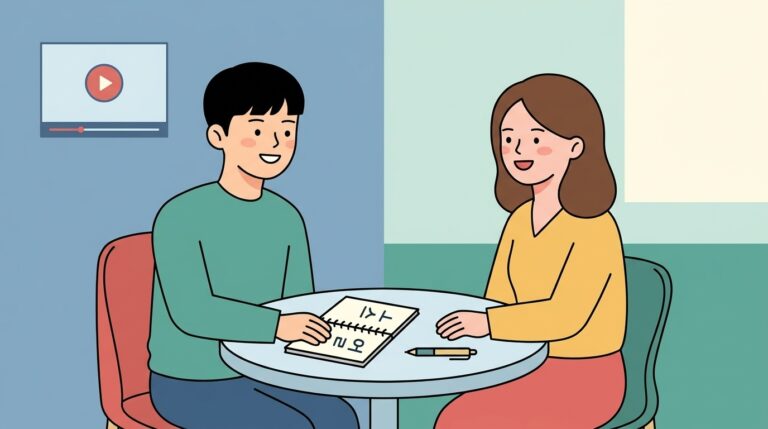
Imagine this: You’re hanging out with your new Korean friends at a cozy cafe in Hongdae. Someone turns to you and asks:
“어떤 영화 좋아해요?” (Eo-tteon yeong-hwa jo-ah-hae-yo?)
Your heart rate spikes. You know the word 영화 (yeong-hwa / movie) and 좋아해요 (jo-ah-hae-yo / like), but how do you reply? Do you just shout “Action!” or “Romance!” and hope for the best?
Don’t worry! Talking about your favorite films is the absolute best way to break the ice in Korea. Today, we’ll master the most natural, A1-friendly ways to share your movie tastes—no stiff textbook jargon, just the real, friendly phrases your Korean besties use! Let’s dive in! 🎬
Phase 2: Core Expressions (핵심 표현 3선)
1. 어떤 영화 좋아해요? (Eo-tteon yeong-hwa jo-ah-hae-yo?)
- Pronunciation: Eo-tteon (sounds like ‘up-dawn’ but softer) yeong-hwa (young-wah) jo-ah-hae-yo (jo-ah-hey-yo)
- Meaning: “What kind of movies do you like?”
- K-Culture Moment: This is the ultimate icebreaker in K-Dramas! When two characters start getting close, they almost always ask this while walking home or eating 치맥 (chi-maek / chicken & beer).
- Editor’s Insight: 어떤 (eo-tteon) means “what kind of” or “which”. It’s much more natural than asking “무슨 영화” (mu-seun yeong-hwa) in casual daily chats.
- Situation Spectrum: Casual (✅) / Semi-formal (✅) / Formal (⚠️)
- 🤔 Think About It: In English, we often ask “What is your favorite movie?” directly. In Korean, we usually start broader with “What kind of movies do you like?” to keep the conversation flowing. Why do you think Koreans prefer starting with broad categories?
2. 저 액션 영화 좋아해요. (Jeo aek-syeon yeong-hwa jo-ah-hae-yo.)
- Pronunciation: Jeo (juh) aek-syeon (action) yeong-hwa (young-wah) jo-ah-hae-yo (jo-ah-hey-yo)
- Meaning: “I like action movies.”
- K-Culture Moment: Perfect for discussing high-octane Korean blockbusters like The Outlaws (범죄도시)!
- Editor’s Insight: You can replace 액션 (aek-syeon) with any genre!
- 로맨스 (ro-maen-seu): Romance
- 공포 (gong-po): Horror
- 코미디 (ko-mi-di): Comedy
- Situation Spectrum: Casual (✅) / Semi-formal (✅) / Formal (⚠️)
- 🤔 Think About It: Notice how English puts an ‘-s’ at the end of “movies” (plural), but Korean just uses the singular 영화 (yeong-hwa). Isn’t that so much simpler?
3. 그거 진짜 재밌어요! (Geu-geo jin-jja jae-mit-seo-yo!)
- Pronunciation: Geu-geo (geu-guh) jin-jja (jin-jja – stretch the ‘jja’ slightly!) jae-mit-seo-yo (jay-meet-suh-yo)
- Meaning: “That is really fun/good!”
- K-Culture Moment: You’ll hear this 100 times an hour on Korean variety shows (like Running Man) when guests react to a funny clip or story.
- Editor’s Insight: 재밌어요 (jae-mit-seo-yo) means “to be interesting/fun”. Koreans use this single word to say a movie is good, fun, exciting, or entertaining.
- Situation Spectrum: Casual (✅) / Semi-formal (✅) / Formal (🚫)
- 🤔 Think About It: Koreans love expressing shared enthusiasm. Saying “진짜 재밌어요!” builds an instant bond with the person you are talking to.
Phase 3: Textbook vs. Real Korean (교과서 vs. 진짜 한국어)
Let’s look at how textbooks teach movie talk versus how we actually speak in Seoul!
Scenario 1: Sharing your preference
- 📖 Textbook Style: “저는 한국 영화를 좋아합니다.” (Jeo-neun Han-guk yeong-hwa-reul jo-ah-hap-ni-da.)
- Why it’s stiff: It sounds like you are introducing yourself in a formal job interview!
- 🗣️ Real K-Life Style: “저 한국 영화 좋아해요!” (Jeo Han-guk yeong-hwa jo-ah-hae-yo!)
- 💡 Why it works: Dropping the topic marker ~는 and using the friendly ~해요 ending makes you sound approachable and natural.
Scenario 2: Asking if a movie is good
- 📖 Textbook Style: “그 영화는 재미있습니까?” (Geu yeong-hwa-neun jae-mi-it-seup-ni-ka?)
- Why it’s stiff: It sounds like a survey question.
- 🗣️ Real K-Life Style: “그 영화 재밌어요?” (Geu yeong-hwa jae-mit-seo-yo?)
- 💡 Why it works: Just raise your voice slightly at the end to make it a friendly question! Also, we contract “재미있어요” to 재밌어요 in daily life.
Phase 4: K-Culture Deep Dive & Non-verbal Manners
4-1. The Korean Nod & Eye Contact
When someone says they like a movie you also like, do the “K-Agreed Nod”: slightly lean your head forward, open your eyes wide in excitement, and say “맞아요! (Ma-ja-yo! / That’s right!)”. This shows high active listening, which is highly valued in Korean culture.
4-2. The “K-Movie Theater” Culture
If you ever visit a CGV or Lotte Cinema in Seoul, you must try the 갈릭 팝콘 (garlic popcorn) and 버터구이 오징어 (butter-grilled squid). Yes, squid at the movies! It is a delicious local cultural staple. Sharing snacks is a big part of the experience, so pass the bucket to your friend with both hands as a polite gesture!
Phase 5: Interactive Roleplay Scenario
Meet Minho (민호), a friendly local college student who loves Netflix. You are grabbing sweet potato lattes at a cafe.
🎭 Scene: At a cozy cafe in Sinchon
- Minho: “혹시 어떤 영화 좋아해요?” (Hok-si eo-tteon yeong-hwa jo-ah-hae-yo?)
(By the way, what kind of movies do you like?) - You: “저 액션 영화 좋아해요. 민호 씨는요?” (Jeo aek-syeon yeong-hwa jo-ah-hae-yo. Min-ho ssi-neun-yo?)
(I like action movies. How about you, Minho?) - Minho: “오, 진짜요? 저도 액션 좋아해요! 최근에 ‘범죄도시’ 봤어요?” (Oh, jin-jja-yo? Jeo-do aek-syeon jo-ah-hae-yo! Choe-geun-e ‘Beom-joe-do-si’ bwat-seo-yo?)
(Oh, really? I like action too! Did you watch ‘The Outlaws’ recently?) - You: “아, 아직 안 봤어요. 재밌어요?” (Ah, a-jik an bwat-seo-yo. Jae-mit-seo-yo?)
(Ah, I haven’t watched it yet. Is it good?) - Minho: “네! 진짜 재밌어요! 마동석 배우 최고예요!” (Ne! Jin-jja jae-mit-seo-yo! Ma Dong-seok bae-u choe-go-ye-yo!)
(Yes! It’s really fun! Actor Ma Dong-seok is the best!) - You: “우와, 저도 꼭 볼래요!” (U-wa, jeo-do kkok bol-rae-yo!)
(Wow, I want to watch it too, for sure!) - Minho: “이번 주말에 같이 볼래요?” (I-beon ju-mal-e gat-i bol-rae-yo?)
(Do you want to watch it together this weekend?) - You: (Make your choice below!)
🔀 Your Turn! Choose Your Response:
- Choice A: “좋아요! 같이 가요!” (Jo-ah-yo! Gat-i ga-yo! / Sounds good! Let’s go together!)
- Feedback (BEST): Perfect! It’s warm, enthusiastic, and accepts the invitation naturally.
- Choice B: “아니요, 안 가요.” (A-ni-yo, an ga-yo. / No, I am not going.)
- Feedback (BAD): Too harsh! It sounds like you are rejecting Minho flat out. Try to say “죄송해요, 주말에 바빠요” (I’m sorry, I’m busy this weekend) instead.
- Choice C: “음… 영화 좋아해요.” (Eum… yeong-hwa jo-ah-hae-yo. / Hmm… I like movies.)
- Feedback (RISK): Out of context! Minho asked if you want to watch it together, so answering that you like movies sounds like a robot malfunction.
Phase 6: 10-Second Emotion Shadowing Drill
Let’s practice speaking with real Korean emotion!
- [😊 Expressing Excitement]
- “그 영화 / 진짜 / 재밌어요!”
- (Geu yeong-hwa / jin-jja / jae-mit-seo-yo!)
- Tip: Put extra power on “진짜” (jin-jja) to make it sound incredibly genuine!
- [🥺 Softly Rejecting/Regretting]
- “아… / 아직 / 안 봤어요.”
- (Ah… / a-jik / an bwat-seo-yo.)
- Tip: Make a slight cute pouting face on “안” (an) to show you are sad you missed it.
Phase 7: K-Culture Mini Dictionary
- 영화 (Yeong-hwa): Movie / Film.
- Usage: Basic building block for any media chat!
- 팝콘 (Pap-kon): Popcorn.
- Usage: Essential vocabulary when entering a Korean cinema.
- 배우 (Bae-u): Actor / Actress.
- Usage: Use this to talk about your favorite stars like Gong Yoo or Han So-hee.
- 감독 (Gam-dok): Director.
- Usage: Perfect for talking about famous directors like Bong Joon-ho (Parasite).
Phase 8: Survivor’s Kit for Travelers
Survival Phrases TOP 3:
- **
Frequently Asked Questions (FAQ)
Q: What does "어떤 영화 좋아해요? (Eo-tteon yeong-hwa jo-ah-hae-yo?)" mean in Korean and how do you pronounce it?
A: In Korean, "어떤 영화 좋아해요? (Eo-tteon yeong-hwa jo-ah-hae-yo?)" is pronounced [Eo-tteon (sounds like 'up-dawn' but softer] and means: "What kind of movies do you like?"
Q: What does "저 액션 영화 좋아해요. (Jeo aek-syeon yeong-hwa jo-ah-hae-yo.)" mean in Korean and how do you pronounce it?
A: In Korean, "저 액션 영화 좋아해요. (Jeo aek-syeon yeong-hwa jo-ah-hae-yo.)" is pronounced [Jeo (juh] and means: "I like action movies."
Q: What does "그거 진짜 재밌어요! (Geu-geo jin-jja jae-mit-seo-yo!)" mean in Korean and how do you pronounce it?
A: In Korean, "그거 진짜 재밌어요! (Geu-geo jin-jja jae-mit-seo-yo!)" is pronounced [Geu-geo (geu-guh] and means: "That is really fun/good!"







