

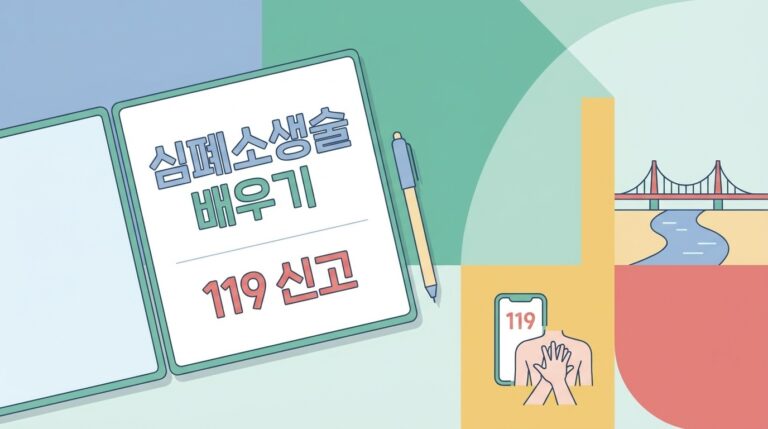
C1 Korean Masterclass: Saving Lives in Korean – Step-by-Step Adult CPR (성인 심폐소생술)
Phase 1: Empathy (공감) — When Seconds Count, Language Shouldn’t Be a Barrier
안녕하세요! 매일한글 (Daily Hangul) family! It’s your favorite cultural navigator and editor here.
Imagine this: You are enjoying a serene afternoon at a Han River park in Seoul, watching the golden sunset, when suddenly a person nearby collapses. A crowd gathers, but everyone is in shock. You know exactly what to do—CPR (심폐소생술)—but in that high-adrenaline moment, can you coordinate with Korean bystanders, direct someone to call 119, or locate an AED?
In emergency situations, language barriers can cause fatal delays. Many of our advanced (C1) learners have shared that while they can discuss Korean politics or K-Dramas easily, they freeze up when thinking about medical emergencies. Today, we are going to master the Adult CPR Sequence (성인 심폐소생술 순서) in natural, authoritative, yet urgent Korean. This guide is built based on the official guidelines of the Korean Association of Cardiopulmonary Resuscitation (대한심폐소생협회) and real feedback from expats living in Korea. Let’s equip you with the words that can literally save a life.
Phase 2: Core Expressions Deep Dive (핵심 표현 3선)
1. 의식을 확인하다 (Identify consciousness / Assess responsiveness)
- Pronunciation: Uisigeul hwaginhada (Wee-shik-eul hwahg-in-hah-dah)
- Meaning: Literally “to check consciousness.” In an emergency, this translates to assessing whether the victim is responsive.
- K-Culture Moment: You’ve likely seen this in medical K-Dramas like Hospital Playlist (슬기로운 의사생활) or Dr. Romantic (낭만닥터 김사부), where the first responder frantically taps the patient’s shoulders.
- Editor’s Insight: At a C1 level, you should differentiate between “괜찮으세요?” (Are you okay?) and the clinical term “의식 확인” (checking responsiveness). When performing this, tap both shoulders firmly (양쪽 어깨를 가볍게 두드리며) and speak loudly.
- Situation Spectrum: Casual 🚫 | Semi-formal ⚠️ | Formal ✅ (Highly clinical/instructive)
- 🤔 Think About It: How does the Korean term ‘의식’ (consciousness/awareness) differ from the English ‘responsiveness’ in a psychological sense? Why do you think Korean emergency protocols emphasize verbalizing every step?
2. 가슴 압박을 시행하다 (Perform chest compressions)
- Pronunciation: Gaseum apbageul sihaenghada (Gah-seum ahp-bahg-eul shee-haeng-hah-dah)
- Meaning: To perform/administer chest compressions.
- K-Culture Moment: In K-Dramas, actors are often shown doing this with the iconic rhythmic counting: “하나, 둘, 셋, 넷…”
- Editor’s Insight: The verb ‘시행하다’ (to implement/execute) elevates your Korean to C1 professional level, as opposed to simply saying ‘하다’ (to do) or ‘누르다’ (to press). The standard depth is 5cm to 6cm at a rate of 100 to 120 compressions per minute.
- Situation Spectrum: Casual 🚫 | Semi-formal ⚠️ | Formal ✅
- 🤔 Think About It: Koreans heavily value collaborative action. Why is it crucial to explicitly state that you are ‘시행’ (executing) a procedure to the crowd rather than just doing it silently?
3. 자동심장충격기를 가져오다 (Bring the AED)
- Pronunciation: Jadongsimjangchungyeokgireul gajeooda (Jah-dong-sheem-jahng-choong-gyeok-ghee-reul gah-jyeo-oh-dah)
- Meaning: Bring the Automated External Defibrillator (AED).
- K-Culture Moment: Usually found in subway stations or apartment security offices in Korea, labeled clearly as 자동심장충격기 (AED).
- Editor’s Insight: While many Koreans understand the acronym “AED”, the official public safety term is ‘자동심장충격기’ (literally: automatic heart shocker). In an emergency, pointing at a specific person and using this exact term avoids the ‘bystander effect’.
- Situation Spectrum: Casual ⚠️ | Semi-formal ✅ | Formal ✅
- 🤔 Think About It: In your home country, how accessible are AEDs compared to Korea’s highly dense public transit installation system?
Phase 3: Textbook Korean vs. Real-World Korean
Situation 1: Calling for Help
- 📖 Textbook: “119에 신고해 주시고 자동제세동기를 찾아주세요.” (Please report to 119 and find the automated external defibrillator.)
- 🗣️ 진짜 한국어: “거기 빨간 티셔츠 입으신 분, 119에 신고해 주시고 지하철역에서 자동심장충격기(AED) 좀 빨리 가져다주세요!“
- 💡 왜 다를까?: In real-life emergencies, vague passive statements fail. Koreans use highly specific visual identifiers (e.g., “빨간 티셔츠 입으신 분”) and urgent colloquial markers like “~좀 빨리 ~해 주세요” to command action.
Situation 2: Directing the Crowd
- 📖 Textbook: “주변 사람들은 물러서 주시기 바랍니다.” (I hope the surrounding people will step back.)
- 🗣️ 진짜 한국어: “환자분 숨 쉴 수 있게 뒤로 물러서 주세요! 공간 좀 확보해 주세요!”
- 💡 왜 다를까?: The textbook version is too passive and polite. In a crisis, you must use imperative, direct commands: “뒤로 물러서 주세요!” (Please step back!) and “공간 확보해 주세요!” (Secure some space!).
Phase 4: K-Culture Deep Dive & Non-Verbal Manners
4-1. Nunchi & Emergency Etiquette in Korea
In Korea, taking charge in an emergency requires a balance of 눈치 (Nunchi – situational quick-wittedness) and authoritative command. When a crowd hesitates, a first responder must bypass the typical Korean politeness hierarchy and speak with absolute, unambiguous authority.
* The Pointing Gesture: Never point vaguely with your hand. Point directly at an individual, look them dead in the eye, and identify their clothing item.
* Consent & Touch: When assessing a stranger (especially of a different gender), state loudly what you are doing so the crowd understands your actions are purely medical: “맥박 확인하겠습니다!” (Checking pulse!).
4-2. Safety Culture in Korea (안전교육)
If you’ve spent time in Korea, you’ve probably noticed safety posters in subways detailing ‘심폐소생술 순서’ (CPR steps). Korea has a robust civil defense training system, and most citizens have undergone mandatory CPR training at school or work. Utilizing correct terms immediately builds trust with Korean bystanders, allowing you to lead the rescue effectively.
Phase 5: Real-World Roleplay Scenario
Setting: Han River Park (한강공원). A middle-aged man suddenly collapses while jogging. You are the only one who knows CPR.
Characters:
* You (C1 Expert Rescuer)
* 행인 (Bystander – Min-su, in a blue cap)
Dialogue
- You: 🎭 (Approaching rapidly, tapping the patient’s shoulders) “정신 차려보세요! 제 말 들리세요?!”
(Wake up! Can you hear me?!) - 행인: “어떡해… 쓰러지셨나 봐요. 어쩌죠?”
(Oh dear… I think he collapsed. What should we do?) - You: 🎭 (Pointing directly at Min-su) “거기 파란 모자 쓰신 분! 망설이지 말고 지금 바로 119에 신고해 주세요! 스피커폰 켜주시고요!”
(You, the person in the blue cap! Don’t hesitate, call 119 right now! Turn on the speakerphone!) - 행인: “아, 네! 알겠습니다. 바로 전화할게요!”
(Ah, yes! Got it. Calling right now!) - You: “그리고 지나가시는 다른 분! 근처 공원 화장실 옆에 있는 자동심장충격기(AED) 좀 빨리 가져와 주세요!”
(And someone else passing by! Please bring the AED next to the park restroom quickly!) - 행인: “119 연결됐습니다! 어떻게 해야 하죠?”
(119 is connected! What should we do?) - You: 🎭 (Interlocking fingers, positioning over center of chest) “환자 호흡이 없어요. 제가 가슴 압박 시작할 테니, 구급대원한테 상황 계속 전해 주세요!”
(The patient is not breathing. I will start chest compressions, so keep updating the paramedic on the situation!) - 행인: “네! 구급대원분이 지금 위치가 어디냐고 물어봅니다!”
(Yes! The paramedic is asking where our current location is!)
🔀 Interactive Choice Points
How do you respond to the paramedic’s location inquiry through the bystander?
- Choice A: “모르겠어요. 그냥 한강공원이라고 하세요!” (I don’t know. Just say Han River Park!)
- Feedback (Bad): Han River Park is massive. Emergency services won’t find you. This leads to critical time loss.
- Choice B: “배달존 2번 구역 근처 편의점 앞이라고 전해 주세요!” (Tell them we are in front of the convenience store near Delivery Zone 2!)
- Feedback (Best): Excellent! Using localized landmarks like ‘배달존’ (Delivery Zones) or convenience store names is the fastest way to get located in Korean parks.
- Choice C: “주소를 검색해서 알려줄 테니 잠깐 기다리라고 하세요.” (Tell them to wait while I search the address.)
- Feedback (Risk): Never stop chest compressions to look at your phone. You must delegate location tracking to bystanders.
Phase 6: 10-Second Emotional Shadowing Drill
Practice these urgent phrases. Match the emotional tone of a crisis!
- [🚨 Urgently and Loudly]
“거기 / 파란 모자 쓰신 분, / 119에 신고해 주시고 / AED 좀 가져다주세요!”
(Geo-ghi / pa-ran mo-ja sseu-shin bun, / il-il-gu-e shin-go-hae ju-shi-go / A-E-D jom gah-jyeo-dah-ju-se-yo!) -
[💪 Firmly and Directing]
“환자분 숨 쉴 수 있게 / 뒤로 조금씩만 / 물러서 주세요!”
(Hwan-ja-bun sum swil su it-gae / dwi-ro jo-geum-sshik-man / mul-leo-seo ju-se-yo!)
Phase 7: K-Culture Mini-Dictionary
- 골든타임 (Gol-deun-ta-im) | The Golden Time | The critical 4-minute window after cardiac arrest during which CPR must begin to prevent brain damage.
- 심폐소생술 (Sim-pye-so-saeng-sul) | Cardiopulmonary Resuscitation (CPR) | The technical, official Sino-Korean term used in medical and emergency contexts.
- 119 안전센터 (Il-il-gu An-jeon-sen-teo) | 119 Safety Center | The local fire station and emergency response headquarters in Korea.
- 착한 사마리아인 법 (Chak-han Sa-ma-ri-a-in Beop) | Good Samaritan Law | Legal protection in Korea that exempts rescuers from civil/criminal liability in case of accidental harm during emergency aid.
Phase 8: Survivor’s Kit for Travelers
Survival Phrases TOP 3
- “여기 응급 환자가 있어요!” (Yeo-gi eung-geup hwan-ja-ga is-seo-yo!)
- Pro Tip: Use this immediately when calling 119 or seeking help in public space.
- “심폐소생술 하실 줄 아는 분 계십니까?” (Sim-pye-so-saeng-sul ha-shil jul a-neun bun gye-shim-ni-ka?)
- Pro Tip: If you need backup, shout this to find trained citizens.
- “제 말 들리시면 눈 좀 떠보세요!” (Je mal deul-li-shi-myeon nun jom tteo-bo-se-yo!)
- Pro Tip: Part of assessing responsiveness while tapping the victim.
Editor’s Travel Note
When traveling or living in Korea, download the KakaoMap or Naver Map app. Under emergency circumstances, these apps let you instantly search “자동심장충격기” or “AED” to show the nearest live units. Disclaimer: App functions and interfaces may be updated; check settings prior to travel.
Phase 9:
Frequently Asked Questions (FAQ)
Q: What does "의식을 확인하다 (Identify consciousness / Assess responsiveness)" mean in Korean and how do you pronounce it?
A: In Korean, "의식을 확인하다 (Identify consciousness / Assess responsiveness)" is pronounced [Uisigeul hwaginhada (Wee-shik-eul hwahg-in-hah-dah] and means: Literally "to check consciousness." In an emergency, this translates to assessing whether the victim is responsive.
Q: What does "가슴 압박을 시행하다 (Perform chest compressions)" mean in Korean and how do you pronounce it?
A: In Korean, "가슴 압박을 시행하다 (Perform chest compressions)" is pronounced [Gaseum apbageul sihaenghada (Gah-seum ahp-bahg-eul shee-haeng-hah-dah] and means: To perform/administer chest compressions.
Q: What does "자동심장충격기를 가져오다 (Bring the AED)" mean in Korean and how do you pronounce it?
A: In Korean, "자동심장충격기를 가져오다 (Bring the AED)" is pronounced [Jadongsimjangchungyeokgireul gajeooda (Jah-dong-sheem-jahng-choong-gyeok-ghee-reul gah-jyeo-oh-dah] and means: Bring the Automated External Defibrillator (AED).






