

Navigating ‘Muryo Nanum’ (Free Sharing): The Art of Kind Giving on Karrot Market
안녕하세요! Welcome back to Daily Hangul, your trusty cultural navigator. I’m your senior editor and Korean bestie!
Have you ever looked at a perfectly good item in your room—maybe an album you have duplicates of, a book you’ve finished, or a toaster you upgraded—and thought, “I don’t need this, but it’s too good to throw away”?
In Korea, we don’t just throw things out; we do 무료 나눔 (Muryo Nanum), which means “free sharing” or “gifting.” This is a massive subculture on Korea’s favorite local secondhand app, 당근마켓 (Karrot Market).
But here is the catch: because it’s free, bad manners can easily lead to misunderstandings, or even make you look like you’re dumping trash on someone else. Our B2-level learners often ask: “How do I offer things for free politely without sounding like I’m bragging or giving away garbage?” Today, we are going to master the sweet, polite, and deeply warm Korean art of free sharing. Let’s dive in!
Phase 2: Deep Dive into 3 Essential Expressions
1. 무료 나눔 합니다 (Muryo nanum hamnida)
- Pronunciation: Moo-ryoh nah-noom hahm-nee-dah (Think of “Moo” like a cow’s moo, “ryoh” like the ‘rio’ in Rio de Janeiro, “nah-noom” like ‘nah’ + ‘noon’ with an M sound.)
- Meaning: I am doing a free giveaway / sharing this for free.
- K-Culture Moment: You’ll see this phrase constantly in social welfare dramas or neighborhood vlogs. When someone has excess home-baked goods or is moving out, they post pictures on Karrot Market with this exact title.
- Editor’s Insight: ‘무료’ means free of charge, and ‘나눔’ comes from the verb ‘나누다’ (to share/divide). Combining them shows that you aren’t just dumping unwanted items; you are actively sharing value with your community.
- Situation Spectrum: Casual ⚠️ | Semi-formal ✅ | Formal ✅
- 🤔 Think About It: In your home country, is there a specific word that distinguishes “giving away trash” from “sharing something of value for free”?
2. 필요하신 분이 가져가셨으면 좋겠어요 (Piryo-hasin buni gajyeo-gasyeosseumyeon jokesseoyo)
- Pronunciation: Peer-yoh-hah-sheen boon-ee gah-jyeoh-gah-shyeoss-eum-yeon joh-kess-eoh-yoh (Run “gajyeo-gasyeosseumyeon” together: gah-jyeo-gah-shyuh-suhm-yuhn)
- Meaning: I hope someone who really needs it takes it.
- K-Culture Moment: This is the ultimate “warm-hearted neighbor” line. It signals that you care about the item’s destination and want it to find a good home, rather than being resold for profit.
- Editor’s Insight: By using the honorific ending ‘-시-‘ in ‘필요하신 분’ (the person who needs it), you show respect to the anonymous recipient before you even meet them. It reflects the Korean value of Jeong (정) – warm attachment.
- Situation Spectrum: Casual ⚠️ | Semi-formal ✅ | Formal ✅
- 🤔 Think About It: Why does specifying “someone who really needs it” prevent greedy resellers from taking advantage of free listings?
3. 예민하신 분은 피해주세요 (Yemin-hasin buneun pihae-juseoyo)
- Pronunciation: Yeh-meen-hah-sheen boon-eun pee-hae-joo-seh-yoh
- Meaning: If you are sensitive, please skip this (pass on this).
- K-Culture Moment: This is a crucial disclaimer used in almost every secondhand listing. It politely warns buyers that the item is used and might have minor flaws, protecting the seller from picky complainers.
- Editor’s Insight: ‘예민하다’ means to be sensitive or picky. By saying “Please avoid (피해주세요) if you are sensitive,” you set a polite boundary. It keeps the transaction smooth and stress-free.
- Situation Spectrum: Casual ⚠️ | Semi-formal ✅ | Formal ✅
- 🤔 Think About It: How do you politely warn secondhand buyers about minor wear and tear in your own language?
Phase 3: Textbook Korean vs. Real-Life Korean
Here is how to sound like a local neighbor rather than a rigid robot.
Scenario 1: Describing minor scratches on an item
- 📖 Textbook: 이 물건에는 약간의 흠집이 있습니다. (I mulgeon-eun yakgan-ui heumjibi isseumnida. – This object has some flaws.)
- 🗣️ Real-Life: 사용감은 좀 있지만 깨끗해요. (Sayong-gam-eun jom itjiman kkaekkeuthaeyo. – It has some signs of use, but it’s clean.)
- 💡 Why the difference? Saying “흠집 (flaws)” sounds like you are selling defective merchandise. Saying “사용감 (signs of use/vibe of being used)” is a much softer, more natural way to describe used goods.
Scenario 2: Asking where to meet
- 📖 Textbook: 어디에서 만날까요? (Eodi-eseo mannalkkayo? – Where shall we meet?)
- 🗣️ Real-Life: 혹시 OO역 근처에서 직거래 가능하신가요? (Hoksi [Station] yeok geuncheo-eseo jik-georae ganeung-hasingayo? – By any chance, is an in-person trade near [Station] possible?)
- 💡 Why the difference? ‘직거래’ (direct in-person deal) is the standard term used in apps. Specifying a landmark (like a subway station) makes the planning much more efficient and polite.
Phase 4: K-Culture Deep Dive & Non-Verbal Manners
4-1. The “Muryo Nanum” Etiquette
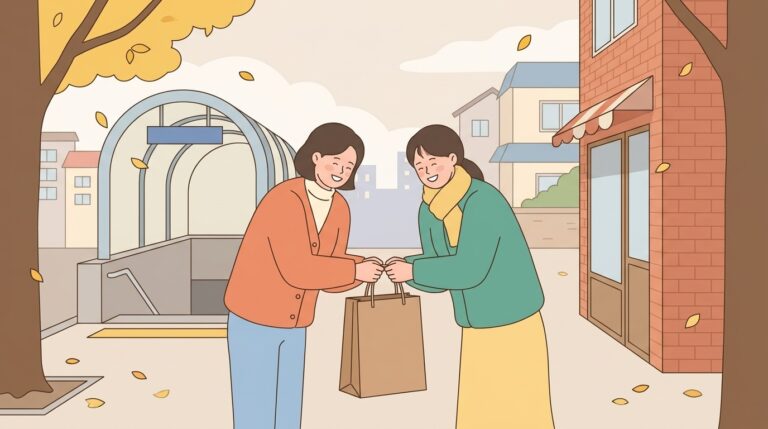
- The Gift Bag Gesture: When giving something away for free, Koreans rarely hand it over bare or in a trash bag. Putting it in a clean shopping bag (like a Starbucks paper bag) or wrapping it slightly is a huge sign of respect.
- The Bow & Two-Hand Handover: Even though it’s free, when you meet, greet them with a slight bow (about 15 degrees) and hand the item over using both hands.
4-2. The “Karrot Market” Phenomenon
Karrot Market (당근마켓) is not just eBay; it’s a hyper-local community app. The name “당근” (Danggeun) literally means carrot, but it’s short for “당신 근처의 마켓” (The market near you). It has created a culture where neighbors exchange warm notes, small treats (like a canned coffee or some candies) as a thank-you for free items, and build local trust.
Phase 5: Real-Life Roleplay Scenario
Setting: You are giving away a study desk lamp on Karrot Market. You are meeting Min-ji (민지), a local university student, near Hapjeong Station (합정역) Exit 7.
Min-ji (Buyer): 저 혹시... 당근 나눔 하시는 분 맞으실까요?
(Jeo hoksi... Danggeun nanum hasineun bun majeuseilkkayo?)
"Excuse me... are you by any chance the person doing the Karrot free giveaway?"

You: 아, 네! 맞아요. 스탠드 나눔 하러 나왔어요.
(Ah, ne! Majayo. Seutaendeo nanum hareo nawasseoyo.)
"Ah, yes! That's right. I came out to give away the desk lamp."

Min-ji: 와, 정말 감사해요! 공부할 때 스탠드가 꼭 필요했거든요.
(Wa, jeongmal gamsahaeyo! Gongbuhal ttae seutaendeuga kkok piryohaetgeodeunyo.)
"Wow, thank you so much! I really needed a desk lamp for studying."

You: 다행이네요. 사용감은 좀 있지만 작동은 아주 잘 돼요.
(Dahaeng-ineyo. Sayong-gam-eun jom itjiman jakdong-eun aju jal dwaeyo.)
"I'm glad to hear that. It has some signs of use, but it works really well."

Min-ji: 네, 편하게 잘 쓸게요! 아, 이건 약소하지만 제 마음이에요.
(Ne, pyeonhage jal sseulkeyo! Ah, igeon yaksohajiman je maeum-ieyo.)
"Yes, I'll use it well! Oh, this is a small token, but it's from my heart."
🎭 (Hands you a warm can of honey-pear tea with both hands)

You: 어머, 안 주셔도 되는데... 정말 감사합니다! 따뜻하게 잘 마실게요.
(Eomeo, an jusyeodo doeneunde... Jeongmal gamsahamnida! Ttatteuthage jal masilkeyo.)
"Oh my, you didn't have to... Thank you so much! I'll enjoy the warm drink."

Min-ji: 제가 더 감사하죠. 추운데 조심히 들어가세요!
(Jega deo gamsahajyo. Chuunde josimhi deureogaseyo!)
"I'm the one who should be grateful. It's cold, so please get home safely!"

You: 네, 민지 씨도 열공하시고 좋은 하루 보내세요!
(Ne, Min-ji ssido yeolgong-hasigo joeun haru bonaeseyo.)
"Yes, study hard Min-ji, and have a great day!"
🔀 Interactive Choice Point
Min-ji hands you a warm canned drink as a thank-you. How do you respond?
* A. “이거 필요 없는데 그냥 가져가세요.” (I don’t need this, just take it back.)
* B. “어머, 안 주셔도 되는데 정말 감사해요!” (Oh my, you didn’t have to, but thank you so much!)
* C. “우와, 제가 제일 좋아하는 음료수네요! 다음에도 공짜로 드릴게요.” (Wow, this is my favorite drink! I’ll give you free stuff next time too.)
Feedback:
- Choice A (Bad): 🚫 This kills the vibe immediately. In Korea, rejecting a small token of gratitude (정) can make the other person feel incredibly awkward and rejected.
- Choice B (Best): ✅ Perfect! “안 주셔도 되는데” is the classic polite Korean way to accept a gift. It acknowledges their effort while showing humility.
- Choice C (Risk): ⚠️ A bit too enthusiastic and creates an awkward expectation of future transactions when this is just a one-time neighborly trade.
Phase 6: 10-Second Emotion Shadowing Drill
Practice these with natural emotion! The slash / indicates a tiny pause for breath.
- [😊 Expressing warm gratitude & relief]
- 필요하신 분이 / 가져가셨으면 / 좋겠어요.
- (Piryo-hasin buni / gajyeo-gasyeosseumyeon / jokesseoyo.)
- [🥺 Softly cautious but polite]
- 사용감은 좀 있지만, / 예민하신 분은 / 피해주세요!
- (Sayong-gam-eun jom itjiman, / yemin-hasin buneun / pihae-juseoyo!)
Phase 7: K-Culture Mini-Dictionary
- 직거래 (Jik-georae) | In-person/Direct Trade | Meeting face-to-face to trade items, which is highly preferred over shipping in Korea to avoid scams.
- 택포 (Taek-po) | Shipping Included | Short for ‘택배비 포함’ (postal shipping fee included). You’ll see this in online listings.
- 당근 온도 (Danggeun Ondo) | Karrot Temperature | A metric in the Karrot app starting at 36.5°C (human body temp). It goes up when you get positive reviews, showing how warm and reliable you are!
- 쿨거래 (Kool-georae) | Cool Deal | A fast, smooth transaction without unnecessary negotiations or delays.
Phase 8: Survivor Kit for Travelers
Survival Phrases TOP 3
- 혹시 나눔 완료되었나요? (Hoksi nanum wanryo-doeeonnayo?)
- Pro Tip: Use this to check if a free listing is already taken.
- 문고리 거래 가능할까요? (Mungori georae ganeunghalkkayo?)
- Pro Tip: “Mungori” means doorknob. This means “Can we do contactless trade by leaving it on your doorknob?” (Very popular in Korea!).
- 시간 맞춰서 갈게요! (Sigan matchweoseo galkeyo!)
- Pro Tip: “I’ll be there right on time!” Punctuality is extremely crucial in Korean secondhand trades.
Editor’s Travel Note
To get started with local secondhand life, download the 당근마켓 (Karrot Market) App. Note: The app requires local GPS verification in Korea to connect you with neighbors within a 2-6km radius, making it a highly localized and secure community experience.
Phase 9: “Going One Step Deeper” (Reflections on Korean ‘Jeong’)
In many Western cultures, giving things away for free is often done via “Buy Nothing” groups or simply leaving boxes on the curb with a “FREE” sign. However, in Korea, the process of 무료 나눔 is deeply relational. It’s tied to the concept of 정 (Jeong)—a feeling of connection, affection, and mutual care. Even when no money is exchanged, Koreans treat the recipient with high respect, often exchanging tiny gifts or hand-written letters. It shows that in Korean society, trading items is ultimately about connecting people.
💬 Your Turn: Have you ever done a free exchange in your country? How does the etiquette differ from Korea’s “Muryo Nanum”? Let us know in the comments below!
Phase 10: FAQ & Avoiding Misunderstandings
Q: Can I request free items on Karrot Market?
A: Yes, you can post a “구해요” (Looking for) listing. However, make sure to write politely, explaining why you need it, and avoid sounding demanding.
Q: What should I do if the free item I received has a major undisclosed defect?
A: Since it was free, it is considered bad manners to complain aggressively. However, if the item is completely unusable (e.g., broken electronics), you can politely message the giver to let them know, but demanding compensation is highly discouraged.
Q: Is it okay to resell a free item I received?
A: Absolutely not! “나눔 재판매” (reselling shared items) is considered a massive taboo on Korean secondhand apps and can lead to your account being banned.
🚨 Common Mistakes Board
- Mistake 1: Giving away dirty or unwashed clothes.
- Correct Action: Wash and fold clothes nicely before doing a nanum.
- Mistake 2: Being late to a nanum appointment.
- Correct Action: Since the other person is giving you something for free, arriving 5 minutes early is basic manners.
- Mistake 3: Not saying thank you after receiving the item.
- Correct Action: Send a warm review on the app within a few hours to boost their “Karrot Temperature.”
Phase 11: Action Mission
- 🥉 Bronze Medal: Find an item you don’t use anymore and practice writing a mock description using “무료 나눔합니다” and “예민하신 분은 피해주세요.”
- 🥈 Silver Medal: Share this post on your socials with the hashtag
#DailyHanguland tell us one item you would love to give away to a Korean neighbor! - 🥇 Gold Medal: Actually download the Karrot app (if you are in Korea) and complete a contactless “문고리 거래” (doorknob trade) using our survival phrases!
Phase 12: Interactive Quiz Challenge
Test your B2-level Korean secondhand manners!
1. Which phrase is the most polite way to warn buyers about minor scratches on a used bag?
- A) 이 가방 쓰레기 같으니까 대충 쓰세요.
- B) 사용감은 좀 있지만 들고 다니기에 깨끗해요.
- C) 새 상품과 다름없으니 환불 불가합니다.
2. True or False: It is polite to hand over a free item in a standard blue plastic trash bag.
- True / False
🎉 Click to reveal Answers & Explanations!
1. Correct Answer: B
Explanation: B politely frames the wear-and-tear as “사용감” (signs of use) while reassuring the buyer that it’s clean. A is rude, and C is misleading for a used item.
2. Correct Answer: False
Explanation: Handing over items in trash bags (쓰레기 봉투) makes it look like you’re dumping garbage. Always use a clean paper shopping bag!







