

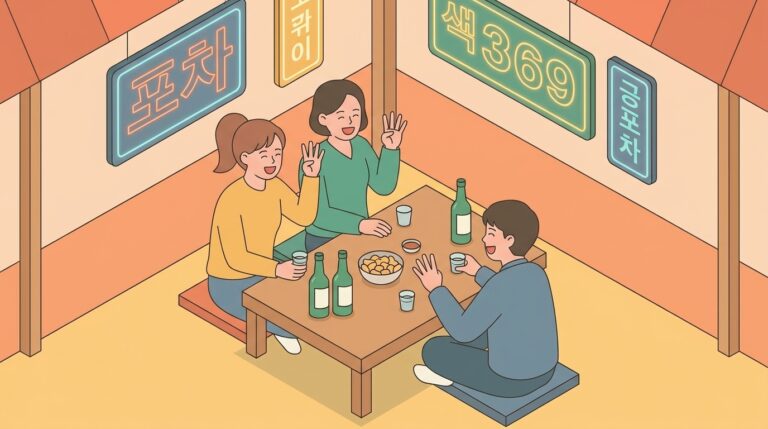
Master Korean Drinking Games: How to Survive and Shine in a Korean Suljari (술자리)
안녕하세요! (Annyeonghaseyo!) It’s your favorite K-Culture Navigator and Daily Hangul Editor! 👋
Have you ever watched a K-Drama where characters are laughing, chanting in unison, and clapping while drinking soju? Suddenly, someone makes a mistake, and everyone erupts in joy, chanting: “Mashinga-myeonseo baeuneun sul-geim!” (Learning drinking games while drinking!)
You might have felt a mix of excitement and absolute dread. “What if I get invited to a Korean drinking session (술자리 – suljari) and they play these games? Will I ruin the mood?”
Don’t worry! Today, we are going to master Korea’s two most iconic drinking games: Baskin Robbins 31 and 3-6-9 (Sam-Yuk-Gu). By the end of this guide, you won’t just survive; you’ll be the life of the party! Let’s dive in! 🍻
Phase 2: Deep-Dive into 3 Essential Expressions
To play like a local, you need to know the verbal “cues” that kick off the fun. Here are three crucial expressions:
1. 게임 시작해! (Geim sijak-hae!)
- Pronunciation: Game she-jahk-hae! (Sounds like “Game” + “she-jack” + “hey!”)
- Meaning: Let’s start the game! / Start the game!
- K-Culture Moment: Usually shouted by the game host while tapping their hands on the table rhythmically to get everyone’s attention.
- Editor’s Insight: This is a highly casual, imperative form. Use this only with friends (banmal). If you are with older colleagues, they will usually initiate it, but if you must, you would say “게임 시작할까요?” (Geim sijak-hal-kkayo? – Shall we start the game?).
- Situation Spectrum: Casual ✅ | Semi-formal ⚠️ | Formal 🚫
- 🤔 Think About It: In Korean culture, starting a game is a communal decision. Why do you think group harmony is so prioritized in Korean social gatherings compared to Western ones?
2. 마시면서 배우는 술게임! (Mashingamyeonseo baeuneun sul-geim!)
- Pronunciation: Mah-shin-gah-myeon-seo bae-oon-eun sool-game!
- Meaning: A drinking game that you learn while drinking!
- K-Culture Moment: This is the ultimate chanted shield. If a newcomer doesn’t know the rules, the group chants this loudly to reassure them that it’s okay to make mistakes (because making a mistake means you drink, which is the “learning” process!).
- Editor’s Insight: It sounds friendly, but it is a sweet trap! It playfully pressures you to drink because “making mistakes” is part of the fun.
- Situation Spectrum: Casual ✅ | Semi-formal ⚠️ | Formal 🚫
- 🤔 Think About It: How does this chant reduce the anxiety of trying something new in a group setting?
3. 아싸, 너 당첨! (Assa, neo dangcheom!)
- Pronunciation: Ah-ssah, neo dang-cheom!
- Meaning: Yay, you’re the one! / Oh, you got caught!
- K-Culture Moment: Shouted in unison pointing fingers at the person who made a mistake in the 3-6-9 game or hit the number 31 in Baskin Robbins.
- Editor’s Insight: Assa (아싸) is the Korean equivalent of “Yay!” or “Bingo!”. Dangcheom (당첨) originally means “winning a lottery,” but in drinking games, it sarcastically means “you are selected to drink!”
- Situation Spectrum: Casual ✅ | Semi-formal 🚫 | Formal 🚫
- 🤔 Think About It: Why does Korean slang use positive words like “winning” to describe losing a game?
Phase 3: Textbook Korean vs. Real-Life Korean
Let’s compare textbook phrases with what you will actually hear at a trendy bar in Hongdae!
Situation 1: Suggesting a game
- 📖 Textbook: “이제 게임을 시작합시다.” (Ije geim-eul sijak-hapsida. – Let us start the game now.)
- 🗣️ Real-Life: “아, 게임 고?” (Ah, geim go? – Ah, game? Go? / Down for a game?)
- 💡 Why the difference? Younger Koreans love mixing English loanwords with short, snappy Korean structures to keep the high-energy vibe alive.
Situation 2: Asking someone to drink for losing
- 📖 Textbook: “졌으니 술을 마셔요.” (Tyeosseuni sul-eul maseyeo. – You lost, so drink alcohol.)
- 🗣️ Real-Life: “마셔라! 마셔라! 마셔라!” (Maseyeora! Maseyeora! Maseyeora! – Drink! Drink! Drink! – Usually sung as a rhythmic chant)
- 💡 Why the difference? Drinking is a performance! Chanting builds pressure, excitement, and a sense of shared joy.
Phase 4: K-Culture Deep-Dive & Non-verbal Etiquette
4-1. Nunchi (눈치) & Body Language
- The Eye-Contact Rhythm: During games like 3-6-9, don’t stare too intensely at your hands. Look around the table, clap with tempo, and use Nunchi (tactful situational awareness) to predict when your turn is coming.
- The “Soju Pour” Angle: If the loser is older than you, hold your pouring hand’s wrist with your other hand as a sign of respect while serving them their penalty shot.
4-2. The Games Explained
- Baskin Robbins 31 (배스킨라빈스 31): Going clockwise, each person can call out 1, 2, or 3 consecutive numbers in order (e.g., Person A: “1, 2!”, Person B: “3!”, Person C: “4, 5, 6!”). The person forced to say “31” loses and must drink!
- 3-6-9 (삼육구): Take turns counting up from 1. Whenever a number contains a 3, 6, or 9, you must clap instead of saying the number. For 33, 36, or 39, you must clap twice! If you speak the number or clap on a regular number, you drink.
Phase 5: Real-Life Roleplay Scenario
Setting: A lively pocha (Korean street-style bar) in Sinchon. You are sitting with Minho (your Korean buddy) and Jiwon (the champion of drinking games).
Characters:
* Minho (민호): Enthusiastic, loves teasing.
* Jiwon (지원): Fast-paced, high energy, professional game initiator.
8-Turn Script:
- Jiwon: (Tapping table) “자~ 신나게 게임 시작해! 삼육구 할래, 배스킨라빈스 할래?”
(Ja~ sinnage geim sijak-hae! Sam-yuk-gu hallae, Baskin Robbins hallae?)
(Translation: Now~ let’s start the game excitedly! Do you want to do 3-6-9 or Baskin Robbins?) - You: “나 삼육구 할래! 자신 있어!”
(Na sam-yuk-gu hallae! Jasin isseo!)
(Translation: I want to do 3-6-9! I’m confident!) - Minho: “오~ 좋아! 그럼 나부터 시작한다. 일! (1)”
(Oh~ joha! Geureom na-buteo sijak-handa. Il!)
(Translation: Oh~ nice! Then I start first. One!) - Jiwon: “이! (2)”
(I!)
(Translation: Two!) - You: (You need to clap on 3)
🎭 claps hands enthusiastically“(Clap!)” - Minho: “사! (4)”
(Sa!)
(Translation: Four!) - Jiwon: “오! (5)”
(O!)
(Translation: Five!) - You: (Wait, it’s 6! You accidentally say the number) “육! (6)… 아차!”
(Yuk!… A-cha!)
(Translation: Six!… Ah, oops!)
🔀 Interactive Choice:
How do you react after making this mistake?
* A. [The Best Match] Throw your hands up, laugh, and yell: “아! 마시면서 배우는 거지!” (Ah! Mashingamyeonseo baeuneun geoji! – Ah! You learn while drinking!)
* B. [The Awkward Silence] Politely bow and say: “죄송합니다. 제가 술을 못 마십니다.” (Joesong-hamnida. Jega sul-eul mot masimnida. – Sorry, I cannot drink alcohol.)
* C. [The High Risk] Accuse Jiwon of counting too fast: “지원이가 너무 빨랐어요!” (Jiwon-iga neomu ppallasseoyo! – Jiwon was too fast!)
Feedback:
- A (Best): Excellent! You embraced the spirit of the game. The group will chant happily and respect your positive vibe.
- B (Bad): While honest, saying this abruptly kills the gaming mood. Instead, take a sip of water or soft drink as a substitute while keeping the energy high.
- C (Risk): Playful whining is okay, but accusing someone seriously might make you look like a sore loser. Keep it light!
Phase 6: 10-Second Emotion Shadowing Drill
To sound native, you must practice the dramatic rise and fall of Korean party energy. Try reading these with the slash / denoting short pauses!
- [🔥 Super Excited & Chanting]
“마시면서 / 배우는 / 술게임! / 아싸 / 너 당첨!”
(Ma-shin-gam-myeon-seo / bae-oon-eun / sool-game! / Ah-ssah / neo dang-cheom!) -
[😜 Playfully Teasing]
“아~ / 369 진짜 못하네! / 마셔라! / 마셔라!”
(Ah~ / sam-yuk-gu jin-jja mot-ha-ne! / Ma-syeo-ra! / Ma-syeo-ra!)
Phase 7: K-Culture Mini-Dictionary
- 포차 (Pocha) | Shorthand for Pojangmacha | Tent-style street bars or retro-themed pubs popular among young adults.
- 짠 (Jjan) | Cheers | The sound of glasses clinking. Essential to say before every group sip.
- 벌주 (Beol-ju) | Penalty drink | The glass filled with alcohol given to the loser of a game.
- 흑기사 (Heuk-gisa) | Black Knight | A male friend who volunteers to drink the penalty shot on behalf of someone else (usually a female friend) in exchange for a wish.
Phase 8: Traveler’s Survival Kit
Survival Expressions TOP 3:
- “저 한 입만 봐주세요!” (Jeo han ip-man bwa-juseyo!)
- Meaning: “Please let me off just this once!” (Use when you really can’t drink the penalty shot).
- “물로 채워도 돼요?” (Mul-lo chaewodo dwaeyo?)
- Meaning: “Can I fill my glass with water instead?”
- “오늘 분위기 진짜 좋다!” (Oneul bunwigi jinjja joha!)
- Meaning: “The vibe tonight is seriously so good!”
📍 Editor’s Travel Note: To find the best local pochas in Seoul, don’t rely heavily on foreign maps. Download the local search engine and mapping app, Naver Map, which has real-time reviews of popular drinking spots in areas like Hongdae and Itaewon. Note: Information and popularity of venues may change depending on seasonal trends.
Phase 9: “A Step Deeper” (Reflective Question)
Korean drinking games are not just about consuming alcohol; they are highly cooperative social rituals. Unlike Western drinking games which often focus on individual competition, Korean games focus on rhythm, collective chants, and maintaining group tempo. It teaches participants Nunchi (quick social adaptation) and fast communication.
💬 Your Turn: Does your country have games that require rhythmic hand-clapping or group chants? How do they differ from Korea’s high-speed game culture? Let us know in the comments below!
Phase 10: FAQ & Avoiding Misunderstandings
Q: Can I refuse to drink the penalty shot if I don’t drink alcohol?
A: Absolutely! Korean society is highly modernizing, and forcing people to drink (ganggwon) is widely discouraged today. Simply say, “저는 오늘 술을 못 마셔서 물로 할게요” (I can’t drink today, so I will use water). You can still play the game using water or soda!
Q: What is the most common mistake in 3-6-9?
A: Forgetting that numbers like 30 to 39 are pure chaos! For instance, on 33, you cannot say “thirty-three.” You have to clap twice! This is where even native Koreans fail constantly.
Q: Do I need to pour my own drink?
A: Try to avoid pouring your own drink (jajak), as old superstition says it brings bad luck. Always wait for someone to pour for you, and return the favor!
🚨 Common Mistakes Warning Board:
- Saying “3” in 3-6-9: Remember, never say the number containing 3, 6, or 9. Only clap!
- Shouting “31” in Baskin Robbins: If you say “31” out loud, you immediately lose. Your goal is to stop at 30 so the next person has to say 31.
- Drinking with one hand: If an older person pours a penalty drink for you, always receive it with both hands.
Phase 11: Action Mission
- Bronze Medal: Try clapping to the rhythm of “1, 2, [clap], 4, 5, [clap]” alone at home to master the 3-6-9 rhythm.
- Silver Medal: Share this post on your SNS and tag your friend with the caption: “우리 다음에 한국 가면 술게임 고?” (Shall we play drinking games when we go to Korea?)
- Gold Medal: Use the phrase “마시면서 배우는 거지!” during your next casual hangout with Korean friends.
🎮 K-Culture Mission: Watch any episode of the variety show Running Man or search for “Korean drinking game” on YouTube, and identify at least one person chanting “마셔라!” Write down how many times they say it!
Phase 12: Interactive Quiz Challenge
Test your knowledge before hitting the bar!
🔍 Q1. In 3-6-9, what should you do when it’s your turn on the number “36”?
Answer: Clap twice!
Explanation: Since “36” contains both a 3 and a 6, you must clap twice without making any sound.
🔍 Q2. In Baskin Robbins 31, what is the maximum number of consecutive numbers you can say in one turn?
Answer: 3 numbers.
Explanation: You can say 1, 2, or 3 numbers (e.g., “12, 13” or “14, 15, 16”).
🔍 Q3. True or False: If you make a mistake, you should immediately apologize formally to everyone and leave the table.
Answer: False!
Explanation: Making a mistake is the most fun part of the game! Laugh, accept your penalty drink, and yell “마시면서 배우는 거지!” to keep the party atmosphere lively.







