

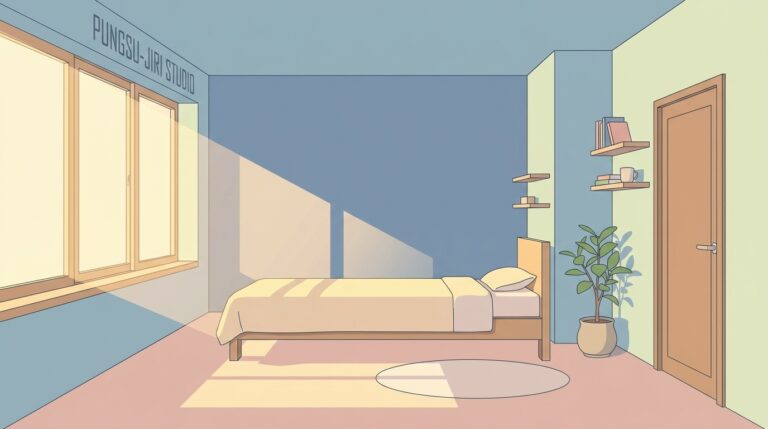
Master the Flow of Qi: The Advanced Guide to Korean Feng Shui (Pungsu-jiri) Interior Design
Phase 1: Empathy (Journey into the Soul of Pungsu-jiri)
안녕하세요! Welcome back to another premium masterclass by Daily Hangul. I’m your Lead Editor and Local Culture Navigator.
Imagine this: You’ve just moved into a chic studio apartment in the heart of Mapo, Seoul. You spent weeks scouring Instagram for the perfect minimalist aesthetic. You buy a sleek bed, place it directly facing the entrance because “it looks spacious,” and hang a massive mirror right in front of the door. But somehow, your sleep is restless, and your creative projects are hitting unexpected walls.
When you casually mention this to your Korean friend over a cup of ssanghwa-cha, they gasp and say, “Ah, that’s because you’ve blocked your luck! Your bed is in the death spot!”
This isn’t mere superstition. In Korea, Pungsu-jiri (풍수지리)—the traditional art of geomancy and spatial alignment—is deeply woven into both classical architecture and modern interior design. For C2 advanced learners, mastering the lexicon of Pungsu isn’t just about vocabulary; it’s about understanding the subtle, unspoken spatial psychology of Korean homes. Let’s dive deep into how to align your space—and your language—to invite absolute harmony (gi/ki flow) into your life.
Phase 2: Advanced Spatial Lexicon (Deep Dive)
1. 배산임수 (Baesan-imsu)
- Pronunciation: Bae-san-im-su (Think “beh-sahn-eem-soo”)
- Meaning: Literally “Back to the mountain, facing the water.” Academically, it denotes the ideal layout where a structure is nestled with mountains protecting its back and a river flowing in front.
- K-Culture Moment: You will hear this term constantly in historical dramas (Sageuk) when kings choose palace sites, but in modern real estate variety shows like Seoul Check-in or Where is My Home (구해줘! 홈즈), realtors use it to praise premium apartments situated behind Namsan and facing the Han River.
- Editor’s Insight: Beyond geography, Baesan-imsu is applied metaphorically in interiors. Your desk or bed should ideally have a solid wall (“mountain”) behind it and an open view (“water/flow”) toward the door or window to ensure psychological security.
- Situation Spectrum: Casual (⚠️ – sounds a bit poetic/academic) | Semi-formal (✅) | Formal (✅)
- 🤔 Think About It: How does your cultural background define spatial security? Do you prefer facing the door, or having your back to it?
2. 기(氣)의 흐름을 막다 (Gi-ui heureum-eul makda)
- Pronunciation: Gi-ui heu-reum-eul mak-da (Think “ghee-we hur-um-ul mahk-dah”)
- Meaning: To block the flow of life energy (Qi/Chi).
- K-Culture Moment: In modern lifestyle vlogs, when K-Celebs reorganize their dressing rooms, they often consult a design expert who warns: “현관 앞에 큰 거울을 두면 집안으로 들어오는 기의 흐름을 막아요” (Placing a large mirror in front of the entrance blocks the flow of energy coming into the house).
- Editor’s Insight: While Western design focuses on light and utility, Korean Pungsu emphasizes invisible pathways. Blocking these pathways is believed to lead to physical stagnation or financial blockages.
- Situation Spectrum: Casual (✅) | Semi-formal (✅) | Formal (✅)
- 🤔 Think About It: Is there an equivalent concept of “invisible energy” or spatial vibe in your native language?
3. 동선이 꼬이다 (Dong-seon-i kko-i-da)
- Pronunciation: Dong-seon-i kko-i-da (Think “dong-sun-ee kko-ee-dah”)
- Meaning: Literally “The lines of movement are twisted.” In design, it refers to an awkward, inefficient, or cluttered layout that disrupts daily traffic.
- K-Culture Moment: On home makeover shows like The House Detox (신박한 정리), professional organizers inspect cluttered living rooms and exclaim: “가구 배치가 잘못되어서 동선이 완전히 꼬였네요!” (The furniture layout is wrong, so the flow of movement is completely tangled!).
- Editor’s Insight: While Gi is spiritual, Dongseon is physical. In Korean design philosophy, physical clutter and spiritual stagnation are two sides of the same coin.
- Situation Spectrum: Casual (✅) | Semi-formal (✅) | Formal (⚠️ – slightly colloquial but widely accepted in professional design)
- 🤔 Think About It: How does physical flow (Dongseon) affect your mental state on a busy morning?
Phase 3: Textbook Korean vs. Native Korean
Situation 1: Describing an awkward room layout
- 📖 Textbook: “가구의 배치가 적절하지 않아 통행이 불편합니다.” (The placement of furniture is not appropriate, making transit inconvenient.)
- 🗣️ Native: “가구 배치가 애매해서 동선이 다 꼬여요.” (The furniture placement is awkward, so the whole flow of movement is tangled up.)
- 💡 Why the difference? Textbook Korean relies on rigid Sino-Korean adjectives (jeok-jeol-hada, tong-haeng). Real Koreans use sensory words like aeme-hada (awkward/ambiguous) and the highly descriptive idiomatic verb kko-i-da (to tangle) to express frustration with spatial flow.
Situation 2: Expressing why you want to move a mirror
- 📖 Textbook: “거울의 위치가 나쁩니다. 그것은 운을 반사합니다.” (The mirror’s location is bad. It reflects luck.)
- 🗣️ Native: “현관 마주 보는 거울은 복을 쫓아내요.” (A mirror directly facing the entrance chases away good fortune.)
- 💡 Why the difference? Textbooks translate “bad luck” literally. Natives use the concept of Bok (복)—vital, active luck/blessings—and use active, vivid verbs like jjoch-a-nae-da (to chase/kick out) to describe spatial taboos.
Phase 4: K-Culture Deep Dive & Non-Verbal Etiquette
4-1. The Body Language of Space
When discussing Pungsu with interior designers or elders in Korea, respect for space is shown physically:
* The Open-Palm Sweep: Never point directly at an offending corner with a single finger. Use a gentle, open-handed sweep (sondit-jit) to indicate layout changes. It shows elegance and respect for the room’s energy.
* Slight Head Tilt of Consideration: When an elder suggests moving your headboard away from the bathroom wall (believed to drain energy), a slight head tilt while saying “아, 그렇군요” (Ah, I see) shows you value their cultural wisdom, even if you eventually decide otherwise.
4-2. The Modern K-Pungsu Trend
Modern Korean millennials and Gen Z do not view Pungsu as archaic superstition. Instead, it is branded as “Healing Interior” (힐링 인테리어). They combine Scandinavian minimalism with Pungsu guidelines. For instance, placing green leafy plants (관엽식물) near the entrance is highly popular because plants are believed to neutralize harsh energy entering from the outside world.
Phase 5: Real-Life Roleplay Scenario
Characters
- 민지 (Minji): A sophisticated interior designer who specializes in blending modern aesthetics with traditional Pungsu principles.
- Alex (C2 Learner): A design enthusiast seeking to revamp their Seoul officetel.
민지: 에이전시에서 보낸 평면도 잘 봤어요, 알렉스 씨. 그런데 침대 위치가 조금... 애매하네요.

알렉스: 🎭 (눈을 동그랗게 뜨며 걱정스럽게) 아, 정말요? 저는 채광이 좋아서 창문 바로 옆에 붙여 뒀는데, 혹시 문제가 있나요?

민지: 네, 창문 쪽으로 머리를 두고 자면 외부의 거친 기운을 바로 받아서 숙면을 취하기 어려워요. 이른바 '풍수지리의 기본'에서 벗어난 배치예요.

알렉스: 🎭 (턱을 괴고 골똘히 생각하며) 아, 배산임수 원칙을 실내에도 적용해야 하는군요. 침대 헤드를 견고한 벽면 쪽으로 붙이는 게 나을까요?

민지: 맞아요! 그리고 침대가 문을 열었을 때 대각선 방향에 놓여야 안도감을 느끼고 복이 들어오는 통로가 확보돼요.

알렉스: 🎭 (끄덕이며 수긍하는 표정으로) 그렇군요. 그럼 현관문 바로 앞에 있는 대형 전신거울은 어떡하죠? 그것도 마음에 걸려요.

민지: 아, 그건 정말 피해야 해요! 현관을 열자마자 거울이 마주 보이면 들어오는 운을 그대로 반사해서 돌려보내거든요.

알렉스: 🎭 (미소를 지으며 안도의 한숨을 쉬며) 당장 거울 위치부터 옮겨야겠네요. 동선이 꼬이지 않게 식물 화분도 하나 놓아야겠어요.
🔀 Interactive Choice Point
How should Alex respond to Minji’s final advice to optimize the layout?
- A: “귀찮은데 그냥 대충 살게요.” (It’s a hassle, I’ll just live with it roughly.)
- 🔴 Feedback (Bad): Extremely dismissive. Chases away both the Gi and Minji’s professional enthusiasm.
- B: “풍수지리는 과학적 근거가 없지 않나요?” (Isn’t Pungsu-jiri lacking scientific evidence?)
- ⚠️ Feedback (Risk): While intellectually curious, it sounds overly confrontational and disrupts the collaborative, polite atmosphere of a design consultation.
- C: “선생님 말씀대로 배치를 바꾸고 싱그러운 화분을 현관 쪽에 두어 생기를 불어넣어야겠어요!” (As you said, teacher, I should change the layout and place a fresh plant near the entrance to breathe vitality into the space!)
- 🟢 Feedback (Best!): Shows high linguistic competence (using idioms like saeng-gi-reul bureo-neotda – to breathe vitality) and culturally respectful engagement.
Phase 6: 10-Second Emotion Shadowing Drill
Practice these natural, emotive sentences. Master the pauses (/) and the emotional intentions to sound incredibly native.
[🥺 Worried but deeply curious]- “침대 위치가 / 기의 흐름을 막는다고 하니까 / 괜히 신경 쓰이네요.”
- Chim-dae wi-chi-ga / gi-ui heu-reum-eul mak-neun-da-go ha-ni-kka / gwaen-hi sin-gyeong sseu-i-nae-yo.
- (Since you said the bed position blocks the flow of energy, I can’t help but feel anxious about it.)
[💡 Realizing an epiphany]- “아! / 현관 마주 보는 거울이 / 복을 반사해서 쫓아내는군요!”
- Ah! / Hyeon-gwan ma-ju bo-neun geo-ul-i / bok-eul ban-sa-hae-seo jjoch-a-nae-neun-gun-yo!
- (Ah! So a mirror facing the entrance reflects and chases away good fortune!)
Phase 7: K-Culture Mini Dictionary
- 수액 (Suaek) | Sap / Tree Fluid: Often used in botanical feng shui discussions; plants that secrete heavy sap are considered negative for home energy.
- 벽지 색상 (Byeok-ji Saek-sang) | Wallpaper Color: In Pungsu, wallpaper colors are chosen based on the five elements (Ohaeng) to balance the resident’s birth year energy.
- 사기 (Sagi) | Dead / Toxic Energy: Heavy, stagnant energy that accumulates in dark, cluttered corners (구석진 곳).
- 현관 매트 (Hyeon-gwan Maet) | Entrance Mat: A crucial filter in modern Pungsu that is believed to brush off negative energy from the outside world before you step inside.
Phase 8: Traveler’s Survival Kit
Survival Phrases for Interior Shopping
- “이 가구, 원목 재질인가요?” (Is this furniture made of solid wood?)
- Pro Tip: Wood element (Mok) furniture is highly recommended in Pungsu for bringing growth and vitality.
- “집안에 두기에 너무 과하지 않은 크기일까요?” (Is this size not too overpowering for a home?)
- Pro Tip: Balance (Jo-hwa) is key; oversized furniture traps energy.
- “조명을 조금 은은한 것으로 바꾸고 싶어요.” (I want to change the lighting to something softer/ambient.)
- Pro Tip: Harsh fluorescent lights create sharp Sagi (dead energy), whereas warm, ambient lighting invites wealth.
Editor’s Travel Note
When looking for authentic feng shui-friendly decor items or premium local Korean interior goods in Seoul, do not miss the specialized design shops in Insadong (인사동) or the larger lifestyle floors at the The Hyundai Seoul (더현대 서울) department store. To navigate easily, make sure to download the Naver Map App rather than relying on global map engines, which often lag in Korea.
Disclaimer: Store operational hours and stock availability are subject to change depending on seasonal trends.
Phase 9: “Going Deeper” (Cultural Insights)
In the West, interior design is largely an aesthetic expression of individualism—a reflection of the “Self.” In Korea, however, a home is viewed as an extension of nature and the cosmos. We do not merely “own” or “decorate” space; we co-exist with it. This stems from a deep history of Confucianism and Taoism, where harmony with the environment dictates personal health, familial peace, and ancestral honor. When you design a room according to Pungsu-jiri, you are practicing mindfulness—showing respect to the physical boundaries of your shelter.
💬 Your Turn: Have you ever rearranged your room and felt an immediate shift in your mood or productivity? Tell us in the comments below! We’d love to hear your spatial stories.
Phase 10: FAQ & Common Mistakes
Q: Can I place my bed directly under a large window?
A: According to Pungsu-jiri, placing your bedhead directly beneath a window is highly discouraged. Windows are volatile portals where energy fluctuates constantly. It is best to place the headboard against a solid wall, leaving a small gap of about 10-15cm between the bed and the wall/window for gentle air circulation.
Q: Is it true that dried flowers (드라이플라워) are bad luck?
A: Yes! In Korean Pungsu, dried flowers are considered “dead plants” that emit dead energy (Sagi). They are believed to drain the active vitality (Saeng-gi) of the inhabitants. Opt for living, vibrant potted plants with rounded leaves instead of sharp, spiky cacti.
Q: Where is the best spot to place a mirror in the living room?
A: Avoid placing a mirror where it reflects the messy kitchen or chaotic corners. Instead, place it where it reflects a beautiful landscape outside the window or a vibrant plant, effectively doubling the positive energy entering your home.
🚨 Common Mistakes Warning Board
- Placing a mirror directly opposite the front door:
- Correct Action: Move the mirror to the side wall of the entrance, or cover it with a beautiful fabric poster.
- Leaving the toilet lid open:
- Correct Action: In Pungsu, the bathroom is a place of heavy water energy where wealth can literally slip away. Always keep the toilet lid closed and the bathroom door shut.
- Keeping broken clocks or electronic devices:
- Correct Action: Stagnant time represents stagnant progress. Repair or discard broken timepieces immediately.
Phase 11: Action Mission
- 🥉 Bronze Mission: Check your entryway right now. Ensure there are no shoes cluttered directly in the middle of the doorway. Clean the threshold!
- 🥈 Silver Mission: Take a photo of your desk or bed setup, post it on Instagram, and tag us at @DailyHangul using the hashtag #MyPungsuHome with a Korean caption explaining your layout.
- 🥇 Gold Mission: Walk into a local Korean lifestyle shop (or look at an online Korean interior store) and ask the customer service: “현관에 두기 좋은 생기 있는 관엽식물을 추천해 주시겠어요?” (Could you recommend a lively leafy plant that is good to place at the entrance?)
Phase 12: Interactive Quiz Challenge
Test your mastery of Korean spatial alignment and C2 design terminology!
1. Situational Judgment
Which of the following layouts most closely aligns with the principle of 배산임수 (Baesan-imsu) in a modern bedroom?
* A) Placing your desk in the middle of the room with your back completely exposed to the door.
* B) Positioning your bed headrest against a solid, structural wall while having a clear view of the room’s entrance and windows.
* C) Placing your bed directly between the bathroom door and the front entrance to maximize walking speed.
Reveal Answer & Explanation
Correct Answer: B
Explanation: Having a solid wall behind you represents the protective mountain (Bae-san), while facing the open room and door mimics looking out onto water/flow (Im-su), which provides the highest level of psychological safety and harmonic flow.
2. Fill in the Blank
“현관에 거울을 마주 보게 걸어두면 집안으로 들어오는 ( )을/를 반사해서 쫓아냅니다.”
* A) 동선 (Dong-seon)
* B) 복 (Bok)
* C) 배산임수 (Baesan-imsu)
Reveal Answer & Explanation
Correct Answer: B) 복 (Bok)
Explanation: Mirrors directly facing the entrance reflect and chase away the Bok (good fortune/blessings) that tries to enter the house.
3. True or False
True or False: Cacti and sharp-pointed plants are highly recommended for the bedroom to protect the owner from negative energy.
Reveal Answer & Explanation
Correct Answer: False
Explanation: Sharp, spiky plants like cacti are believed to generate harsh, aggressive energy (Sagi) and are discouraged in cozy, restorative spaces like bedrooms. Soft, rounded leaves are preferred.






