

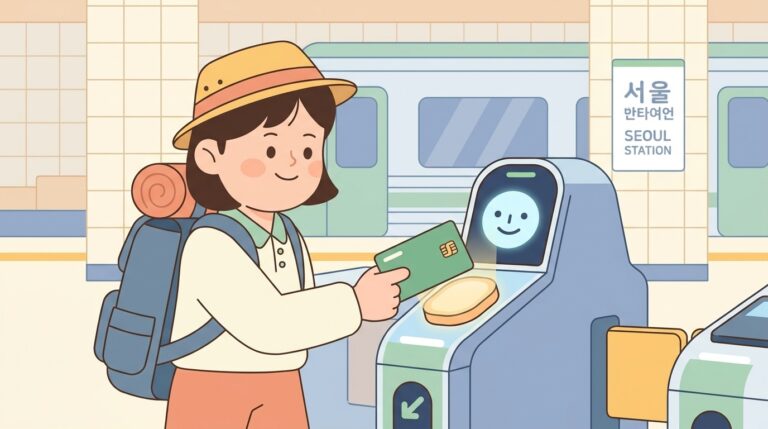
Phase 1: Empathy (Welcome, My Friend!)
안녕하세요! (An-nyeong-ha-se-yo!) I’m your Daily Hangul editor and your personal Korean culture navigator.
Imagine this: You’ve just arrived in Seoul. The subway station is bustling, neon signs are glowing, and you can smell delicious delimanjo (custard cakes) baking nearby. You walk up to the subway turnstile, card in hand. But suddenly, you feel a splash of anxiety. Where do I tap? What if it beeps loudly and the gate doesn’t open? What do I say if I get stuck?
Don’t worry at all! Every single expat and traveler has stood right where you are, feeling that exact same pinch of panic. Tap-tap anxiety is real! Today, we are going to learn how to breeze through the Korean subway gates like a local. By the end of this guide, you’ll confidently tap your card, understand the sounds of the turnstile, and even know how to ask for help with absolute ease. Let’s dive in!
Phase 2: Deep Dive into 3 Essential Expressions
1. 카드를 대 주세요 (Ka-deu-reul dae ju-se-yo)
- Pronunciation: Kah-deu-reul dae joo-seh-yo (Sounds like “car-due” + “rail” + “day” + “joo-say-yo”)
- Meaning: Please tap/place your card.
- K-Culture Moment: You will hear this polite, automated voice from the turnstile sensor if you stand there too long without tapping. In K-Dramas, when characters are distracted by a dramatic phone call at the subway gate, this machine voice often plays in the background!
- Editor’s Insight: The verb 대다 (dae-da) means “to touch” or “to place close to.” Korean subway sensors are super fast, so a light, 1-second touch is all it takes!
- Situation Spectrum:
- Casual: 카드 대 (Ka-deu dae) 🚫 (Too blunt!)
- Semi-formal: 카드 대 주세요 (Ka-deu dae ju-se-yo) ✅ (Perfect for talking to staff or friends politely!)
- Formal: 카드를 접촉해 주십시오 (Ka-deu-reul jeop-chok-hae ju-sip-si-o) ⚠️ (You only see this on official instruction screens.)
- 🤔 Think About It: In your country, do people say “tap,” “swipe,” or “scan”? Why do you think Korean uses the word “touch/place” (대다)?
2. 안 돼요 (An dwae-yo)
- Pronunciation: An dway-yo (Sounds like “ahn” + “dway-yo”)
- Meaning: It’s not working. / I can’t. (Literally: “It does not become.”)
- K-Culture Moment: When your card balance is empty and the gate screen flashes red, you look at the station worker and say with a cute, slightly embarrassed smile, “안 돼요!”
- Editor’s Insight: This is one of the most versatile words in Korea. You can use it when your subway card doesn’t work, when a machine is broken, or when someone asks you to do something impossible. It’s gentle yet clear.
- Situation Spectrum:
- Casual: 안 돼 (An dwae) ⚠️ (Only with close friends)
- Semi-formal: 안 돼요 (An dwae-yo) ✅ (Extremely natural and polite for daily life!)
- Formal: 안 됩니다 (An dem-ni-da) ✅ (Very formal, often used by staff explaining rules to you.)
- 🤔 Think About It: How does your culture politely signal that something is “not working” without sounding too aggressive?
3. 도와주세요 (Do-wa-ju-se-yo)
- Pronunciation: Doh-wah-joo-seh-yo (Sounds like “door-wah” + “joo-say-yo”)
- Meaning: Please help me.
- K-Culture Moment: If you accidentally tap into the wrong direction platform (Seoul subways have separate gates for different directions sometimes!), you can press the red “Helper/Emergency” button on the side gate and say this to the speaker.
- Editor’s Insight: Koreans are incredibly helpful. If you say “도와주세요” with a polite bow, people will often go out of their way to guide you to the right place.
- Situation Spectrum:
- Casual: 도와줘 (Do-wa-jwo) 🚫 (Don’t use this with strangers!)
- Semi-formal: 도와주세요 (Do-wa-ju-se-yo) ✅ (Perfect, universal, and polite.)
- Formal: 도와주시기 바랍니다 (Do-wa-ju-si-gi ba-ram-ni-da) 🚫 (Too robotic, used on public signs.)
- 🤔 Think About It: Asking for help is not a sign of weakness in Korea; it’s a way to build a quick, warm human connection (Jeong / 정) with locals!
Phase 3: Textbook Korean vs. Real Korean
Situation 1: When your card doesn’t scan
- 📖 Textbook Korean: 교통카드가 작동하지 않습니다. (Gy-o-tong-ka-deu-ga jak-dong-ha-ji an-seup-ni-da.)
- “The transportation card is not functioning.” (Super formal, sounds like a manual booklet.)
- 🗣️ Real Korean: 어, 이거 안 돼요. (Eo, i-geo an dwae-yo.)
- “Uh, this isn’t working.” (Natural, friendly, and instantly understood by any helper nearby.)
- 💡 Why the difference? In real life, Koreans prefer short, context-heavy phrases. Saying “이거 안 돼요” (This doesn’t work) while pointing to the card is much more natural than pronouncing a long, technical word like “작동” (functioning).
Situation 2: Asking where to place the card
- 📖 Textbook Korean: 교통카드를 어디에 접촉해야 합니까? (Gy-o-tong-ka-deu-reul eo-di-e jeop-chok-hae-ya hap-ni-ka?)
- “Where must I contact the transportation card?” (Way too robotic!)
- 🗣️ Real Korean: 카드 어디에 찍어요? (Ka-deu eo-di-e jji-geo-yo?)
- “Where do I tap/stamp the card?”
- 💡 Why the difference? Real Koreans use the lively verb 찍다 (jjik-da – to stamp/print) instead of 접촉하다 (jeop-chok-ha-da – to contact). It sounds active and highly conversational!
Phase 4: K-Culture Deep Dive & Non-Verbal Manners
4-1. The “Quick Tap” Etiquette & Eye Contact
- The 1-Second Rule: Seoul’s subway system handles millions of commuters. When approaching the gate, have your card in hand before you reach the sensor.
- Body Language: If your card makes an error beep (BEEP BEEP!), do not freeze in the middle! Step slightly to the side immediately so the person behind you doesn’t bump into you. Give them a quick, apologetic nod—a slight bend of the head—to signal, “Sorry, go ahead.”
4-2. The Magic Red Button
At every turnstile gate, there is a gate with a wheelchair/stroller symbol. On the side, you will find a cylindrical metallic pole with a big HELP button (usually red or orange). If you tap your card and it beeps red, or if you accidentally went into the wrong direction, press this button! You don’t need to speak fluent Korean. Just say “도와주세요” (Do-wa-ju-se-yo) into the speaker, and a friendly station officer will buzz the gate open for you.
Phase 5: Real-Life Roleplay Scenario
Setting: Gangnam Station (지하철 2호선). You are trying to tap through the turnstile during rush hour, but the screen flashes yellow and says “잔액이 부족합니다” (Insufficient Balance). Min-jun, a kind local standing nearby, sees you looking confused.
Characters:
- You (A1 Learner)
- Min-jun (Subway Savior / NPC)
Dialogue:
- You: (Tapping card frantically, gate keeps beeping)
- “어… 안 돼요!” (Eo… an dwae-yo!)
- 🎭 [Looking panicked, tapping again] / “Uh… it’s not working!”
- Min-jun: “무슨 일 있으세요? 카드 안 찍혀요?” (Mu-seun il i-seu-se-yo? Ka-deu an jji-kyeo-yo?)
- 🎭 [Approaching you warmly] / “Is something wrong? Card not tapping?”
- You: “네, 이거 안 돼요.” (Ne, i-geo an dwae-yo.)
- 🎭 [Showing your card with a sad smile] / “Yes, this isn’t working.”
- Min-jun: “아, 화면에 ‘잔액 부족’이라고 뜨네요. 돈이 없어요.” (Ah, hwa-myeon-e ‘jan-aek bu-jok’-i-ra-go tteu-ney-yo. Don-i eop-seo-yo.)
- 🎭 [Pointing at the gate screen] / “Ah, the screen says ‘low balance’. No money.”
- You: “아… 돈이 없어요? 어디에 충전해요?” (Ah… don-i eop-seo-yo? Eo-di-e chung-jeon-hae-yo?)
- 🎭 [Nodding in realization] / “Ah… no money? Where do I recharge?”
- Min-jun: “저기 기계에서 충전할 수 있어요. 같이 갈까요?” (Jeo-gi gi-gye-e-seo chung-jeon-hal su i-sseo-yo. Gat-i gal-kka-yo?)
- 🎭 [Pointing towards the yellow ticket machine nearby] / “You can recharge at that machine over there. Shall we go together?”
- You: “정말요? 감사합니다! 도와주세요.” (Jeong-mal-yo? Gam-sa-ham-ni-da! Do-wa-ju-se-yo.)
- 🎭 [Sighing in relief and bowing slightly] / “Really? Thank you! Please help me.”
- Min-jun: “네, 이쪽으로 오세요!” (Ne, i-jjok-eu-ro o-se-yo!)
- 🎭 [Leading the way with a friendly smile] / “Yes, come this way!”
🔀 Interactive Choice Point!
What will you do next at the ticket machine?
* Choice A: Say nothing, just hand him your wallet and hope he does it for you.
* Choice B: Ask “카드 어떻게 해요?” (Ka-deu eo-tteo-ke hae-yo? – How do I do the card?) while holding up your card.
* Choice C: Panic and run away to find a taxi.
Feedback:
- Choice A (Risk ⚠️): Handing over your wallet is a bit too quiet and risky! Try to use your words to learn.
- Choice B (Best 👍): Perfect! “카드 어떻게 해요?” is simple, natural, and shows you want to learn the process.
- Choice C (Bad ❌): No need to run! Korean stations are very safe, and Min-jun is happy to help you.
Phase 6: 10-Second Emotion Shadowing Drill
Let’s practice speaking with real Korean emotion! Focus on the pauses (marked by /) and the emotional cues.
- [🥺 Looking worried and apologetic]
- 안 돼요… / 카드 / 안 돼요… (An dwae-yo… / ka-deu / an dwae-yo…)
- “It’s not working… my card… isn’t working…”
- [😊 Super relieved and happy]
- 아! / 감사합니다! / 도와주세요! (Ah! / gam-sa-ham-ni-da! / do-wa-ju-se-yo!)
- “Ah! Thank you! Please help me!”
- [🙋 Confidently asking a question]
- 카드 / 어디에 / 찍어요? (Ka-deu / eo-di-e / jji-geo-yo?)
- “Where / do I / tap the card?”
Phase 7: K-Culture Mini Dictionary
- 교통카드 (Gy-o-tong-ka-deu) | Transportation Card
- Usage: The general term for transit cards like T-Money or Cashbee. You can buy these at any convenience store!
- 찍다 (Jjik-da) | To tap / To stamp
- Usage: Literally “to stamp.” Locals always say “카드 찍고 들어오세요” (Tap your card and come in).
- 충전 (Chung-jeon) | Recharge / Top-up
- Usage: Used for both topping up your subway card and charging your phone battery!
- 잔액 부족 (Jan-aek Bu-jok) | Insufficient Balance
- Usage: The red warning message on the turnstile screen when your card has less than 1,250 KRW left.
Phase 8: Survivor Kit for Travelers
Survival Expressions TOP 3
- 이거 안 돼요. (I-geo an dwae-yo.) – “This doesn’t work.”
- Pro Tip: Use this when your card won’t tap, or when the ticket machine eats your bill.
- 도와주세요. (Do-wa-ju-se-yo.) – “Please help me.”
- Pro Tip: Say this to any station employee wearing a yellow vest or through the intercom button.
- 티머니 있어요? (Ti-meo-ni i-sseo-yo?) – “Do you have T-Money?”
- Pro Tip: Say this at convenience stores when you want to buy a transit card.
📝 Editor’s Travel Note
- Essential App: Never travel without download links for Naver Map or KakaoMap. Google Maps does not update real-time transit paths well in Korea!
- Cash is King (for cards): While Korea is almost 100% cashless, subway card recharge machines only accept cash (Korean Won bills). Always keep a 5,000 or 10,000 KRW note in your pocket for emergencies!
Phase 9:
Frequently Asked Questions (FAQ)
Q: What does "카드를 대 주세요 (Ka-deu-reul dae ju-se-yo)" mean in Korean and how do you pronounce it?
A: In Korean, "카드를 대 주세요 (Ka-deu-reul dae ju-se-yo)" is pronounced [Kah-deu-reul dae joo-seh-yo (Sounds like "car-due" + "rail" + "day" + "joo-say-yo"] and means: Please tap/place your card.
Q: What does "안 돼요 (An dwae-yo)" mean in Korean and how do you pronounce it?
A: In Korean, "안 돼요 (An dwae-yo)" is pronounced [An dway-yo (Sounds like "ahn" + "dway-yo"] and means: It’s not working. / I can’t. (Literally: "It does not become.")
Q: What does "도와주세요 (Do-wa-ju-se-yo)" mean in Korean and how do you pronounce it?
A: In Korean, "도와주세요 (Do-wa-ju-se-yo)" is pronounced [Doh-wah-joo-seh-yo (Sounds like "door-wah" + "joo-say-yo"] and means: Please help me.







