

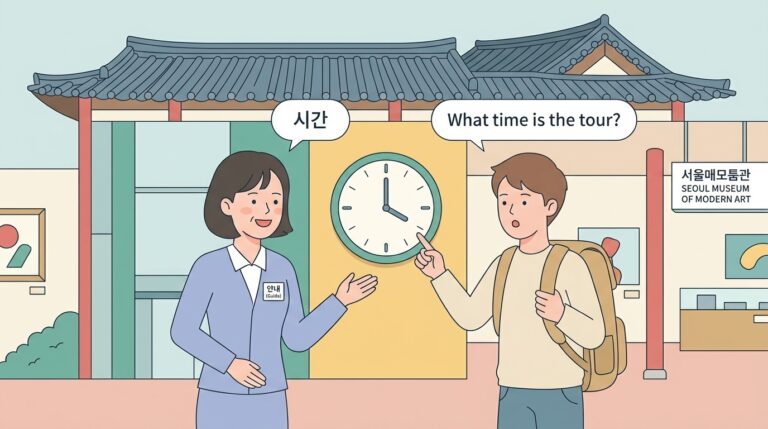
Seoul Art Adventure: How to Check Museum Hours in Korean Without Getting Lost!
안녕하세요! (Annyeonghaseyo!) Hello, my lovely language learners! It’s your favorite K-culture navigator and chief editor of Daily Hangul (매일한글).
Have you ever planned the perfect day in Seoul, dreamed of taking that aesthetic Instagram photo in front of the National Museum of Modern and Contemporary Art (MMCA), only to arrive and find the doors locked? 😭
Maybe you checked the hours online, but “closed on Mondays” or “last entry 1 hour before closing” got lost in translation. Don’t worry! Today, we are going to learn how to confidently ask about museum and art gallery hours in Korean like a local. Let’s make sure your next cultural adventure is smooth and stress-free!
Phase 2: Three Key Expressions to Master
1. 몇 시에 문 닫아요? (Myeot si-e mun dad-a-yo?)
- Pronunciation: Myut she-eh moon dad-ah-yo? (Sounds like “Mute she” + “moon” + “dad” + “ah-yo”)
- Meaning: What time do you close? (Literally: “At what hour do you close the door?”)
- K-Culture Moment: You will hear this in K-Dramas when the main characters are rushing to an art gallery date just before closing time.
- Editor’s Insight: This is the most natural, friendly way to ask. While dictionaries teach “폐관 시간” (closing time), locals rarely say that out loud because it sounds too robotic.
- Situation Spectrum: Casual ✅ | Semi-formal ✅ | Formal ⚠️
- 🤔 Think About It: In Korean, many action-oriented verbs like “closing a door” (문 닫다) are used instead of passive noun forms. How does your native language express this?
2. 몇 시까지 입장 가능해요? (Myeot si-kkaji ip-jang ganeung-haeyo?)
- Pronunciation: Myut she-kkah-jee eep-jang gah-neung-hae-yo? (Sounds like “Mute she” + “kah-jee” + “leap” without ‘l’ + “jang” + “gah-nung-hey-yo”)
- Meaning: Until what time is entry allowed? / When is the last admission?
- K-Culture Moment: Essential for popular immersive media art exhibitions in Insadong or Jeju Island.
- Editor’s Insight: Even if a museum closes at 6 PM, the “last entry” (입장 마감) is usually 5:00 PM. This question saves you from a wasted trip!
- Situation Spectrum: Casual ⚠️ | Semi-formal ✅ | Formal ✅
- 🤔 Think About It: Korean respect culture emphasizes checking rules politely beforehand so you don’t inconvenience the staff.
3. 오늘 열어요? (Oneul yeol-eo-yo?)
- Pronunciation: Oh-neul yul-uh-yo? (Sounds like “Oh-null” + “yull-uh-yo”)
- Meaning: Are you open today? (Literally: “Do you open today?”)
- K-Culture Moment: Used when calling a trendy local pottery workshop or a small indie gallery in Hongdae on a holiday.
- Editor’s Insight: Simple, sweet, and direct. Great for phone calls or quick Instagram DMs!
- Situation Spectrum: Casual ✅ | Semi-formal ✅ | Formal ⚠️
- 🤔 Think About It: Why do you think Korean uses “opening the door” (열다) as a general term for “being open for business”?
Phase 3: Textbook Korean vs. Real-Life Korean
Let’s look at how textbooks make you sound like a robot, and how real Koreans actually speak!
Situation 1: Asking about closing hours
- 📖 Textbook Korean: 관람 종료 시간이 몇 시입니까? (Gwan-ram jong-ryo si-gan-i myeot si-im-ni-ka?) – “What is the viewing termination hour?”
- 🗣️ Real-Life Korean: 몇 시에 끝나요? (Myeot si-e kkeut-na-yo?) – “What time does it finish?”
- 💡 Why the difference? Textbooks love Sino-Korean nouns (관람 종료), but real people prefer simple verbs (끝나다 – to finish) to sound warm and approachable.
Situation 2: Asking if they are open on holidays
- 📖 Textbook Korean: 금일 휴관하십니까? (Geum-il hyu-gwan-ha-sim-ni-ka?) – “Are you closed today?” (Extremely formal/written style)
- 🗣️ Real-Life Korean: 오늘 쉬는 날이에요? (Oneul swi-neun nal-i-e-yo?) – “Is today a rest day (closed)?”
- 💡 Why the difference? “쉬다” (to rest) is the ultimate friendly word for businesses being closed. It feels less like a corporate notice and more like a human conversation.
Phase 4: K-Culture Deep Dive & Non-Verbal Manners
4-1. The “Nunchi” (눈치) of Asking for Directions
When approaching a museum staff member in Korea, a little bit of Nunchi (situational awareness) goes a long way.
* The Soft Bow: Always slightly nod your head when saying “저기요…” (Excuse me…). It instantly shows respect.
* The Smartphone Show: If you struggle with pronunciation, simply show the screen with the museum’s name and point while saying: “오늘… 해요?” (Today… open?). They will understand instantly and guide you with a warm smile!
4-2. Museum Mondays in Korea
In Korea, almost all national and public museums are closed on Mondays (월요일 휴무). If Monday is a national holiday, they usually open on Monday and close on Tuesday instead. Always double-check!
Phase 5: Interactive Roleplay Scenario
Meet Minji (민지), the friendly ticket booth guide at a beautiful art museum in Bukchon Hanok Village. You want to buy a ticket, but it looks a bit late.
The Conversation
- You: 저기요, 실례합니다. (Jeogiyo, sillyehamnida.)
- 🎭 (Approaching politely with a small bow) “Excuse me, sorry to bother you.”
- Minji: 네, 안녕하세요! 무엇을 도와드릴까요? (Ne, annyeonghaseyo! Mueoseul dowadeurilkkayo?)
- 🎭 (Smiling warmly) “Yes, hello! How can I help you?”
- You: 오늘 몇 시에 문 닫아요? (Oneul myeot si-e mun dad-a-yo?)
- 🎭 (Pointing to your watch) “What time do you close today?”
- Minji: 오늘은 저녁 여섯 시에 문 닫아요. (Oneureun jeonyeok yeoseot si-e mun dad-a-yo.)
- 🎭 (Showing 6 fingers) “Today we close at 6 PM.”
- You: 아, 지금 다섯 시예요. 입장 가능해요? (Ah, jigeum daseot si-yeo-yo. Ip-jang ganeung-haeyo?)
- 🎭 (Checking your phone clock with a slightly worried face) “Ah, it’s 5:00 now. Is entry possible?”
- Minji: 네, 다섯 시 반까지 입장하실 수 있어요! (Ne, daseot si ban-kkaji ip-jang-hasil su isseoyo!)
- 🎭 (Nodding reassuringly) “Yes, you can enter until 5:30!”
- You: 다행이네요! 표 한 장 주세요. (Dahaeng-ineyo! Pyo han jang juseyo.)
- 🎭 (Sighing with relief and handing over your card) “What a relief! One ticket, please.”
- Minji: 여기 있습니다. 즐거운 관람 되세요! (Yeogi isseumnida. Jeolgeoun gwanram doeseyo!)
- 🎭 (Handing over the ticket and pointing to the entrance) “Here it is. Enjoy your viewing!”
🔀 Your Turn! What do you say next?
- Choice A: “감사합니다!” (Gamsahamnida!) and head inside.
- Choice B: “언제 열어요?” (Eonje yeol-eo-yo?) even though you just got the ticket.
- Choice C: “너무 비싸요!” (Neomu bissayo!) and walk away.
Feedback:
- Choice A (Best): Perfect! Showing gratitude is the best way to end a pleasant interaction. Enjoy the art!
- Choice B (Risk): A bit confusing! You already have your ticket and know they close at 6 PM. Asking “When do you open?” might make Minji think you want to come back tomorrow.
- Choice C (Bad): Oops! Haggling over museum ticket prices at the booth is considered quite rude in Korea.
Phase 6: 10-Second Emotion Shadowing Drill
Practice speaking with real emotions! Pay attention to the pauses (/).
- [🥺 Worried & Rushing]
- 오늘 / 몇 시에 / 문 닫아요?
- Oh-neul / myeot si-e / mun dad-a-yo?
- [😊 Relieved & Excited]
- 와, / 아직 / 입장 가능하네요!
- Wa, / ajik / ip-jang ganeung-ha-ne-yo!
- [💖 Polite & Grateful]
- 친절하게 / 알려주셔서 / 감사합니다!
- Chin-jeol-ha-ge / al-ryeo-ju-sheo-seo / gam-sa-ham-ni-da!
Phase 7: K-Culture Mini Dictionary
- 미술관 (Misul-gwan) | Art Gallery/Museum | Focused on visual paintings, sculptures, and modern art exhibitions.
- 박물관 (Bangmul-gwan) | Historical Museum | Focused on historical artifacts, traditional relics, and history lessons.
- 휴무 (Hyu-mu) | Closed/Off-day | Often written on signs as “월요일 휴무” (Closed on Mondays).
- 무료 관람 (Mu-ryo Gwan-ram) | Free Admission | Many public museums offer free entry on the last Wednesday of every month!
Phase 8: Traveler’s Survival Kit
Survival Expressions TOP 3
- 사진 찍어도 돼요? (Sajin jjig-eodo dwae-yo?) – Can I take pictures? (Crucial for Instagram lovers!)
- 화장실 어디예요? (Hwajangsil eodi-yeo-yo?) – Where is the restroom?
- 한국어 브로셔 있어요? (Hangugeo beuroshyeo isseoyo?) – Do you have an English/Korean brochure?
🗺️ Editor’s Travel Note
Before heading out, download the Naver Map App (네이버 지도). It is far more accurate for checking holiday hours and temporary museum closures in Korea than Google Maps! Note: Operating hours may change during traditional Korean holidays like Chuseok or Seollal, so always double-check the app live notifications.
Phase 9: “Going One Step Deeper” (Thought Reflection)
In Korea, museums are not just places for tourists; they are popular “date courses” (데이트 코스) for young couples and quiet healing spots for solo travelers. Koreans value quiet observation and respectful distance. When you ask about hours politely, you show that you respect the staff’s work-life balance and the local culture.
💬 Your Turn: What is your favorite type of museum? Do you prefer historical artifacts, or modern, colorful pop-art? Let me know in the comments below!
Phase 10: FAQ & Avoiding Common Mistakes
Q: Can I use “몇 시에 끝나요?” for everything?
A: Yes! You can use “끝나요?” (finish?) for museums, stores, movies, and even concerts. It is incredibly versatile and friendly.
Q: Is “쉬는 날” polite enough for staff?
A: Absolutely. While written signs use “휴관” (closed), asking “오늘 쉬는 날이에요?” is perfectly polite and natural for conversation.
Q: How do I ask if there is an admission fee?
A: You can ask: “입장료 있어요?” (Ip-jang-ryo isseoyo?) – “Is there an entry fee?”
🚨 Common Mistakes Alert!
- Mistake 1: Saying “언제 닫아요?” (When close?). While understandable, it sounds a bit blunt. Use “몇 시에 문 닫아요?” instead.
- Mistake 2: Shouting “Hey!” to grab attention. Instead, raise your hand slightly and say a soft “저기요…” (Excuse me).
Phase 11: Action Mission!
- Bronze Medal: Say “몇 시에 문 닫아요?” out loud 3 times in front of your mirror.
- Silver Medal: Take a screenshot of our Shadowing Drill and share it on your Instagram Story, tagging @DailyHangul!
- Gold Medal (The Ultimate K-Challenge): Next time you watch a K-Drama set in a museum or gallery, listen closely to see if they say “문 닫다” or “끝나다”!
Phase 12: Interactive Quiz Challenge
1. What is the most natural way to ask “What time do you close?” in Korean?
a) 오늘 휴무입니까?
b) 몇 시에 문 닫아요?
c) 왜 문을 안 열어요?
🔍 Show Answer
Correct Answer: b) 몇 시에 문 닫아요?
Explanation: ‘b’ is the friendliest and most natural way to ask. ‘a’ is too formal/written, and ‘c’ sounds a bit angry (“Why aren’t you opening the door?”).
2. Fill in the blank: “Until what time is entry allowed?”
“몇 시까지 ______ 가능해요?”
🔍 Show Answer
Correct Answer: 입장 (Ip-jang – Entry)
Explanation: “입장 가능해요?” means “Is entry possible?”.






