

How to Conquer Korea’s Cross-Country Cycling Certification Like a Pro (C1 Level)
Phase 1: Empathy (Journey into the Cycling Heart of Korea)
안녕하세요! This is your favorite Daily Hangul editor and cultural navigator. Have you ever dreamed of riding your bike along the Han River, passing through majestic mountain passes, and reaching the southern port city of Busan? Korea’s Cross-Country Cycling Certification (국토종주 인증 – guk-to-jong-ju in-jeung) is a world-class network of dedicated cycling paths that spans over 633 kilometers from Incheon to Busan.
But here is the real pain point: many advanced learners and cycling enthusiasts get deeply confused when trying to navigate the certification process. Do I buy a physical passport? How do I use the cyber-certification app? What do I say when a local rider warns me about a grueling uphill climb? Today, we will dive deep into the highly specific, authentic vocabulary used by seasoned Korean cyclists (라이더 – ra-i-deo) so you can conquer this challenge with absolute confidence. Let’s gear up!
Phase 2: Deep Dive into Top 3 Advanced Cycling Expressions
1. 도장을 찍다 (do-jang-eul jjik-da)
- Pronunciation: Doh-jang-eul jjik-dah (Rhymes with “go” + “jang” as in jargon + “ool” + “jeek” + “dah”)
- Meaning: To stamp the passport (Literal) / To complete a certification checkpoint (Nuance)
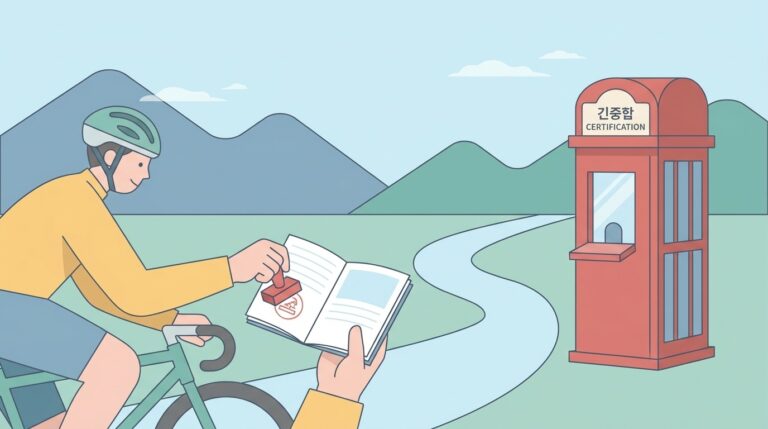
- K-Culture Moment: In popular Korean travel shows, you will see cast members running toward a small red, telephone-booth-like structure called an 인증센터 (in-jeung-sen-teo) to stamp their physical passports with child-like excitement.
- Editor’s Insight: While “도장” means a physical stamp or seal, in the context of cycling, saying “오늘 도장 몇 개 찍었어요?” (How many stamps did you get today?) is a friendly way to gauge someone’s progress.
- Situation Spectrum: Casual ✅ | Semi-formal ✅ | Formal ⚠️
- 🤔 Think About It: In Korea, “도장 깨기” (breaking stamps) originally referred to martial arts challenges but is now used metaphorically to describe systematically conquering a list of goals. What is your personal “도장 깨기” goal?
2. 허벅지가 터질 것 같다 (heo-beok-ji-ga teo-jil geot gat-da)
- Pronunciation: Huh-buk-jee-gah tuh-jeel gut gat-dah (Focus on the double consonant ‘ㄲ’ in “것 같다” which sounds sharp, like “guk-dah”)
- Meaning: My thighs are about to explode.
- K-Culture Moment: You’ll hear this constantly in cycling dramas or fitness variety shows like Physical: 100. It captures the raw, physical struggle of climbing steep mountain passes like the notorious 이화령 (Ihwaryeong Pass).
- Editor’s Insight: Koreans love visceral, exaggerated physical descriptions. Instead of simply saying “My legs hurt” (다리가 아파요), using “허벅지가 터지다” shows you understand the intense grit and camaraderie of Korean sports culture.
- Situation Spectrum: Casual ✅ | Semi-formal ✅ | Formal 🚫
- 🤔 Think About It: How does your native language express extreme muscle fatigue? Does it sound as dramatic as “exploding”?
3. 봉크가 오다 (bong-keu-ga o-da)
- Pronunciation: Bong-keu-gah oh-dah
- Meaning: To bonk / To hit the wall (sudden depletion of energy during endurance sports)
- K-Culture Moment: YouTube cycling channels in Korea often feature riders dramatically falling flat on the grass near a convenience store, whispering “봉크 왔어…” while grabbing a chocolate bar.
- Editor’s Insight: This is a loanword from the English cycling slang “bonk,” but adapted into Korean grammar. It is used as a noun with the verb “오다” (to come).
- Situation Spectrum: Casual ✅ | Semi-formal ⚠️ | Formal 🚫
- 🤔 Think About It: Why do you think global sports slangs like “bonking” integrate so easily into Korean street language?
Phase 3: Textbook Korean vs. Real Rider Korean
Situation 1: Asking if someone has finished the ride
- 📖 Textbook: 국토종주를 완료하셨습니까? (Guk-to-jong-ju-reul wan-ryo-ha-sheot-seup-ni-ka? – “Have you completed the cross-country national tour?”)
- 🗣️ Real Rider: 완주하셨어요? (Wan-ju-ha-shyeo-sseo-yo? – “Did you successfully complete the entire run?”)
- 💡 Why the difference? While “완료” means completion in administrative terms, “완주” (completing a race/run) is the respectful and standard athletic term used between riders.
Situation 2: Warning someone about a very steep hill
- 📖 Textbook: 경사가 아주 급한 언덕이 있습니다. (Gyeong-sa-ga a-ju geup-han eon-deok-i it-seup-ni-da. – “There is a very steep slope ahead.”)
- 🗣️ Real Rider: 앞에 완전히 빨래판 고개예요. (Ap-e wan-jeon-hi ppal-rae-pan go-gae-yeo-yo. – “It is a total washboard hill ahead.”)
- 💡 Why the difference? “빨래판” (washboard) refers to concrete steep slopes with grooved patterns designed to prevent slipping. Riders use this visually descriptive term to warn each other of brutal climbs.
Phase 4: K-Culture Deep Dive & Non-verbal Manners
4-1. Riding Etiquette and Hand Signals
When riding in groups in Korea, safety and collective harmony are paramount. If you spot a pothole or debris, point down to the ground and shout “홀!” (Hole!) or “낙차!” (Fall/Crash!) if someone slips. When passing another rider, it is polite to ring your bell gently or call out “지나갈게요!” (Passing through!) to avoid startling them.
4-2. The “Red Booth” and Convenience Store Culture
The red certification booths (인증부스) are shrines of achievement. It is customary to congratulate fellow riders you meet at these booths. After stamping, the ultimate cultural experience is heading to a nearby convenience store for 한강라면 (Han River instant ramen) cooked on automated induction machines, paired with a cold 포카리스웨트 (Pocari Sweat).
Phase 5: Real-Life Roleplay Scenario
The Setup
- Location: The Ihwaryeong Certification Center (이화령 인증센터), a notorious mountain peak on the Nakdong River path.
- Characters:
- 민우 (Min-woo): A seasoned Korean road cyclist who loves helping foreign riders.
- Alex (You): An advanced rider aiming to complete the Incheon-to-Busan route.
Dialogue
- 민우: (Stretching near the red booth) 🎭 친근하게 웃으며 “안녕하세요! 와, 이 고개를 자전거로 올라오신 거예요? 대단하시네요!”
- (An-nyeong-ha-se-yo! Wa, i go-gae-reul ja-jeon-geo-ro ol-ra-o-shin geo-ye-yo? Dae-dan-ha-shi-ne-yo!)
- “Hello! Wow, did you ride your bike all the way up this pass? That’s amazing!”
- Alex: 🎭 숨을 헐떡이며 웃는다 “감사합니다. 진짜 허벅지가 터질 것 같아요. 죽는 줄 알았습니다.”
- (Gam-sa-hap-ni-da. Jin-jja heo-beok-ji-ga teo-jil geot gat-a-yo. Jung-neun jul al-at-seup-ni-da.)
- “Thank you. My thighs are seriously about to explode. I thought I was going to die.”
- 민우: 🎭 공감하듯 고개를 끄덕이며 “이화령이 좀 빡세죠(tough) 하하. 수첩에 도장은 잘 찍으셨어요?”
- (I-hwa-ryeong-i jom ppak-se-jyo ha-ha. Su-cheop-e do-jang-eun jal jji-geu-shyeo-sseo-yo?)
- “Ihwaryeong is pretty tough, haha. Did you stamp your passport successfully?”
- Alex: 🎭 여권을 보여주며 “네, 모바일 앱으로도 인증받고 수첩에도 도장 찍었어요. 이제 거의 절반 왔네요.”
- (Ne, mo-ba-il aep-eu-ro-do in-jeung-bat-go su-cheop-e-do do-jang jji-geo-sseo-yo. I-je geo-ui jeol-ban wat-ne-yo.)
- “Yes, I got certified via the mobile app and also stamped the physical passport. I’m almost halfway now.”
- 민우: 🎭 배낭에서 초코바를 꺼내 건네며 “아직 낙동강 구간 남았으니까 당 충전 하세요. 잘못하면 봉크 와요.”
- (A-jik nak-dong-gang gu-gan nam-at-seu-ni-ka dang chung-jeon ha-se-yo. Jal-mot-ha-myeon bong-keu wa-yo.)
- “You still have the Nakdong River section left, so replenish your sugar. Otherwise, you’ll hit the wall (bonk).”
- Alex: 🎭 고마워하며 받는다 “와, 살았네요! 진짜 슬슬 봉크가 오려던 참이었거든요.”
- (Wa, sa-rat-ne-yo! Jin-jja seul-seul bong-keu-ga o-ryeo-deon cham-i-eot-geun-yo.)
- “Wow, you saved me! I was actually just about to hit the wall.”
- 민우: 🎭 엄지손가락을 치켜세우며 “부산까지 다치지 말고 안라(안전한 라이딩) 하세요!”
- (Bu-san-kka-ji da-chi-ji mal-go an-ra ha-se-yo!)
- “Ride safely all the way to Busan without getting hurt!”
- Alex: 🎭 손을 흔들며 출발할 준비를 한다 “네! 민우 씨도 안전하게 라이딩하세요! 화이팅!”
- (Ne! Min-woo ssi-do an-jeon-ha-ge ra-i-ding-ha-se-yo! Hwa-i-ting!)
- “Yes! You ride safely too, Min-woo! Fighting!”
🔀 Interactive Choice Point
Min-woo asks if you have a place to stay tonight near the river. How do you respond?
- A. “아무 데나 텐트 치고 자려고요.” (I’m planning to pitch a tent and sleep anywhere.)
- B. “혹시 근처에 라이더 전용 숙소나 자전거 민박 추천해주실 수 있나요?” (Could you perhaps recommend a rider-friendly guesthouse or bicycle homestay nearby?)
- C. “모텔 찾아서 대충 들어가려고요.” (I’ll just find a motel and walk in roughly.)
Feedback
- Choice A (Risk): Korea has strict wild camping laws. While some riverside parks allow it, setting up a tent randomly might result in a fine or being politely asked to move by local patrol officers.
- Choice B (Best): 🌟 Excellent! This shows advanced politeness. Many local guesthouses (자전거 민박) near the trails offer secure bike storage, laundry services, and hearty meals tailored for exhausted riders.
- Choice C (Bad): While practical, some motels do not allow expensive road bikes in the rooms due to wall damage. It is always better to ask specifically for bike-friendly accommodations first.
Phase 6: 10-Second Emotion Shadowing Drill
Practice these lines out loud with the correct dramatic pauses (/) and emotional tone!
- [🥺 Exasperated yet proud]
- 진짜 / 허벅지가 / 터질 것 같아요!
- Jin-jja / heo-beok-ji-ga / teo-jil geot gat-a-yo!
- (My thighs / are seriously / about to explode!)
- [😋 Relieved and hungry]
- 와, / 살았네요! / 마침 / 봉크 오기 직전이었어요.
- Wa, / sa-rat-ne-yo! / Ma-chim / bong-keu o-gi jik-jeon-i-eot-eo-yo.
- (Wow, / you saved my life! / I was / just on the verge of bonking.)
Phase 7: K-Culture Mini-Dictionary
- 안라 (An-Ra)
- Translation: Safe Riding
- Usage: Short for “안전한 라이딩” (An-jeon-han Ra-i-ding). It is the most common sign-off among Korean cyclists online and offline.
- 야라 (Ya-Ra)
- Translation: Night Riding
- Usage: Short for “야간 라이딩”. Riding along the beautifully lit Han River at night is a major social culture in Seoul.
- 끌바 (Kkeul-Ba)
- Translation: Pushing/dragging the bike
- Usage: Short for “끌고 가는 자전거”. When the hill is too steep to pedal, you walk and push your bike. Doing “끌바” is nothing to be ashamed of!
- 멜바 (Mel-Ba)
- Translation: Carrying the bike on your shoulder
- Usage: Short for “메고 가는 자전거”. Used when crossing rugged streams or climbing stairs on the path.
Phase 8: Traveler’s Survival Kit
Survival Phrases TOP 3
- “자전거 보관소는 어디에 있나요?”
- Pronunciation: Ja-jeon-geo bo-gwan-so-neun eo-di-e it-na-yo?
- Meaning: Where is the bicycle storage area?
- Pro Tip: Always ask this when checking into hotels or restaurants.
- “자전거 거치대 좀 이용해도 될까요?”
- Pronunciation: Ja-jeon-geo geo-chi-dae jom i-yong-hae-do doel-kka-yo?
- Meaning: May I use the bike rack?
- “가장 가까운 자전거 자율 정비소가 어디예요?”
- Pronunciation: Ga-jang ga-kka-un ja-jeon-geo ja-yul jeong-bi-so-ga eo-di-ye-yo?
- Meaning: Where is the nearest self-service bike repair station?
Editor’s Travel Note
Before embarking on your journey, download the 네이버 지도 (Naver Map) app. Unlike other global map apps, Naver Map provides incredibly accurate altitude graphs, bicycle-specific paths, and real-time updates on active certification booths. Also, make sure to buy the physical 국토종주 자전거 여행 인증수첩 (Certification Passport) at major starting point booths or order it online beforehand!
Phase 9: “Going One Step Deeper” (Reflective Thought)
Korea’s cross-country cycling trails are built largely along reclaimed river paths. This network reflects Korea’s collective spirit—converting old railway lines and forgotten riverside areas into shared public spaces. The certification system itself, with stamps and medals, taps into the deeply ingrained Korean love for goal-oriented achievements and structured challenges (the “stamp-conquering” mentality).
💬 Your Turn: Would you prefer using a digital app or a physical passport with actual ink stamps to track your achievements? Why? Let us know in the comments below!
Phase 10: FAQ & Common Mistakes
FAQ
Q: Can I complete the certification digitally without the physical passport?
A: Yes! You can use the “국토종주 인증” (Sangyeok Bicycle) mobile app. It uses GPS to automatically certify your location when you pass within 50 meters of a red booth.
Q: What should I do if a stamp pad inside the red booth is completely dry?
A: This is common! If the ink is dry, take a clear photo of yourself with your bicycle in front of the specific booth’s signboard. You can present this photo at any major manned certification center to receive your stamp retroactively.
Q: Are road bikes suitable for the entire path?
A: Most of the paths are beautifully paved. However, some sections along the Nakdong River can be gravelly or under construction. High-quality 28c or wider tires are highly recommended.
🚨 Common Mistakes Alert!
- Mistake 1: Standing in the middle of the bike path to check maps. (Always pull over to the side grass! Slowing down suddenly causes massive chain collisions.)
- Mistake 2: Relying purely on cash. While small remote stalls accept cash, most convenience stores and self-service certification booths require a credit card or T-money card.
- Mistake 3: Saying “자전거 타세요” to mean “Keep riding.” The natural sporting encouragement is “안라하세요!” or “화이팅!”.
Phase 11: Action Mission
- 🥉 Bronze: Open Naver Map and plot the route from Incheon Ara West Sea Lock to Yeouido Park.
- 🥈 Silver: Take a picture of your bike and post it on your social media with the caption: “이번 주말에 안라할게요!” (I will have a safe ride this weekend!)
- 🥇 Gold: Find a local Korean rider online or in person and ask them: “혹시 국토종주 하실 때 봉크 온 적 있으세요?” (Did you ever hit the wall when doing the cross-country ride?)
Phase 12: Interactive Quiz Challenge
Test your knowledge of advanced Korean cycling culture!
1. Match the term to its meaning
- A. 끌바 (Kkeul-Ba)
- B. 야라 (Ya-Ra)
- C. 안라 (An-Ra)
Click to reveal answers & explanations
- A – Pushing/walking the bike uphill.
- B – Night riding.
- C – Safe riding (Wishing someone a safe trip).
2. True or False?
- “If the ink stamp in the certification booth is dry, my progress for that station cannot be verified.”
Click to reveal answer
False! You can take a selfie in front of the certification booth and verify it later at any manned office.







