

Master Seollal’s Craziest Board Game: Play Yutnori Like a Native! 🎲
Phase 1: Empathy (Welcome to the Seollal Living Room!)
안녕하세요! (Annyeonghaseyo!) Hello there, beautiful souls! It’s your favorite Korean bestie and Daily Hangul’s lead editor here.
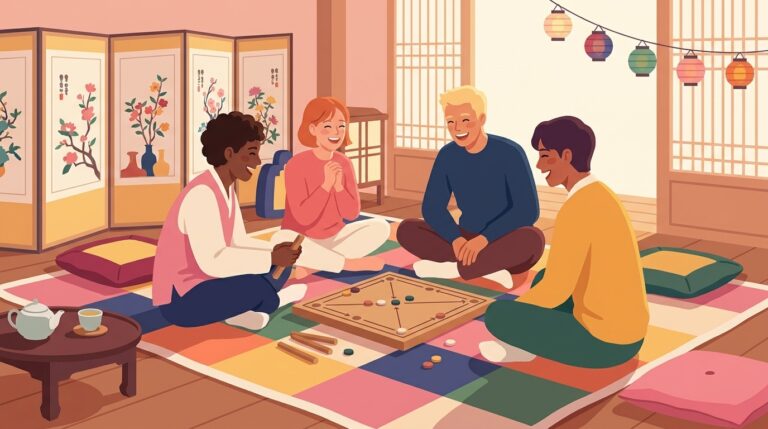
Imagine this: It’s Lunar New Year (Seollal, 설날) in Korea. The delicious smell of savory rice cake soup (Tteokguk, 떡국) fills the air. Your Korean friends or in-laws invite you to sit on the floor around a small blanket. Suddenly, four wooden sticks fly into the air, and everyone starts screaming, laughing, and high-fiving.
Welcome to Yutnori (윷놀이)—Korea’s ultimate, fast-paced, 2,000-year-old traditional board game!
Many of my students tell me, “I wanted to play, but I was too scared of making a mistake or not knowing what to shout!” Don’t worry. Today, we’re going to learn 3 simple phrases that will make you the star of the living room, even if it’s your very first day learning Korean. Let’s dive in! 🎉
Phase 2: Key Expression Deep Dive
Let’s learn the three most exciting things to shout during the game!
1. 던져요! (Deon-jyeo-yo!)
- Pronunciation: Deon-jyeo-yo! (Sounds like: “Dawn-jyu-yo!”)
- Meaning: “Throw!” / “Throw the sticks!”
- K-Culture Moment: In K-Variety shows like Run BTS or Running Man, you’ll always see members chanting this rhythmically to pressure the player whose turn it is.
- Editor’s Insight: The basic verb is 던지다 (to throw). By adding -요 (-yo) at the end, it becomes friendly yet polite. It is the perfect word to encourage your teammate!
- Situation Spectrum: Casual (✅) | Semi-formal (✅) | Formal (⚠️)
- 🤔 Think About It: In English, we say “It’s your turn!” but Koreans love to focus on the active physical action: “Throw!” Why do you think Korean games focus so much on active, shared actions?
2. 모 아니면 도! (Mo a-ni-myeon Do!)
- Pronunciation: Mo ah-nee-myeon Do! (Sounds like: “Mo ah-nee-myun Doe!”)
- Meaning: “All or nothing!” (Literally: “Either a Mo [5 spaces] or a Do [1 space]”)
- K-Culture Moment: This is a super famous Korean idiom used in daily life, K-Dramas, and business! It describes a high-risk, high-reward situation.
- Editor’s Insight: In Yutnori, Do is the lowest score (1 step), and Mo is the highest score (5 steps). Shouting this means you are taking a big risk for a big win!
- Situation Spectrum: Casual (✅) | Semi-formal (✅) | Formal (🚫)
- 🤔 Think About It: Do you have a similar “high risk, high reward” idiom in your language? How does it compare to our wooden sticks?
3. 한 번 더! (Han beon deo!)
- Pronunciation: Han bun duh! (Sounds like: “Hahn burn duh!”)
- Meaning: “One more time!”
- K-Culture Moment: If you throw a Yut (4 flat sides up) or a Mo (4 round sides up), or if you catch an opponent’s marker, you get to throw again! This is when you scream this phrase with joy.
- Editor’s Insight: “한 번” (han beon) means “once,” and “더” (deo) means “more.” You can use this at a karaoke bar (Norebang) or when asking for another serving of delicious side dishes!
- Situation Spectrum: Casual (✅) | Semi-formal (✅) | Formal (✅)
- 🤔 Think About It: Notice how short and punchy Korean cheerleading phrases are. It makes shouting them together so much more energetic!
Phase 3: Textbook Korean vs. Real Native Korean
Let’s compare stiff, textbook language with the lively expressions Koreans actually shout around the game blanket.
Situation 1: Encouraging your friend to throw
- 📖 Textbook: 이제 던지십시오. (I-je deon-ji-sip-si-o.) – “Please throw now.” (Too cold and formal!)
- 🗣️ Real Native: 얼른 던져요! (Eol-reun deon-jyeo-yo!) – “Hurry up and throw!” (Friendly and exciting!)
- 💡 Why the difference? Traditional holidays are all about family intimacy. Using hyper-formal textbook grammar makes you sound like a robot instead of a fun family member!
Situation 2: Celebrating an extra turn
- 📖 Textbook: 기회가 한 번 더 있습니다. (Gi-hoe-ga han beon deo it-seup-ni-da.) – “There is one more opportunity.”
- 🗣️ Real Native: 와, 한 번 더! (Wa, han beon deo!) – “Wow, one more time!”
- 💡 Why the difference? Speed is key in board games! A short, high-energy shout builds the tension and makes the game twice as fun.
Phase 4: K-Culture Deep Dive & Non-Verbal Manners
4-1. The Art of
Frequently Asked Questions (FAQ)
Q: What does "던져요! (Deon-jyeo-yo!)" mean in Korean and how do you pronounce it?
A: In Korean, "던져요! (Deon-jyeo-yo!)" is pronounced [Deon-jyeo-yo! (Sounds like: "Dawn-jyu-yo!"] and means: "Throw!" / "Throw the sticks!"
Q: What does "모 아니면 도! (Mo a-ni-myeon Do!)" mean in Korean and how do you pronounce it?
A: In Korean, "모 아니면 도! (Mo a-ni-myeon Do!)" is pronounced [Mo ah-nee-myeon Do! (Sounds like: "Mo ah-nee-myun Doe!"] and means: "All or nothing!" (Literally: "Either a Mo [5 spaces] or a Do [1 space]")
Q: What does "한 번 더! (Han beon deo!)" mean in Korean and how do you pronounce it?
A: In Korean, "한 번 더! (Han beon deo!)" is pronounced [Han bun duh! (Sounds like: "Hahn burn duh!"] and means: "One more time!"







