

Master Native Korean Numbers for Shopping: Stop Counting on Your Fingers!
Phase 1: Empathy (Your First Step into a Korean Convenience Store)
안녕하세요! (An-nyeong-ha-se-yo!) I’m your Daily Hangul editor and your personal Korean culture navigator!
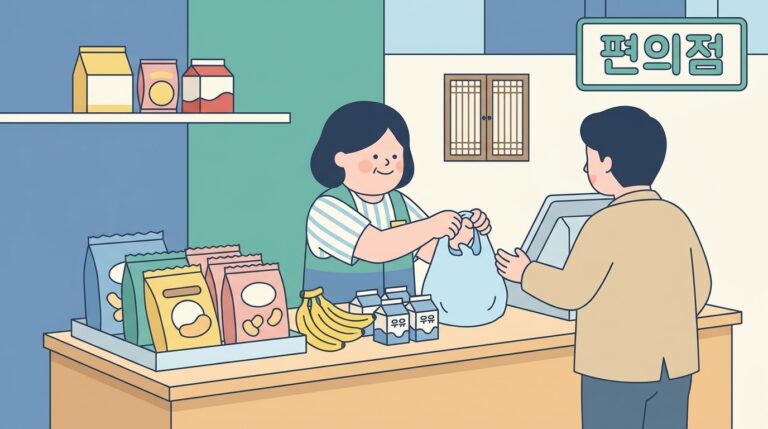
Imagine this: You are standing inside a brightly lit CU or GS25 convenience store in Seoul. The shelves are packed with delicious Samgak Gimbap (triangle rice balls) and sweet Banana Milk. You grab your items, walk to the counter, and want to say, “Two bottles of milk, please.”
Suddenly, your mind goes blank. Do you use the math numbers (il, i, sam)? Or the other set of numbers (hana, dul, set)? And what on earth is a “counter” word?
If you’ve ever felt frozen trying to buy more than one of something in Korea, don’t worry! You are not alone. Many of our premium learners confessed they used to just point and say “This!” while holding up fingers. Today, we are going to change that. By the end of this quick guide, you’ll confidently order exactly how many items you want, just like a local. Let’s dive in!
Phase 2: Top 3 Essential Expressions for Smart Shopping
To buy items in Korea, we use Native Korean Numbers (하나, 둘, 셋…) combined with the counter word 개 (gae), which means “items” or “pieces.”
1. 한 개 주세요 (han gae ju-se-yo)
- Pronunciation: Han gae joo-seh-yo (Sounds like “Hahn” as in Solo + “get” without the ‘t’ + “ju-se-yo”)
- Meaning: “One item, please.”
- K-Culture Moment: You’ll hear this in every K-Drama when a character buys a hot street-food snack like Hotteok (sweet pancake) or Tteokbokki cup.
- Editor’s Insight: Notice that the native number 하나 (ha-na) changes to 한 (han) when it is put right before a counter word like 개 (gae).
- Situation Spectrum:
- Casual: ✅ | Semi-formal: ✅ | Formal: ⚠️
- 🤔 Think About It: In English, we say “one apple” (number + noun). In Korean, we say “apple + one + counter” (사과 한 개). Why do you think Korean structures sentences this way?
2. 두 개 주세요 (du gae ju-se-yo)
- Pronunciation: Doo gae joo-seh-yo (Sounds like “Do” + “gae” + “ju-se-yo”)
- Meaning: “Two items, please.”
- K-Culture Moment: Perfect for when you are buying legendary 2+1 (Two-Plus-One) promotional snacks at a convenience store!
- Editor’s Insight: Just like hana becomes han, the number 둘 (dul) softens to 두 (du) before the counter word 개 (gae).
- Situation Spectrum:
- Casual: ✅ | Semi-formal: ✅ | Formal: ⚠️
- 🤔 Think About It: How does it feel to drop the last consonant to make the pronunciation smoother? It’s all about making speech flow easily!
3. 이거 세 개 주세요 (i-geo se gae ju-se-yo)
- Pronunciation: Ee-geo seh gae joo-seh-yo (Sounds like “E-go” + “say” + “gae” + “ju-se-yo”)
- Meaning: “Three of these, please.”
- K-Culture Moment: When you are buying cute K-beauty face masks or character keyrings as souvenirs for your best friends back home.
- Editor’s Insight: The number 셋 (set) changes to 세 (se). Pointing at the item and saying 이거 (i-geo – this) makes it incredibly easy for the cashier to understand you.
- Situation Spectrum:
- Casual: ✅ | Semi-formal: ✅ | Formal: ⚠️
Phase 3: Textbook Korean vs. Real-Life Korean
Let’s look at how actual Koreans talk at the checkout counter compared to sterile textbook examples.
Scenario 1: Ordering Drinks
- 📖 Textbook Korean: “콜라 두 개를 주십시오.” (Kol-la du gae-reul ju-sip-si-o.) – “Please give me two colas.”
- 🗣️ Real-Life Korean: “콜라 두 개요!” (Kol-la du gae-yo!) – “Two colas, please!”
- 💡 Why the difference? Real Koreans love speed and efficiency. Dropping particles like 를 (reul) and ending with a polite 요 (yo) is natural, polite, and fast!
Scenario 2: Selecting Items
- 📖 Textbook Korean: “이것을 세 개 구매하겠습니다.” (I-geos-eul se gae gu-mae-ha-ges-seum-ni-da.) – “I shall purchase three of these things.”
- 🗣️ Real-Life Korean: “이거 세 개 주세요.” (I-geo se gae ju-se-yo.) – “Three of these, please.”
- 💡 Why the difference? “Purchase” sounds too formal for buying snacks. “주세요 (Give me/Please)” is the ultimate friendly magic word.
Phase 4: K-Culture Deep Dive & Non-Verbal Manners
4-1. Gestures Matter: How to Count with Your Hands
In many Western cultures, counting to two starts with the thumb and index finger. In Korea, when counting on fingers for someone else to see, we usually raise our fingers starting from the index finger (Index = 1, Middle = 2, Ring = 3, etc.).
To be extra polite and clear, hold up your fingers while saying the number! It prevents any misunderstandings in noisy stores.
4-2. The 2+1 Culture (이플러스원)
When you walk into a Korean convenience store, look out for tags that say 1+1 or 2+1. This is Korea’s beloved promotional culture!
If you buy two items, you get one free. To redeem this, you must bring all three items to the counter. The clerk might ask, “하나 더 가져오세요” (Bring one more!). Knowing your numbers helps you grab that free bonus!
Phase 5: Real-Life Roleplay Scenario
Let’s practice! You are at a trendy convenience store in Hongdae. The clerk is friendly but fast.
Characters:
* You (Hungry Traveler)
* 민지 (Minji) (The friendly convenience store cashier)
Dialogue
- 민지: 어서오세요! 봉투 필요하세요?
- Eo-seo-o-se-yo! Bong-tu pil-yo-hae-yo?
- (Welcome! Do you need a plastic bag?)
- You: 🎭 (Nodding politely) 네, 봉투 한 개 주세요.
- Ne, bong-tu han gae ju-se-yo.
- (Yes, one bag please.)
- 민지: 네. 계산할 물건 올려주세요.
- Ne. Gye-san-hal mul-geon ol-lyeo-ju-se-yo.
- (Okay. Please put your items up here.)
- You: 🎭 (Placing Samgak Gimbap on the counter) 이거 두 개랑 삼각김밥 한 개요.
- I-geo du gae-rang sam-gak-gim-bap han gae-yo.
- (These two, and one triangle rice ball, please.)
- 민지: 아, 이거 삼각김밥 2+1 행사예요! 하나 더 가져오실래요?
- Ah, i-geo sam-gak-gim-bap i-peul-reo-seu-won haeng-sa-yeo-yo! Ha-na deo ga-jyeo-o-sil-lae-yo?
- (Oh, this triangle rice ball is on a 2+1 promo! Would you like to grab one more?)
- You: 🎭 (Smiling happily) 진짜요? 잠시만요! … 여기요, 세 개요!
- Jin-jja-yo? Jam-si-man-yo! … Yeo-gi-yo, se gae-yo!
- (Really? Just a moment! … Here you go, three items!)
- 민지: 네, 카드 꽂아주세요.
- Ne, ka-deu kko-ja-ju-se-yo.
- (Great, please insert your card.)
- You: 🎭 (Paying) 감사합니다! 수고하세요!
- Gam-sa-ham-ni-da! Su-go-hae-yo!
- (Thank you! Have a nice day!)
🔀 Choose Your Path!
What do you say when the cashier asks if you want to buy one more for the promo, but you are too full?
* **A)
Frequently Asked Questions (FAQ)
Q: What does "한 개 주세요 (han gae ju-se-yo)" mean in Korean and how do you pronounce it?
A: In Korean, "한 개 주세요 (han gae ju-se-yo)" is pronounced [Han gae joo-seh-yo (Sounds like "Hahn" as in Solo + "get" without the 't' + "ju-se-yo"] and means: "One item, please."
Q: What does "두 개 주세요 (du gae ju-se-yo)" mean in Korean and how do you pronounce it?
A: In Korean, "두 개 주세요 (du gae ju-se-yo)" is pronounced [Doo gae joo-seh-yo (Sounds like "Do" + "gae" + "ju-se-yo"] and means: "Two items, please."
Q: What does "이거 세 개 주세요 (i-geo se gae ju-se-yo)" mean in Korean and how do you pronounce it?
A: In Korean, "이거 세 개 주세요 (i-geo se gae ju-se-yo)" is pronounced [Ee-geo seh gae joo-seh-yo (Sounds like "E-go" + "say" + "gae" + "ju-se-yo"] and means: "Three of these, please."







