

Why ‘Staying on the Right Side of the Law’ in Korea is Your Ultimate K-Culture Superpower!
Phase 1: Empathy (공감)
안녕하세요! Welcome back to another cozy corner of Daily Hangul (매일한글), your trusty cultural navigator!
Imagine this: You are walking down the vibrant, neon-lit streets of Hongdae. You just finished a delicious meal of Samgyeopsal (pork belly) and need to cross the street to get to that trendy photobooth. The road is completely empty, and in your home country, you might just dash across. But you notice every single Korean waiting patiently at the red light, even at 2 AM. Or maybe you’re in a beautiful public park in Han River, and you see signs about recycling that look like a complex science project!
In Korea, “keeping the rules” isn’t just about avoiding a fine; it’s a deeply rooted social contract of mutual respect (배려 – baeryeo). When you master how to talk about and follow local regulations, you aren’t just a tourist anymore—you become a respected, culturally savvy member of the community. Today, we’re going to dive into how to talk about following the law (법을 준수하다) with ease, grace, and B1-level confidence!
Phase 2: Core Expressions (핵심 표현 3선 심층 분석)
1. 법을 준수하다 (beop-eul jun-su-ha-da)
- Pronunciation: Bup-eul joon-soo-ha-da (Sounds like “Bup” as in puppy, “joon” as in June, “soo” as in soup)
- Meaning: To obey/observe the law (Formal/Written)
- K-Culture Moment: You will hear this frequently in legal K-Dramas like Extraordinary Attorney Woo (이상한 변호사 우영우) during court scenes, or in news broadcasts regarding public safety.
- Editor’s Insight: While
준수하다(to obey/comply) sounds highly formal, using it shows a sophisticated grasp of vocabulary. In casual conversations, Koreans prefer법을 지키다(to keep/protect the law). - Situation Spectrum: Casual (🚫) | Semi-formal (⚠️) | Formal (✅)
- 🤔 Think About It: How does the word ‘지키다’ (which also means ‘to protect’ or ‘to guard’) change your perspective on how Koreans view laws? It’s not just a restriction; it’s something to protect together!
2. 무단횡단을 하다 (mu-dan-hoeng-dan-eul ha-da)
- Pronunciation: Moo-dan-hoeng-dan-eul ha-da (Sounds like “Moo” as in cow, “dan” as in duster, “hoeng-dan” like “hung-dan”)
- Meaning: To jaywalk (Literally: “Unauthorized crossing”)
- K-Culture Moment: In many romantic K-Dramas, you’ll see the main leads waiting at a crosswalk. Jaywalking is highly frowned upon in Korea, and you’ll get intense side-eyes from Halmeonis (grandmothers) if you try it!
- Editor’s Insight:
무단means “without permission” and횡단means “crossing”. You can use무단for other rule-breakings too, like무단 침입(trespassing) or무단 투기(illegal dumping of trash). - Situation Spectrum: Casual (✅) | Semi-formal (✅) | Formal (✅)
- 🤔 Think About It: In Korea, traffic lights for pedestrians often have countdown timers. Do you think this encourages people to obey the law more?
3. 과태료를 내다 (gwa-tae-ryo-reul nae-da)
- Pronunciation: Gwa-tae-ryo-reul nae-da (Sounds like “Gwa” as in guava, “tae” as in tae-kwondo, “ryo” like “rio”)
- Meaning: To pay a fine (administrative fine)
- K-Culture Moment: Think of Hometown Cha-Cha-Cha where characters get warned about parking in the wrong zone near the harbor.
- Editor’s Insight: Koreans distinguish between
벌금(beol-geum – criminal fine for serious offenses) and과태료(gwa-tae-ryo – non-criminal fine for minor violations like speeding or improper recycling). Knowing the difference is a huge B1 milestone! - Situation Spectrum: Casual (✅) | Semi-formal (✅) | Formal (✅)
- 🤔 Think About It: Minor fines in Korea are often linked to your phone number or license plate automatically. How does this level of digitalization affect civic duty?
Phase 3: Textbook vs. Real Life (교과서 한국어 vs 진짜 한국어)
Situation 1: Warning a friend not to smoke in a non-smoking area
- 📖 Textbook Korean: “여기서 담배를 피우면 법률을 위반하는 것입니다.” (If you smoke here, you are violating the law.) – Too robotic!
- 🗣️ Real Life Korean: “여기 금역 구역이라 벌금 내야 할 수도 있어요.” (This is a non-smoking zone, so you might have to pay a fine.)
- 💡 Why the Difference? Real Koreans rarely use heavy words like “법률 위반” (law violation) in daily speech. They point out the specific rule (
금연 구역– non-smoking zone) and the practical consequence (벌금– fine).
Situation 2: Asking if it’s okay to park somewhere
- 📖 Textbook Korean: “이곳에 주차하는 것이 허용됩니까?” (Is parking permitted in this place?) – Sounds like a textbook from 1990!
- 🗣️ Real Life Korean: “여기 주차해도 돼요? 단속 안 떠요?” (Can I park here? Are they patrolling/enforcing?)
- 💡 Why the Difference?
단속(dan-sok) refers to crackdowns or enforcement checks. Asking “단속 안 떠요?” (Will there be a crackdown patrol?) shows you understand the local system.
Phase 4: K-Culture Deep-Dive & Non-Verbal Manners
4-1. The Art of “Nunchi” (눈치) in Public Spaces
In Korea, keeping the law is closely tied to Nunchi (눈치 – emotional quickness/situational reading).
* Escalator Etiquette: Stand on the right, walk on the left. While not a written law, doing this keeps the flow safe.
* Subway Seats: Even if the subway is packed, do NOT sit in the designated seats for the elderly, disabled, or pregnant women (often colored pink). Sitting there is considered a major social faux pas, almost akin to breaking a rule.
4-2. Garbage Separation: Bunri-Sugyeo (분리수거)
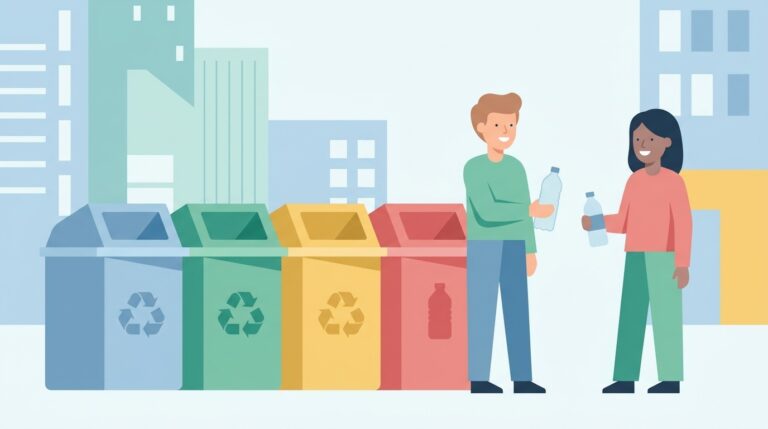
If you watch any slice-of-life K-Drama, you’ll see characters meticulously washing plastic containers and sorting them. In Korea, food waste goes into special biodegradable bags (음식물 쓰레기 봉투), while recyclables are sorted by material (PET, vinyl, paper). Getting this wrong can lead to a hefty 과태료 (fine) for your landlord!
Phase 5: Real-Life Roleplay Scenario
Character & Setting
- You (민우 – Min-woo): An exchange student trying to navigate the complex world of trash disposal.
- Ji-a (지아): Your helpful Korean friend/roommate who is very strict about recycling rules.
지아: 민우 씨, 분리수거 그렇게 하면 안 돼요!
     (Min-woo ssi, boon-ri-soo-geo geu-reoh-ge ha-myeon an dwae-yo!)
     🎭 [Frowning slightly but with a warm, teaching smile, pointing at the plastic bottle]
     "Min-woo, you shouldn't do the recycling like that!"

민우: 네? 페트병은 그냥 플라스틱에 버리면 되는 거 아니에요?
     (Ne? Pe-teu-byeong-eun geu-nyang-plastic-e beo-ri-myeon dwen-ggeo a-ni-e-yo?)
     🎭 [Looking confused, holding a plastic water bottle with the label still attached]
     "Huh? Can't I just throw plastic bottles into the plastic bin?"

지아: 비닐 라벨을 꼭 떼고, 안에 내용물도 씻어서 버려야 해요.
     (Bi-nil label-eul kkok tte-go, an-e nae-yong-mul-do ssis-eo-seo beo-ryeo-ya hae-yo.)
     🎭 [Showing how to peel off the label cleanly]
     "You must peel off the plastic label and wash the contents inside before throwing it away."

민우: 아, 몰랐어요. 그냥 버리면 어떻게 되는데요?
     (Ah, mol-las-eo-yo. Geu-nyang beo-ri-myeon eo-tteoh-ge dwen-de-yo?)
     🎭 [Scratching the back of his head in embarrassment]
     "Ah, I didn't know. What happens if I just throw it away?"

지아: 잘못하면 구청에서 나와서 과태료 물릴 수도 있어요. 법을 준수해야죠!
     (Jal-mot-ha-myeon gu-cheong-e-seo na-wa-seo gwa-tae-ryo mul-ril soo-do iss-eo-yo. Beop-eul jun-su-hae-ya-jyo!)
     🎭 [Wagging her finger playfully but seriously]
     "If we do it wrong, the district office might check and fine us. We have to obey the rules!"

민우: 그렇군요. 벌금 내는 건 싫으니까 다음부터 조심할게요.
     (Geu-reoh-goon-yo. Beol-geum nae-neun geon sil-eu-ni-kka da-eum-bu-teo jo-sim-hal-ge-yo.)
     🎭 [Nodding quickly and peeling off the label carefully]
     "I see. I hate paying fines, so I'll be careful from now on."
🔀 Interactive Choice Point
How would you respond to Ji-a’s warning?
- A) “귀찮은데 그냥 대충 버리면 안 돼요?” (It’s a hassle, can’t we just throw it away roughly?)
- B) “알겠어요. 이제부터 라벨 꼭 떼고 깨끗이 씻어 놓을게요!” (Got it. From now on, I’ll definitely peel the label and wash it clean!)
- C) “과태료는 누가 내요? 지아 씨가 내요?” (Who pays the fine? Do you pay it, Ji-a?)
Feedback
- Choice A (Bad): ⚠️ Oh no! This might make Ji-a think you don’t care about the shared community space. Korean apartments take recycling very seriously!
- Choice B (Best): ✅ Perfect! You showed respect for the local rules (
법을 준수하다) and active willingness to cooperate. Ji-a will love having you as a roommate! - Choice C (Risk): 🚫 High risk of coming off as passive-aggressive or rude. Avoid shifting responsibility!
Phase 6: 10-Second Emotion Shadowing Drill
Let’s practice speaking like a real Korean! Pay attention to the pauses (/) and feel the emotion.
- [🥺 Realizing a mistake & slightly worried]
- 아, / 제가 / 실수로 / 무단횡단을 / 할 뻔했어요!
- Ah, / je-ga / sil-su-ro / mu-dan-hoeng-dan-eul / hal ppeon-haess-eo-yo!
- (Oh, I almost jaywalked by mistake!)
- [😊 Reassuring and helpful]
- 여기는 / 주차 금지 구역이라 / 다른 곳에 / 세워야 해요.
- Yeo-gi-neun / ju-cha geum-ji gu-yeok-i-ra / da-reun got-e / se-wo-ya hae-yo.
- (This is a no-parking zone, so we have to park somewhere else.)
Phase 7: K-Culture Mini Dictionary
- 쓰레기 종량제 (Sseu-re-gi Jong-ryang-je) | Volume-rate waste disposal system | You can only throw general waste in official bags sold at local convenience stores. Throwing trash in regular bags is illegal.
- 단속 카메라 (Dan-sok Camera) | Enforcement / Speed camera | Korea has highly advanced GPS and traffic cameras. They will catch speeding or illegal parking instantly.
- 금연 구역 (Geum-yeon Gu-yeok) | Non-smoking zone | Most public streets, areas near subway exits, and restaurants are strictly non-smoking.
- 기초질서 (Gi-cho Jil-seo) | Basic public order | Refers to minor laws like not littering, not spitting on the street, and queuing up.
Phase 8: Traveler’s Survival Kit
Survival Phrases TOP 3
- “여기 주차해도 괜찮아요?” (Yeo-gi ju-cha-hae-do gwen-chan-ah-yo?) – Is it okay to park here?
- “음식물 쓰레기는 어디에 버려요?” (Eum-sik-mul sseu-re-gi-neun eo-di-e beo-ryeo-yo?) – Where do I throw away food waste?
- “대중교통 안에서는 마스크 써야 해요?” (Dae-jung-gyo-tong an-e-seo-neun mask sseo-ya hae-yo?) – Do I need to wear a mask on public transit? (Good to ask as rules change!)
Editor’s Travel Note
When driving or walking in Korea, download the Naver Map App (네이버 지도) rather than using Google Maps. Naver Map provides incredibly accurate, real-time alerts for speed cameras, pedestrian crosswalks, and even localized safety warnings to help you stay compliant on the road!
Phase 9: “A Step Deeper” (한 발 더 깊이)
Korea’s strict adherence to public rules comes from the traditional concept of “Jeong” (정 – communal affection) and “Uri” (우리 – we/our). Breaking a public rule is not just seen as a personal crime; it’s viewed as hurting the “Uri” (the collective family). This is why community pressure to follow rules is high, but it is also the reason why Korea boasts some of the safest streets and cleanest subway systems in the entire world.
💬 Your Turn: What is one rule in your country that is much stricter (or laxer) than in Korea? Let us know in the comments below!
Phase 10: FAQ & Common Mistakes
Q: Can I get fined for throwing away a plastic cup with ice still in it?
A: Yes! In Korea, liquids and ice must be emptied out before recycling. Leaving food or drink residue inside classified plastics can result in a fine because it contaminates the recycling process.
Q: Is jaywalking heavily fined in Korea?
A: Yes, if you are caught by police, you can face a fine of around 20,000 KRW to 30,000 KRW. More than the fine, the public disapproving looks are quite powerful!
Q: Are all parks in Seoul alcohol-free?
A: Some designated parks (like parts of the Han River parks during late hours) have local restrictions, but generally, moderate drinking is allowed. However, creating a public disturbance under the influence will lead to immediate enforcement.
🚨 Common Mistakes Alert!
- Mistake 1: Throwing food waste into the general trash bag.
- Correct Action: Bananas peels, apple cores go to food waste (
음식물 쓰레기). Hard shells (egg shells, bones) go to general waste (일반 쓰레기).
- Correct Action: Bananas peels, apple cores go to food waste (
- Mistake 2: Walking away when your T-money card beeps red.
- Correct Action: If your transit card doesn’t register, tap again. Riding without paying is a serious offense with a fine of 30 times the fare.
- Mistake 3: Parking temporarily on a red line road.
- Correct Action: Red-painted curbs mean absolute no-parking zone (usually near fire hydrants). Even a 1-minute stop is heavily fined.
Phase 11: Action Mission
- 🥉 Bronze Mission: Find a Korean product in your house and practice peeling the label off like a recycling pro while saying: “법을 준수해야 해요!”
- 🥈 Silver Mission: Take a screenshot of your Naver Map app with a safety route and share it on Instagram tagging
@DailyHangul! - 🥇 Gold Mission: Next time you watch a K-Drama, spot a scene near a crosswalk or a trash dump and identify if the characters are following the rules correctly.
Phase 12: Interactive Quiz Challenge
1. Which of the following words means “to jaywalk”?
* A) 주차위반 (ju-cha-wi-ban)
* B) 무단횡단 (mu-dan-hoeng-dan)
* C) 분리수거 (bun-ri-su-geo)
🔍 Click here for the Answer!
Correct Answer: B) 무단횡단
Explanation: ‘무단횡단’ is jaywalking. ‘주차위반’ is parking violation, and ‘분리수거’ is waste separation.
2. True or False: In Korea, you can throw eggshells and chicken bones into the food waste (음식물 쓰레기) bag.
🔍 Click here for the Answer!
Correct Answer: False
Explanation: Hard objects like eggshells, animal bones, and corn husks cannot be processed as animal feed, so they must go into the general waste (일반 쓰레기) bag.







