

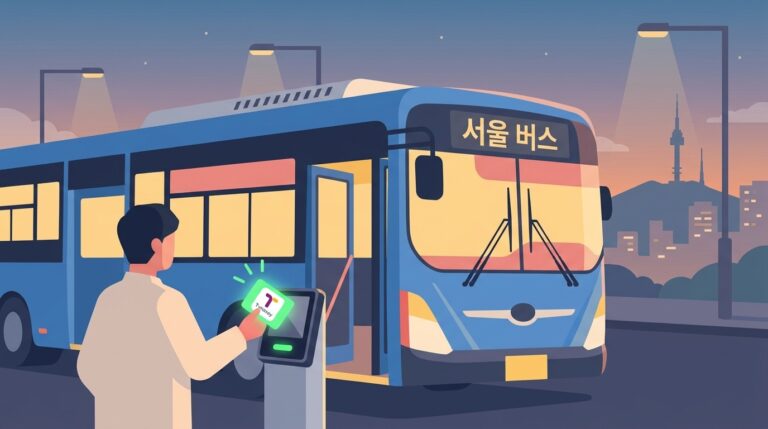
Master the Tap-On, Tap-Off: Your Ultimate C1 Guide to Seoul’s Bus System
Phase 1: Empathy (An Editor’s Welcome)
안녕하세요! Welcome back to Daily Hangul, your premium home for mastering Korean language and culture. I’m your senior editor and cultural navigator.
Imagine this: You are stepping onto a sleek blue Seoul city bus. It’s rush hour. Your heart does a little flutter as a queue of fast-paced Seoulites forms behind you. You reach for your T-money card. You know you have to tap it, but wait—what if you hear that dreaded high-pitched double-beep of ‘Jandegi bujok’ (insufficient balance)? Or even worse, what if you forget to tap off as you exit into the bustling streets of Hongdae, fearing you’ll be charged double next time?
If you have ever felt a split second of panic at the bus doors, you are not alone. Transitioning from the textbook ‘How much is this ticket?’ to the fast-paced, high-context world of Korean public transit is a common pain point for advanced learners. Today, we’re leveling up your C1-level fluency by decoding the unspoken social rules, the exact native terminology, and the quick-witted phrases you need to conquer Korea’s transit system like a born-and-raised Seoulite. Let’s dive in!
Phase 2: Deep Dive into 3 Essential Expressions
To navigate the buses smoothly, you need to master these three high-frequency, high-context phrases. Let’s unpack them.
1. 환승입니다 (Hwan-seung-im-ni-da)
- Pronunciation: Hwan-seung-im-ni-da (Sounds like “Hwan-sung-im-nee-da”. Rhyme the ‘hwan’ with the first syllable of ‘Wanda’.)
- Meaning: “It is a transfer.”
- K-Culture Moment: You hear this iconic robotic voice every time you tap onto a bus within 30 minutes of exiting another bus or the subway. It’s the sweet sound of saving money!
- Editor’s Insight: This isn’t just a notification; it’s a social cue. When you hear this, you know your card was successfully read for a free or discounted transfer. If it says anything else, check the screen immediately!
- Situation Spectrum: Casual 🚫 | Semi-formal ✅ | Formal ✅ (This is an official system announcement tone.)
- 🤔 Think About It: In many Western cities, transfers require paper tickets or manual driver validation. Why do you think Korea’s highly automated, seamless integration of transfer discounts reflects the cultural value of Ppalli-ppalli (빨리빨리 – fast-paced efficiency)?
2. 하릴없이 카드를 미리 찍다 (Ha-ril-eop-si ka-deu-reul mi-ri jjik-da)
- Pronunciation: Ha-ril-eop-si ka-deu-reul mee-ree jjik-da (The ‘jj’ in ‘jjik’ is a tense, sharp ‘ch’ sound made with tight vocal cords.)
- Meaning: “To inevitably tap one’s card in advance (before arrival).”
- K-Culture Moment: If you watch K-dramas like My Liberation Notes, you’ll see characters standing up and tapping their cards while the bus is still moving, just to save three seconds before the doors open.
- Editor’s Insight: Grammatically, harileopsi (하릴없이) means doing something because there is no other choice or out of habit. Tapping early is technically discouraged for safety reasons, yet everyone does it to prevent bottlenecking the exit.
- Situation Spectrum: Casual ✅ | Semi-formal ✅ | Formal ⚠️
- 🤔 Think About It: How does this habit of prepping your card before the bus even stops highlight the collective pressure to not hold up the line for others?
3. 카드가 안 읽혀요 (Ka-deu-ga an ilk-hyeo-yo)
- Pronunciation: Ka-deu-ga an il-kyuh-yo (Make sure not to pronounce the silent ‘h’ in ‘ilkhyeo’—it blends into a crisp ‘k’ sound.)
- Meaning: “My card is not being read/scanned.”
- K-Culture Moment: That awkward moment when you tap, but the machine remains silent, or red lights flash. You say this politely to the driver as you try scanning a different angle.
- Editor’s Insight: Note the passive verb ilhida (읽히다 – to be read). Instead of blaming the machine (‘The machine is broken’), Koreans naturally describe the situation objectively: “The card is not getting itself read.”
- Situation Spectrum: Casual ⚠️ | Semi-formal ✅ | Formal ✅
- 🤔 Think About It: How does using passive grammar in frustrating situations like this help maintain interpersonal harmony (Hwa, 화) in public spaces?
Phase 3: Textbook Korean vs. Real-World Korean
Let’s compare the polite, rigid phrases found in classic curricula with what actually flies on the streets of Seoul.
Scenario A: Asking if the card needs to be tapped upon exiting.
- 📖 Textbook Korean: “내릴 때도 카드를 단말기에 대어야 합니까?” (Nae-ril ttae-do ka-deu-reul dan-mal-gie dae-eo-ya hap-ni-ka? – “Must I apply the card to the terminal upon exiting as well?”)
- 🗣️ 진짜 Korean: “내릴 때도 찍어야 돼요?” (Nae-ril ttae-do jji-ggeo-ya dwae-yo? – “Do I tap when getting off too?”)
- 💡 Why the Difference? Real Koreans rarely use formal terms like dan-mal-gi (단말기 – terminal) or dae-da (대다 – to apply/touch) in casual transit. The verb jjik-da (찍다 – to stamp/tap/print) is the universal, natural choice.
Scenario B: Informing the driver about a card scanning error.
- 📖 Textbook Korean: “교통카드 인식기에 오류가 발생했습니다.” (Gyo-tong-ka-deu in-sik-gie o-ryu-ga bal-saeng-haet-seup-ni-da. – “An error has occurred in the transit card recognition device.”)
- 🗣️ 진짜 Korean: “카드가 잘 안 찍혀요.” (Ka-deu-ga jal an jji-khyeo-yo. – “The card isn’t tapping well.”)
- 💡 Why the Difference? Stating “an error has occurred” sounds like a technical manual. Saying “It’s not tapping well” is soft, conversational, and prompts the driver to reset the terminal for you immediately.
Phase 4: K-Culture Deep Dive & Non-Verbal Manners
4-1. Nunchi (눈치) & Gesture Etiquette at the Exit Door
To avoid getting the dreaded collective sigh from commuters behind you, master the Pre-Exit Stance:
1. The Prep: Stand up when the bus is approaching your stop (but hold the handrails tightly!).
2. The Card Hold: Hold your card flat against your fingers, not pinched, so you can slam-tap it smoothly in one motion.
3. The Eye Contact: If the scanner fails, make brief, apologetic eye contact with the driver, slightly bow your head, and try again. Never stand there repeatedly smashing the card; instead, step slightly aside to let others pass while trying to rub the card against your sleeve (a common local superstition to remove static!).
4-2. The “Transfer Window” Culture
Korea’s transfer system is a marvel of urban planning. You get up to 4 transfers for free within a 30-minute window (expanded to 1 hour from 9:00 PM to 7:00 AM to accommodate late-night commuters). This high-tech system is why “tapping off” is mandatory—if you forget, you forfeit your transfer discount, and you will be charged a penalty fare on your next ride!
Phase 5: Real-World Roleplay Scenario
Setting: A crowded Green Bus (No. 7011) heading toward Sinchon during a rainy evening. You are trying to exit, but the passenger in front of you is having card issues, and the bus is about to pull away.
Characters:
* You (C1 Korean Learner): Ready to exit, polite but assertive.
* Driver (기사님 – Gi-sa-nim): Busy, pragmatic, but helpful if addressed correctly.
The Dialogue
- You: (Stepping toward the back door, holding the strap)
🎭 Moving carefully as the bus sways
기사님, 이번 정류장에 내릴게요!
(Gi-sa-nim, i-beon jeong-ryu-jang-e nae-ril-ge-yo!)
“Driver, I’ll be getting off at this stop!” - Driver: (Nodding while looking in the rearview mirror)
🎭 Shouting back lightly over the engine sound
네, 문 열립니다. 내릴 때 카드 미리 찍으세요.
(Ne, mun yeol-lim-ni-da. Nae-ril ttae ka-deu mi-ri jji-geu-se-yo.)
“Yes, doors opening. Please tap your card in advance as you step down.” - You: (Tapping the card, but the machine makes a triple beep)
🎭 Flustered as a crowd waits behind you
어? 단말기가 인식을 안 하네요. 다시 대볼게요.
(Eo? Dan-mal-gi-ga in-si-geul an ha-ne-yo. Da-si dae-bol-ge-yo.)
“Oh? The terminal isn’t recognizing it. I’ll try touching it again.” - Driver: (Checking his console)
🎭 Tapping his own screen to reset the reader
뒤에 분들 잠시만요, 기계 다시 켰어요. 한번 더 찍어봐요.
(Dwi-e bun-deul jam-si-man-yo, gi-gye da-si kyeot-eo-yo. Han-beon deo jji-geo-bwa-yo.)
“Everyone in the back, hold on a second. I reset the machine. Try tapping once more.” - You: (Tapping again, hears a single beep and “Transfer” voice)
🎭 Relieved, bowing slightly
아, 이제 됐네요! 감사합니다.
(Ah, i-je dwaet-ne-yo! Gam-sa-ham-ni-da.)
“Ah, it worked now! Thank you.” - Driver: (Releasing the brake)
🎭 Waving you off quickly
네, 비 오니까 계단 조심해서 내려가세요.
(Ne, bi o-ni-ka gye-dan jo-sim-hae-seo nae-ryeo-ga-se-yo.)
“Yes, it’s raining so watch your step on the stairs.” - You: (Stepping off the bus onto the wet pavement)
🎭 Turning back to wave goodbye
수고하세요!
(Su-go-ha-se-yo!)
“Thank you for your hard work!” - Driver: (Closing the door with a hiss)
🎭 Nodding and pulling away into traffic
네, 조심히 가세요.
(Ne, jo-sim-hi ga-se-yo.)
“Yes, go safely.”
🔀 Interactive Choice Point
The passenger behind you is in a rush and says, “아, 빨리 좀 찍고 내립시다!” (Ah, ppal-li jom jjik-go nae-rip-si-da! – “Ah, let’s tap quickly and get off!”). How do you react?
* A) Say nothing, panic, and push past the exit without tapping.
* Feedback (Bad): You’ll lose your transfer discount, pay a penalty, and feel the sting of social awkwardness.
* B) Turn around, bow slightly, and say: “죄송합니다, 카드가 잘 안 찍혀서요.”
* Feedback (Best): Extremely polite and mature. By acknowledging the delay and using passive language, you disarm their frustration instantly.
* C) Argue back: “기다리세요! 제 잘못이 아니잖아요!” (Wait! It’s not my fault!)
* Feedback (Risk): Too confrontational. It will disrupt the public peace and make the ride tense for everyone.
Phase 6: 10-Second Emotion Shadowing Drill
To sound truly native, you must practice the rise and fall of emotional speech. Say these aloud with the designated feelings:
- [🥺 Flustered & Apologetic]
어…? / 카드가 / 왜 / 안 찍히지? / 어떡해…
(Eo…? / Ka-deu-ga / wae / an jjik-hi-ji? / Eo-tteok-hae…)
“Uh…? / Why / is my card / not tapping? / What do I do…” -
[😊 Relieved & Polite]
앗, / 이제 / 찍혔네요! / 감사합니다, / 기사님!
(At, / i-je / jji-khyeon-nae-yo! / Gam-sa-ham-ni-da, / gi-sa-nim!)
“Ah, / it finally / tapped! / Thank you, / driver!”
Phase 7: K-Culture Mini Dictionary
- 하차 태그 (Ha-cha Tae-geu) | Exit Tap | The act of tapping your transportation card on the reader before stepping off the bus to register your journey length.
- 잔액 부족 (Jan-aek Bu-jok) | Insufficient Balance | The dreaded phrase spoken by the automated card machine when your T-money card balance falls below the minimum fare.
- 광역버스 (Gwang-yeok-beo-seu) | Red Express Bus | The rapid transit buses that connect Seoul’s metropolitan areas with surrounding cities like Gyeonggi-do.
- 기사님 (Gi-sa-nim) | Driver-nim | The respectful title used to address bus drivers, taxi drivers, and technicians in Korea.
Phase 8: Survivor’s Kit for Travelers
Survival Phrases TOP 3
- 찍어주세요 (Jji-geo-ju-se-yo): “Please tap it/register it for me.” (Use this if you are traveling with a child and need the driver to adjust the fare on one card before you tap).
- 하차문 열어주세요 (Ha-cha-mun yeol-eo-ju-se-yo): “Please open the exit door.” (Crucial if the driver closes the door before you can step off).
- 충전소 어디예요? (Chung-jeon-so eo-di-yeo-yo?): “Where is the charging station?” (To reload your transit card balance at a nearby convenience store).
Editor’s Travel Note
Always download the Naver Map App before venturing out. Google Maps is notoriously spotty in Korea due to national security mapping laws. Naver Map will show you down to the exact second when your bus is arriving, how crowded it is (Spare, Moderate, Congested), and which door you should stand near.
Phase 9: “A Step Deeper” (Reflections on Korean Collectivism)
In Korea, public transit is not just a utility; it is a shared social contract. The silent choreography of preparing your card, keeping your voice to a whisper, and moving swiftly at the doors reflects a culture deeply rooted in Gong-dong-che ui-sik (공동체 의식 – community consciousness). By making an effort to learn these subtle transit manners, you aren’t just getting from Point A to Point B—you are showing respect for the daily rhythm of millions of people.
💬 Your Turn: Have you ever experienced a “card error” panic in Korea or your home country? How did you handle it? Let’s chat in the comments below!
Phase 10: FAQ & Avoiding Misunderstandings
Q: Can I use one T-Money card for multiple people on the bus?
A: Yes, you can! However, before tapping, you must tell the driver: “두 명요” (Du myeong-yo – “Two people, please”). Wait until the driver updates the terminal screen, then tap your card once. Note: This does not allow free transfers for both of you later!
Q: What happens if I forget to tap off (하차 태그) when exiting?
A: If you fail to tap off, you will be charged the maximum distance fare of the route on your next trip, and you will lose any transfer discounts. Always make tapping off an absolute habit!
Q: Can I pay with cash on Seoul buses?
A: Increasingly, no. Seoul has been transitioning to “Cash-free buses” (현금 없는 버스) on almost all routes. It is highly recommended to always carry a loaded T-money card or use a compatible mobile pay option.
🚨 Common Mistakes Warning Board
- Mistake 1: Tapping your wallet with multiple credit cards inside.
- Result: The machine will beep loudly and say “카드를 한 장만 대주세요” (Please present only one card).
- Correct Action: Keep your transit card in an easily accessible pocket or outer slot of your wallet.
- Mistake 2: Standing right in front of the exit door when you aren’t getting off at the next stop.
- Result: You will block people trying to leave, leading to gentle nudges.
- Correct Action: Stand back near the handrails until it is your turn.
Phase 11: Action Mission & Participation
- Bronze Mission (Solo): Practice saying “내릴게요” (I’m getting off) in front of the mirror with absolute confidence.
- Silver Mission (Socials): Take a photo of your favorite Korean bus route or transit card and post it with the hashtag
#DailyHangulBusChallenge. - Gold Mission (Real Life): Next time you ride a Seoul bus, make eye contact with the driver when exiting and say a warm, natural “수고하세요!” (Keep up the good work!).
Phase 12: Interactive Quiz Challenge
Test your transit IQ with these quick questions!
1. Situational Judgment
You are boarding a bus, and the terminal displays a flashing red light and says “잔액이 부족합니다.” What should you do?
Click to reveal the Answer & Explanation
Answer: Apologize to the driver (“죄송합니다”), step off the bus safely, and head to the nearest convenience store to reload your card. Do not block the entrance trying to find cash unless it’s a cash-accepting bus.
2. Fill-in-the-Blank
“버스에서 내릴 때 카드를 꼭 _______ 해요. 안 그러면 추가 요금이 나와요.”
(Hint: “You must tap your card when getting off the bus. Otherwise, you’ll be charged extra.”)
Click to reveal the Answer & Explanation
Answer: 찍어야 (or 태그해야)
Explanation: “찍어야 해요” (must tap) is the most natural conversational choice for daily life.
3. True or False
True or False: You can get a transfer discount even if you wait 45 minutes between rides at 2:00 PM.
Click to reveal the Answer & Explanation
Answer: False
Explanation: The transfer window is strictly 30 minutes during the day. It only extends to 1 hour late at night (9 PM to 7 AM).
Disclaimer: Bus transit rules, fees, and operational policies are subject to change by local municipal governments. Always check official announcements or the Seoul Metro website for the most up-to-date transit guidelines.







