

Master Korea’s CVS Delivery System: Send and Receive Parcels Like a Local
Phase 1: Empathy (스토리 몰입형 오프닝)
안녕하세요! Welcome back to another edition of Daily Hangul, your premium ticket to mastering Korean like a true local! 🇰🇷✨
Picture this: You are living in Seoul, and your favorite Korean online shopping mall just delivered a package, but you won’t be home to receive it. Or perhaps you need to send a heavy box of Korean cosmetics back home to your family, but the local post office (우체국) closes at 6:00 PM, and you are stuck in a meeting.
Your savior? The nearest 24-hour convenience store (편의점).
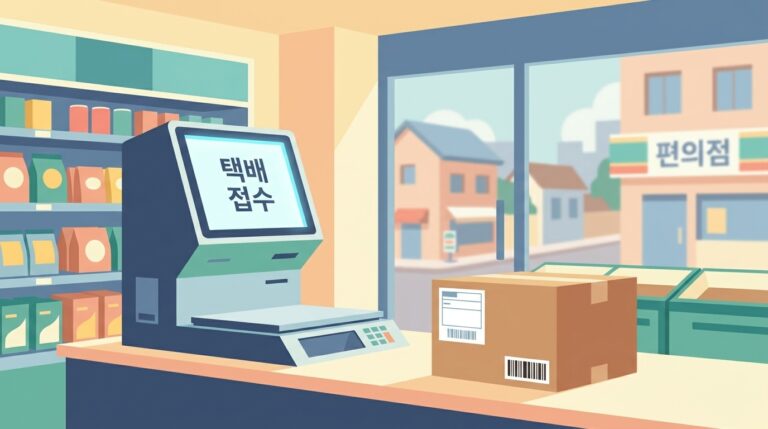
In Korea, convenience stores are not just places to grab a midnight ramyeon; they are high-tech, neighborhood logistics hubs. However, walking up to a self-service parcel machine (택배 장비) or explaining to a busy store clerk that you are there to collect a “half-price delivery” (반값택배) can feel incredibly intimidating. Even advanced (C1) learners often freeze up when the machine asks them to choose between “domestic parcel” (국내택배) and “store-to-store” (점포간 배송).
Don’t worry! Today, we are going to dive deep into the cultural nuances, complex machinery terms, and high-level spoken Korean you need to conquer the convenience store delivery system flawlessly. Let’s get started!
Phase 2: 핵심 표현 3선 심층 분석 (Deep Dive into Key Expressions)
1. 반값택배로 부칠게요 (한글)
- Pronunciation: Ban-gap-taek-bae-ro bu-chil-ge-yo (Sounds like: “Bahn-gahp taek-bae-roh boo-cheel-geh-yo”)
- Meaning: I’d like to send this via half-price delivery.
- K-Culture Moment: If you watch slice-of-life K-Dramas or lifestyle vlogs on YouTube, you’ll often see characters rushing to GS25 or CU to drop off packages for secondhand deals on Danggeun Market (당근마켓). They almost always use 반값택배 because it costs nearly half of regular courier services by utilizing the convenience store’s internal logistics trucks.
- Editor’s Insight: 부치다 (to send/mail) is often confused with 붙이다 (to stick/paste) because they sound identical. In conversational Korean, saying “[Method]~(으)로 부칠게요” is the most natural way to declare your preferred delivery method.
- Situation Spectrum:
- Casual: 반값택배로 부칠게 ⚠️ (Use with close friends)
- Semi-formal: 반값택배로 부칠게요 ✅ (Perfect for store clerks)
- Formal: 반값택배로 발송하겠습니다 ✅ (Appropriate in business contexts)
- 🤔 Think About It: Why do you think Korea’s convenience stores developed such a highly integrated logistics network compared to your home country?
2. 택배 수령하러 왔는데요 (한글)
- Pronunciation: Taek-bae su-ryeong-ha-reo wat-neun-de-yo (Sounds like: “Taek-bae soo-ryeong-hah-ruh wahn-neun-deh-yo”)
- Meaning: I’m here to pick up a delivery package.
- K-Culture Moment: When a character in a web-drama picks up a package that was delivered to a convenience store for privacy or safety reasons, they walk up to the counter and say this exact phrase.
- Editor’s Insight: 수령하다 is a Hanja-based word (受領) meaning “to receive/collect.” While 받다 is the basic verb for “to get,” using 수령하다 shows a C1-level command of official transactional Korean, which immediately signals to the clerk that you know exactly what service you are utilizing.
- Situation Spectrum:
- Casual: 택배 찾으러 왔어 ⚠️
- Semi-formal: 택배 수령하러 왔는데요 ✅
- Formal: 택배를 수령하고자 합니다 🚫 (Too stiff, sounds like a robot)
- 🤔 Think About It: How does the linguistic distinction between casual ‘찾다’ (to look for/retrieve) and formal ‘수령하다’ reflect the transactional nature of Korean services?
3. 운송장 출력해 주세요 (한글)
- Pronunciation: Un-song-jang chul-ryeok-hae ju-se-yo (Sounds like: “Oon-song-jahng chool-ryeok-hae joo-seh-yo”)
- Meaning: Please print the shipping label/waybill.
- K-Culture Moment: Sometimes the automated kiosk at the store runs out of paper or encounters an error right before printing your label. To resolve this, you must approach the counter and politely request the clerk to print it from their primary POS terminal.
- Editor’s Insight: 운송장 (waybill/shipping label) is the lifeblood of Korean logistics. It contains the barcode and tracking number. Knowing this specific term instead of pointing and saying “스티커” (sticker) will save you tons of time.
- Situation Spectrum:
- Casual: 송장 좀 뽑아줘 ⚠️
- Semi-formal: 운송장 출력해 주세요 ✅
- Formal: 운송장 출력을 요청드립니다 ✅
- 🤔 Think About It: How does utilizing precise Hanja-derived vocabulary like 출력 (print output) rather than English loanwords like 프린트 change the dynamic of customer-service interactions in Korea?
Phase 3: 교과서 한국어 vs 진짜 한국어 (Textbook vs. Real-Life Korean)
Situation 1: Asking if the store accepts delivery drop-offs
- 📖 Textbook Korean: 여기서 택배를 보낼 수 있습니까? (Yeo-gi-seo taek-bae-reul bo-nae-su it-seup-ni-ka? – “Is it possible to send a package from here?”)
- 🗣️ 진짜 한국어: 여기서 택배 접수 돼요? (Yeo-gi-seo taek-bae jeop-su dwae-yo? – “Do you take delivery drop-offs here?”)
- 💡 왜 다를까?: Native Koreans prefer the word 접수 (registration/reception) over 보내다 (to send) when dealing with service counters. It sounds much more natural and idiomatic.
Situation 2: Informing the clerk that you have finished weighing your package
- 📖 Textbook Korean: 무게 측정이 끝났습니다. (Mu-ge cheuk-jeong-i kkeut-nat-seup-ni-da. – “The weight measurement has finished.”)
- 🗣️ 진짜 한국어: 무게 다 쟀어요. (Mu-ge da jaet-eo-yo. – “I’ve weighed it all.”)
- 💡 왜 다를까?: In real life, people avoid heavy technical terms like 측정 (measurement) in spoken conversation, opting instead for the active verb 재다 (to weigh/measure) coupled with the completion adverb 다 (all/completely).
Phase 4: K-Culture 딥다이브 & 비언어적 매너 (Cultural Nuances & Gestures)
4-1. 눈치 (Nunchi) & Gestures at the Kiosk
When you use the CU or GS25 parcel machine, you will often find a scale integrated into the screen stand.
* The Nunchi Rule: If there is a line behind you, quickly prep your address details on your smartphone beforehand using the service’s app (like GS25 편의점택배). This allows you to log in via QR code and print the label in under 10 seconds. Leaving your box on the scale while you manually type an address character-by-character is a major breach of convenience store Nunchi!
* Handing over the label: When presenting the printed 운송장 to the clerk at the cash register, always hold it with both hands (두 손으로) and point the barcode toward the clerk so they can scan it easily.
4-2. The Rise of
Frequently Asked Questions (FAQ)
Q: What does "반값택배로 부칠게요 (한글)" mean in Korean and how do you pronounce it?
A: In Korean, "반값택배로 부칠게요 (한글)" is pronounced [Ban-gap-taek-bae-ro bu-chil-ge-yo (Sounds like: "Bahn-gahp taek-bae-roh boo-cheel-geh-yo"] and means: I'd like to send this via half-price delivery.
Q: What does "택배 수령하러 왔는데요 (한글)" mean in Korean and how do you pronounce it?
A: In Korean, "택배 수령하러 왔는데요 (한글)" is pronounced [Taek-bae su-ryeong-ha-reo wat-neun-de-yo (Sounds like: "Taek-bae soo-ryeong-hah-ruh wahn-neun-deh-yo"] and means: I'm here to pick up a delivery package.
Q: What does "운송장 출력해 주세요 (한글)" mean in Korean and how do you pronounce it?
A: In Korean, "운송장 출력해 주세요 (한글)" is pronounced [Un-song-jang chul-ryeok-hae ju-se-yo (Sounds like: "Oon-song-jahng chool-ryeok-hae joo-seh-yo"] and means: Please print the shipping label/waybill.






