

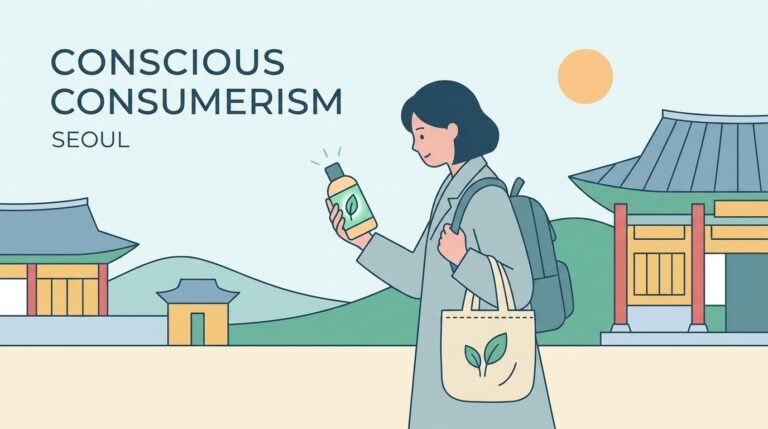
Greenwashing or Green-saving? Master the Art of Reading Eco-Labels in Korea (C1 Level)
Phase 1: Empathy (스토리 몰입형 오프닝)
안녕하세요! Your trusty Korean language navigator and editor from Daily Hangul(매일한글) is here!
Imagine this: You are standing in the aisle of a trendy lifestyle store in Olive Young or a local organic supermarket in Seoul. You want to be an ethical consumer—supporting the planet while enjoying your K-beauty and eco-friendly lifestyle. You grab a trendy-looking lotion. It’s wrapped in kraft paper, boasting words like “Natural,” “Eco,” and “Pure.” But wait… is it actually eco-friendly, or is it just clever greenwashing (그린워싱)?
In Korea, sustainable living is huge right now, but with so many pseudo-eco products flooding the market, knowing how to verify official eco-labels (친환경 인증 마크) is a superpower. Many of our advanced learners have told us, “I want to ask the staff if these eco-claims are officially certified, but I lack the sophisticated vocabulary to do so without sounding like a toddler!”
Don’t worry! Today, we are upgrading your Korean to C1 level so you can confidently assert your consumer rights and advocate for the environment in flawless, nuanced Korean. Let’s dive in!
Phase 2: Deep Dive into 3 Essential Expressions (핵심 표현 3선 심층 분석)
1. 그린워싱인지 잘 따져봐야 해요 (그린워싱인지 잘 따져봐야 해요)
- Pronunciation: Geu-rin-wo-sing-in-ji jal tta-jyeo-bwa-ya hae-yo (Sounds like: “Green-washing-in-ji jal tah-jyeh-bwah-yah-heh-yo”)
- Meaning: “You need to carefully scrutinize whether it’s greenwashing or not.”
- K-Culture Moment: You will hear this frequently on modern Korean consumer advocacy podcasts like “Yeong-su-jeung” (The Receipt) or eco-friendly YouTube channels discussing sustainable lifestyles in Seoul.
- Editor’s Insight: The verb 따지다 (to calculate, scrutinize, or demand answers) combined with -어 보다 (to try doing) creates a very proactive consumer tone. It’s not just “checking”; it’s critically analyzing the validity of a claim.
- Situation Spectrum:
- Casual: 그린워싱인지 잘 따져봐야 돼. (✅)
- Semi-formal: 그린워싱인지 잘 따져봐야 해요. (✅)
- Formal: 그린워싱 여부를 면밀히 따져보아야 합니다. (✅)
- 🤔 Think About It: How does your home country’s culture view “consumer questioning”? In Korea, asking detailed questions about product authenticity is increasingly seen as the mark of a 똑똑한 소비자 (smart, savvy consumer) rather than being fussy.
2. 공식 인증을 획득한 제품인가요? (공식 인증을 획득한 제품인가요?)
- Pronunciation: Gong-sik in-jeung-eul hwek-deuk-han je-pum-in-ga-yo? (Sounds like: “Gong-sheek een-jeung-eul hwek-deuk-hahn jeh-poom-een-gah-yo?”)
- Meaning: “Is this a product that has acquired official certification?”
- K-Culture Moment: Used when talking to customer service representatives or brand managers at eco-exhibitions in COEX, Seoul.
- Editor’s Insight: While beginners use 받다 (to receive), C1 learners should use 획득하다 (to acquire/obtain) to sound highly professional. “공식 인증” refers to government-backed certifications like the Korea Eco-Label (친환경 마크) or the Green Product certification.
- Situation Spectrum:
- Casual: 이거 진짜 인증받은 거야? (✅)
- Semi-formal: 공식 인증을 획득한 제품인가요? (✅)
- Formal: 본 제품이 정부 공인 친환경 인증을 취득했는지 확인하고자 합니다. (✅)
- 🤔 Think About It: “공식” (Official) carries heavy weight in Korea. Why do you think official governmental stamps are so trusted in Korean consumer culture compared to private labels?
3. 성분 표기랑 인증 마크가 매칭이 안 되네요 (성분 표기랑 인증 마크가 매칭이 안 되네요)
- Pronunciation: Seong-bun pyo-gi-rang in-jeung ma-keu-ga mae-ching-i an doe-ne-yo (Sounds like: “Seong-boon pyoh-ghee-rahng een-jeung mah-keu-gah meh-ching-ee ahn dweh-neh-yo”)
- Meaning: “The ingredient list and the eco-label certification don’t seem to match up.”
- K-Culture Moment: A line you might use when reviewing a cosmetic product online or pointing out a discrepancy to a shop manager.
- Editor’s Insight: 매칭이 안 되다 is a very natural Konglish phrase widely used in professional and casual settings to denote mismatch. Using -네요 at the end softens your critical observation, making it polite yet firm.
- Situation Spectrum:
- Casual: 성분표랑 마크가 매칭이 안 되네. (✅)
- Semi-formal: 성분 표기랑 인증 마크가 매칭이 안 되네요. (✅)
- Formal: 성분 표시와 인증 표식 간에 불일치가 존재합니다. (✅)
- 🤔 Think About It: Pointing out discrepancies directly can sometimes be awkward. Using indirect endings like -네요 helps maintain harmony while getting your point across.
Phase 3: Textbook Korean vs. Real-Life Korean (교과서 한국어 vs. 진짜 한국어)
Situation 1: Asking if a product is environmentally friendly
- 📖 Textbook Korean: 이 물건은 환경에 무해합니까? (I mul-geon-eun hwan-gyeong-e mu-hae-hap-ni-ka? – “Is this object harmless to the environment?”)
- 🗣️ Real-Life Korean: 이거 혹시 친환경 마크 정식으로 검증된 제품이에요? (I-geo hok-si chin-hwan-gyeong ma-keu jeong-sik-eu-ro geom-jeung-doen je-pum-i-e-yo? – “By any chance, is this a product whose Eco-Label is formally verified?”)
- 💡 Why the difference? Nobody says “harmless to the environment” (환경에 무해합니까) in real life. It sounds like a science textbook. Real consumers ask about the 친환경 마크 (Eco-Label) and whether it is 검증된 (verified).
Situation 2: Expressing doubt about vague eco-claims
- 📖 Textbook Korean: 이 광고는 거짓입니다. (I gwang-go-neun geo-jit-im-ni-da. – “This advertisement is a lie.”)
- 🗣️ Real-Life Korean: 이거 딱 보니 그린워싱 같은데, 인증 내역 확인해 볼 수 있을까요? (I-geo ttak bo-ni geu-rin-wo-sing gat-eun-de, in-jeung nae-yeok hwan-in-hae bol su is-eul-ka-yo? – “Looking at this, it seems like greenwashing. Can I check the certification details?”)
- 💡 Why the difference? Calling something “a lie” directly is overly confrontational in Korean culture. Saying 딱 보니 (At a glance / Obviously) and suggesting 그린워싱 gently shifts the focus to objective certification details rather than personal honesty.
Phase 4: K-Culture Deep Dive & Non-Verbal Manners (비언어적 매너)
4-1. The Art of “Polite Scrutiny” (예의 바른 따지기)
When questioning a product’s green credentials in Korea, non-verbal cues are vital. You want to be a smart consumer, not a 진상 (a troublesome customer).
* The Gesture: Do not point your index finger at the product or the staff. Instead, hold the product in one hand, tilt your head slightly (about 5 degrees) to show curiosity rather than aggression, and use your other hand to open-palm gesture toward the label.
* Tone of Voice: Keep your pitch slightly high and soft. End your sentences with trailing tones like “~않을까 싶어서요…” (I was wondering if…) to avoid sounding like you are conducting an interrogation.
4-2. The “Zero-Waste” Era in K-Drama & Lifestyle
If you watch modern slice-of-life K-Dramas like Our Blues or Run On, characters often carry their own tumbler (텀블러) or use multi-use shopping bags (장바구니). Korea has one of the strictest recycling systems in the world (분리배출). Being an ethical consumer is considered very hip (힙하다). Showing that you know how to look up official certifications on the Green Product Information System makes you instantly respected as someone who truly understands Korean societal trends.
Phase 5: Real-Life Roleplay Scenario (실전 롤플레이)
Context:
Ji-ho (a passionate eco-activist and your Korean friend) and Min-ji (a shop manager at a fancy eco-friendly store in Hannam-dong) are discussing a newly launched vegan shampoo.
Characters:
* 지호 (Ji-ho): Analytical, eco-conscious, polite but uncompromising.
* 민지 (Min-ji): Helpful shop manager, knowledgeable but slightly nervous about high-level questions.
지호: 🎭 (제품 용기를 꼼꼼히 살피며) 민지 씨, 이 비건 샴푸 용기에 있는 마크 말이에요. 이게 사설 마크인가요, 아니면 환경부에서 공인한 친환경 인증인가요?
      (Min-ji, about this mark on this vegan shampoo bottle... Is this a private label, or is it an official eco-certification authorized by the Ministry of Environment?)

민지: 🎭 (안내 책자를 펼치며) 아, 고객님! 그건 브랜드 자체에서 디자인한 친환경 컨셉 마크고요, 실제 정부 인증은 현재 심사 중인 단계예요.
      (Oh, valued customer! That is an eco-concept mark designed by the brand itself, and the actual government certification is currently under review.)

지호: 🎭 (미소를 지으며 부드럽게) 아, 그렇군요. 요즘 그린워싱 문제가 많다 보니 저도 모르게 성분 표기랑 마크 매칭 여부를 꼼꼼히 따져보게 되더라고요.
      (Ah, I see. Since there are many greenwashing issues these days, I find myself meticulously checking if the ingredients and the mark match up.)

민지: 🎭 (고개를 끄덕이며 공감하듯) 맞아요. 스마트한 소비자분들이 늘어나셔서 저희도 전 성분 공개를 원칙으로 투명하게 운영하려고 노력 중이랍니다.
      (You're absolutely right. As the number of smart consumers increases, we are also trying to operate transparently by disclosing all ingredients as a rule.)

지호: 🎭 (인증 마크를 가리키며) 다행이네요. 소비자 권익 보호 차원에서도 이런 공인 인증 여부가 명확히 표기되어 있으면 구매하기가 훨씬 수월할 것 같아요.
      (That's a relief. For the sake of protecting consumer rights, it would be much easier to make a purchase if official certifications like this were clearly marked.)

민지: 🎭 (메모지에 받아 적으며) 좋은 의견 감사합니다! 본사에 건의해서 패키지 시안에 인증 보류 표기나 설명서 보강을 꼭 요청하도록 할게요.
      (Thank you for the great feedback! I will definitely suggest this to headquarters to request a notice about pending certification or a more detailed manual on the package.)
🔀 Interactive Choice Point!
How would you respond to Min-ji’s last comment?
* Option A: “아예 인증 완료되기 전에는 친환경이란 단어를 쓰면 안 되는 거 아닌가요?” (Isn’t it illegal to use the word ‘eco-friendly’ before certification is even completed?)
* Option B: “상세한 설명 감사합니다. 다음번에 인증 완료되면 꼭 다시 와서 구매할게요!” (Thank you for the detailed explanation. Once the certification is completed next time, I’ll definitely come back to buy it!)
* Option C: “네, 수고하세요.” (Yes, goodbye.)
Feedback:
- Option A (Risk): While legally logical, this tone can feel extremely confrontational (갑질-adjacent) in a gentle retail setting. Use only if you want to start an argument.
- Option B (Best): Excellent! It politely holds the brand accountable while showing support, embodying the perfect C1-level diplomatic consumer.
- Option C (Bad): Too abrupt. It cuts off a great networking opportunity to practice high-level Korean with a local manager.
Phase 6: 10-Second Emotional Shadowing Drill (10초 감정 섀도잉)
Let’s practice speaking with nuance. Pay attention to the pauses (/) and internalize the emotion!
- Scenario 1: [🤨 Highly Skeptical & Analytical]
- “이 제품 / 친환경이라고 광고하는데 / 공식 마크는 / 왜 하나도 없죠?”
- (I je-pum / chin-hwan-gyeong-i-ra-go gwang-go-ha-neun-de / gong-sik ma-keu-neun / wae ha-na-do eop-jyo?)
- “They advertise this product as eco-friendly… but why isn’t there a single official mark?”
- Scenario 2: [😊 Courteous but Firm]
- “소비자 권익을 위해서 / 이런 인증 내역은 / 투명하게 / 공개해 주셨으면 해요.”
- (So-bi-ja gwon-ig-eul wi-hae-seo / i-reon in-jeung nae-yeok-eun / tu-myeong-ha-ge / gong-gae-hae ju-syeos-eu-men hae-yo.)
- “For the sake of consumer rights, I would appreciate it if these certification details were disclosed transparently.”
Phase 7: K-Culture Mini Dictionary (K-Culture 미니 사전)
- 그린워싱 (Geu-rin-wo-sing) | Greenwashing
- Misleading consumers regarding the environmental practices of a company or the environmental benefits of a product. Highly debated in Korean green consumer groups.
- 소비자 권익 (So-bi-ja Gwon-ik) | Consumer Rights & Interests
- The legal and ethical rights of buyers to receive correct information, safety, and choice in the marketplace.
- 친환경 인증 마크 (Chin-hwan-gyeong In-jeung Ma-keu) | Official Eco-Label
- The official stamp issued by the Korean Ministry of Environment certifying that the product reduces environmental impact.
- 가치소비 (Ga-chi-so-bi) | Conscious/Value-Driven Consumption
- The trend among Gen Z and Millennials in Korea of buying products that align with their personal values, such as animal rights or environmental protection.
Phase 8: Survivor Kit for Travelers (여행자를 위한 생존 키트)
Survival Expressions TOP 3:
- “이 마크 환경부 공인인가요?” (I ma-keu hwan-gyeong-bu gong-in-in-ga-yo?)
- Pro Tip: Use this to check if the label is backed by the Ministry of Environment, which is the gold standard.
- “리필 스테이션이 어디에 있나요?” (Ri-pil seu-te-i-syeon-i eo-di-e in-na-yo?)
- Pro Tip: Korea now has zero-waste stores with refill stations. Ask this to refill your shampoo/detergent.
- “영수증은 모바일로 발행해 주세요.” (Yeong-su-jeung-eun mo-ba-il-ro ba-raeng-hae ju-se-yo.)
- Pro Tip: Koreans almost always opt for paperless mobile receipts to save trees.
✈️ Editor’s Travel Note:
When shopping in Korea, utilize the Korea Environmental Industry & Technology Institute (KEITI) official portal or search for “초록누리” (GreenNuri) on your phone to instantly verify chemical ingredients and environmental certifications. (Note: System database availability and portal layouts may change without prior notice.)
Phase 9:
Frequently Asked Questions (FAQ)
Q: What does "그린워싱인지 잘 따져봐야 해요 (그린워싱인지 잘 따져봐야 해요)" mean in Korean and how do you pronounce it?
A: In Korean, "그린워싱인지 잘 따져봐야 해요 (그린워싱인지 잘 따져봐야 해요)" is pronounced [Geu-rin-wo-sing-in-ji jal tta-jyeo-bwa-ya hae-yo (Sounds like: "Green-washing-in-ji jal tah-jyeh-bwah-yah-heh-yo"] and means: "You need to carefully scrutinize whether it’s greenwashing or not."
Q: What does "공식 인증을 획득한 제품인가요? (공식 인증을 획득한 제품인가요?)" mean in Korean and how do you pronounce it?
A: In Korean, "공식 인증을 획득한 제품인가요? (공식 인증을 획득한 제품인가요?)" is pronounced [Gong-sik in-jeung-eul hwek-deuk-han je-pum-in-ga-yo? (Sounds like: "Gong-sheek een-jeung-eul hwek-deuk-hahn jeh-poom-een-gah-yo?"] and means: "Is this a product that has acquired official certification?"
Q: What does "성분 표기랑 인증 마크가 매칭이 안 되네요 (성분 표기랑 인증 마크가 매칭이 안 되네요)" mean in Korean and how do you pronounce it?
A: In Korean, "성분 표기랑 인증 마크가 매칭이 안 되네요 (성분 표기랑 인증 마크가 매칭이 안 되네요)" is pronounced [Seong-bun pyo-gi-rang in-jeung ma-keu-ga mae-ching-i an doe-ne-yo (Sounds like: "Seong-boon pyoh-ghee-rahng een-jeung mah-keu-gah meh-ching-ee ahn dweh-neh-yo"] and means: "The ingredient list and the eco-label certification don't seem to match up."







