

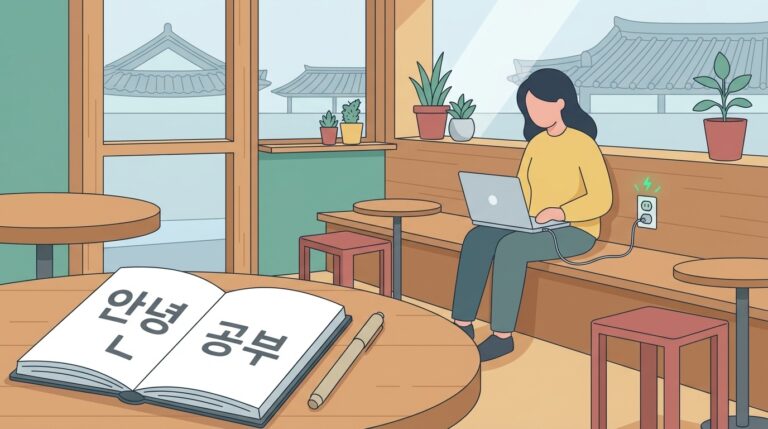
Finding a Power Outlet in a Korean Cafe: Your Ultimate Survival Guide
Phase 1: Empathy (Welcome to Seoul’s Cafe Heaven!)
안녕하세요! (Annyeonghaseyo!) I’m your Daily Hangul editor and your personal cultural navigator.
Picture this: You are in a gorgeous, multi-story cafe in Hongdae. The aesthetic is perfect, your iced americano is refreshing, and you are ready to edit your travel photos or upload a reel. But then—your phone flashes 10% battery.
You look around. The cafe is bustling. You see a few wall sockets, but they are tucked behind tables where other people are sitting. Do you awkwardly stare? Do you leave and find another cafe?
Don’t worry! In Korea, using cafe outlets (콘센트 – konsenteu) is extremely common and socially accepted—but there is a polite way to find and ask for these coveted spots. Many of our student subscribers have told us, “I saw a plug, but I didn’t know how to ask the person sitting next to it if I could use it!”
Today, you’ll learn exactly what to say to secure your charging spot like a local, without feeling awkward!
Phase 2: Deep Dive into 3 Key Expressions
1. 여기 콘센트 있어요? (Yeogi konsenteu isseoyo?)
- Pronunciation: “Yuh-gi kon-sen-teu ee-suh-yo?” (Sounds like con-cent with an ‘eu’ at the end)
- Meaning: “Is there an outlet here?” / “Do you have a power outlet here?”
- K-Culture Moment: You walk up to the counter or ask a staff member near the seating area before you order.
- Editor’s Insight: Koreans use the word 콘센트 (consent), which comes from “concentric plug.” If you ask for an “outlet” or “socket,” staff might not understand immediately. Stick to konsenteu!
- Situation Spectrum: Casual ✅ | Semi-formal ✅ | Formal ⚠️
- 🤔 Think About It: In your country, do people freely charge their laptops in cafes, or is it discouraged by owners?
2. 혹시 자리 옮겨도 돼요? (Hoksi jari omgyeodo dwaeyo?)
- Pronunciation: “Hok-shi ja-ri om-gyuh-do dwae-yo?”
- Meaning: “By any chance, is it okay if I move seats?”
- K-Culture Moment: You sat down at a table without a plug, but you spot an empty table next to an outlet opening up.
- Editor’s Insight: 혹시 (hoksi) means “by any chance” or “perhaps.” Starting your sentence with this instantly softens your tone and makes you sound incredibly polite and respectful of the cafe staff.
- Situation Spectrum: Casual ✅ | Semi-formal ✅ | Formal ⚠️
- 🤔 Think About It: Why does adding softeners like “perhaps” make a big difference in polite communication across different cultures?
3. 여기 혹시 써도 돼요? (Yeogi hoksi sseodo dwaeyo?)
- Pronunciation: “Yuh-gi hok-shi ssuh-do dwae-yo?” (The ‘ss’ is a tense, sharp ‘s’ sound like in “sshh”)
- Meaning: “Is it okay if I use this (outlet/space) by any chance?”
- K-Culture Moment: There is an outlet near another customer’s feet/table, and you want to ask for permission before reaching over to plug your charger in.
- Editor’s Insight: Point gently to the outlet when saying this. This shows high 눈치 (Nunchi – situational awareness/tact) and respects personal space.
- Situation Spectrum: Casual ✅ | Semi-formal ✅ | Formal 🚫
- 🤔 Think About It: How does asking before crossing into someone’s physical space build immediate mutual respect, even with strangers?
Phase 3: Textbook Korean vs. Real Korean
Let’s compare what formal textbooks teach you versus how real Koreans actually talk in modern cafes.
Situation A: Asking staff if they have a charger plug
- 📖 Textbook: “전기 콘센트가 어디에 위치합니까?” (Jeongi konsenteuga eodie wichihamnidda? – “Where is the electrical outlet located?”)
- 🗣️ Real Korean: “여기 콘센트 자리 있어요?” (Yeogi konsenteu jari isseoyo? – “Are there any seats with outlets here?”)
- 💡 Why the difference? The textbook version is overly robotic and sounds like a manual. Real Koreans combine the words for outlet (konsenteu) and seat (jari) into 콘센트 자리 (outlet seat) because that’s what matters!
Situation B: Asking a neighbor to use a shared plug near them
- 📖 Textbook: “제가 이 콘센트를 사용해도 괜찮겠습니까?” (Jega i konsenteureul sayonghaedo gwenchankeussumnikka? – “Would it be alright if I utilized this outlet?”)
- 🗣️ Real Korean: “저 혹시… 이거 써도 될까요?” (Jeo hoksi… igeo sseodo dwelkkayo? – “Excuse me, by any chance… could I use this?”)
- 💡 Why the difference? “저 혹시…” (Jeo hoksi…) with a slight pause is the ultimate magic social lubricant in Korea. It shows you don’t want to intrude on their peace.
Phase 4: K-Culture Deep Dive & Non-Verbal Manners
4-1. The Art of “Nunchi” (눈치) & Café Etiquette
Korea is famous for its safety and study-friendly cafe culture. You will see people leave their laptops, iPads, and expensive bags on a table to go to the restroom or order a drink. However, finding a plug requires some subtle body language:
* The Soft Point: When asking a stranger if you can use the plug near them, don’t point directly with one finger. Instead, open your hand flat with palm up and gesture toward the outlet.
* The Bow Head: A slight 15-degree head tilt or mini-bow when saying “감사합니다” (Gamsahabnida – Thank you) after they let you plug in goes a long way!
4-2. The “Ka-Gong-Jok” (카공족) Phenomenon
Have you heard of 카공족 (Ka-gong-jok)? It is a portmanteau of 카페 (Cafe), 공부 (Study), and 족 (tribe/group). It refers to the massive demographic of students and freelancers who study in cafes. Because of this, many Korean cafes have long communal tables equipped with built-in outlets and wireless charging pads.
Pro-tip: If a cafe has these long tables, you don’t even need to ask! You can just sit down and plug in.
Phase 5: Real-Life Roleplay Scenario
Setting: A trendy, warm wood-toned cafe in Mapo-gu, Seoul. You need to finish your work, but your laptop battery is at 15%. You spot an outlet near a friendly-looking student (Minjun) who is studying.
The Dialogue
- You (🎭 Holding charger, looking hesitant):
저 혹시… 여기 콘센트 써도 될까요?
(Jeo hoksi… yeogi konsenteu sseodo dwelkkayo?)
“Excuse me… by any chance, could I use this outlet?” -
Minjun (🎭 Smiling warmly, moving his backpack out of the way):
아, 네! 쓰셔도 돼요. 제가 선 조금 치워드릴게요.
(Ah, ne! Sseusyeodo dwaeyo. Jega seon jogeum chiwodeurilgeyo.)
“Oh, yes! You can use it. I’ll move my cable out of the way for you.” -
You (🎭 Smiling gratefully, slightly bowing):
감사합니다! 혹시 제 선 때문에 불편하진 않으세요?
(Gamsahabnida! Hoksi je seon ttaemune bulpyeonhajin aneuseyo?)
“Thank you! Is my wire bothering you by any chance?” -
Minjun (🎭 Waving hands horizontally in a ‘no’ gesture):
아니요, 전혀 괜찮아요. 편하게 쓰세요.
(Aniyo, jeonhyeo gwenchanayo. Pyeonhage sseuseyo.)
“No, not at all, it’s fine. Please use it comfortably.”
🔀 Interactive Choice Point
Your charger wire is slightly short, making it stretch across the edge of his desk. What do you say?
- Choice A: Say nothing, plug it in tightly, and start typing vigorously.
- Choice B: “선이 짧아서 죄송해요.” (Seoni jjalbaseo joesonghaeyo. – “Sorry that the cord is short.”)
- Choice C: “이거 콘센트 고장 났어요?” (Igeo konsenteu gojang nasseoyo? – “Is this outlet broken?”)
Feedback:
- Choice A (Bad): 🚫 This might make the other person uncomfortable as the wire might pull on their things. It lacks Nunchi!
- Choice B (Best): ✅ Perfect! Acknowledging the short cord shows you are incredibly polite and considerate. Minjun will likely help you adjust the laptop or plug.
- Choice C (Risk): ⚠️ Unless there is actually no power flowing, asking this abruptly can sound accusatory or demanding.
Phase 6: 10-Second Emotion Shadowing Drill
Practice saying these out loud with the correct emotional tone. Use the / to pause and breathe!
- [🥺 Polite & Slightly Apologetic]
저 혹시… / 여기 / 써도 될까요?
(Jeo hok-si… / yeo-gi / ssuh-do dwel-kka-yo?) -
[😊 Bright & Relieved]
아, / 감사합니다! / 편하게 쓸게요.
(Ah, / gam-sa-ham-ni-da! / pyeon-ha-ge sseul-gae-yo.) -
[🙏 Friendly & Courteous]
혹시 / 자리 / 옮겨도 괜찮을까요?
(Hok-si / ja-ri / om-gyuh-do gwen-cha-neul-kka-yo?)
Phase 7: K-Culture Mini-Dictionary
- 콘센트 (Konsenteu) | Power Outlet
- Originates from “concentric plug.” Used universally in Korea instead of “outlet” or “socket.”
- 와이파이 비밀번호 (Waipai bimilbeonho) | Wi-Fi Password
- Essential for working in cafes. Usually printed on the bottom of your receipt or written on the cafe wall/counter.
- 진동벨 (Jindong-bel) | Buzzer/Vibrating Bell
- The small plastic puck cafe staff give you after ordering. It vibrates when your beverage is ready.
- 테이크아웃 (Teikeu-aut) | Takeout / To-go
- If you want your drink to go. Note that in Korea, by law, you cannot use single-use plastic cups if you drink inside the cafe.
Phase 8: Traveler’s Survival Kit
Survival Phrases TOP 3
- 혹시 충전기 있어요? (Hoksi chungjeongi isseoyo?)
- Meaning: “Do you happen to have a charger?” (Some cafes can charge your phone behind the counter if you ask!)
- 와이파이 잘 돼요? (Waipai jal dwaeyo?)
- Meaning: “Does the Wi-Fi work well?”
- 콘센트 있는 자리 어디예요? (Konsenteu inneun jari eodiyeyo?)
- Meaning: “Where are the seats with outlets?”
Editor’s Travel Note
Most modern cafes in Korea use Type F (two round pins) plugs running on 220V. Don’t forget to pack a travel adapter! If you are looking for spacious cafes with guaranteed outlets, look up “Cafe for studying” or use the local map application KakaoMap or Naver Map search functions to read user reviews on plug availability.
Phase 9:
Frequently Asked Questions (FAQ)
Q: What does "여기 콘센트 있어요? (Yeogi konsenteu isseoyo?)" mean in Korean and how do you pronounce it?
A: In Korean, "여기 콘센트 있어요? (Yeogi konsenteu isseoyo?)" is pronounced ["Yuh-gi kon-sen-teu ee-suh-yo?" (Sounds like con-cent with an 'eu' at the end] and means: "Is there an outlet here?" / "Do you have a power outlet here?"
Q: What does "혹시 자리 옮겨도 돼요? (Hoksi jari omgyeodo dwaeyo?)" mean in Korean and how do you pronounce it?
A: In Korean, "혹시 자리 옮겨도 돼요? (Hoksi jari omgyeodo dwaeyo?)" is pronounced ["Hok-shi ja-ri om-gyuh-do dwae-yo?"] and means: "By any chance, is it okay if I move seats?"
Q: What does "여기 혹시 써도 돼요? (Yeogi hoksi sseodo dwaeyo?)" mean in Korean and how do you pronounce it?
A: In Korean, "여기 혹시 써도 돼요? (Yeogi hoksi sseodo dwaeyo?)" is pronounced ["Yuh-gi hok-shi ssuh-do dwae-yo?" (The 'ss' is a tense, sharp 's' sound like in "sshh"] and means: "Is it okay if I use this (outlet/space) by any chance?"







