

Master K-Engineering: The High-Rise Tech Speak (Seismic & Wind Tunnel Design)
Phase 1: Empathy (An Immersive Story Opening)
안녕하세요! Daily Hangul Editor here, your ultimate cultural navigator.
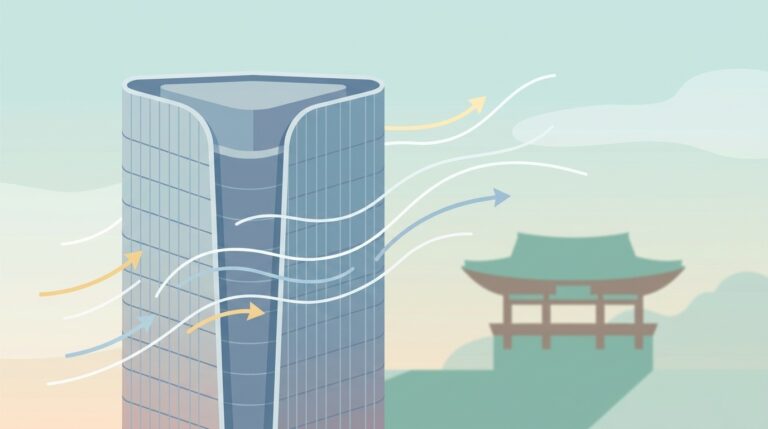
Imagine this: You are standing on the 123rd floor of the Lotte World Tower in Seoul. The view is breathtaking, but suddenly you feel a slight, rhythmic sway. Your heart skips a beat. Is it an earthquake? Or is it the fierce wind blowing off the Han River? A Korean colleague next to you smiles calmly and says, “걱정 마세요. 이 건물은 와류 진동을 제어하도록 풍동 실험을 거친 내진 설계의 결정체니까요.” (Don’t worry. This building is the epitome of seismic design, wind-tunnel tested to control vortex shedding.)
When diving into Korea’s cutting-edge civil engineering and architectural sectors, discussing structural integrity isn’t just academic—it’s highly prestigious. South Korea boasts some of the world’s tallest, most resilient megastructures (built by tech giants like Samsung C&T). However, as a C2-level professional or enthusiast, relying on basic textbook terms like “튼튼하다” (to be strong) just won’t cut it. You need the precise, high-level lexicon of structural dynamics to command authority in high-stakes meetings or academic debates.
This guide was built from real feedback from foreign structural engineers working in Seoul’s top firms. Let’s master the elite linguistic tools that bridge state-of-the-art engineering with natural Korean phrasing!
Phase 2: Deep Dive into 3 Core Expressions
1. 내진 성능을 확보하다 (確保–)
- Pronunciation: Nae-jin seong-neung-eul hwak-bo-ha-da (Sounds like “Nay-jean sung-nung-ul hwak-bo-ha-da”)
- Meaning: To secure seismic performance / To ensure structural integrity against earthquakes.
- K-Culture Moment: Seen frequently in Korean tech documentaries (like KBS’s Science Cafe) when discussing how the Lotte World Tower was engineered to withstand a 9.0 magnitude earthquake.
- Editor’s Insight: While “확보하다” literally means “to secure,” in C2 engineering contexts, it refers to guaranteeing that a building meets or exceeds rigorous regulatory and safety standards under dynamic loads.
- Situation Spectrum: Casual: 🚫 | Semi-formal: ⚠️ | Formal: ✅
- 🤔 Think About It: Western engineering often emphasizes “rigidity” (making structures stiff), whereas East Asian architecture, influenced by traditional wooden pagodas (like the ancient Hwangnyongsa), focuses on “flexibility within strength” (유연한 복원력). How does your native language reflect this philosophical difference in engineering?
2. 와류 진동을 제어하다 (渦流 振動– 制御–)
- Pronunciation: Wa-ryu jin-dong-eul je-eo-ha-da (Sounds like “Wah-ryoo jean-dong-ul jay-uh-ha-da”)
- Meaning: To control/mitigate vortex shedding induced vibrations.
- K-Culture Moment: Crucial during design pitch presentations for futuristic landmarks in Songdo International Business District or Haeundae, Busan.
- Editor’s Insight: “와류” (vortex/eddy) and “제어하다” (to control/curb) are highly technical. Using “제어하다” instead of “막다” (to block) showcases your advanced understanding of fluid-structure interaction—you aren’t stopping the wind; you are managing its energy.
- Situation Spectrum: Casual: 🚫 | Semi-formal: ⚠️ | Formal: ✅
- 🤔 Think About It: Why does Korean technical jargon utilize Sino-Korean roots (Hanja) like 制御 (Control) and 振動 (Vibration) to achieve precision, similar to how English relies on Latin/Greek roots?
3. 풍동 실험을 거치다 (風洞 實驗–)
- Pronunciation: Pung-dong sil-heom-eul geo-chi-da (Sounds like “Poong-dong sheel-hum-ul guh-chee-da”)
- Meaning: To undergo/pass wind tunnel testing.
- K-Culture Moment: Mentioned by lead architects in design reviews or promotional materials highlighting a skyscraper’s aerodynamic safety.
- Editor’s Insight: The verb “거치다” means to pass through a phase or process. It implies that the test was not just a mere check, but a rigorous, mandatory passage of validation.
- Situation Spectrum: Casual: ⚠️ | Semi-formal: ✅ | Formal: ✅
- 🤔 Think About It: Think of how “거치다” implies journey and qualification. How do you emphasize the rigorous validation process of a design in your culture?
Phase 3: Textbook Korean vs. Real Native Korean
Scenario 1: Discussing wind resistance design
- 📖 Textbook Korean: “이 건물은 바람에 견디도록 설계되었습니다.” (This building is designed to withstand the wind.)
- 🗣️ Real Native Korean: “초고층 빌딩 특성상 횡하중과 와류 진동을 상쇄하기 위해 모서리를 모따기(chamfering) 처리했습니다.” (Given the nature of supertall buildings, the corners were chamfered to offset lateral loads and vortex shedding.)
- 💡 Why the difference? Textbook phrases are overly simplistic. Professional Korean engineers utilize specific physical terms like “횡하중” (lateral loads) and “상쇄하다” (to offset/neutralize) to explain structural mechanics precisely.
Scenario 2: Explaining seismic dampers
- 📖 Textbook Korean: “지진 대비 장치가 충격을 흡수합니다.” (The earthquake device absorbs the impact.)
- 🗣️ Real Native Korean: “동조질량담퍼(TMD)가 구조물의 고유 진동수를 동조시켜 지진 에너지를 소산시킵니다.” (The Tuned Mass Damper tunes the structure’s natural frequency to dissipate seismic energy.)
- 💡 Why the difference? C2 fluency requires mastery of specialized acronyms combined with elegant Korean verbs like “소산시키다” (to dissipate) rather than the basic “흡수하다” (to absorb).
Phase 4: K-Culture Deep Dive & Non-verbal Manners
4-1. Nunchi & Architectural Gestures in Korea
When presenting structural data to Korean senior executives (임원진), maintain a posture of “겸손한 당당함” (humble confidence).
* The Pointer Gesture: When pointing to structural blueprints or wind tunnel aerodynamic models, never use a single index finger—it can look demanding or aggressive. Instead, use an open palm facing upward (손바닥을 위로 향하게 하여) to guide their gaze.
* Nunchi Cue: Watch the senior executive’s forehead. If they frown slightly while looking at the wind-tunnel drag coefficients, it’s a sign to immediately transition from high-level theory to concrete safety margins and cost efficiency.
4-2. The “K-Construction Speed and Safety” Paradox
Korean construction culture is famously driven by the “빨리빨리” (Palli-Palli) spirit, yet when it comes to supertall landmarks, safety is treated with absolute, almost religious solemnity. In dramas like My Mister (나의 아저씨), the protagonist’s job as a structural safety inspector highlights the deep ethical weight placed on safety coefficients (안전율). Understanding this cultural pride in zero-accident, high-speed megastructures will make your professional communications highly resonant.
Phase 5: Real-Life Roleplay Scenario
The Setup
You are Dr. Alex Smith, a senior structural consultant. You are meeting with Director Kim (김 전무), the head of structural engineering at a major Korean conglomerate, in a high-rise office overlooking the Han River.
Characters
- Dr. Alex Smith (You): Brilliant consultant advocating for advanced aerodynamic modifications.
- Director Kim (NPC): Experienced, pragmatic director concerned about cost, scheduling, and wind load safety.
Dialogue
- Director Kim: “스미스 박사님, 이번 110층 타워 안 말입니다. 서울 지역의 최대 기본 풍속을 고려했을 때, 상층부 흔들림이 너무 심하지 않을까요?”
(Dr. Smith, regarding this 110-story tower design. Considering Seoul’s maximum basic wind speed, won’t the top-floor sway be too severe?) - Dr. Alex: “
🎭 (자료를 열어 보이며 단호하게)걱정 마세요. 이미 초기 풍동 실험을 거쳐 기류의 흐름을 분석했습니다. 상층부 모서리 형태만 변경해도 횡하중을 크게 줄일 수 있습니다.”
(Don’t worry. We have already undergone wind tunnel testing to analyze the airflow. Just modifying the upper-level corner geometry can drastically reduce lateral loads.) - Director Kim: “형태 변경이라… 구체적으로 어떤 제안이십니까? 시공성이 떨어지면 안 됩니다.”
(Modifying the geometry… what specific proposal do you have? We cannot compromise buildability.) - Dr. Alex: “
🎭 (태블릿의 3D 모델을 가리키며)모서리에 감쇠 슬릿(Slit)을 도입하여 와류 진동을 제어하는 방안입니다. 이는 풍압을 효과적으로 분산시킵니다.”
(We propose introducing attenuation slits on the corners to control vortex-induced vibrations. This effectively disperses wind pressure.) - Director Kim: “흠, 획기적이군요. 하지만 예산 범위 내에서 실현 가능한가요? 내진 설계 보강 비용도 만만치 않은데요.”
(Hmm, innovative. But is it feasible within our budget? The cost for reinforcing seismic design is also substantial.) - Dr. Alex: “
🎭 (안심시키는 듯한 미소를 지으며)슬릿 디자인을 적용하면 구조용 강재 사용량을 약 7% 절감할 수 있어, 우수한 내진 성능을 확보하면서도 오히려 경제적입니다.”
(Applying the slit design reduces structural steel consumption by about 7%, making it highly economical while still securing excellent seismic performance.) - Director Kim: “강재가 절감된다고요? 아주 흥미롭네요. 다음 주 이사회 보고용 세부 데이터를 준비해 주실 수 있겠습니까?”
(Reducing steel consumption? Highly interesting. Could you prepare the detailed data for next week’s board presentation?) - Dr. Alex: “
🎭 (가볍게 고개를 숙여 신뢰감을 주며)네, 즉시 시뮬레이션 리포트와 예산 비교표를 송부해 드리겠습니다. 맡겨 주십시오.”
(Yes, I will immediately send you the simulation report and budget comparison chart. Leave it to me.)
🔀 Interactive Choice Points
How will you respond to Director Kim’s request for the board meeting data?
- Choice A: “당장 오늘 퇴근 전까지 완벽한 리포트를 작성해 보내겠습니다.”
- Feedback (Risk): Showing extreme speed is great, but promising a full simulation report in hours might sound unrealistic or desperate to a pragmatic director, potentially undermining your C2-level professional credibility.
- Choice B: “네, 다음 주 보고서인 만큼 정밀 시뮬레이션을 돌려 월요일 오전까지 송부해 드리겠습니다.”
- Feedback (Best!): Highly professional. It balances realistic engineering time constraints with the legendary Korean “Palli-Palli” expectation of having materials ready before the work week begins.
- Choice C: “제 일정이 좀 바쁜데, 수요일까지 드리면 안 될까요?”
- Feedback (Bad): Shows lack of drive and poor “Nunchi.” In Korean business culture, missing the chance to prepare a board-level report early suggests a lack of alignment with company priorities.
Phase 6: 10-Second Emotion Shadowing Drill
To sound like a true Korean expert, you must master the cadence of logical persuasion. Practice pausing at / and mimicking the emotional tone!
- The Tone: Confidence mixed with absolute scientific certainty.
- Sentence:
“이 모델은 / 풍동 실험을 통해 / 안전성이 검증되었으며, / 최악의 강풍에서도 / 와류 진동을 완벽히 제어하여 / 건물의 흔들림을 소산시킵니다.” - Pronunciation Guide:
Ee mo-del-eun / poong-dong sheel-hum-eul tong-hae / an-jeon-seong-ee geom-jeung-doe-eot-eu-myeo, / choe-ak-ui gang-poong-e-seo-do / wa-ryu jean-dong-ul wan-byeok-hee jay-uh-ha-yeo / geon-mul-ui heun-deul-reem-eul so-san-shee-keep-nee-da. - Emotional Signpost:
[😎 Confidently, with deep assurance and smooth flow]
Phase 7: K-Culture Mini Dictionary
- 칼퇴근 (Kal-toe-geun) | Sharp clock-out | Leaving the office exactly on time. In high-pressure engineering projects, this is a rare luxury but a universally understood goal.
- 시방서 (Si-bang-seo) | Specification sheet | A highly technical document outlining the materials and methods for construction. Standard textbook Korean uses “설명서” (manual), but professionals say “시방서.”
- 마감 기한 (Ma-gam Gi-han) | Deadline | Crucial in fast-paced Korean infrastructure projects. Missing this is a major taboo.
- 현장 감리 (Hyeon-jang Gam-ri) | On-site construction supervision | Ensuring that the real-world construction matches the blueprints and seismic design specifications precisely.
Phase 8: Traveler’s Survival Kit (For Visiting Engineers)
Top 3 Survival Expressions
- “안전모와 안전화는 어디서 받습니까?” (An-jeon-mo-wa an-jeon-hwa-neun eo-di-seo bat-seup-ni-ka?)
- Pro Tip: “Where can I get my hard hat and safety boots?” Essential for on-site visits.
- “설계 도면과 실제 시공 현장에 오차가 있습니다.” (Seol-gye do-myeon-gwa sheel-je shee-gong hyeon-jang-e o-cha-ga eet-seup-ni-da.)
- Pro Tip: “There is a discrepancy between the design blueprints and the actual construction site.” Say this to immediately halt unauthorized alterations.
- “풍동 시험 성적서를 보여주시겠습니까?” (Pung-dong shee-heom seong-jeok-seo-reul bo-yeo-ju-shi-get-seup-nee-ka?)
- Pro Tip: “Could you show me the wind tunnel test report?” Perfect for structural audits.
Editor’s Travel Note
When conducting site surveys in Korea, you must download the Naver Map App (네이버 지도) as Google Maps does not function properly due to national security regulations regarding spatial data.
(Note: Subway schedules and map databases are subject to change, so always verify app updates before departure.)
Phase 9: Go Deeper (Cultural Perspective Reflection)
In Korea, the construction of a supertall skyscraper is not merely a commercial project; it is a manifestation of 국격 (Guk-gyeok – National Prestige). Historically, Korea’s rapid economic rise—the “Miracle on the Han River”—was built on massive infrastructure achievements. When you discuss seismic design and wind engineering with Korean engineers, you are tapping into a deeply rooted national pride of transforming a war-torn country into a global technological powerhouse.
💬 Your Turn: How does your country view grand infrastructure projects? Are they seen as symbols of national pride, or purely functional investments? Let’s talk in the comments below!
Phase 10: FAQ & Avoiding Misunderstandings
Q: Is
Frequently Asked Questions (FAQ)
Q: What does "내진 성능을 확보하다 (確保--)" mean in Korean and how do you pronounce it?
A: In Korean, "내진 성능을 확보하다 (確保--)" is pronounced [Nae-jin seong-neung-eul hwak-bo-ha-da (Sounds like "Nay-jean sung-nung-ul hwak-bo-ha-da"] and means: To secure seismic performance / To ensure structural integrity against earthquakes.
Q: What does "와류 진동을 제어하다 (渦流 振動-- 制御--)" mean in Korean and how do you pronounce it?
A: In Korean, "와류 진동을 제어하다 (渦流 振動-- 制御--)" is pronounced [Wa-ryu jin-dong-eul je-eo-ha-da (Sounds like "Wah-ryoo jean-dong-ul jay-uh-ha-da"] and means: To control/mitigate vortex shedding induced vibrations.
Q: What does "풍동 실험을 거치다 (風洞 實驗--)" mean in Korean and how do you pronounce it?
A: In Korean, "풍동 실험을 거치다 (風洞 實驗--)" is pronounced [Pung-dong sil-heom-eul geo-chi-da (Sounds like "Poong-dong sheel-hum-ul guh-chee-da"] and means: To undergo/pass wind tunnel testing.






