

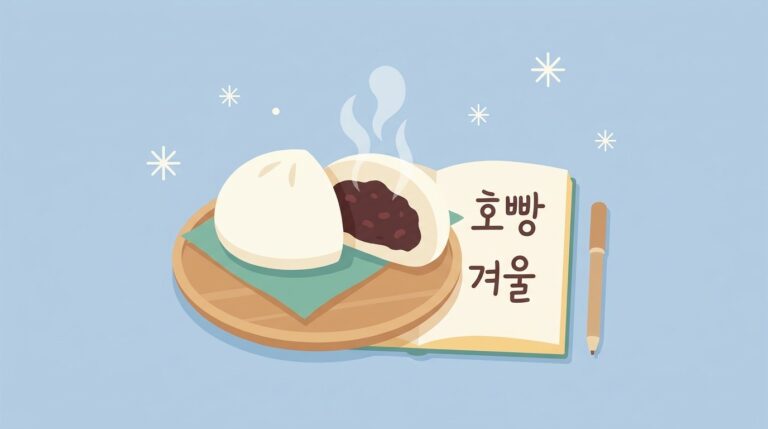
Stay Warm with Hoppang: Your Ultimate Guide to Korea’s Cozy Winter Snack
Phase 1: Empathy (Welcome to Your Cozy Korean Winter!)
안녕하세요! (An-nyeong-ha-se-yo!) Hello! I’m your senior editor and local culture navigator at Daily Hangul.
Imagine this: It’s a freezing December evening in Seoul. The wind is biting, your fingers are numb, and you can see your breath in the air. Suddenly, you spot a warm, glowing light from a convenience store. On the counter, there is a round, steaming glass machine filled with fluffy, white buns.
This is 호빵 (Hoppang), Korea’s ultimate winter comfort food!
Many of my first-time students tell me, “I want to try those steaming buns, but I get nervous when standing at the counter. How do I ask for one? What if I choose the wrong flavor?”
Don’t worry! Today, we are going to learn how to confidently order this warm winter treat like a true local. It’s super simple, and by the end of this guide, you’ll be holding a piping hot Hoppang in your hands! Let’s dive in!
Phase 2: Deep Dive into 3 Essential Expressions
1. 호빵 주세요 (Hoppang ju-se-yo)
- Pronunciation: Hoppang joo-seh-yo (Sounds like “hope-pahng” + “ju” as in juice + “say-yo”)
- Meaning: “Please give me Hoppang.”
- K-Culture Moment: You will hear this in every Korean winter drama. When the lead characters are walking in the snow, one of them will run to a convenience store and say, “호빵 주세요!” to share a warm moment.
- Editor’s Insight: This is the most magical, polite, and easiest phrase for beginners. “주세요” (ju-se-yo) means “Please give me.” Just put any food name before it!
- Situation Spectrum: Casual ✅ | Semi-formal ✅ | Formal 🚫
- 🤔 Think About It: In Korea, sharing warm street food is a way of showing affection. Who is the first person you would want to share a hot Hoppang with?
2. 단팥으로 주세요 (Dan-pat-eu-ro ju-se-yo)
- Pronunciation: Dan-pat-eu-ro joo-seh-yo (“Dan” as in dawn + “pat” as in pot + “eu-ro”)
- Meaning: “Please give me the sweet red bean one.”
- K-Culture Moment: Classic vs. Trendy! There is always a playful debate in Korea: “Are you Team Red Bean (단팥) or Team Vegetable (야채)?”
- Editor’s Insight: “단팥” (dan-pat) means sweet red bean, which is the original, classic Hoppang flavor. “~으로” (eu-ro) means “with” or “as”. It is used to choose a specific option.
- Situation Spectrum: Casual ✅ | Semi-formal ✅ | Formal 🚫
- 🤔 Think About It: Does your home country have desserts made with sweet red beans? It might sound unique at first, but it is incredibly sweet and cozy!
3. 뜨거워요 (Tteu-geo-wo-yo)
- Pronunciation: Tteu-guh-wo-yo (Make a tight, tense “t” sound like the “t” in “star”)
- Meaning: “It is hot!”
- K-Culture Moment: When you tear open a fresh Hoppang, steam pours out. Koreans will blow on their fingers and gasp, “아, 뜨거워!” (Ah, tteu-guh-wo!).
- Editor’s Insight: Hoppang is served extremely hot. Use this word to warn your friends, or to explain why you are eating so slowly.
- Situation Spectrum: Casual ✅ | Semi-formal ✅ | Formal ⚠️
- 🤔 Think About It: The name ‘Hoppang’ actually comes from the sound “Ho-Ho” (blowing to cool down hot food) and “Pang” (bread). The name itself tells you it’s hot!
Phase 3: Textbook Korean vs. Real-Life Korean
Situation 1: Choosing a flavor at the counter
- 📖 Textbook Korean: 어떤 맛을 원하십니까? (Eot-teon mat-eul won-ha-sim-ni-kka?) – “Which flavor do you desire?” (Too formal and unnatural!)
- 🗣️ Real-Life Korean: 무슨 맛으로 드릴까요? (Mu-seun mat-eu-ro deu-ril-kka-yo?) – “Which flavor shall I give you?”
- 💡 Why the difference?: Korean store clerks use the polite “드릴까요?” (deu-ril-kka-yo – Shall I give you) to make customers feel comfortable.
Situation 2: Warning a friend about the hot steam
- 📖 Textbook Korean: 이것은 매우 뜨겁습니다. 조심하십시오. (I-geot-eun mae-u tteu-geop-seum-ni-da. Jo-sim-ha-sip-si-o.) – “This is very hot. Please be careful.” (Sounds like a robot safety manual!)
- 🗣️ Real-Life Korean: 진짜 뜨거워요! 조심해요! (Jin-jja tteu-geo-wo-yo! Jo-sim-hae-yo!) – “It’s really hot! Be careful!”
- 💡 Why the difference?: In real life, friends and friendly locals use active, expressive words like “진짜” (jin-jja – really) to show genuine care.
Phase 4: K-Culture Deep Dive & Non-Verbal Manners
4-1. The Art of “Ho-Ho” (호호)
When eating Hoppang, never bite straight into it! It will burn your tongue.
1. The Gentle Tear: Hold the bun with both hands and tear it in half.
2. The “Ho-Ho” Blow: Blow soft air into the center of the bun where the steam is rising. Say “호호” (Ho-ho) quietly.
3. The Paper Peel: Don’t forget to peel off the white paper on the bottom of the bun before eating! Eating the paper is a very common beginner mistake.
4-2. The Convenience Store Culture
In Korea, convenience stores (편의점 – pyeon-ui-jeom) are social hubs. During winter, the Hoppang machine sits right next to the cash register. It’s completely normal to buy one, sit at the window counter inside the store, and eat it while watching the snow fall outside.
Phase 5: Real-Life Roleplay Scenario
Setting: A cozy GS25 convenience store in Hongdae, Seoul.
Characters:
* You: A hungry winter traveler.
* Min-su (민수): A friendly, part-time store clerk wearing a blue vest.
Min-su: 어서 오세요! (Eo-seo o-se-yo!)
        🎭 [Smiling politely behind the counter]
        "Welcome!"

You: 안녕하세요! 저... 호빵 있어요? (An-nyeong-ha-se-yo! Jeo... hoppang is-seo-yo?)
     🎭 [Pointing gently at the warm glass machine]
     "Hello! Um... do you have Hoppang?"

Min-su: 네, 있어요! 단팥이랑 야채 있어요. (Ne, is-seo-yo! Dan-pat-i-rang ya-chae is-seo-yo.)
        🎭 [Nodding and pointing at the machine]
        "Yes, we do! We have red bean and vegetable."

You: 단팥 호빵 두 개 주세요. (Dan-pat hoppang du gae ju-se-yo.)
     🎭 [Holding up two fingers with a smile]
     "Two red bean Hoppangs, please."

Min-su: 네, 여기요. 뜨거우니까 조심하세요! (Ne, yeo-gi-yo. Tteu-geo-u-ni-kka jo-sim-ha-se-yo!)
        🎭 [Carefully handing you the warm paper bags]
        "Yes, here they are. They are hot, so be careful!"

You: 감사합니다! 진짜 따뜻해요. (Gam-sa-ham-ni-da! Jin-jja tta-tteut-hae-yo.)
     🎭 [Holding the warm bun close to your chest]
     "Thank you! It is really warm."

Min-su: 맛있게 드세요! (Mas-it-ge deu-se-yo!)
        🎭 [Waving lightly]
        "Enjoy your meal!"

You: 네, 안녕히 계세요! (Ne, an-nyeong-hi gye-se-yo!)
     🎭 [Bowing your head slightly as you exit]
     "Yes, goodbye!"
🔀 Interactive Choice Point
Min-su asks: “무슨 맛으로 드릴까요?” (Which flavor shall I give you?)
* Choice A: “김치 주세요!” (Kimchi ju-se-yo!)
* Choice B: “단팥 하나, 야채 하나 주세요.” (Dan-pat ha-na, ya-chae ha-na ju-se-yo.)
* Choice C: “아무거나 주세요.” (A-mu-geo-na ju-se-yo.)
Feedback:
- Choice A (Risk ⚠️): Kimchi flavor (김치호빵) exists and is delicious! However, not all stores have it ready in the machine. Min-su might look embarrassed and say, “죄송해요, 김치는 없어요.” (Sorry, we don’t have Kimchi flavor today.)
- Choice B (Best 👍): Perfect! You get to try the two most famous, classic flavors: one sweet red bean (단팥) and one savory vegetable (야채).
- Choice C (Bad 👎): “아무거나” means “anything.” While grammatically correct, it makes the clerk do the thinking, which can create a tiny, awkward pause in busy Korean stores!
Phase 6: 10-Second Emotion Shadowing Drill
Let’s practice speaking with real Korean emotion! Use the pauses (/) and emotional cues below.
[😊 Excited & Friendly]
안녕하세요! / 호빵 / 주세요!
(An-nyeong-ha-se-yo! / Hoppang / ju-se-yo!)-
[🥺 Cute & Cold (Rubbing your hands)]
추워요! / 진짜 / 따뜻해요.
(Chu-wo-yo! / Jin-jja / tta-tteut-hae-yo.) -
[😱 Surprised & Warning]
앗! / 뜨거워요! / 조심해요!
(At! / Tteu-geo-wo-yo! / Jo-sim-hae-yo!)
Phase 7: K-Culture Mini-Dictionary
- 편의점 (Pyeon-ui-jeom) | Convenience Store
- The magical 24/7 street-side stores (like GS25, CU, 7-Eleven) where you buy Hoppang, warm drinks, and hot packs.
- 단팥 (Dan-pat) | Sweet Red Bean Paste
- The traditional, sweet filling loved by Koreans of all generations.
- 야채 (Ya-chae) | Vegetables (and meat)
- A savory filling option, similar to a warm, savory dumpling.
- 따끈따끈 (Tta-keun-tta-keun) | Piping Hot / Cozy Warm
- An onomatopoeia describing foods or blankets that are perfectly, comfortably warm in winter.
Phase 8: Traveler’s Survival Kit
Survival Expressions TOP 3
- 카드 돼요? (Ka-deu dwae-yo?)
- Meaning: “Do you accept cards?”
- Pro Tip: Korea is almost cashless. Even for a cheap Hoppang, paying with a card is perfectly fine!
- 봉투 필요해요. (Bong-tu pil-yo-hae-yo.)
- Meaning: “I need a plastic/paper bag.”
- Pro Tip: Useful if you are buying multiple hot buns to take back to your hotel.
- 이거 맛있어요? (I-geo mas-it-seo-yo?)
- Meaning: “Is this delicious?”
- Pro Tip: Ask this to the clerk if you see a new, mysterious flavor of Hoppang!
📍 Editor’s Travel Note:
To find the nearest convenience stores and check their locations easily, make sure to download the Naver Map App. It is much more accurate in Korea than Google Maps! Note: Local store inventories may change during late-night hours.
Phase 9: “A Step Deeper” (Thoughtful Reflection)
In English, we say “warm-hearted.” In Korea, warmth is closely linked to food and sharing. Sharing a steaming, split-half Hoppang with a friend on a freezing day represents a unique Korean concept called 정 (Jeong)—a deep, warm feeling of attachment and love. Food is not just fuel; it’s a way to transfer physical warmth from one person to another.
💬 Your Turn: What is the ultimate winter comfort food in your culture? How do you share warmth with your loved ones during cold days? Let us know in the comments below!
Phase 10: FAQ & Common Mistakes
Q: Can I buy Hoppang at any time of the year?
A: Generally, no. Hoppang is a seasonal product. You will see the glowing steam machines appear in convenience stores from October to February. In summer, they disappear!
Q: Can I buy cold Hoppangs to heat up later?
A: Yes! You can buy multi-packs of uncooked Hoppang in the refrigerated section of supermarkets. You can steam them at home or microwave them with a damp paper towel on top.
Q: What is the difference between 호빵 (Hoppang) and 찐빵 (Jjinppang)?
A: They are very similar! Jjinppang is the traditional, rustic steamed bun sold at outdoor markets. Hoppang is the brand-name version developed for home and convenience store cooking.
🚨 Common Mistakes Alert!
- Mistake 1: Biting the bottom paper. Always check the bottom of the bun! There is always a round piece of paper preventing the bun from sticking to the steamer.
- Mistake 2: Screaming “뜨거워!” (Tteu-guh-wo!) loudly in formal settings. This is a very casual exclamation. Use “뜨거워요” (Tteu-guh-wo-yo) with polite tones if you are talking to the shop clerk.
- Mistake 3: Not blowing on it. Seriously, the steam inside can cause painful burns. Follow the “Ho-Ho” rule!
Phase 11: Action Mission for Today
- 🥉 Bronze Mission (Solo): Read the Phase 6 shadowing drill out loud 3 times in front of your mirror with real acting!
- 🥈 Silver Mission (Social): Share a picture of your favorite warm winter food on Instagram and tag us with
#DailyHanguland the caption: “진짜 따뜻해요!” - 🥇 Gold Mission (Real-Life): Walk into a convenience store (or a Korean market online/offline), point at a bun, and confidently say: “호빵 주세요!”
Phase 12: Interactive Quiz Challenge
Test your new winter snack skills!
1. Match the flavor to the correct Korean word:
- A. Sweet Red Bean
- B. Vegetable
(1) 야채 (Ya-chae) | (2) 단팥 (Dan-pat)
🔍 Click to view Answer & Explanation
Answer:
* A matches with (2) 단팥 (Dan-pat)
* B matches with (1) 야채 (Ya-chae)
Explanation: Remember, “Dan” (단) means sweet, and “Pat” (팥) means red bean! “Ya-chae” is vegetables.
2. True or False?
“You should eat the paper on the bottom of the Hoppang because it is edible starch paper.”
🔍 Click to view Answer & Explanation
Answer: FALSE!
Explanation: The paper on the bottom is normal baking paper. Peel it off carefully and throw it in the trash bin before taking your first delicious bite!







