

Stand, Slurp, and Smile: The Ultimate Guide to Standing and Eating Street Food in Korea
Phase 1: Empathy (스토리 몰입형 오프닝)
안녕하세요! (Annyeonghaseyo!) Your friendly neighborhood Korean guide from Daily Hangul is here! 🎬
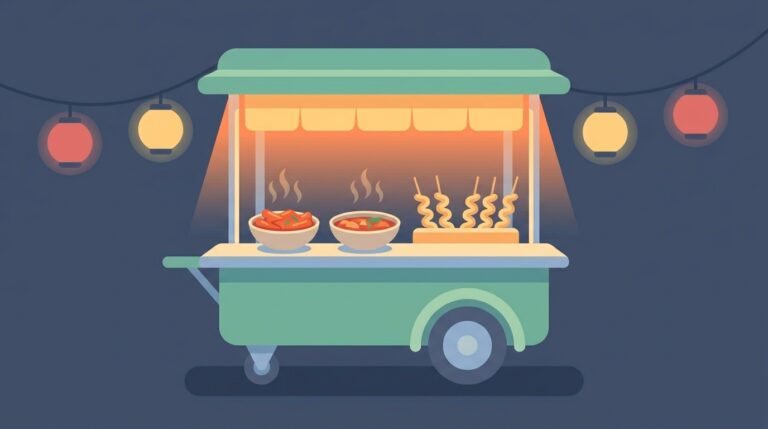
Picture this: It’s a chilly autumn evening in Seoul. You’re walking past a glowing orange plastic tent (Pojangmacha, 포장마차) on a bustling street corner. The steam rising from a large, bubbling metal tray carries the sweet and spicy aroma of Tteokbokki (떡볶이), mixed with the savory, comforting scent of Eomuk (fish cake, 어묵) broth. You see locals huddled around the cart, standing shoulder-to-shoulder, laughing, and happily poking spicy rice cakes with wooden toothpicks.
You want to join them, but a wave of anxiety hits you: “Do I just walk up and grab a stick? How do I pay? Is it okay to stand here? Can I drink the soup for free?”
Don’t worry! We have all been there. Eating while standing at a street cart (gilgeori eumsik, 길거리 음식) is one of the most soulful, authentic Korean experiences you can have, but it has its own unwritten social rules. Today, we’ll unlock the secret codes of standing and eating like a true Seoulite so you can step up to any food cart with absolute confidence!
Phase 2: Three Key Expressions (핵심 표현 3선 심층 분석)
Let’s master the three magic phrases that will make you sound like a local street food connoisseur.
1. 서서 먹어도 돼요? (Seoseo meogodeo dwaeyo?)
- Pronunciation: Suh-suh muh-gaw-daw dwae-yo? (Sounds like “Suh-suh” as in subtle, “muh-gaw” as in more, “dwae-yo” like play-o)
- Meaning: “Is it okay to eat standing up here?”
- K-Culture Moment: You’ll hear this when a tourist or a polite young person wants to confirm if the small cart is for standing-room-only or if there’s a specific spot to stand.
- Editor’s Insight: While most food carts are naturally designed for standing, asking this politely shows immense respect for the owner’s limited space, especially when it’s crowded.
- Situation Spectrum: Casual ✅ | Semi-formal ✅ | Formal ⚠️
- 🤔 Think About It: In some western cultures, eating while standing on the street is seen as rushed or impolite. Why do you think Koreans find standing together around a hot grill so warm and communal?
2. 국물 좀 더 주실 수 있어요? (Gungmul jom deo jusil su isseoyo?)
- Pronunciation: Goong-mool jom duh joo-shil soo ee-suh-yo? (Sounds like “Goong” like gong, “mool” like mule but shorter, “jom” like gym with an ‘o’)
- Meaning: “Could I please have a bit more broth?”
- K-Culture Moment: In almost every Korean street food scene in K-Dramas, you’ll see characters scooping up Eomuk broth with a small paper cup while chatting. It’s the ultimate winter comfort.
- Editor’s Insight: Gungmul (broth) is usually free and unlimited when you buy fish cakes! However, always ask politely instead of just grabbing it. It warms up both your hands and your heart.
- Situation Spectrum: Casual ✅ | Semi-formal ✅ | Formal 🚫
- 🤔 Think About It: How does the concept of “free refills” for warm broth reflect the Korean culture of Jeong (정) — affection and warm-heartedness?
3. 계산은 어떻게 해요? (Gyesaneun eotteoke haeyo?)
- Pronunciation: Gye-san-eun au-thuh-ge hae-yo? (Sounds like “Gye” as in yes, “san-eun” as in sun-un, “au-thuh-ge” as in autumn-kay)
- Meaning: “How do I pay?”
- K-Culture Moment: Since street food carts are often cash-only or bank-transfer-only, this phrase helps you figure out if they accept cards or if you need to use mobile transfer.
- Editor’s Insight: Many street food owners are older grandmas (Halmeoni, 할머니) who might not have card readers. Asking this beforehand avoids any awkward payment moments!
- Situation Spectrum: Casual ✅ | Semi-formal ✅ | Formal ✅
- 🤔 Think About It: What payment methods are most common for street markets in your home country compared to Korea?
Phase 3: Textbook Korean vs. Real Korean (교과서 한국어 vs 진짜 한국어)
Let’s look at how textbooks teach you to order versus how locals actually do it in a bustling street environment!
Situation 1: Ordering Spicy Rice Cakes
- 📖 Textbook style: “떡볶이 일 인분을 주십시오.” (Tteokbokki il inbuneul jusipsio. – Please give me one serving of tteokbokki.)
- 🗣️ Real Korean style: “이모님, 떡볶이 일인분만 버무려 주세요!” (Imonim, tteokbokki ilinbunman beomuryeo juseyo! – Auntie, please mix one serving of tteokbokki with sauce/twigoim!)
- 💡 Why the difference? Calling the female owner “Imonim” (Auntie) instantly builds a friendly bond. Asking to beomuryeo (mix) means you want them to mix fried bites (Twigim) into the sweet and spicy tteokbokki sauce. It’s the ultimate pro-move!
Situation 2: Asking for Fish Cake Broth
- 📖 Textbook style: “어묵 국물을 마셔도 됩니까?” (Eomuk gungmureul masyeodo doemnikka? – May I drink the fish cake broth?)
- 🗣️ Real Korean style: “사장님, 국물 좀 마실게요!” (Sajan-nim, gungmul jom masilgeyo! – Boss, I’ll have some broth!)
- 💡 Why the difference? Street food stalls are very casual. Instead of asking for formal permission, a polite declaration like “I will drink some broth!” while smiling is the natural, friendly way to do it.
Phase 4: K-Culture Deep Dive & Non-Verbal Manners (K-Culture 딥다이브)
4-1. The Art of “Nunchi” (눈치) at the Food Cart
When standing and eating, space is precious.
* The Cup Shield: Always hold your paper cup containing Eomuk close to your chest. This prevents accidental spills when people squeeze past you.
* The Dipping Rule: Never double-dip! The soy sauce container at the fish cake stand is communal. You dip your fish cake once before biting. If you need more sauce, use the small plastic brush or spoon provided to drizzle it onto your food. Double-dipping is a major social crime!
4-2. The “Standing & Eating” Culture
In Korea, eating while standing at a cart isn’t just about fast food; it’s a social equalizer. You will see businessmen in expensive suits standing next to high school students and elderly neighborhood residents. It represents a warm, informal space where everyone is equal under the glowing orange tent.
Phase 5: Real Roleplay Scenario (실전 롤플레이)
Let’s practice! You are at a busy cart near Hongdae Station. The owner is a warm but busy Imo (Auntie).
- Imo (Owner): 어서 와요! 뭐 드릴까? (Eoseo wayo! Mwo deurikka?)
🎭 Smiling warmly while holding a large metal spatula. - You: 저기… 서서 먹어도 돼요? (Jeogi… seoseo meogodeo dwaeyo?)
🎭 Pointing politely to a small empty space at the counter. - Imo (Owner): 그럼요, 이쪽으로 들어와서 서요! (Geureomyo, iccogeuro deureowaseo seoyo!)
🎭 Beckoning you to come closer to the warm grill. - You: 감사합니다! 떡볶이 일인분하고 어묵 두 개 주세요. (Gamsahabnida! Tteokbokki ilinbun-hago eomuk du gae juseyo.)
🎭 Holding up two fingers to clarify the fish cake count. - Imo (Owner): 매운 거 잘 먹어요? 떡볶이 좀 매운데! (Maeun geo jal meogeoyo? Tteokbokki jom maeunde!)
🎭 Winking playfully as she scoops the steaming red rice cakes. - You: 네, 매운 거 좋아해요! 국물도 좀 마실게요. (Ne, maeun geo joahaeyo! Gungmul-do jom masilgeyo.)
🎭 Carefully picking up a small paper cup for the fish cake broth. - Imo (Owner): 여기 뜨거우니까 조심해요! 더 필요하면 말하고. (Yeogi tteugeounikka josimhaeyo! Deo piryohamyen malhago.)
🎭 Handing over the plate covered in a green plastic bag. - You: 정말 맛있어요! 계산은 어떻게 해요? 현금만 돼요? (Jeongmal masisseoyo! Gyesaneun eotteoke haeyo? Hyeongeum-man dwaeyo?)
🎭 Taking out your wallet politely after finishing the last bite. - Imo (Owner): 계좌이체도 되고, 카드도 돼요! 편한 걸로 해줘요. (Gyejwa-iche-do doego, kadeu-do dwaeyo! Pyeonhan geollo haejueyo.)
🎭 Pointing to a small card reader and a printed bank account number on the wall.
🔀 Interactive Choice Point
How would you respond to the payment options?
* A: “여기 만 원짜리 한 장이요!” (Yeogi man-won-ccari han jang-iyo! – Here is a 10,000 won bill!)
* B: “죄송해요, 저는 현금이 아예 없어요.” (Joesong-haeyo, jeoneun hyeongeum-i aye eopseoyo. – I’m sorry, I don’t have any cash at all.)
* C: “계좌이체 할게요! 여기 번호로 보내면 되나요?” (Gyejwa-iche halgeyo! Yeogi beonholo bonaemyen dwenayo? – I’ll do a bank transfer! Do I send it to this number?)
💡 Feedback:
- Choice A (Best): 🌟 Excellent! Handing over cash (especially small bills) is highly appreciated by street vendor owners as it keeps transactions fast and easy.
- Choice B (Risk): ⚠️ A bit too apologetic and direct. Since she said they accept cards, you can just say, “카드로 할게요!” (I will pay by card!) instead of feeling bad about not having cash.
- Choice C (Best): 🌟 Fantastic! Doing a bank transfer (Gyejwa-iche) makes you look exactly like a local. It’s super common and convenient in Korea!
Phase 6: 10-Second Emotion Shadowing Drill (10초 감정 섀도잉)
Let’s practice speaking with the exact emotions of a hungry, excited street foodie! Pay attention to the pauses (/) and the emotional cues.
- [😊 Excited & Friendly]
- “이모님! / 떡볶이 일인분하고 / 어묵 국물 / 좀 마실게요!”
- Imonim! / Tteokbokki ilinbun-hago / eomuk gungmul / jom masilgeyo!
- [🥺 Appreciative & Hungry]
- “와, / 진짜 따뜻하고 / 맛있어요! / 최고예요!”
- Wa, / jinjja ttatteuthago / masisseoyo! / Choegoyeyo!
- [🙋 Polite & Inquiring]
- “사장님, / 계좌이체로 / 보내드렸는데 / 확인해 주세요!”
- Sajannim, / gyejwa-iche-ro / bonae-deuryeonneunde / hwagin-hae juseyo!
Phase 7: K-Culture Mini Dictionary (K-Culture 미니 사전)
- 포장마차 (Pojangmacha) | Tented Street Stall | Often shortened to Pocha, these are traditional orange or yellow tented carts serving comforting street snacks by day and alcohol/street food by night.
- 이모님 (Imonim) | Auntie | A warm, respectful way to call middle-aged female restaurant or street food owners. It builds instant rapport.
- 계좌이체 (Gyejwa-iche) | Bank Transfer | Sending money directly from your banking app to the owner’s account. Almost all food stall owners have their account numbers printed on a piece of paper on the cart.
- 어묵 (Eomuk) | Fish Cake | Skewered fish cakes boiled in a savory broth. A staple companion to spicy tteokbokki.
Phase 8: Survivor Kit for Travelers (여행자를 위한 생존 키트)
Survival Phrases TOP 3
- “이거 얼마예요?” (Igeo eolmayeyo?) – How much is this? (Pro Tip: Use this while pointing at any delicious stick!)
- “이거 안 매운 걸로 주세요.” (Igeo an maeun geollo juseyo.) – Please give me the non-spicy one of this.
- “영수증은 안 주셔도 돼요.” (Yeongsujeungeun an jusyeodo dwaeyo.) – You don’t need to give me a receipt. (Great for keeping busy stalls moving fast!)
Editor’s Travel Note
Before heading out to explore the food streets, make sure you have the Naver Map App downloaded on your phone to find famous markets like Gwangjang Market or Mangwon Market. Disclaimer: Street vendors’ operational hours and locations can change depending on weather and local regulations. Always keep about 10,000 KRW in cash just in case!
Phase 9: A Step Deeper (한 발 더 깊이)
In many cultures, eating is a private, structured activity. But in Korea, the street cart represents shared warmth (Jeong, 정). Squeezing into a tiny standing space with strangers, inhaling the same steam, and sharing the same broth pot breaks down social barriers. It shows a unique aspect of Korean collectivism where eating together is a form of mutual comfort.
💬 Your Turn: Would you feel comfortable standing and eating close to strangers? Have you ever tried street food like this in your home country? Tell us in the comments below!
Phase 10: FAQ & Common Mistakes (FAQ & 오해 방지)
Q: Can I grab the fish cake broth cup and fill it myself?
A: Yes! Usually, there is a ladle (gukja, 국자) and paper cups at the front of the cart. You are welcome to scoop the hot broth yourself. Just make sure to wait your turn if it’s crowded!
Q: Do street food stalls accept international credit cards?
A: Some modernized stalls do, but many traditional carts in markets only accept cash or local bank transfers. It is always wise to keep cash on hand.
Q: Is it okay to stand and eat if I only ordered one stick of fish cake (about 1,000 KRW)?
A: Absolutely! No one will judge you. Many locals stop by for just 2 minutes to eat one fish cake, drink a cup of warm soup to heat up their body, and leave.
🚨 Common Mistakes Alert!
- Mistake 1: Double-dipping the fish cake stick into the shared soy sauce cup.
- Correct Action: Dip once, or use the soy sauce spray/brush provided!
- Mistake 2: Blocking the entrance of the stall after you finish eating.
- Correct Action: Once done, step back to allow other hungry customers to reach the counter.
- Mistake 3: Throwing your used wooden skewers in the general street trash.
- Correct Action: Hand them back to the owner or place them in the designated wooden box on the cart.
Phase 11: Action Mission (액션 미션)
- 🥉 Bronze Mission: Practice saying “서서 먹어도 돼요?” out loud in front of a mirror 3 times.
- 🥈 Silver Mission: Share this post on your social media and tag a friend you want to go to a Korean street market with!
- 🥇 Gold Mission: Go to your nearest local Korean restaurant or street market, order standing up, and politely ask for “Gungmul 좀 더 주실 수 있어요?”!
Phase 12: Interactive Quiz Challenge (인터랙티브 퀴즈)
Test your street food manners!
- What is the most polite way to add soy sauce to your fish cake after you have already taken a bite?
- True or False: You must pay for the fish cake broth (Eomuk Gungmul) separately.
🔍 Click here to reveal the answers!
- Answer: Use the provided plastic brush or spoon to drizzle sauce over your food, or spray it if there is a spray bottle. Never dip the bitten food directly into the communal cup!
- Answer: False. The broth is free and complimentary when you purchase street snacks! Enjoy it warmly!







