

Master the Art of Chimaek: Your Ultimate Guide to Korea’s Legendary Chicken & Beer Pairing
Phase 1: Empathy (Connection-First Opening)
안녕하세요! (Annyeonghaseyo!) It’s your K-culture navigator from Daily Hangul.
Imagine this: You’ve just finished a long, exciting day exploring the neon-lit streets of Seoul. Your feet are tired, your stomach is rumbling, and it’s past 10 PM. You open a food delivery app or step into a lively neighborhood joint, and the sensory overload hits you—the deafening sizzle of frying chicken, the clinking of icy beer glasses, and the warm, golden laughter of friends unwinding.
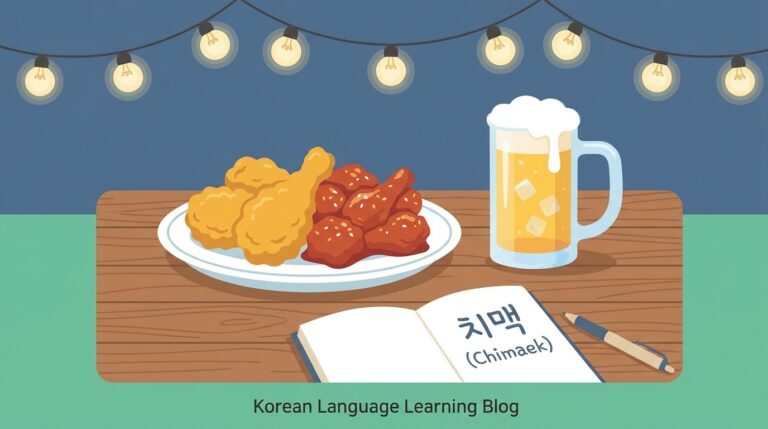
This isn’t just dinner; it’s a cultural ritual known as 치맥 (Chimaek).
Many intermediate Korean learners feel comfortable ordering basic food, but when they sit down in a buzzing Hof (호프 – Korean-style pub), they freeze. “How do I ask for half-and-half flavor?” “What’s the natural way to ask for more pickled radish without sounding like a textbook?”
If you’ve ever felt overwhelmed by the fast-paced chatter of a late-night Korean spot, don’t worry! Today, we’re diving deep into the ultimate Chimaek survival guide. By the end of this post, you’ll order like a true Seoulite and understand the unspoken social rules of Korea’s favorite late-night culture.
Phase 2: Deep-Dive into 3 Key Expressions
Let’s master three essential expressions that will instantly make you sound like a local in any chicken joint.
1. 반반으로 해 주세요 (Ban-ban-eu-ro hae ju-se-yo)
- Pronunciation: Bahn-bahn-eu-ro hae joo-seh-yo (Sounds like “barn-barn” with a soft “ooh-roh”)
- Meaning: “Please make it half-and-half.”
- K-Culture Moment: You are sitting in a chicken restaurant with a friend. You want the sweet-and-spicy sauce (양념 – yang-nyeom), but your friend wants the classic, crispy fried option (후라이드 – hu-ra-i-deu). Instead of arguing, you confidently look at the waiter and say this magic phrase.
- Editor’s Insight: 반 (Ban) means “half.” Saying it twice (반반) is the universal Korean shortcut for ordering two flavors in one box. It’s a symbol of compromise and sharing in Korean dining culture.
- Situation Spectrum:
- Casual: ✅ (반반으로 해 줘)
- Semi-formal: ✅ (반반으로 해 주세요)
- Formal: ⚠️ (반반으로 부탁드립니다 – used in highly polite dining situations)
- 🤔 Think About It: In many Western countries, mixing flavors in one order can be complicated or extra work. Why do you think Korean food culture embraced the “half-and-half” system so universally?
2. 치맥은 진리다 (Chimaeg-eun jin-li-da)
- Pronunciation: Chee-maeg-eun jil-lee-dah (Rhymes with “jeel-lee-dah”)
- Meaning: “Chimaek is the absolute truth” (or “Chimaek is the ultimate law of the universe”).
- K-Culture Moment: You take your first bite of crispy, hot chicken followed immediately by a gulp of freezing cold draft beer. You close your eyes, sigh with relief, and utter this slang phrase to your friends, who nod in deep, spiritual agreement.
- Editor’s Insight: 진리 (Jin-ri) literally translates to “absolute truth” or “gospel.” In modern Korean slang, calling something “진리다” means it is an undeniable, perfect combination that never fails.
- Situation Spectrum:
- Casual: ✅ (치맥은 진짜 진리야!)
- Semi-formal: ✅ (치맥은 진리예요)
- Formal: 🚫 (Too slangy for business meetings!)
- 🤔 Think About It: What is the ultimate “absolute truth” (진리) food pairing in your home country?
3. 무 많이 주세요 (Mu manh-i ju-se-yo)
- Pronunciation: Moo mah-nee joo-seh-yo (Think of a cow’s “moo” followed by “mah-nee”)
- Meaning: “Please give me lots of pickled radish.”
- K-Culture Moment: Korean fried chicken always comes with a side of cubed, sweet-and-sour pickled white radish (치킨무). It cleanses your palate and cuts through the grease. If you run out, this is the phrase you use to ask for a generous refill.
- Editor’s Insight: 무 (Mu) means radish, and 많이 (manh-i) means “a lot.” In Korea, banchan (side dishes) are usually free to refill, so don’t be shy to ask!
- Situation Spectrum:
- Casual: ✅ (무 많이 줘)
- Semi-formal: ✅ (무 많이 주세요)
- Formal: ✅ (무 많이 부탁드립니다)
Phase 3: Textbook Korean vs. Real-Life Korean
Let’s look at how textbooks teach food ordering versus how real Koreans actually talk when they are hungry at night.
Scenario 1: Ordering Draft Beer
- 📖 Textbook Korean: “맥주 두 잔을 주문하고 싶습니다.” (Maeg-ju du jan-eul ju-mun-ha-go sip-seub-ni-da. – “I would like to order two glasses of beer.”)
- 🗣️ Real-Life Korean: “여기 생맥 오백 두 잔이요!” (Yeo-gi saeng-maeg o-baeg du jan-i-yo! – “Over here, two 500cc drafts, please!”)
- 💡 Why the difference? 생맥 (Saeng-maeg) is short for saeng-maeg-ju (draft beer), and 오백 (o-baeg) refers to the standard 500cc mug. Saying “여기 ~요” (Over here, please) is way faster and more natural in a noisy pub environment.
Scenario 2: Asking for Boneless Chicken
- 📖 Textbook Korean: “뼈가 없는 치킨으로 주십시오.” (Ppyeo-ga eob-neun chi-kin-eu-ro ju-sip-si-o. – “Please give me the chicken that does not have bones.”)
- 🗣️ Real-Life Korean: “순살로 변경해 주세요.” (Sun-sal-lo byeon-gyeong-hae ju-se-yo. – “Please change it to boneless.”)
- 💡 Why the difference? 순살 (Sun-sal) literally means “pure flesh” (boneless meat). Using “변경하다” (to change/convert) is the standard service-industry term for switching options on a menu.
Phase 4: K-Culture Deep Dive & Non-Verbal Manners
4-1. Nunchi & Gestures: The Art of the Pub Refill
In a crowded, loud Korean chicken shop, shouting “Excuse me!” (저기요! – Jeo-gi-yo) too loudly can feel intrusive, but staying quiet means you’ll never get your beer.
* The Nunchi Move: Make eye contact with the server, raise your hand slightly (about chest level), and give a gentle nod. If you need a refill of draft beer, you can catch their eye and raise your empty glass slightly—they will understand instantly!
* Pouring Etiquette: When pouring beer from a pitcher or bottle for someone older or of higher social status, always hold the bottle with two hands (or place your left hand under your right forearm) as a sign of respect.
4-2. The Cultural Anatomy of “Chimaek”
Chimaek is not just food; it’s a stress-relief mechanism. In Korean drama culture (like the iconic scene in Crash Landing on You or My Love from the Star), eating Chimaek represents vulnerability. It is the meal characters eat when they want to confess their feelings, gossip about work, or cry after a hard day. It represents “Jeong” (정 – deep social connection).
Phase 5: Interactive Roleplay Scenario
Setting: You are at a bustling chicken pub in Hongdae called “Seoul Hof.” Your guide is Min-ji, a friendly local who is excited to show you the real late-night scene.
Characters:
- Min-ji (민지): Your passionate Korean friend.
- Server (직원): A busy but polite waiter running around with trays of beer.
The Conversation:
- 민지: (Smiling widely) 오늘 진짜 힘들었지? 치맥 먹으면서 스트레스 확 풀자!
(O-neul jin-짜 him-deul-eot-ji? Chi-maeg meog-eon-seo seu-tre-seu hwag pul-ja!)
🎭 Claps her hands excitedly
“Today was so tough, right? Let’s totally blow away our stress with some Chimaek!” -
You: 맞아, 진짜 배고파. 우리 뭐 시킬까?
(Ma-ja, jin-ja bae-go-pa. U-ri mwo si-kil-kka?)
“Agreed, I’m starving. What should we order?” -
민지: 난 다 좋은데, 양념치킨도 먹고 싶고 그냥 바삭한 후라이드도 당기네.
(Nan da jo-eun-de, yang-nyeom-chi-kin-do meog-sip-go geu-nyang ba-sag-han hu-ra-i-deu-do dang-gi-ne.)
🎭 Points at the menu pictures
“I’m fine with anything, but I want both the sweet-spicy chicken and the crispy fried one is calling to me.” -
You (Your Turn! Select Option below): [Make your choice here]
-
직원: 주문 도와드리겠습니다. 어떤 걸로 드릴까요?
(Ju-mun do-wa-deu-ri-get-seub-ni-da. Eo-tteon geol-lo deu-ril-kka-yo?)
🎭 Holds a notepad, looking ready to write
“I can take your order. What would you like?” -
You: 반반으로 해 주세요. 그리고 순살로 변경해 주세요.
(Ban-ban-eu-ro hae ju-se-yo. Geu-ri-go sun-sal-lo byeon-gyeong-hae ju-se-yo.)
“Please make it half-and-half. And change it to boneless, please.” -
직원: 네, 반반 순살로 준비해 드리겠습니다. 주류는 어떻게 하시겠어요?
(Ne, ban-ban sun-sal-lo jun-bi-hae deu-ri-get-seub-ni-da. Ju-ryu-neun eo-tteon-ge ha-si-get-eo-yo?)
“Understood, half-and-half boneless it is. Any drinks for you?” -
You: 여기 생맥 오백 두 잔 주세요!
(Yeo-gi saeng-maeg o-baeg du jan ju-se-yo!)
🎭 Raises two fingers with a warm smile
“Two 500cc draft beers here, please!”
🔀 Interactive Choice Points (Step 4)
- Choice A: “그럼 그냥 두 마리 시키자!”
- Feedback (Bad): Ordering two whole chickens for two people is usually way too much food in Korea! Min-ji might look shocked at your massive appetite.
- Choice B: “그럼 반반으로 해 주세요라고 말하자!”
- Feedback (Best!): Perfect choice! This uses the natural “반반” expression to satisfy both of your cravings.
- Choice C: “메뉴 다 시킬까?”
- Feedback (Risk): “Should we order the whole menu?” High financial risk! You’ll end up paying a fortune and wasting a lot of delicious food.
Phase 6: 10-Second Emotion Shadowing Drill
Speak like a native by practicing these sentences with natural rhythm and emotional cues. The slash / indicates a tiny, natural pause.
- [😊 Excited & Energetic]
“치맥은 / 진짜 / 진리야!”
(Chi-maeg-eun / jin-jja / jil-lee-ya!)
Stress the word “진짜” (jin-jja) to show your deep culinary conviction. -
[🥺 Needy & Craving]
“이모님, / 여기 / 무 많이 주세요~!”
(I-mo-nim, / yeo-gi / moo manh-i / joo-seh-yo~!)
Slightly stretch the end of “주세요” to sound friendly and polite.
Phase 7: K-Culture Mini Dictionary
- 치맥 (Chimaek) [Chee-maeg]: Chicken (치킨) + Beer (맥주). The undisputed king of Korean late-night food combos.
- 순살 (Sunsal) [Soon-sal]: “Pure flesh.” Boneless chicken. Highly recommended if you hate getting your hands dirty with bones at a pub.
- 치킨무 (Chikin-mu) [Chee-kin-moo]: White radish cubes pickled in vinegar and sugar. It is the mandatory side dish served with every chicken order.
- 호프집 (Hof-jip) [Hoh-peu-jip]: Traditional German-style beer houses that evolved into classic Korean pubs serving draft beer and fried snacks.
Phase 8: Survivor Kit for Travelers
Survival Phrases TOP 3
- 포장해 주세요 (Po-jang-hae ju-se-yo): “Please wrap it up for takeout.” (Use this if you can’t finish your mountain of chicken!)
- 뼈 있는 걸로 주세요 (Ppyeo itt-neun geol-lo ju-se-yo): “Please give me the one with bones.” (Some purists believe bone-in chicken is juicier!)
- 물티슈 좀 주세요 (Mul-ti-syu jom ju-se-yo): “Please give me some wet wipes.” (Crucial for cleaning sticky sauce off your hands!)
📌 Editor’s Travel Note
To experience the ultimate Chimaek vibe in Seoul, download the Naver Map App to find highly rated local joints. Head over to Banpo Hangang Park during spring or autumn. You can use delivery zones directly inside the park to order hot Chimaek straight to your picnic mat! (Note: Park policies on alcohol consumption may vary based on local regulations.)
Phase 9: “One Step Deeper” (Reflective Question)
In Western countries, drinking is often separated from eating heavy meals, or food is seen purely as a side dish to alcohol. In Korea, however, the concept of 안주 (Anju – food eaten with alcohol) is essential; you rarely drink alcohol without substantial food. Why do you think Korean culture places such a high emphasis on pairing specific drinks with specific, hearty foods?
💬 Your Turn: Let me know your thoughts in the comments below! What is your go-to Anju back home?
Phase 10: FAQ & Common Mistakes
Q: Can I order Chimaek for delivery late at night if I don’t have a Korean phone number?
A: It can be difficult to use major apps like Baemin without local ID verification. However, many hotels will gladly call and order for you, or you can use English-friendly global food concierge services online.
Q: Is it rude to pour my own drink in Korea?
A: In informal settings with friends, it’s fine, but in group settings, it’s polite to pour for others first. If someone offers to pour your drink, hold your glass with two hands to show respect.
Q: Do I need to tip the server in a Korean Hof?
A: No, tipping is not practiced in South Korea. The price on the menu is exactly what you pay!
🚨 Common Mistakes Alert!
- Mistake 1: Calling pickled radish just “무” (mu) in a non-food context. Correction: Always ask for 치킨무 (Chikin-mu) specifically to avoid confusion.
- Mistake 2: Ordering a beer by saying “맥주 주세요” without specifying the size. Correction: Say 생맥 오백 (saeng-maeg o-baeg) for a standard draft mug.
Phase 11: Action Mission
- 🥉 Bronze: Go to your local Korean chicken restaurant (or order takeout) and use the phrase “반반으로 해 주세요” to get half-and-half!
- 🥈 Silver: Take a picture of your chicken and beer, post it on Instagram, and tag us @DailyHangul with the caption: “치맥은 진짜 진리야! 🍗🍺”
- 🥇 Gold: Spot a K-drama character eating Chimaek and write down at least one slang phrase they use during their pub scene!
Phase 12: Interactive Quiz Challenge
1. What does “반반” (ban-ban) mean?
- A) Free refill
- B) Half-and-half
- C) Extra spicy
2. True or False: You have to pay extra for refilling pickled radish (치킨무) in Korean restaurants.
🔍 Click here to reveal the answers and explanations!
1. Correct Answer: B (Half-and-half)
Explanation: “반” means half. Saying it twice refers to splitting your chicken order into two different flavors!
2. Correct Answer: False
Explanation: Side dishes like pickled radish are provided free of charge and can be refilled upon request. Just say, “무 많이 주세요!”







